Overview
Students will create their own survival kit explaining and illustrating what skills, ideas or tips are most important when navigating social media and online claims. Use the student facing guide for students to collaborate in partners or small groups or modify instructions to best suit your class.
Objectives
- Evaluate effective strategies for verifying claims online and explain them to others.
- Apply knowledge about mis- and disinformation tactics and strategies to protect against them.
- Create original works (or responsibly repurpose/remix).
Subjects
Media literacy, social studies, language arts/English, journalismGrade Levels
Grades 6-12Supplemental Links
Standards
-
Common Core
: Distinguish among fact, opinion, and reasoned judgment in a text.
CCSS.ELA-LITERACY.RH.9-10.8 Assess the extent to which the reasoning and evidence in a text support the author's claims.
CCSS.ELA-LITERACY.RH.11-12.8 Evaluate an author's premises, claims, and evidence by corroborating or challenging them with other information.
-
ISTE
1.2.b: Students engage in positive, safe, legal and ethical behavior when using technology, including social interactions online or when using networked devices.
-
College, Career, and Civic Life (3C)
Participation and Deliberation: Applying Civic Virtues and Democratic Principles
This lesson is the third in a three-part series on media literacy, however, it works fine on its own. For a Google doc version of the lesson, click here. You will need to make a copy to access the Google doc.
Key terms
Review and apply key terms from lesson 1 and lesson 2.
Lesson 1:
- Satire: Use of humor and imitation to provide commentary or critique.
- Conspiracy theory: An unfounded explanation of an event or situation that blames the secretive work or sinister, powerful people (such as a government, company, group or even one person).
- Misinformation: False information that spreads, regardless of its intent.
- Disinformation: Information spread to intentionally deceive, misguide or influence public opinion.
- Post-truth : When objective facts are less influential than personal beliefs and emotion; relating to a situation where people are more likely to accept an argument based on their emotions and beliefs, rather than one based on facts.
Lesson 2:
- Tactics: An action or strategy carefully planned to achieve a specific goal.
- Claim: Asserting something as true.
- Narrative: An account of connected events; a story.
- Verification: The process of establishing the truth, accuracy or validity of something.
- State-affiliated media: Outlets where the state (government) exercises control over editorial content.
Warm-up activity
- Have students discuss the following questions :
- How do you know for sure that what you’re seeing online is true or real?
- What do you do if you’re not sure?
- Have you seen anything recently that you questioned or wondered about? ( Opportunity to review some skills and strategies from prior lessons, as well as access student prior knowledge.)
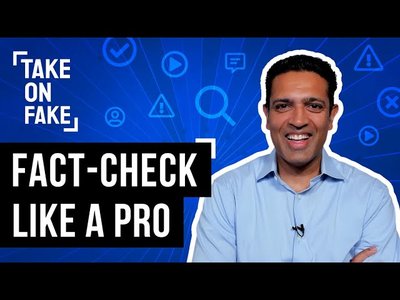
- Then, watch 8 Tips for Debunking Fake News included in this article . As students watch, have them keep track of the ones they already know and any new strategies they could try. Review as a group after finishing the video. What other tips, strategies or ideas are important when trusting claims made online? (Think back to prior lessons.)
Main activity: Creating the survival kit
Students will create a survival kit and will argue what they think are most important practices for verifying what they see online. Students can use the student guide alongside a partner to brainstorm ideas, narrow them down, choose a medium and create. Teachers: you can make a copy and modify the assignment sheet/student guide however you need to.
Kate Stevens, M.S. in Curriculum & Instruction, is a high school language arts educator. An instructional coach, global professional development leader, and former photojournalist, she currently teaches & coaches in Poudre School District in Fort Collins, Colo. In 2015, Kate was honored with Colorado Department of Education’s Online & Blended Teacher of the Year. Connect with Kate on Twitter @KateTeaching.