For a Google doc version of this lesson, click here. You will be prompted to make a copy.
Overview
Innovation doesn’t always mean inventing a new device. Sometimes the real breakthrough is redesigning how people interact with a problem. Josephine Cochrane didn’t start by asking, “What machine can I build?” She asked, “Why does this keep going wrong, and who is paying the price?”
Objectives
Students will:
- Analyze everyday labor through an innovation lens
- Identify inefficiencies and hidden harm in systems
- Practice experience-based innovation
- Justify design decisions using constraints
- Understand that invention includes processes, systems, and behaviors
Estimated time: 60–90 minutes (adaptable)
Grade level: 6-12
Materials
- Experience map template (or blank paper divided into steps) and reflection prompt sheet
- Sketch paper
- Markers or pencils
Warm-up activity
Start by watching the News Hour segment:
Who becomes an inventor? This Arkansas innovation hub is trying to spark a new generation
- As a class, discuss — what makes the students in this segment innovators? What kinds of creative thinking are they applying?
Main activity
- Share with students that they are going to learn more about an inventor they may not have heard of before, Josephine Cochrane. Show the introductory video and/or supply the background reading.
Teacher's note (you may want to share with your students):
“Josephine Cochrane didn’t invent the dishwasher because she loved machines. She invented it because dishes kept breaking and the work of washing them was undervalued, rushed and invisible.”
Have students do some brief background reading on Josephine (use the passages provided or any other materials). Then, have students discuss briefly:
- What makes dishwashing frustrating?
- What sometimes or often goes wrong?
- Who usually does the dishwashing in your home? Have you ever heard them complaining about something not working?
- What happens if you wash your dishes by hand instead? How does that change the experience? What problems can you run into there?
Important rule: Students should not be discussing solutions to identified problems yet.
Step 1: Map the current experience (15 minutes)
Students create an Experience Map of dishwashing as it exists now (this can include washing dishes in a sink, as opposed to in a machine dishwasher). They must include:
- Who is involved
- When dishwashing happens
- Steps involved in dishwashing
- Pain points (breakage, time, conflict, waste, unfairness)
Prompt: “Where does frustration peak?”
Students mark pain points with ⚠️ symbols.
Step 2: Choose one innovation angle (5 minutes)
Students must commit to ONE lens only:
- Process – Who does it, when and how
- System – Rules, roles, incentives and accountability
- Product add-on – Small physical change (not a machine)
- Behavior change – Nudges, norms, reminders and social rules
They are not allowed to switch angles once chosen.
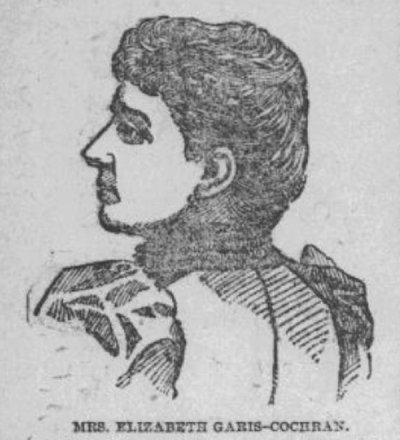
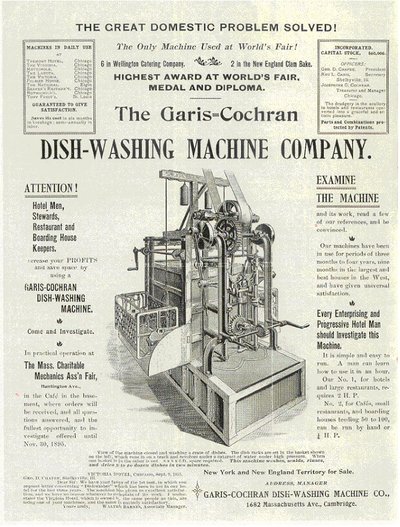
Illustration of Josephine Cochrane. Waterbury Democrat. (Waterbury, CT), Nov. 19 1895. https://www.loc.gov/item/2016270502/1895-11-19/ed-1/.
Step 3: Redesign under constraints (20–30 minutes)
Constraints (posted clearly):
🚫 No motors
🚫 No electronics
🚫 No full appliance redesign
Students redesign the experience, not the dishwasher.
What each angle must include:
Process Innovators
Must answer:
- Who does what?
- When?
- In what order?
Example outputs:
- Rotational systems
- Pre-sorting steps
- Shared responsibility models
- Time-saving routines
System innovators
Must include:
- A rule or expectation
- A way to track or reward
- A consequence or accountability mechanism
Example outputs:
- Visual accountability boards
- Incentive systems
- Shared agreements tied to fairness
Product add-on innovators
Must design:
- ONE physical object that changes the experience
- It must attach to or interact with existing tools
Examples:
- Protective dish racks
- Pre-rinse sorting trays
- Soap-dispensing tools (non-mechanized)
Behavior change innovators
Must include:
- A trigger (what prompts action)
- A behavior shift
- A benefit to the group
Examples:
- Social contracts
- Visual reminders
- Habit-building cues
Credit: USPTO
Step 4: Create the deliverables (15–20 minutes)
Each student or group submits three artifacts:
Annotated experience map
- Before vs. after
- Clear labels
- Pain points addressed
Labeled sketches
- Clear drawings
- Parts labeled
- Arrows showing interaction
Written Explanation (1 paragraph)
Must answer:
- What problem did you target?
- Why does your solution works within constraints?
- How does it reduce harm, waste or conflict?
Step 5: Gallery Walk & Reflection (10 minutes)
Students circulate and leave feedback using prompts:
- “This solves the problem because…”
- “One thing I hadn’t considered was…”
- “This reminds me of Josephine Cochrane because…”
Reflection Questions (Choose 1–2)
- Why is redesigning systems sometimes more powerful than inventing new machines?
- Who benefits most from your redesign?
- What kind of innovation is hardest to get credit for, and why?
Assessment focus:
✔ Clear problem identification
✔ Thoughtful use of constraints
✔ Alignment between redesign and problem
✔ Justification of impact
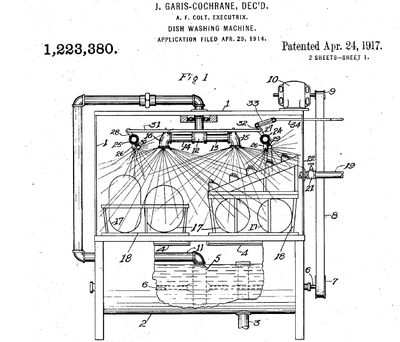
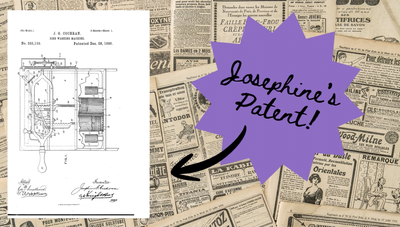
U.S. Patent for Josephine Cochrane's dishwasher, USPTO
Extension activity
As a class, discuss these IP (intellectual property) connections:
- Would this redesign be patentable? Why or why not? You can also use this lesson about patenting inventions.
- Or is it better to share the idea for free?
Additional resources
- PBS News Hour Classroom Invention Education lesson collection — use the filters and choose the lesson that works best for you and your students
- U.S. Patent and Trademark Office's (USPTO) "I'll do it myself" article about Josephine Cochrane
- The Invent Ed Network
- Invention Convention Worldwide
Standards
NGSS MS-PS3-3 Energy: Apply scientific principles to design, construct, and test a device that either minimizes or maximizes thermal energy transfer.
About the author
Madeline Stoddard: Courtesy Florida Inventors Hall of Fame
Madeline Stoddard is an innovation educator, curriculum designer and founder of inventHERS, a platform dedicated to amplifying women inventors and expanding who sees themselves as an inventor. She has served as a classroom teacher, district STEM/STREAM Coordinator and instructional leader, designing invention-centered learning experiences that connect creativity, problem-solving and real-world impact. MJ currently serves as the Education and Outreach Coordinator for the Florida Inventors Hall of Fame at the University of South Florida, where she leads IGNITE (Inspiring Generations of New Inventors Through Engagement) and Invention Convention Florida, the official state affiliate of Invention Convention Worldwide.
Sign up to receive our weekly newsletter with Daily News Lessons and community events.
To provide feedback on News Hour Classroom's resources, including this lesson, click here.