 |
|
 |
 |
| THE ISSUES OF CAMPAIGN 2000 | |
 June 24, 1999 
|
||

|
|
With the primaries still eight months away, candidates are beginning to define and debate the issues they believe are America's most pressing. But what are the topics that need to be addressed? In the first part of a continuing series, Jim Lehrer talks with a roundtable of historians.
|

|
JIM LEHRER: Linda, what would you add or subtract from that? |
 |
|||||||||
| Issues of society. | |||||||||||
|
JIM LEHRER: But should the candidates -- the people who want to be President of the United States -- be forced to talk about these things? LINDA CHAVEZ: Well, I think they are already talking about them. I think we see it both in Vice President Gore's campaign; we certainly see it in George W. Bush. We've heard it from Elizabeth Dole and others. They are talking about some of these issues. What's interesting is they are not talking in big terms about some of the major issues that Presidents can do something about, for example, in the foreign policy arena. Michael mentioned China. China is the great challenge of the 21st century to the United States. And yet we are not hearing a lot of very specific about what the United States' relationship with China should be and that, of course, ought to be something that helps us determine whom we want to support in this presidential election. |
|||||||||||
| Elections in times of prosperity. | |||||||||||
|
JIM LEHRER: Haynes, first would you agree with Michael that the slate is cleaner now than it has ever been, at least in modern times, in a presidential election?
JIM LEHRER: Shelby Steele, where would you come down on what this election should be about? SHELBY STEELE: Well, I think one thing certainly that I'd like to see it be about is the issue of responsibility. I think this relates to what Linda was saying about our concern about society. It seems to me that there are some really unresolved -- responsibility remains a rather unresolved issue in American life. JIM LEHRER: Excuse me. Are you talking about individual responsibility?
JIM LEHRER: Do you think that presidential candidates should be forced to talk about this kind of thing whether they want to or not? SHELBY STEELE: I'm not saying they should be -- it seems to me that if you are going to lead the country, it is -- this is a great opportunity, since so many other issues are resolved, to say what our democracy stands for, because responsibility is the agent for social change. So far we have, in the past 30 years, certainly, we've asked the government to take that agency almost entirely. And that's been sort of modern liberalism. Now it seems to me that the society is asking us to move in another direction. George Bush is saying in compassionate conservatism, I can make both social responsibility and individual responsibility compatible. And I think that's something that Americans actually want of all backgrounds. JIM LEHRER: Whether they want George W. Bush to do it or not. SHELBY STEELE: Whether they want him or not, they certainly seem to want that. And I think that explains a good deal of his popularity. But he certainly needs to go a great deal further in explaining exactly what that means. |
 |
||||||||||
|
A turn to domestic problems? |
|||||||||||
|
JIM LEHRER: Now, Doris, what would be -- if you were the great issue God in the sky, what would you want the candidates for President of the United States to discuss, however you wanted them to come down, what would you want them to talk about over the next several months? DORIS KEARNS GOODWIN: Well, domestically there are two huge issues that would I love them to talk about. One is as old as the country itself, and that's economic justice. Despite this golden moment, despite the booming prosperity, ordinary Americans are not that much better off than they were when the boom started. We look at income statistics and it takes two people working in the family to just keep going lots of hours. Poverty is almost as bad as it was before, if not worse. So I think economic justice, the oldest theme absolutely should be at the center of this campaign. And secondly, I think there is something that leaders and government can do about the cultural issue because the real question is how do we restore parental authority and parental presence back into the homes without losing the liberating impulses of women going to work in the 20th century. And that means that government and business and the working world alike has to figure out how to better balance family and working life. And that means huge changes in flexible hours, in job sharing, substantial changes in day care, figuring out how to make it easier for our country to bring up its kids, bring childhood back to our children. In World War II, when they needed women to work in the factories, somehow government and business got together and they created this incredible day care system operating 24 hours a day, even providing hot meals for the women to take home at the end of the day so they wouldn't have to shop and cook. Well, we need to figure out ways to ease that transition for people who have young children, and government and business better be together in that. I think those are huge issues and they are very important. JIM LEHRER: Yes, Linda. |
|||||||||||
| The role of women. | |||||||||||
|
JIM LEHRER: Haynes. HAYNES JOHNSON: Absolutely. We talk about this golden moment but underneath it are real problems -- economic justice, social justices, the old concepts are very much there -- but there is even one more than that. Health care, for instance, we had this session about the doctors, size of American life, the impersonality of it. So the doctors are now joining unions because the health system is too big, so we can't get into it. People feel that, they feel the size in their lives and are disconnected from it. But there is something else about the election. I hope what comes out of it is a rekindling of belief in our political and public purpose. Now, I don't know care you define it, ideological or the rest, because there is a deep cynicism. We are voting less and less and less, all for the last 30 years, going down and down and down, and the public is like this; and you can't deal with long-term problems unless you have a people that believes in the purposes of the society. JIM LEHRER: Michael, what does history tell us, if anything, about the public's ability to grab hold of a presidential election and force candidates to talk about what matters to them, the things that you all have been talking about? MICHAEL BESCHLOSS: You know, it's very tough, Jim, in the absence of some kind of a crisis or overwhelming issue, and it's even harder when you have a golden moment like this. I've often thought, you know, what was the happiest year to be an American in this century? And I always thought it was 1956 because had you a wonderful economy and the Cold War was relatively at bay. 2000 -- if things stay the same the way they are now -- will put 1956 in the shade. And what '56 showed was Eisenhower and Stevenson, it's a rather vapid campaign. Eisenhower and Stevenson should have been talking about civil rights, certain of the issues that would flare up in the next few years and anticipating those things. And what history suggests is that too often in years like this, you don't have a presidential candidate who has a vision, takes some risky positions, creates some kind of controversy. And the sad thing is that it's exactly that kind of controversy, the sense of a campaign and election that really is about things that people care about. That's what brings back trust in government and gets people to vote in big numbers. JIM LEHRER: Shelby Steele. Yes, go ahead. DORIS KEARNS GOODWIN: I disagree, Jim. I mean, I think that we have had two periods of time in the 20th century, absent a crisis, when were able to mobilize the citizenry. The turn of the century was one, during the Progressive Era; the 60's was another. And look at the 60's - it was a time of equal prosperity but we did so many things that had large public purposes. Now part of it was we had the civil rights movement, part of it was that we had unions that were stronger than they were, and the citizenry was activated; but you can't just depend on a crisis. We have got to hope that these social movements can force government to act on these issues. And we've done it before and we can do it again. JIM LEHRER: Shelby Steele, do you have a suggestion as to how the collective we keep the year 2000 from being a vapid campaign? SHELBY STEELE: Well, I think that, you know, we do have areas, as I think everybody is agreeing with, of very serious social problems. I mean, the inner city school systems are an absolute wreck. Poverty is still a problem, certainly in black America and minority America we have a racial identity politics that are completely unresolved. And so I think, you know -- and I'm certainly not against the idea of us discussing the matter of government action and so forth you, but I think what would really be valuable right now is if we would, in some way, have the campaign adjudicate this matter of responsibility for social change. There are certain things government can do. There are certain things that individuals must do, and in terms of those inner city chronic sorts of ongoing seemingly intractable problems, this society has been unable to ask to apply individual responsibility to those problems. And I think that's what's exacerbated them and would I certainly love to see the candidates address that. I think George W. Bush has done a bit more of that to this point than the others. JIM LEHRER: Let me ask Doris about that. What do you think about that as a centerpiece for a campaign debate or a campaign discussion -- just what Shelby Steele just said?
JIM LEHRER: Haynes, is there - |
 |
||||||||||
| Individual responsibility as an issue. | |||||||||||
|
SHELBY STEELE: I could have a great dialogue precisely along those lines because I think government should be involved. But where do you bring in individual responsibility? It seems to me that's the ingredient that has been missing for 30 years and that's exacerbated the very problems that you want to get to so much, that you and I want to get to so much. JIM LEHRER: Is there a danger, Haynes that this -- there could be too much talk here?
JIM LEHRER: And, as I said earlier, we will be talking about all of this because we're going to be asking similar year 2000 issue questions of a variety of people over the next many months. You may offer an answer as well, if you'd like, by visiting our Web site. |
|||||||||||


 JIM
LEHRER: Next tonight, a launching of what we call a "special emphasis"
related to the year 2000 campaign for President of the United States.
Over the next several months we will ask, what should this election
for President be about; what are the issues the candidates should be
discussing and debating? We will ask these questions of various individuals
and groups, beginning tonight with three NewsHour regulars, author/journalist
Haynes Johnson, presidential historians Doris Kearns Goodwin and Michael
Beschloss, joined by Linda Chavez, president the Center for Equal Opportunity
and a former Reagan administration official; and Shelby Steele, senior
fellow at the Hoover Institution at Stanford University. Okay, Michael,
you get to go first. What should this campaign be about, sir?
JIM
LEHRER: Next tonight, a launching of what we call a "special emphasis"
related to the year 2000 campaign for President of the United States.
Over the next several months we will ask, what should this election
for President be about; what are the issues the candidates should be
discussing and debating? We will ask these questions of various individuals
and groups, beginning tonight with three NewsHour regulars, author/journalist
Haynes Johnson, presidential historians Doris Kearns Goodwin and Michael
Beschloss, joined by Linda Chavez, president the Center for Equal Opportunity
and a former Reagan administration official; and Shelby Steele, senior
fellow at the Hoover Institution at Stanford University. Okay, Michael,
you get to go first. What should this campaign be about, sir? MICHAEL
BESCHLOSS: Well, you know, I sort of think, Jim, of John Kennedy in
1960. He was asked by James Reston of the "New York Times"
in an interview, how should this country be different after four or
eight years if you're President. And Reston was amazed. He said that
Kennedy looked at me as if I was the man on the moon. He hadn't been
thinking in those terms. And you know, in history, often times it's
so often the case that a campaign is really shaped by a crisis; for
instance, in 1860 there was no way that campaign was not going to be
about slavery or 1980 there was no way that the campaign between Reagan
and Carter was not going to be about 21 percent interest rates and the
resurgence of Soviet power and the Iran hostage crisis. 2000 is different
from that, and we've seen this also in history. It's a golden moment
when things are going remarkably well internationally and also in domestic
policy. So you have to ask presidential candidate number one, how will
the country change if you get the White House, and also, what if things
go wrong? This economic prosperity won't last forever. What are you
going to do about taxes and spending if there is a new recession or,
God forbid, a depression -- and also in foreign policy - if Russia and
China begin to act up as powers that threaten us once again, what can
we expect from you? If there is another Kosovo, does what President
Clinton did this year provide a precedent? These are all kinds of things
that we really have the right to know before we cast a vote.
MICHAEL
BESCHLOSS: Well, you know, I sort of think, Jim, of John Kennedy in
1960. He was asked by James Reston of the "New York Times"
in an interview, how should this country be different after four or
eight years if you're President. And Reston was amazed. He said that
Kennedy looked at me as if I was the man on the moon. He hadn't been
thinking in those terms. And you know, in history, often times it's
so often the case that a campaign is really shaped by a crisis; for
instance, in 1860 there was no way that campaign was not going to be
about slavery or 1980 there was no way that the campaign between Reagan
and Carter was not going to be about 21 percent interest rates and the
resurgence of Soviet power and the Iran hostage crisis. 2000 is different
from that, and we've seen this also in history. It's a golden moment
when things are going remarkably well internationally and also in domestic
policy. So you have to ask presidential candidate number one, how will
the country change if you get the White House, and also, what if things
go wrong? This economic prosperity won't last forever. What are you
going to do about taxes and spending if there is a new recession or,
God forbid, a depression -- and also in foreign policy - if Russia and
China begin to act up as powers that threaten us once again, what can
we expect from you? If there is another Kosovo, does what President
Clinton did this year provide a precedent? These are all kinds of things
that we really have the right to know before we cast a vote. 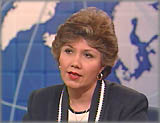 LINDA
CHAVEZ: Well, I think ironically what most of the American people are
interested in right now has very little to do with some of the issues
that presidents could do much about. The future of foreign policy is
certainly something the campaign should be about. There are some domestic
issues it should be about. But what is most on people's minds today
is what's happened to our society. I think there is a tremendous amount
of concern among the American people that despite our prosperity, despite
the fact we're the leader of the world, no longer fighting a Cold War,
something is amiss, and people are feeling very insecure about what's
happened to families. They are concerned about the values and the traditions
of our society. And so I think you're going to see a hungering on the
part of the people to hear about things that you can't come up with
a ten-point program to fix.
LINDA
CHAVEZ: Well, I think ironically what most of the American people are
interested in right now has very little to do with some of the issues
that presidents could do much about. The future of foreign policy is
certainly something the campaign should be about. There are some domestic
issues it should be about. But what is most on people's minds today
is what's happened to our society. I think there is a tremendous amount
of concern among the American people that despite our prosperity, despite
the fact we're the leader of the world, no longer fighting a Cold War,
something is amiss, and people are feeling very insecure about what's
happened to families. They are concerned about the values and the traditions
of our society. And so I think you're going to see a hungering on the
part of the people to hear about things that you can't come up with
a ten-point program to fix. HAYNES
JOHNSON: My friend took my words. This is a golden moment for the country.
And it really is a remarkable time. There are no crises visible for
us. We don't have a civil war. We don't have the racial revolution and
turmoil. We don't have Vietnam. We don't have assassinations. The economy's
the best it's ever been in the longest boom in all of American history.
And we really have no enemies that charge us in the way the bomb and
Russia or World War II and Hitler. So the question is, and Michael's
right -- 100 years ago a great scientist made a tour of the United States
-- Sir Thomas Huxley. He got on the boat in New York to go back home;
he looked at America and the reporters of the day, Jim, asked a lot
of stupid questions, which reporters do. And they said, Sir Thomas,
aren't you impressed with how big we are and powerful and rich we are?
And he said no, I'm not impressed with those things. The question is
what do you Americans want to do with all the great things you have?
And that's preparing the people for a very different future. Remarkable.
We're in the middle of a scientific, technological, medical, demographic
revolution. We have problems, as you said, around the world -- I mean
here at home and around the world. So that the test of an election is
to lay out where we think how the society should be prepared to deal
with very real but different questions.
HAYNES
JOHNSON: My friend took my words. This is a golden moment for the country.
And it really is a remarkable time. There are no crises visible for
us. We don't have a civil war. We don't have the racial revolution and
turmoil. We don't have Vietnam. We don't have assassinations. The economy's
the best it's ever been in the longest boom in all of American history.
And we really have no enemies that charge us in the way the bomb and
Russia or World War II and Hitler. So the question is, and Michael's
right -- 100 years ago a great scientist made a tour of the United States
-- Sir Thomas Huxley. He got on the boat in New York to go back home;
he looked at America and the reporters of the day, Jim, asked a lot
of stupid questions, which reporters do. And they said, Sir Thomas,
aren't you impressed with how big we are and powerful and rich we are?
And he said no, I'm not impressed with those things. The question is
what do you Americans want to do with all the great things you have?
And that's preparing the people for a very different future. Remarkable.
We're in the middle of a scientific, technological, medical, demographic
revolution. We have problems, as you said, around the world -- I mean
here at home and around the world. So that the test of an election is
to lay out where we think how the society should be prepared to deal
with very real but different questions.  SHELBY
STEELE: I'm talking about responsibility in terms of bringing about
social change. There's still great inequities in our society. There
are still racial tensions. We have public policies likes affirmative
action that are still hotly debated. We have welfare reform that people
pay a great deal of attention to. And I think we have one of the issues
that came out of the 60's is that the government was the seat of responsibility,
the agent of social change. And I think that in American society, there's
been a sort of countervailing movement to have the individuals who actually
suffer the problems, social problems, be the agents of change and primarily
responsible and then maybe supported by government, but that they themselves
should be the people who take responsibility in transforming themselves
and becoming a part of the American mainstream. On the other hand, politically,
any mention of responsibility suggests ideology, and so I think candidates
have been very reluctant to get into that area. On the other hand, George
Bush has, in his idea of compassionate conservatism, seems to me to
be the candidate so far who has come closest to actually trying to engage
this deeper issue of responsibility.
SHELBY
STEELE: I'm talking about responsibility in terms of bringing about
social change. There's still great inequities in our society. There
are still racial tensions. We have public policies likes affirmative
action that are still hotly debated. We have welfare reform that people
pay a great deal of attention to. And I think we have one of the issues
that came out of the 60's is that the government was the seat of responsibility,
the agent of social change. And I think that in American society, there's
been a sort of countervailing movement to have the individuals who actually
suffer the problems, social problems, be the agents of change and primarily
responsible and then maybe supported by government, but that they themselves
should be the people who take responsibility in transforming themselves
and becoming a part of the American mainstream. On the other hand, politically,
any mention of responsibility suggests ideology, and so I think candidates
have been very reluctant to get into that area. On the other hand, George
Bush has, in his idea of compassionate conservatism, seems to me to
be the candidate so far who has come closest to actually trying to engage
this deeper issue of responsibility. LINDA
CHAVEZ: Well, it is interesting because I think we do see an issue in
which we could have some definitions between the parties because certainly
the Democratic Party has been the party of government solutions like
day care centers -- to deal and cope with problems of women in the work
force. I think this would be one of the issues where you would find
more Republicans saying why not make it possible for women to choose
to stay home if they want to by changing the tax structure, by making
opportunities available for families to chip in. And I think you do
see a divide here. Interestingly, I think the whole question of women's
role, Haynes and I were talking about this before the show started,
in the last half of the 20th century, there probably hasn't been a single
event that has been more significant than the mass movement of women
into the labor force. This is a grand social experiment and we don't
have the foggiest idea how it's going to turn out. And by the way, I
don't think that two male candidates are going to find it very comfortable
to talk about this because if you want to be honest you're going to
have on to say some things that are going to ruffle some feathers.
LINDA
CHAVEZ: Well, it is interesting because I think we do see an issue in
which we could have some definitions between the parties because certainly
the Democratic Party has been the party of government solutions like
day care centers -- to deal and cope with problems of women in the work
force. I think this would be one of the issues where you would find
more Republicans saying why not make it possible for women to choose
to stay home if they want to by changing the tax structure, by making
opportunities available for families to chip in. And I think you do
see a divide here. Interestingly, I think the whole question of women's
role, Haynes and I were talking about this before the show started,
in the last half of the 20th century, there probably hasn't been a single
event that has been more significant than the mass movement of women
into the labor force. This is a grand social experiment and we don't
have the foggiest idea how it's going to turn out. And by the way, I
don't think that two male candidates are going to find it very comfortable
to talk about this because if you want to be honest you're going to
have on to say some things that are going to ruffle some feathers. DORIS
KEARNS GOODWIN: Oh, I think there is something to the idea that we need
to figure out especially in the cynicism people have now about government,
what government's role can be, what individuals can do, what families
can do. But that doesn't mean that you can abdicate responsibility.
What does government mean, after all? It means our collective impulses
as a nation to care about problems that may not affect us personally,
the inner city, some of those people in poverty, but we can care about
them at certain eras in our destiny, and I think that's what we need
to recall back to the citizenry now -- not just what we are individually
responsible for but what as a nation do we care about. And if we don't
start feeling that collective sense, then I think we're just going to
be having a dialogue. We've talked too much in the last eight years.
Every time we talk, we sort of name a problem and then we think it's
over with. We have got to do stuff and we have got to start quickly.
DORIS
KEARNS GOODWIN: Oh, I think there is something to the idea that we need
to figure out especially in the cynicism people have now about government,
what government's role can be, what individuals can do, what families
can do. But that doesn't mean that you can abdicate responsibility.
What does government mean, after all? It means our collective impulses
as a nation to care about problems that may not affect us personally,
the inner city, some of those people in poverty, but we can care about
them at certain eras in our destiny, and I think that's what we need
to recall back to the citizenry now -- not just what we are individually
responsible for but what as a nation do we care about. And if we don't
start feeling that collective sense, then I think we're just going to
be having a dialogue. We've talked too much in the last eight years.
Every time we talk, we sort of name a problem and then we think it's
over with. We have got to do stuff and we have got to start quickly.
 HAYNES
JOHNSON: Yes, sure. And I'd like to see the candidates be very specific.
Take science, medicine and technology, these are all very different
questions that affect privacy, the role of computers, how you're connected
or not connected, medicine, cloning. I mean food, agriculture, these
are huge. But they are very specific and they are affecting people's
lives now. Let's talk about that.
HAYNES
JOHNSON: Yes, sure. And I'd like to see the candidates be very specific.
Take science, medicine and technology, these are all very different
questions that affect privacy, the role of computers, how you're connected
or not connected, medicine, cloning. I mean food, agriculture, these
are huge. But they are very specific and they are affecting people's
lives now. Let's talk about that.