 |
|
 |
 |
| GATHERING STORM | |
 November 21, 2000  |
|

|
Perspectives
from five editorial writers about the election struggle in Florida. The NewsHour Media Unit is funded by a grant from the Pew Charitable Trusts.
|


|
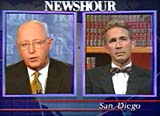
TERENCE SMITH: We get those perspectives from NewsHour regular Robert
Kittle of the San Diego Union Tribune. And joining him tonight
is Rachelle Cohen of the Boston Herald; Christine Bertelson of
the St. Louis Post Dispatch; and John Diaz of the San Francisco
Chronicle. Welcome to you all. |
|||||||||||||||||||
| Hopes for the Florida Supreme Court | ||||||||||||||||||||
|
TERENCE SMITH: Christine Bertelson, what's your view?
TERENCE SMITH: Stop working the levers of the pinball machine? In other words, stop the spin? CHRISTINE BERTELSON: Stop the spin. I think if I were in Mr. Bush's camp or Mr. Gore's camp, I would probably be doing what they're doing, which is trying to use every lever they have to get the election to come out in their favor. But from the public's point of view, I think we want to see that it's a process that has not been corrupted, that the spin doesn't take over and that they can believe that the government is going to work the way it's supposed to. TERENCE SMITH: John Diaz, what do you think the court should do?
TERENCE SMITH: Rachelle Cohen, what's your view? RACHELLE COHEN: Well, the process is a process that should have been determined by the Florida legislature, and that this is not the job of a court to engage in at this particular juncture. So my fondest hope is that the court will take a look at Florida law and determine that indeed there was a good deal of wisdom in it and that the secretary of state made the right decision. TERENCE SMITH: And yet, Rachelle Cohen, isn't it the campaigns that brought it to the courts?
|
 |
|||||||||||||||||||
| What should happen after a certified outcome? | ||||||||||||||||||||
|
TERENCE SMITH: Bob Kittle, looking ahead to that moment that you're hoping for when we get a certified outcome in Florida, what should the campaigns do then? Is it then up to them to accept it, or is it logical and proper to continue to fight it in the courts?
TERENCE SMITH: Christine Bertelson, is that what you want to see, an end to this legal process and an acceptance of the outcome? CATHERINE BERTELSON: Absolutely. We want to make sure that the process is followed. It comes to an end and that whoever loses is a gracious loser, and, as you said, put his support toward the man who is president, and get on with the healing in Congress as well.
CATHERINE BERTELSON: It does presuppose that. But we hope that the influence that we have as members of the press and the letters from the people that they're reading in newspapers and what they hear on television will persuade them that this is not in the best interest of the country, it's not in the best interest of either candidate to carry it on to the bitter, bitter end. |
 |
|||||||||||||||||||
| What's in the best interest of the country? | ||||||||||||||||||||
|
TERENCE SMITH: John Diaz, what is in the best interest of the country? Is it an outcome that the public and everyone feels secure with, or is it an early end to the process or something in between? JOHN DIAZ: I don't know that we're ever going to have a process that everyone is absolutely satisfied with. I think this is one of those elections that's going to be scrutinized and debated for centuries on end. But I think what we do need at this point is once the Florida Supreme Court does rule, and I think they do have to come up with a process. I do not think the Florida legislature has laid out a clear enough path with some of the contradictions in there. But I think once the Florida Supreme Court rules, I think Al Gore is certainly bound to accept whatever they come out with and likewise George W. Bush. I think to challenge it beyond the Florida Supreme Court is going to test the limits of patience of the American people on this. So far, it's been fairly patient.
RACHELLE COHEN: Well, there are two junctures at which the legislature could indeed determine this. I think there is a good deal to be said for finality. But I'm not sure that the finality that the court had in mind is... well, facing a deadline. If this goes back to the Florida legislature for their determination, I think that would not be a happy picture. But has the Florida legislature provided the court with an adequate piece of legislation by which they could make a decision? Yes, indeed, I think they have. TERENCE SMITH: Well, that, of course, has to be determined but there is a date of December 18 for the electors to do their business; is there not? RACHELLE COHEN: Well, there's even... There's a date of December 12 by which a point Florida has to name its electors. TERENCE SMITH: Correct. RACHELLE COHEN: And that's the date that the court seemed very concerned about and determined to get a decision in, in plenty of time for the parties to appeal, if need be. TERENCE SMITH: Bob Kittle, there's been a reference here to the patience of the public. How well do you think that patience is holding up?
TERENCE SMITH: Christine Bertelson, a corrosion in the public trust? CHRISTINE BERTELSON: I think it's a paradox. I think people are anxious for a resolution but they don't want a resolution that comes at the expense of accuracy. As the law is cut finer and finer, it becomes more complicated and that's part of the paradox too. We would like to see an answer that's clear. Unfortunately, Florida law does not appear to be clear enough. It is contradictory. What we're seeing in our letters to the editor are people who have a lot of passion for bringing it to resolution, but I don't think they want it to happen if it's going to be without some rigor in the process that they can believe in. TERENCE SMITH: John Diaz, what's your sense of the public added to it? Is it contributing to a cynicism about the process or is it, as some people have said, a great civics lesson? JOHN DIAZ: Well, let's got forget, this was an election that a great deal of the American public expressed a lot of ambivalence about before the election, and they're certainly not now so I think in that sense it's healthy. As far as what Bob was referring to as the erosion of confidence in the system, I think one of the outcomes that we can rest assured is going to happen from this election is -- I don't know if there will be any tinkering with the electoral college system -- but I think there will be some focus on the processes by which we count the ballots. I think all of these issues -- and I haven't heard anyone come up with necessarily a really great answer yet, but I think legislatures across the country are going to come out with a way that... that makes sure that every vote does indeed count. |
||||||||||||||||||||
| What next? | ||||||||||||||||||||
|
TERENCE SMITH: Do we need, John Diaz, to look at the electoral college or uniform balloting or issues like that?
TERENCE SMITH: Rachelle Cohen, what do you think about the lessons to be learned, the conclusions to be drawn? RACHELLE COHEN: Well, I think that it wouldn't be a dreadful thing to revisit the issue of the electoral college. Editorially we have been in favor of the "mend it, don't end it" school of thought. Looking at things like proportional representation by districts as Maine and Nebraska now do. And as to ballots, I don't know whether we want to look at a uniform ballot as much as provide a little guidance, perhaps a menu of acceptable ballots and vote-counting systems from which states and localities can choose pretty much the way Massachusetts has done. There are some systems that are outlawed. You know, Florida's would be high on the list or at least that used in Palm Beach County and Broward County would be high on the list of systems that need to be revisited. But a menu of ballots I think would be a splendid idea. TERENCE SMITH: Bob Kittle, there's been a great deal of talk about the eventual winner being crippled or diminished as a president, his authority. What do you think about that? ROBERT KITTLE: Well, I think there's no doubt, Terry, that the next president -- whether it's Al Gore or George Bush -- is going to have a devalued presidency in many ways. I think there's every chance that the Congress will begin to assert itself more than it has in the past, even though it is evenly divided. I mean throughout most of our history, the locus of power in Washington was on Capitol Hill. It really wasn't until Franklin Roosevelt and later with Lyndon Johnson and Richard Nixon that the strength of the government shifted down Pennsylvania Avenue to the White House. And I think because the next President is not going to have much of a mandate and because, unfortunately, the legitimacy of his election may be in question, depending upon how this plays out in Florida, that we're going to see some congressional leaders asserting more power, reaching to have a bigger say in shaping the national agenda, and I think we may see the pendulum shift some away from the White House and toward the Congress in terms of setting the national agenda. TERENCE SMITH: Christine Bertelson, very quickly, is that the future you envision as well?
TERENCE SMITH: The virtues of gridlock, eh? CHRISTINE BERTELSON: Right. TERENCE SMITH: Thank you, all of you, very much. |
||||||||||||||||||||


 ROBERT
KITTLE: Well, Terry, I think to begin with, I hope that the Florida
Supreme Court will resolve the case and that whatever ruling it makes
will not lead to more litigation down the road and that we can get shortly
to a certification of a final tally for the state of Florida. I think
it's also important that this decision not be made by a court, per se,
that is, that a court not choose who the winner of this election is,
that the Supreme Court in Florida leave enough discretion in the hands
of the state officials to make the final decision on exactly who won
in the state of Florida. I think it's important that that be done by
the state officials rather than imposed by a court.
ROBERT
KITTLE: Well, Terry, I think to begin with, I hope that the Florida
Supreme Court will resolve the case and that whatever ruling it makes
will not lead to more litigation down the road and that we can get shortly
to a certification of a final tally for the state of Florida. I think
it's also important that this decision not be made by a court, per se,
that is, that a court not choose who the winner of this election is,
that the Supreme Court in Florida leave enough discretion in the hands
of the state officials to make the final decision on exactly who won
in the state of Florida. I think it's important that that be done by
the state officials rather than imposed by a court.  CHRISTINE
BERTELSON: I would agree. I think we want to make sure that the Supreme
Court comes up with a fair process that the public can believe in, that
both sides who are madly working the levers of this pinball machine
in Florida finally agree to stop and that we can have an answer and
go on about the business of the country.
CHRISTINE
BERTELSON: I would agree. I think we want to make sure that the Supreme
Court comes up with a fair process that the public can believe in, that
both sides who are madly working the levers of this pinball machine
in Florida finally agree to stop and that we can have an answer and
go on about the business of the country.  JOHN
DIAZ: Terence, I think what we're looking for from the court to add
two things that have been distinctly lacking in this whole process:
that being uniformity and fairness. Really, if you look at this election,
there's no way to escape the conclusion that it is a tie for all intensive
and purposes -- the result both in Florida and nationally really falls
within the margin of error of what our electoral system is able to handle.
And I think what we want is some kind of process not for the court to
pick a winner but to come up with a process that we can reach that doesn't
necessarily predict a particular outcome. That's the problem with what
the two candidates are proposing is each one, they know it's to their
strategic advantage.
JOHN
DIAZ: Terence, I think what we're looking for from the court to add
two things that have been distinctly lacking in this whole process:
that being uniformity and fairness. Really, if you look at this election,
there's no way to escape the conclusion that it is a tie for all intensive
and purposes -- the result both in Florida and nationally really falls
within the margin of error of what our electoral system is able to handle.
And I think what we want is some kind of process not for the court to
pick a winner but to come up with a process that we can reach that doesn't
necessarily predict a particular outcome. That's the problem with what
the two candidates are proposing is each one, they know it's to their
strategic advantage. 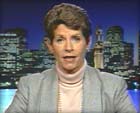 RACHELLE
COHEN: Well, it's the Gore campaign which appealed the decision of the
circuit court judge who said the secretary of state was well within
her rights and her jurisdiction that she did everything quite properly
and within her discretion. I think that decision should have stood.
RACHELLE
COHEN: Well, it's the Gore campaign which appealed the decision of the
circuit court judge who said the secretary of state was well within
her rights and her jurisdiction that she did everything quite properly
and within her discretion. I think that decision should have stood.
 ROBERT
KITTLE: Terry, we have argued on our editorial page really from the
day of the election that once the state of Florida reaches an official
verdict, a final tally, and declares a winner, the losing candidate,
regardless of which one it is, should accept that decision and not press
on with another round of litigation -- that basically we need to have
a way for the Florida officials to declare a winner, and once that happens,
I think it's in the best interest of the country for the losing candidate
to concede, accept the results and join in the... with the president-elect
in trying to unify the country to the extent that's possible after this
very divisive process. So I would hope that once a winner is declared,
once the secretary of state in Florida certifies a winner, that the
losing candidate will accept that, not try to press it on perhaps to
the US Supreme Court or seek other litigation that really could stretch
this out for weeks and weeks to come.
ROBERT
KITTLE: Terry, we have argued on our editorial page really from the
day of the election that once the state of Florida reaches an official
verdict, a final tally, and declares a winner, the losing candidate,
regardless of which one it is, should accept that decision and not press
on with another round of litigation -- that basically we need to have
a way for the Florida officials to declare a winner, and once that happens,
I think it's in the best interest of the country for the losing candidate
to concede, accept the results and join in the... with the president-elect
in trying to unify the country to the extent that's possible after this
very divisive process. So I would hope that once a winner is declared,
once the secretary of state in Florida certifies a winner, that the
losing candidate will accept that, not try to press it on perhaps to
the US Supreme Court or seek other litigation that really could stretch
this out for weeks and weeks to come. TERENCE
SMITH: Doesn't that pre-suppose, Christine Bertelson, that the candidates
and the campaigns would actually accept what they were told, accept
the process that led up to the certification? If they don't, shouldn't
they pursue it?
TERENCE
SMITH: Doesn't that pre-suppose, Christine Bertelson, that the candidates
and the campaigns would actually accept what they were told, accept
the process that led up to the certification? If they don't, shouldn't
they pursue it?  TERENCE
SMITH: Rachelle Cohen, John Diaz doesn't want to see the legislature
determine this and doesn't feel they've laid out a clear enough path.
TERENCE
SMITH: Rachelle Cohen, John Diaz doesn't want to see the legislature
determine this and doesn't feel they've laid out a clear enough path.
 ROBERT
KITTLE: I think the patience is running out, Terry. I think if the Florida
Supreme Court does not issue a ruling that effectively resolves this
matter, that the American people are going to become very impatient
with another round of litigation. And my real concern is that the longer
this goes on, the more Americans may be inclined to lose a measure of
trust in the electoral process. After all, we've seen some rather, you
know, we've seen the underside of how votes are counted now. It's not
a pretty picture. And I think our electoral system is built largely
on trust. And to the extent this matter, this most important matter
that we choose a president every four years, is dragged out for more
weeks, I think there's a danger that there will be a real corrosion
in the public's trust and respect for the electoral process. And that's
not good for democracy at all.
ROBERT
KITTLE: I think the patience is running out, Terry. I think if the Florida
Supreme Court does not issue a ruling that effectively resolves this
matter, that the American people are going to become very impatient
with another round of litigation. And my real concern is that the longer
this goes on, the more Americans may be inclined to lose a measure of
trust in the electoral process. After all, we've seen some rather, you
know, we've seen the underside of how votes are counted now. It's not
a pretty picture. And I think our electoral system is built largely
on trust. And to the extent this matter, this most important matter
that we choose a president every four years, is dragged out for more
weeks, I think there's a danger that there will be a real corrosion
in the public's trust and respect for the electoral process. And that's
not good for democracy at all.  CHRISTINE
BERTELSON: I think it depends on the quality of the leadership of the
man in the office. I think the presidency will be devalued if he's not
a great leader. It's a terrific opportunity to try to find consensus.
I would hope that Republicans and Democrats can both get over their
disappointment at feeling like the other guy stole the election.
CHRISTINE
BERTELSON: I think it depends on the quality of the leadership of the
man in the office. I think the presidency will be devalued if he's not
a great leader. It's a terrific opportunity to try to find consensus.
I would hope that Republicans and Democrats can both get over their
disappointment at feeling like the other guy stole the election.