 |
|
 |
|
| ARCHITECTS' AGENDA | |
 August 18, 1999 
|
||

|
|
Continuing our special emphasis on the 2000 campaign, four architects discuss their interests in the coming elections.
|

|
Welcome to you all. Robert Stern, let me begin with you and ask you, as an architect, as someone who is interested in historic preservation, what you'd like to hear the presidential candidates debate and discuss in this upcoming campaign. |
||||||||||
| Controlling urban growth | |||||||||||
|
The obverse side of controlling the growth, which I think is on many people's minds out into the countryside, is how to reclaim the vast amount of land that lies virtually sallow in the centers of cities like Detroit or St. Louis, just to name two, of many cities of importance that are just -- have been completely abandoned or virtually abandoned, and in which we really must address our attentions, if we are going to have a healthy urban economy and a healthy economy in general in life in the future. TERENCE SMITH: All right. Walter Hood, you are a specialist, among other things, in urban design. What are the issues that might relate to the cities that you want to hear discussed?
And I think if we turn our attention to these urban neighborhoods and those problems, I think in time we'll begin to see the shift from suburbanization back to the reurbanization back into our core cities. I think it's really important for us to have that balance and for us not to really look at one group of people, but try to look at our society as a total, and begin to have some parity as far as where we put those improvements, and where we focus our attention.
WILLIAM MORRISH: I'd like to see the candidates actually eliminate the rhetoric that we've had in the past, where somehow we pit the central cities against the suburbs -- the central cities being the ones that exist on subsidized welfare, and the suburbs the ones that seem to pay their own way -- and begin to acknowledge that what we're dealing with is a large metropolitan economic engine, that within it are a set of communities, which really have similar issues. That is the quality of life. The federal government needs to focus on issues of tax credits, to renovated housing, as opposed to new home starts. There are other ways to indicate the way progress and growth is happening in a city besides only new construction. We need to utilize our infrastructure more effectively. And the federal government needs to start tying its policies on federal transportation to land use and commerce issues, which are now putting forward; rather than just the information highway, we need to access into livable communities, which is access to jobs and the utilizations of our existing metropolitan areas, not just the core cities, but even the first- ring suburbs, which are going through rapid change at this moment. TERENCE SMITH: Julie Bargmann, you've done some work on reclaiming industrial sites. Is that an issue you want to hear debated, or have any hope to hear debated?
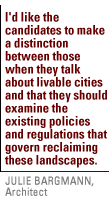
And also, this is perpetuating a pervasive thing with these landscapes of not really creative reuse, of often just clearing them, erasing all the layers, the wonderful layers that are on those landscapes, or actually just kind of capping them to let, you know, the next generation find the toxicity, which I think is rather absurd. |
 |
||||||||||
| Setting architectural precedents | |||||||||||
|
TERENCE SMITH: All right. Robert Stern, the federal government obviously builds a great number of buildings. What should be the federal role in the aesthetics of this bastion; in their own construction and the things that they promote by taxes tax policy and other ways? ROBERT STERN: Well, it's complicated. Architecture is always torn between an urge to reiterate historical values and another countervailing urge, usually propounded by younger architects, to push the envelope of expression someplace new. Traditionally, the federal government has reiterated the inherent classicism of the Capitol in Washington in general, say for example in courthouses. The federal government has embarked on a huge courthouse program now, and the aesthetic issues and the debates about modernity or futurism, if you will, and traditionalism are very much a part of it. But I'm not so worried about aesthetics.
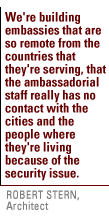
So I think the federal government, the President has to set out certain executive policies with respect to that. It also goes, by the way, to our embassies. We're building embassies that are so remote from the countries that they're serving, that the ambassadorial staff really has no contact with the cities and the people where they're living because of the security issue. I think it's just as bad as people locking themselves into gated communities and far suburbs or whatever. We're doing that even with our most urban building types. So we have to be very, very careful about that, and I think that has to do with the heart of our society as an open and engaged society, or whether we're going to be running scared and walling ourselves off. So I think the issue is not aesthetics, but an urban issue, an issue of reflecting our own culture and are we going to pull back in like the Roman empire did when it started to be besieged, or are we still going to be the confident open society we have historically been?
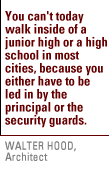
WALTER HOOD: Yes. I mean, I think historically we can look at great case studies and examples of things that have worked in our cities, mixed use. We're finding that a mixture of uses makes places vibrant. At one time we were basically thinking that there should be singular uses, and I think that's coming back now through commercial and neighborhoods and housing mixed together. I think we can also look to our educational system. I mean, I was raised in North Carolina during the 70's, and we had one of the best educational systems in the country. Nowadays, you look at the quality of education in those environments and there's not enough attention focused on that. TERENCE SMITH: And your answer before suggested that that's where it all begins, in your view, with education or its downfall? WALTER HOOD: Oh, most definitely. I mean if you go to some of the inner city schools today, I mean, they're like fortresses. As Mr. Stern just said, I mean it's much more introverted when we think about it. You can't today walk inside of a junior high or a high school in most cities, because you either have to be led in by the principal or the security guards. At one time, our educational facilities, they were actually part of our public realm.
|
 |
||||||||||
| The nation's infrastructure | |||||||||||
|
WILLIAM MORRISH: Well, I think there are several issues that the federal government can be heavily involved. They're the primary builders of a nation's infrastructure, everywhere from roads to open space, from one level to the other. I think that the transportation policies of the federal government should be interrelated with the policies that come out of HUD. There are two offices that sit across from each other on the same road in Washington, D.C., and there's little communication between the two. TERENCE SMITH: Are you talking about rail versus road, for example? WILLIAM MORRISH: Actually, the whole notion of actually developing a multi- modal system or a set of transportation systems which we use all of the systems. We can't just use one or the other. It's actually how they intersect, rather than how they just sort of run one or the other. At the other end -- the other part of it is national housing policy, we have not talked about housing for over 25 years, and the role that the federal government can play in actually renovating the existing housing stock.
The fact that we do not invest heavily in our open space, huge articles about the lack of care and maintenance of our Yellowstone Parks and so forth, those are fundamental elements to the quality of our cities. Those are capital investments that only the federal government can make, which those of us who live in metropolitan areas and predominant population will be living in the metropolitan areas, will service as major, major components to the balance and quality of life. And those things need to be invested with in. TERENCE SMITH: Julie Bargmann, you must deal with the federal government in what you're doing. I wonder, A, how rewarding that is, and B, what part of it could be discussed and debated in the campaign that might help? JULIE BARGMANN: Well, I do deal with agencies, such as the EPA, often because of working with superfund sites and with Brownfield sites. And I think what I see is an increasing trend, a hopeful trend in agencies like that understanding that when you talk about the environment, we're not talking just green, that we are really talking about the brown of brown fields and the gray of highways, and that it's really one integrated mosaic that really needs to be thought of in rather a new definition of ecology.
TERENCE SMITH: Right. Thank you all very much. ELIZABETH FARNSWORTH: Our emphasis and questions will continue for several more months, and you can participate by visiting our Web site, at pbs.org/newshour, and also by regular mail, to the NewsHour, Box 2626, Washington, D.C., 20013. |
 |
||||||||||

 TERENCE
SMITH: We turn to four people who design the spaces in which we live
and work. Robert A.M. Stern is dean of the Yale School of Architecture.
Walter Hood is chair of the Landscape Architecture and Environmental
Planning Department at the University of California at Berkeley. William
Morrish is a Professor of Architecture and director of the Design Center
for American Urban Landscape at the University of Minnesota. And Julie
Bargmann is an Assistant Professor of Landscape Architecture at the
University of Virginia.
TERENCE
SMITH: We turn to four people who design the spaces in which we live
and work. Robert A.M. Stern is dean of the Yale School of Architecture.
Walter Hood is chair of the Landscape Architecture and Environmental
Planning Department at the University of California at Berkeley. William
Morrish is a Professor of Architecture and director of the Design Center
for American Urban Landscape at the University of Minnesota. And Julie
Bargmann is an Assistant Professor of Landscape Architecture at the
University of Virginia. 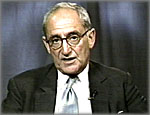 ROBERT
A.M. STERN: Well, I think the most important issue, from the professional
range that I represent, is the issue of the control of the growth of
the cities as they spread out all over the open landscape, and the federal
government's role in influencing that growth, or curbing or directing
the growth, I suppose principally through mortgage programs that the
federal government sponsors and of course through the use of the highways
and transportation policies in general, which are the vehicles for which
that growth can be either fostered or sustained. I would add one more
thing.
ROBERT
A.M. STERN: Well, I think the most important issue, from the professional
range that I represent, is the issue of the control of the growth of
the cities as they spread out all over the open landscape, and the federal
government's role in influencing that growth, or curbing or directing
the growth, I suppose principally through mortgage programs that the
federal government sponsors and of course through the use of the highways
and transportation policies in general, which are the vehicles for which
that growth can be either fostered or sustained. I would add one more
thing. 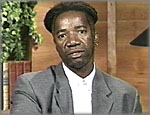 WALTER
HOOD: Well, as Bob just -- Bob Stern just said, I guess I would take
a totally different approach. What I would look first to the cities,
and particularly our urban neighborhoods, and I would first start out.".
I would like to see a discussion really look at education and the problem
that's sort of perpetuated itself over the years with the schools within
these urban neighborhoods, looking at jobs, labor, housing and then
looking at the public spaces that the common folk basically have to
live and play in.
WALTER
HOOD: Well, as Bob just -- Bob Stern just said, I guess I would take
a totally different approach. What I would look first to the cities,
and particularly our urban neighborhoods, and I would first start out.".
I would like to see a discussion really look at education and the problem
that's sort of perpetuated itself over the years with the schools within
these urban neighborhoods, looking at jobs, labor, housing and then
looking at the public spaces that the common folk basically have to
live and play in. 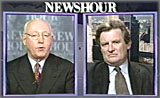 TERENCE
SMITH: William Morrish, you also focus on the urban landscape, but for
Minneapolis. What issues do you want to hear debated?
TERENCE
SMITH: William Morrish, you also focus on the urban landscape, but for
Minneapolis. What issues do you want to hear debated? 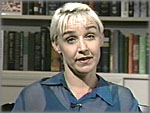 JULIE
BARGMANN: Well, sure, because it relates to what Bill was just talking
about in terms of programs and policy, and I'd like the candidates to
make a distinction between those when they talk about livable cities
and that they should examine the existing policies and regulations that
govern reclaiming these landscapes. Often there's hesitation to want
to fund programs, but it's the policies that I encounter, it's working
with interdisciplinary groups and the communities that they have obstacles
created by the regulations.
JULIE
BARGMANN: Well, sure, because it relates to what Bill was just talking
about in terms of programs and policy, and I'd like the candidates to
make a distinction between those when they talk about livable cities
and that they should examine the existing policies and regulations that
govern reclaiming these landscapes. Often there's hesitation to want
to fund programs, but it's the policies that I encounter, it's working
with interdisciplinary groups and the communities that they have obstacles
created by the regulations.  I
don't think that's really the issue. I think when you have a major investment,
say, of a new courthouse, the site selection in a town, the relationship
of the building to the surrounding urban environment can either be devastatingly
negative -- a big mote of security, for example, is a major problem
we have now, no outreach to public spaces and transportation -- or it
can be incredibly reinforcing and contributive. I don't think there's
enough attention paid to that. And frankly, I think we don't realize
yet, as a culture of builders or the government, which is a culture
of builders, as well, through the General Services Administration, the
consequences of all this security that we're imposing on our buildings.
I
don't think that's really the issue. I think when you have a major investment,
say, of a new courthouse, the site selection in a town, the relationship
of the building to the surrounding urban environment can either be devastatingly
negative -- a big mote of security, for example, is a major problem
we have now, no outreach to public spaces and transportation -- or it
can be incredibly reinforcing and contributive. I don't think there's
enough attention paid to that. And frankly, I think we don't realize
yet, as a culture of builders or the government, which is a culture
of builders, as well, through the General Services Administration, the
consequences of all this security that we're imposing on our buildings.
 TERENCE
SMITH: Walter Hood, one issue certainly is what works in the cities
and what doesn't. Is that something that you would join in, and you
would want to hear discussed?
TERENCE
SMITH: Walter Hood, one issue certainly is what works in the cities
and what doesn't. Is that something that you would join in, and you
would want to hear discussed?  Now
they're actually becoming more privatized. I think you can also look
at labor and housing and other public spaces, labor meaning jobs --
who actually work in the neighborhood. You're finding most people work
outside of their neighborhoods. There's a trend now from a lot of architects
and a lot of planners to begin to bring those jobs back into the community.
I would like it to go one step forward and to begin to think about the
quality of life in those communities, and how neighborhood residents
can actually participate -- if it's not through just basic things like
street cleaners, to maintenance people within parks, to people actually
taking part and investing back within that public landscape.
Now
they're actually becoming more privatized. I think you can also look
at labor and housing and other public spaces, labor meaning jobs --
who actually work in the neighborhood. You're finding most people work
outside of their neighborhoods. There's a trend now from a lot of architects
and a lot of planners to begin to bring those jobs back into the community.
I would like it to go one step forward and to begin to think about the
quality of life in those communities, and how neighborhood residents
can actually participate -- if it's not through just basic things like
street cleaners, to maintenance people within parks, to people actually
taking part and investing back within that public landscape.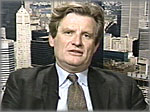 TERENCE
SMITH: William Morrish, this is a federal campaign we're talking about.
What should the federal role be? We've heard some discussion of sprawl
already in the campaign. But what should the federal role be?
TERENCE
SMITH: William Morrish, this is a federal campaign we're talking about.
What should the federal role be? We've heard some discussion of sprawl
already in the campaign. But what should the federal role be?  We
tend to mark our nation's progress around new home starts. We should
be really focused on the number of renovated house starts, not only
in the central city, but in the area that we're working on quite heavily
is the future of the first-string suburbs, those suburban communities
that are 50 years old now, that have small civic capacities for change,
but offer a unique opportunity to service jobs both in the outer ring
and the inner central city. But yet there are no mechanisms from the
federal level to actually help people make that social change that is
going on in their family structure. The third area is open space.
We
tend to mark our nation's progress around new home starts. We should
be really focused on the number of renovated house starts, not only
in the central city, but in the area that we're working on quite heavily
is the future of the first-string suburbs, those suburban communities
that are 50 years old now, that have small civic capacities for change,
but offer a unique opportunity to service jobs both in the outer ring
and the inner central city. But yet there are no mechanisms from the
federal level to actually help people make that social change that is
going on in their family structure. The third area is open space.  I
would call it an industrial ecology or a working ecology, where they
really - we really sponsor partnerships between environmentalists, industrialists,
historians, so that we really are working towards these very multi-layered
and very rich landscapes that people would like to live in -- again,
not this head-in-the- sand, "just call me when it's all green again,"
but really one that integrates it into a really rich mosaic.
I
would call it an industrial ecology or a working ecology, where they
really - we really sponsor partnerships between environmentalists, industrialists,
historians, so that we really are working towards these very multi-layered
and very rich landscapes that people would like to live in -- again,
not this head-in-the- sand, "just call me when it's all green again,"
but really one that integrates it into a really rich mosaic.