 |
|
 |
CHILEAN POLITICS |
|
The MacNeil/Lehrer NewsHour -- November 19, 1984 PINOCHET CRACKS DOWN
The announcement meant Pinochet's government was suspending Chileans basic civil rights, and imposing censorship and curfews. A pastoral letter by the Archbishop of Santiago condemned Pinochet's state of siege, calling the 90-day suspension of civil liberties "a grave reversal for understanding and peace."
Government troops also rounded up thousands of suspected anti-Pinochet activists, some of whom were sent into makeshift prison camps. Chileans' dissatisfaction with Pinochet had been on the rise after an economic downturn that brought unemployment and inflation to high levels in many areas.
"You have a reality outside the palace, which is the unemployment we've just seen, the tremendous economic setbacks and the growing dissatisfaction with the government, which is certainly very broad, although there's some support for the government even now," Falcoff said. "But the point is, perhaps all of the political actors are riding a tiger none of them can control, and when that tiger rears its head, Pinochet instinctively reacts by cracking down so he can show that he's still in control, which is utterly essential to him."
"I went out to one of those neighborhoods that was raided by the air force, the army, the police, and looked at the destruction left behind: the clinic destroyed, the kindergarten destroyed, the houses ransacked, all the males in the slum arrested -- that's pretty terrifying," Neier said.
|
|||||||||||||||||||
|
|
||||||||||||||||||||




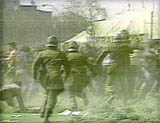 Chilean
President Augusto Pinochet declared a state of siege after a resurgence
of street violence by those demanding a return to democratic government.
Chilean
President Augusto Pinochet declared a state of siege after a resurgence
of street violence by those demanding a return to democratic government.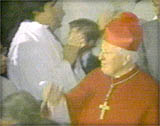 Only
Chile's church-owned radio could report on the archbishop's letter,
due to a government crackdown on the media.
Only
Chile's church-owned radio could report on the archbishop's letter,
due to a government crackdown on the media. Mark
Falcoff of the American Enterprise Institute said Pinochet's show of
force was meant not only to keep Chileans in line, but to underscore
the general's strength in the minds of the country's military leaders.
Mark
Falcoff of the American Enterprise Institute said Pinochet's show of
force was meant not only to keep Chileans in line, but to underscore
the general's strength in the minds of the country's military leaders. Aryeh
Neier of America's Watch, a group monitoring human rights abuses in
the Western Hemisphere, said the anger -- and the government reaction
-- was concentrated in Chile's poorer areas.
Aryeh
Neier of America's Watch, a group monitoring human rights abuses in
the Western Hemisphere, said the anger -- and the government reaction
-- was concentrated in Chile's poorer areas.