


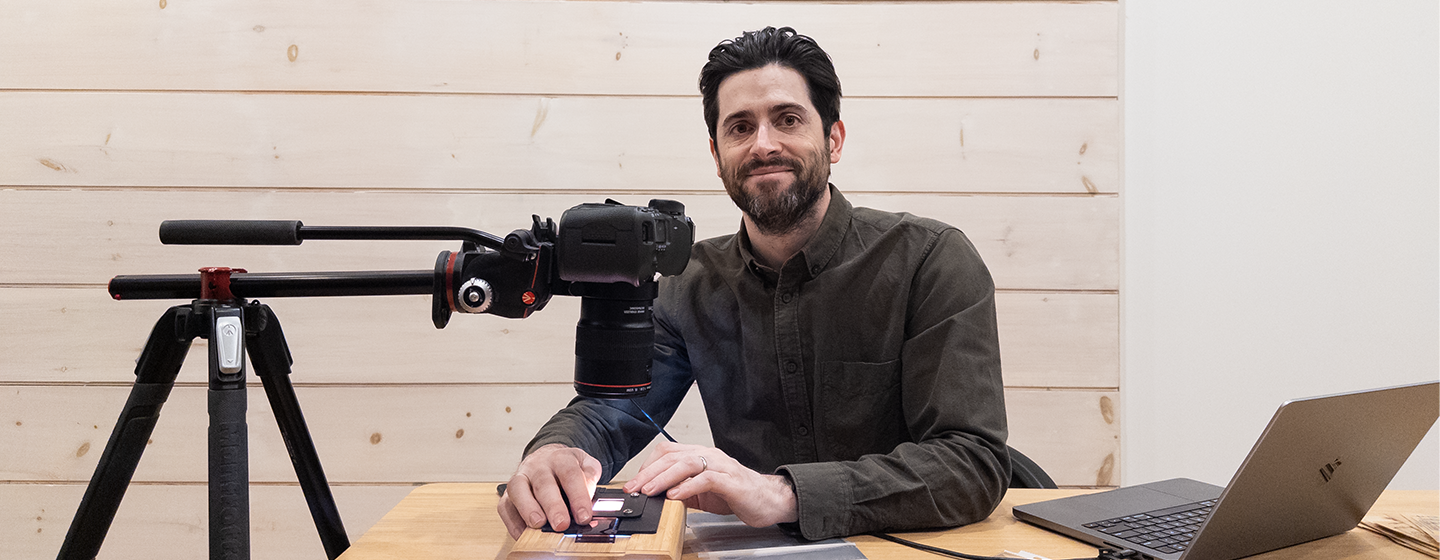
Since joining Florentine Films in 2015, Tim McAleer has had numerous producing roles on historical documentaries for PBS such as Muhammad Ali, Jackie Robinson, and Leonardo da Vinci. Before joining Florentine, he worked at BBC Studios. Being involved in all stages of production, from development to delivery, McAleer is well aware of how challenging data management can be. He has figured out how to use AI tools to help with that workflow.
McAleer does not use AI to generate content. Rather he uses it to build tools that assist with archiving, logging, and managing the assets for a project.
As an example of the volume of material underlying a single project, for the documentary on Muhammad Ali there were 20,000 still images, more than 100 hours of footage, and 35 new interviews. By using AI to assist with the work of logging and tracking material at that scale, it can free up invaluable time for the researchers to do more searching and to dig deeper.
In this Q&A with PBS Standards & Practices, McAleer offers advice and resources that can help filmmakers make their work more organized and searchable. This conversation has been lightly edited for clarity and brevity.
1) The PBS Editorial Standards encourage producers to be “leaders in experimenting with innovative techniques for presentation, storytelling, interactivity, information delivery, and engagement with the public.” You recently leveraged AI tools to create an app called Breadcrumbs that embodies this idea in the standards. How has the app, and the use of AI tools to create it, furthered your filmmaking work?
Filmmaking can be quite technical, even when the end product doesn’t look or feel that way from the outside. Particularly in documentary, behind every scene is a web of research, licensing, and file management, often held together by spreadsheets and one person who happens to know where everything is. AI can be very helpful in that behind-the-scenes work, and that is where a lot of my focus has been. So rather than using AI to generate parts of the film itself, I like to use it as a software development partner to build tools that make the unglamorous parts of production more reliable and less time-consuming.
A concrete example is a Mac app I built called Breadcrumbs. When researchers are downloading archival images or video clips, they need to be able to trace where they came from, find them again, and connect them to whatever IDs, descriptions, or rights information the source archive provides. Researchers tend to have a million tabs open, and the decision to “paste the link later” can be when things get lost.
Breadcrumbs does one small thing at that moment. It captures the source URL and any useful page context, then embeds that information directly into the file. The AI component is assistive, it helps pull out practical details a researcher already needs to track. The goal is to make sure the work they are already doing is captured consistently and can be audited later — and far from replacing the researcher’s judgement, the tool is meant to support it.
That, ultimately, is how I feel AI can further filmmaking work. It helps us stay organized with large volumes of media, and makes it easier to turn over every rock without losing track of what we’ve found and where it came from.
2) Accuracy is a core principle in the PBS Editorial Standards, which require producers to “exercise the highest level of care in verifying information.” As you use AI tools to help enter thousands of records into an archival database, what guardrails do you put in place to implement this principle of accuracy?
A huge part of archival production is data entry: names, dates, locations, rights info, etc. AI can be quite helpful here, but only if it is constrained to evidence.
For our productions at Florentine Films’ Brooklyn Studio, I built an internal system we call AutoLog. It analyzes stills and footage as items are entered into our research database and produces a first draft of the description and relevant tags. The key is that it is not asked to be creative, it is explicitly asked to be disciplined.
The guardrails for AutoLog are as follows:
- All AI outputs are based on evidence: It only works from what we already know. File metadata, a researcher’s notes, and the original link if we have one. If AutoLog cannot find evidence for a particular image or video, it just stops and invites the researcher to come back and either enter the information themselves manually or tell the AI model what they know.
- Human review is still the standard: AI-generated fields are treated as a first draft. Producers and researchers still review, correct, and verify, especially for names, dates, locations—anything that could make its way into editorial decisions.
- Repeatable instructions, rather than one-off prompting: Instead of chatbot-style interactions, we use a consistent set of instructions that define what the system can do, what it must not do, and how it should behave when uncertain. I call it our "System Prompt." It is about two pages long and, in practice, reduces errors dramatically.
Some collections come with more information than others, so AutoLog doesn't do everything. But the guardrails mean that when it does contribute, it is pulling from evidence and flagging what it cannot verify. The time it saves on data entry is time researchers can spend verifying details, cross-checking sources, or looking for more.
AutoLog also has a second purpose which is to help make the archive easier to search later. There are many tools now that use AI to search media files visually, but those systems often work from the model’s first impression of an image or clip. AutoLog is designed around a different idea. As researchers and producers review, correct, and improve the metadata, the system can “re-scan” the item so the semantic search reflects the latest human-reviewed understanding of the material. So the fact-checking does not sit off to the side, it becomes part of how the archive is searched. That matters in documentary work because retrieval is not just about finding “a tree,” “a car,” or “a person entering a room.” It is often about finding material according to context, source, subject, rights status, historical meaning, or what the team has learned about it over time. The goal is not simply to make media searchable by AI. It is to make the production’s verified knowledge more findable later.
3) The PBS Editorial Standards also indicate that producers should “never assume that online materials or generative AI output is truthful or accurate. Producers should pay careful attention to the accuracy of names and titles, dates, places, statistics, and foreign language translations.” How do AI tools for optical character recognition (OCR) purposes, whether in archival cursive letters or archival newspaper clippings, help inform historical documentaries that prioritize accuracy?
One of the most practical uses of AI for archival work is making primary sources more legible and searchable. In historical documentaries, we deal with handwritten letters, newspaper clippings, scanned documents, and images where the relevant information is literally locked in the pixels.
It’s worth pointing out that this is not new. Archives have relied on OCR and machine-assisted transcription and translation for a long time. What’s new is the leap in capability. Today’s models handle a wider range of inputs — rough scans, garbled audio, odd layouts, ancient cursive — and can use surrounding context to make smarter guesses about what a word is likely to be. It’s funny to think about, but that “reasoning” ability is the same mechanism that leads these models to hallucinate. Sometimes AI fixes what older OCR would mangle. Sometimes it confidently invents something. The only way to tell the difference is to use it, stay skeptical, and check anything important against the original.
So these tools do not help accuracy by being right all the time. They help accuracy by making it possible to do deeper research. Handwritten letters that no one on your team can read. A bad scan of a 200-year-old newspaper. Audio in a language nobody in the office speaks. In the past, those items sat in a folder untouched because there was not enough time or expertise to process them. Now you can get a usable transcription or translation, search across it, and cross-check details against other sources. The output is never treated as truth, but it is a starting point, and anything that matters gets checked against the original document. But because you can now search and compare across so many more sources, you end up catching things you never would have found otherwise. That is where the accuracy comes from.
You can read more about a tool called OCR Party here
4) As an experienced public television producer, what emerging possibilities or capabilities of AI tools are you most excited about? And what are you most wary or cautious about?
What excites me most is AI’s ability to help researchers and producers navigate scale by making it feasible to work through enormous archives with more rigor.
Documentaries are often built from massive troves of archival material. Sometimes it’s a pop musician that’s been followed for years by a camera crew, sometimes it’s a political campaign where every moment was filmed behind-the-scenes. I worked on an eight-hour series about Muhammad Ali, and at the height of his fame he was arguably the most famous man in the world. If you were determined enough, you could probably track his daily whereabouts by triangulating the wire services and news archives. You can only imagine how that translates to a digital world where nearly everything leaves a trail of photos, video, posts. In my view, tools that can help us sift and organize large archives are going to become essential just to keep up with the volume of material the modern era produces.
What I’m most wary about is the same thing that probably worries the average news consumer, which is deepfakes and misinformation. We live in a time of historic mistrust in the media already and anything that blurs the truth, especially synthetic media, will only exacerbate that. Moreover, the risk to me is not only that audiences could be deceived, but that journalists, researchers, and archives could become polluted with content that looks authentic but is not.
The way through that, in my view, is more technology, not less. I think the strongest position is fluency. If you understand how these tools work and where they fail, you are in a much better position to set meaningful standards and catch problems. Avoiding the technology does not make it go away.
The Archival Producers Alliance has done great work around this and I would refer to their Best Practices guidelines and their Tool Kit for filmmakers.
5) For the many local public television stations and producers across the country who might not know where to start with assistive AI tools, what would you suggest as good initial steps to explore the potential for these tools?
I have two recommendations, one on the research side, and one on the post-production side.
On the research side, I’d recommend trying Deep Research, all of the major chatbots have a version of this feature. It’s designed to plan a research approach, browse lots of sources, and return a structured write-up. At worst, it simulates that first hour or two where you open a million tabs and beat your head against the wall, then hands you a cleaner starting point. At best, it gives you a sourced memo you can follow up on with your own judgment and fact-checking.
On the post-production side, the biggest unlock I've seen for small teams is using AI coding assistants to automate repetitive media chores. Tools like Cursor can help you generate small scripts that work on your real files, like renaming and organizing batches, generating transcripts, and handling other tasks that quietly eat hours in production. (Cursor, Claude Code, Codex — these are largely interchangeable for this purpose, so if you already have a subscription to one, use what you have.) If you've never used a coding tool before it can look intimidating at first, but it's essentially a chatbot that can see your project folder and help you run practical jobs within it. The key is to start with one workflow you already do regularly and keep the scope small.
One last thing worth mentioning here is the pace of change. If you tried one of these tools a year ago and it felt unreliable, that impression is probably already outdated. These models evolve quickly, and the best way to keep up is to check in regularly with low-risk experiments and build your own sense of where they are helpful and where they are not.
Contact PBS Standards & Practices at standards@pbs.org.