One-on-One
Carlos Medina; Colonel Jeff Cantor; Shanda Johnson, PhD
Season 2025 Episode 2846 | 27m 51sVideo has Closed Captions
Carlos Medina; Colonel Jeff Cantor; Shanda Johnson, PhD
Carlos Medina, President and CEO of the Statewide Hispanic Chamber of Commerce NJ, talks about his series on PBS, “Que Pasa NJ.” Colonel Jeff Cantor, Ret. US Army, CEO of the NJ State Veterans Chamber of Commerce, and Director of Product Development & Partnerships of MA Salute at Braven Health, discusses removing barriers to healthcare access for former service members. Shanda Johnson, PhD, Double
Problems playing video? | Closed Captioning Feedback
Problems playing video? | Closed Captioning Feedback
One-on-One is a local public television program presented by NJ PBS
One-on-One
Carlos Medina; Colonel Jeff Cantor; Shanda Johnson, PhD
Season 2025 Episode 2846 | 27m 51sVideo has Closed Captions
Carlos Medina, President and CEO of the Statewide Hispanic Chamber of Commerce NJ, talks about his series on PBS, “Que Pasa NJ.” Colonel Jeff Cantor, Ret. US Army, CEO of the NJ State Veterans Chamber of Commerce, and Director of Product Development & Partnerships of MA Salute at Braven Health, discusses removing barriers to healthcare access for former service members. Shanda Johnson, PhD, Double
Problems playing video? | Closed Captioning Feedback
How to Watch One-on-One
One-on-One is available to stream on pbs.org and the free PBS App, available on iPhone, Apple TV, Android TV, Android smartphones, Amazon Fire TV, Amazon Fire Tablet, Roku, Samsung Smart TV, and Vizio.
Providing Support for PBS.org
Learn Moreabout PBS online sponsorship- [Narrator] Funding for this edition of One-On-One with Steve Adubato has been provided by New Jersey Sharing Network.
Hackensack Meridian Health.
Keep getting better.
United Airlines.
Kean University.
Where Cougars climb higher.
Newark Board of Education.
PSEG Foundation.
Eastern Atlantic States Regional Council of Carpenters.
The New Jersey Economic Development Authority.
And by Operating Engineers, Local 825.
Promotional support provided by NJ.Com.
Keeping communities informed and connected.
And by New Jersey Globe.
- This is One-On-One.
- I'm an equal American just like you are.
- The way we change Presidents in this country is by voting.
- A quartet is already a jawn, it’s just The New Jawn.
- January 6th was not some sort of violent, crazy outlier.
- I don't care how good you are or how good you think you are, there is always something to learn.
- I mean what other country sends comedians over to embedded military to make them feel better.
- People call me 'cause they feel nobody's paying attention.
_ It’s not all about memorizing and getting information, it’s what you do with that information.
- (slowly) Start talking right now.
- That's a good question, high five.
(upbeat music) - Hi everyone, Steve Adubato.
We kick off the program with an in-depth interview that my colleague, Mary Gamba.
Mary is the co-host of our sister series "Lessons and Leadership."
We sat down and talked to Carlos Medina, President and CEO of the Statewide Hispanic Chamber of Commerce in New Jersey.
We talked to Carlos about his leadership journey, board leadership, and also a series that Carlos has on Public Broadcasting called "Que Pasa New Jersey."
Carlos Medina, check it out.
- Carlos, good to see you, buddy.
- Always a pleasure to see you, Steve.
- Listen, first, before we get into leadership, can you promote "Que Pasa?"
- Sure.
I'm on season six of "Que Pasa."
It airs on Saturdays, nine in the morning.
Next episode will be a Father's Day special airing in a week and a half and it'll be a fun episode.
- Great, and we'll also put up the website so people can find out more and also broadcast with our partners at NJ PBS.
Hey, Carlos, talk to us about this, your leadership journey, pretty unique.
Describe it.
- Sure.
I was somebody who grew up with a very strict father, so I'm sure you could appreciate that.
(chuckles) - Just a little bit.
- So going to law school was not an option in my house, I was going to law school.
And it was a struggle.
I was shy, I wasn't a public speaker like I've been forced to be now.
I still get nervous getting in front of folks, but dad was very aggressive and then fast forward to the chamber being in crisis, I was an attorney working at an engineering firm and we were $300,000 in the hole.
Our founder became ill and somebody had to step forward and I sat with dad and dad was like, "You know, I think it's a good thing to do, but, you know, sit with your family, let 'em know the additional hours you're gonna be working."
And, you know, I'm glad I did, that's probably the moment that changed my life the most was joining the chamber, helping turn them around.
- Yeah, lemme follow up on that.
Mary'll jump in in a second.
Without getting back on a soapbox, I was saying that when you lead an organization, particularly a nonprofit, 300 grand in the hole, right?
You step in.
I was saying, and I believe this, even with great partners like Mary who is an exceptional leader, that very often leadership when you're having to make budget is lonely.
Is that just me crying the blues or do you think it's true?
- It's true.
I was picking up the phone call, you know, to call friends.
I called friends from high school and I think at some point people stopped picking up the call 'cause it probably got around the community, Carlos is looking to save the chamber, don't pick up.
(Steve laughs) You know?
"Hey, Sam, he's about to call you, I'm just giving you the heads up."
That was tough, I mean, we had people leave the board when they saw the finances, which was, you know, we need their time, we need their treasurer, they're taking both away and saying, "We're packing up our lunchbox and going home."
So that was tough.
But at the end of the day, if I had to use a phrase or, you know, it's all about relationships, Steve.
That's what saved me, that's what saved the chamber, and that's always been in my life.
I'm a big proponent that you need to, you know, nurture your relationships.
There's a friend of mine named Ted Rubin who says, you know, relationships are the new currency.
So instead of ROI, he likes to say ROR, return on relationship.
- Yeah, your friend's a smart guy because Mary and I have built this organization through our relationships and also our relationships with a great team that we have.
Go ahead, Mary.
- It's funny you mentioned relationships, Carlos, with our new up and coming leaders, our younger 20 something leaders, Steve has sons in their 20s, I have two sons, a 20 and a 23-year-old.
How do you recommend to these young leaders up and coming to build relationships when so much of what they do is just like we're doing right now, on Zoom, on Teams, and how do you build relationships, and on the phone, in this type of format?
- I'm not shy, Mary.
So like, I have a 22-year-old daughter who you'll see on that episode.
She joins me on the Father's Day episode, so.
She wants to be a Broadway performer in musical theater so I'm just like.
- Oh my, Carlos.
- Go ahead, Mary.
- My son is at NYU Tisch right now studying to be an actor.
- So we have to have a coffee with the kids.
- Definitely.
- My daughter graduated Marymount Manhattan in musical theater.
- Congrats.
- So she comes on the show.
I've introduced her to, you know, Mandy Gonzalez from Broadway, Christopher Jackson.
So she's met some really great people.
So it's just, I really, I'm aggressive with her.
I'm like, you have to come to this cocktail party with me because you're gonna meet a producer that could perhaps open a door for you.
But I do struggle with the 20 something year olds are so different than the three of us that are on camera right now.
I mean, it's such a different world.
They don't build relationships, it's all digital.
So I think there's a big disconnect in that generation.
But those that can embrace it are gonna, there's no stopping them.
You know, like Steve's kids automatically having Steve as a dad, they're gonna have networks, they're gonna know how to network - Or they don't want their dad getting involved.
- Or, and my wife Jennifer watches occasionally.
Jen, I know you accuse me of trying to micromanage our kids' lives, which is a euphemism for Nick, Chris, Olivia, my older son, Steven, here's what you need to do.
You need to call so and so.
"No, I'm gonna text him."
No, you need to call so and so and have a real conversation.
They don't know what they don't know.
And I know they push back, but Carlos, this is a leadership and parenting question.
Do we let them fail, or fall, however it's gonna play out, even when we know that they need to do this thing?
We're not trying to control them, but help them understand that it isn't all digital and texting is not talking.
Go ahead- - I think we have to let 'em have a little stumble, Steve, you know, not a long fall from a high building, but I think occasionally you have to let them, my daughter is my personality.
So she's so stubborn that if I tell her I think automatically she already has an inclination to say no just because it's coming outta my mouth.
So I have to let her organically come to the same conclusion by supporting her as best I can.
But yeah, it's a challenge.
(chuckles) - Carlos, I've said to Steve a million times, I said, "You need to let them fail."
If you always are there to catch them, as long as it's nothing ethical, immoral, illegal, dangerous, let them fail because if not, they're not gonna learn if you're always there to just scoop 'em right up.
- All right, so, stop talking about my issues with my kids.
All right, Mary, last question.
- Carlos, I did read a lot, we do our research before these shows, and you are a self-professed storyteller.
Where did your passion come from?
I mean, we just saw it now for the past nine, 10 minutes, where does your passion for storytelling, because at the way beginning of this segment, you shared that you get nervous sometimes with public speaking, but you're also a storyteller.
Where does that connection come from?
- Yeah, it's a weird conflict that I experience.
Dad was an amazing storyteller, to the point that as he was getting older and his memory was failing, some people might like in a party come and say, "Save me, your dad's told me this story 100 times."
So I then become a little, I'm conscious like, be careful, Carlos, you don't wanna be.
So then I kind of become more, you know, retrospective.
I become a little more inward and I'm not as aggressive, 'cause I'm like, wait, I don't want to be harassing folks.
But I love storytelling, I loved hearing dad's stories and the way, you know, he could command the crowd and people would just circle him and appreciate his knowledge, it was always...
It's just a rush that I can't explain when you have a good conversation with somebody.
- Hey, Carlos, you're doing important work at the chamber, the statewide Hispanic Chamber of Commerce and also with "Que Pasa" New Jersey, seen with our great friends and broadcast partners, NJ PBS.
And go online, it'll be up one more time so people will see past episodes.
Carlos, wishing you and your team all the best.
Thank you.
- Great, thank you.
- You got it.
Stay with us, we'll be right back.
- [Narrator] To watch more One on One with Steve Adubato find us online and follow us on Social media.
- Recently, I visited, along with some incredible people.
This was a health fair, a Veterans Health Fair that took place in Newark, New Jersey at Branch Brook Park.
And I sat down, you're about to see an interview with Colonel Jeff Cantor, who is in fact the CEO of New Jersey Veterans Chamber of Commerce.
Here's what we talked to the colonel about.
A whole range of issues facing our veterans today, healthcare issues, life after deployment, transitioning back into life outside the military, health related issues, physical health, mental health, a whole range of issues.
Talking to Colonel Jeff Cantor.
- Good to see you, Colonel.
- Great to see you, Steve.
- Talk about this event.
- Yeah, so this is put on by Braven Health.
So Braven came together at a strategy meeting and decided that it's really important to provide access to quality healthcare for the veterans community.
And so we just mobilized and made sure that we could get all the resource partners involved and get some of the strategic partners involved to make sure we're giving quality access of healthcare to the veterans community.
- You're talking about HIV testing, cardiovascular asthma, prostate cancer screenings, mental health resources.
Why mental health in there?
- it's really important, right?
So what's happening a lot in the veterans community is a lot of patients, veterans are suffering with PTSD, anxiety, depression as a result of PTSD and some of the exposures that they've seen during their service.
So what we're trying to do is provide resources for them so that they can get the access to the care that they need, whether it be physical health, mental health, cardiovascular health, pulmonology health, HIV.
Any type of healthcare we wanna provide them access to.
- There's another area that... You know, when I was going over the material with our producers, I looked and I saw mobile mammograms.
There are a significant number of female veterans here.
- So it's the largest- - And male.
- Yeah, absolutely.
But it's interesting you bring that up because female veterans are the largest growing group of veterans in the state of New Jersey, and unfortunately, the VA does not have a mammogram machine in the state of New Jersey.
- Does not?
- Does not.
So what we're trying to do is meet an unmet medical need by providing those resources like free mammogram services for female veterans so that they can get the care that they need.
And we're willing to give that information to them so they can take it to the VA and get the continuity of care, or come to a Braven Salute type program and they can get the care in the community where they live.
- Colonel, help us understand this.
There are hundreds of veterans here today at Branch Brook Park in Newark, New Jersey, and by the way, Essex County very involved.
The director of public health is here, a whole range of officials from the county are here as well.
So it's a collaborative effort between the veterans community, the folks at Braven, as well as the folks in government.
That being said, how did most veterans who are here today even know about this?
- So we put it out through various channels, right?
So we went to the state level of the VFW, the American Legion, the Disabled American Veterans, the Marine Corps League.
Let them know about the program.
We put it out on social media.
We went and visited every single state, every single VFW chapter and post in Essex County.
We went to Essex County to see if we can get their senior services involved, identify who the veterans are.
Joe D stepped up in a big way.
- [Steve] Essex County, Joe DiVincenzo.
- Stepped up in a huge way, provided free transportation for all veterans to come here.
We're working with the Department of Military and Veterans Affairs.
City of Newark stepped up as well, Department of Senior Services and Veteran Services.
So we put it out through a lot of channels and, you know, it's been very successful getting veterans to this event.
- Final question.
Veterans watching right now, looking for resources, not knowing exactly where to go, access is challenging, is there one place you believe, Colonel, they should be going?
- So there is one.
There's actually two places they go.
- Go ahead.
We'll put up the website.
So you talk about it.
- Yeah.
So the first one is thevfa.org.
That's the Veterans Foundation of America.
There's a number of resources for mental health and physical health.
- And by the way, the Veterans Foundation of America, one of the co-sponsors of the event, along with Feeding Our Heroes.
- That is correct.
Yeah.
Feeding our Heroes and Veterans Foundation of America helped.
They were the co-leads that put on this great event, and so they can go to www.thevfa.org.
You can find out about all the other healthcares that we're doing throughout the state.
There's seven healthcare fairs that we're doing in the state of New Jersey between now and November, so it's gonna be very effective.
And they can also go to warriorportal.com.
- [Steve] What is it again?
- Warriorportal.com.
And that's a one-stop-shop for all things veteran.
If they need any information on claims support, mental health support, how to find their closest VA facility, all that's on there.
It's a one-stop-shop for veterans.
- Colonel, well done.
Thank you for your service, and thank you for your service here and the work with your colleagues in making this happen.
Thank you, Colonel.
- Steve, thank you so much.
Appreciate it.
- You got it.
- Thank you, man.
- [Narrator] To watch more One on One with Steve Adubato find us online and follow us on Social media.
- Uplifting music.
- Hi, I am Jacqui Tricario on location at the New Jersey Sharing Network's 5K Celebration of Life here in New Providence, New Jersey.
I'm so pleased to be joined now by Dr. Shanda Johnson, who is a double lung transplant recipient.
Dr. Shanda, thanks so much for joining us.
- Thank you.
And I'm welcome to be here.
- Yeah, I'm so glad that you're able to be here at the 5K this year.
I wanna start first about your health journey.
Take us back before you received the two brand new lungs from your donor.
Take us back to that time and what your day to day life was like.
- So I've been sick for, I was sick for like five years with a, what they said, terminal lung disease.
I had a condition called CHP, which is chronic hypertensive hypersensitivity pneumonitis.
So you know, I was on meds and seeing the advanced lung team and day to day I was on oxygen starting in 2019.
So I was going to work and doing everything.
- On oxygen?
- With my oxygen tank.
You know, and I was a college professor so it wasn't that bad.
But I did have to step away from my nurse practitioner piece just a little bit.
- You were working with little ones?
- Yeah, I was working with kids, but I was still working with them.
But they would give me like the well kids and then as I got sicker, I had to step away, and do the online virtual visits.
- Because of the germs that these kids, I mean I have kids, they have a lot of germs.
(Jacqui laughs) - They have a lot of germs.
So I did, I switched to all virtual visits and lab checks and all of that stuff 'cause there's still a need for that.
So, I missed them.
And then in 2023, right at the five year mark, I started to decline and then one day I just couldn't get my breath.
So I called my sis, I called my transplant center and they were like, "Just come in."
And I'm like, okay, "How do I get there?"
So I called my sister-in-law like, "Are you busy?"
She's like, "No."
I'm like, "I need to go to the doctor."
She's like, "Okay."
I'm like, "UPenn."
She was like, "Let's go."
And then she's like, "Are you sure we're gonna make it there?"
I'm like, "Yeah, this is where I need to go."
So I really honestly thought I was just gonna go in.
They were gonna keep me for like a day or two, titrate my oxygen up.
- Okay.
- And I was gonna- - Get you more stable.
Yep.
- That didn't happen.
- How long were you there for?
- A year.
- A year in the hospital?
- Yeah.
Different like, we call it LTAC, long term acute care.
And then I got the call and then I went back to the main hospital.
My transplant was at UPenn and I was transplanted.
And I ended up staying in the ICU for another five months.
- Another five months.
So this is a very long time to be in the walls of a hospital.
Can you tell us a little bit about the support team that was surrounding you during that time to get you through this time in your life?
From friends, family, the hospital staff?
How important was that support team for you?
- It is the ultimate thing because your mental health is as important as your physical health.
And being inside, not being able to control anything but when you gonna take your shower and when you're gonna go to bed.
Everything else is scripted down to your meds, physical therapy, occupation, even your food.
So it was very difficult.
But I'm blessed because I had a large support system.
So because I'm a nurse, I had my nurses like they know what to do.
So they came in and then my family led by my twin and my sister and my son.
They made sure in terms of family support, who needs to be there when.
And they also coordinated with my girlfriends, my group of girlfriends who are also nurses and other people to say, "Okay, you need to go this time.
We don't wanna overload her."
- They knew how to take care of you.
They knew what needed to be done.
- Yeah.
So I have a big support team.
Now when it comes to the hospital staff, again, they already know.
But the one thing I did say to them is, and I suggested and they were like, "Yeah, we gotta do better with that."
When you list somebody, right?
You all- - The transplant list?
- Yeah.
You all hope that your call is gonna come.
Okay, we do a big evaluation.
They do a psych evaluation and then what happens if your call doesn't come in three months, six months, nine months?
Like me?
Like you just keep waiting and waiting.
And I said to them, "You have to circle back and check on them for how are they doing, maintaining their anxiety, maybe depression?"
Because it's anxious when that call comes or you are friends with people, we have a big support group, they're getting called and you're sitting here like, "Well when is my call gonna come?"
- Well how were you able to get through that time mentally?
Like how were you able to stay positive?
- Well, I'm a saved believer, so I always pray every day and I just said, "Just God, just calm my mind.
It's gonna come when you are ready."
But also we have a support group, a Facebook online support group.
So we meet every Monday on Zoom.
So that helped.
And then the transplant center does support groups and you go in there and I was blessed that when I was at the long-term care center, the person next door to me, she was there.
She came like three weeks before me.
And we were both both waiting for- - Was this Angela?
- Yeah.
Yeah.
We both was waiting and we became the best of friends.
The best of friends.
So you know the outcome for her.
And I was just devastated.
Devastated.
- Yeah, she unfortunately passed away while she was waiting for the gift.
- Yeah.
- So sorry.
- Yeah.
Yeah.
And she got called three times and we call 'em dry runs.
So she was like, "Why?"
Because I was like, "Listen, I'm not telling anybody when that call comes, only my family.
Because if we get sent back-" - You don't wanna get everybody's hopes up, including your own, I'm sure.
- Yeah.
So people were like, "You don't seem happy."
I said, "It's not that I'm not happy, I'm very cautious of my feelings.
So I wanna see the other side, like when I come out, I know it happened."
- Talk about that when you come outta that and I'm sure the emotional rollercoaster that this whole process has been, especially with receiving these two new lungs.
Talk about afterwards.
I know it's been a little bit of a struggle, but also has given you so much more back that you didn't have before.
- Yeah, so recovery was long and you know, because I was able to go outside and do some walking and strengthen myself with PT OT, they just like, "Oh, she's gonna be fine.
She's gonna be fine post-op."
But it was a lot of complications because I have a small chest cavity.
So the lungs that they had to find were had to be from a small person or a child.
And the, you know, the kids go first, so, and they were finding some matches, but from like a six-foot tall person.
That's not gonna fit in my chest cavity.
- Yeah.
- So post-op, you know, I was out for a while.
Like when I woke up, it was already April, going into April.
And I'm like, and then I was trached, so I couldn't talk.
And that stayed until July.
So it was like communication-wise and I had to learn to do everything over.
I'm talking everything, walk, talk, everything.
- You've come such a long way, huh?
- Yeah.
Eat food, everything had to be relearned.
So I was in therapy until December and then I left that type of therapy and then went into a different therapy.
So I'm still in therapy because of my gait.
So I would use a walker.
Recovery is just, it's different, - Ups and downs, I'm sure.
- You go one step forward and take four steps back.
- Yeah.
But you here today is a miracle.
And to have you here at the 5K, the 15 years celebrating this year.
This is the third year with your team, team Bee Strong.
- Yeah.
- And, but you're the first year as a transplant recipient.
What does that feel like for you?
- I'm so happy I get emotional because I didn't think I would be here.
So being able, even, I'm not gonna walk today, but just to be here for my team, everybody's like, "We're so happy."
And I was admitted a couple of weeks ago to the unit that I first went to and every nurse that took care of me had me in 2023.
So the excitement that they see, like, "Oh my God, she's back."
Not that she's back, but- - You're here, you're doing it.
Yeah.
- And she remembers us all and they was just like so amazing.
You know, I just take one day at a time.
Literally.
People often ask, "How do you do this?"
And I say, "One day at a time."
- And you're reinventing yourself in so many ways, especially with your career.
Talk a little bit about that and just how you're becoming more involved with organ and tissue donation.
- I'm now an advocate.
Like I'm an advocate.
I just talk about it to everybody 'cause everybody has their beliefs or myths about what organ transplant is.
And if you check that mark on your driver's license and what's gonna happen, they just gonna steal it.
And I'm like, "That's not what they do."
You know, they have to make sure you know you are a viable candidate and that if something does happen to you that you know it's okay with your family, even though you, you know, marked it, your family may not know you marked it.
So, I always have a conversation.
So, and now that people see me and that I actually went through it, they're like, okay, now we, you know, I've had a lot of people say, "You know, because of your posts on Facebook, we've gone back to change it to yes we'll be a-" You know, whatever viable organs that they is, you know, good, they'll put it down.
- Well, you have a new purpose and a, and you're just doing amazing work and God bless you and hope you continue to do well and be able to spread the word about this amazing gift.
- Education and advocacy.
- Exactly.
That's what we're here for today too.
Thank you so much Dr. Shanda, we really appreciate it.
- Thank you so much.
- Thank you to our Senior Correspondent, Jacqui Tricarico.
And for Jacqui and our entire team here at "One-on-One," we thank you so much for watching.
See you next time.
- [Narrator] One-On-One with Steve Adubato is a production of the Caucus Educational Corporation.
Funding has been provided by New Jersey Sharing Network.
Hackensack Meridian Health.
United Airlines.
Kean University.
Newark Board of Education.
PSEG Foundation.
Eastern Atlantic States Regional Council of Carpenters.
The New Jersey Economic Development Authority.
And by Operating Engineers, Local 825.
Promotional support provided by NJ.Com.
And by New Jersey Globe.
- You are your child's best advocate.
No one cares more about your child's health, safety, development, and wellbeing more than you.
Empower yourself with the vaccination information you need to make the best decisions for your child.
Hackensack Meridian Health can help.
Learn more about fact-based information at hackensackmeridianhealth.org/ vaccine-facts and always talk to your child's pediatrician.
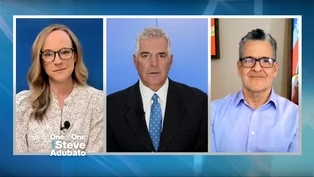
Carlos Medina talks leadership & his PBS series Que Pasa NJ
Video has Closed Captions
Clip: S2025 Ep2846 | 9m 48s | Carlos Medina talks leadership & his PBS series Que Pasa NJ (9m 48s)

Double lung transplant recipient shares her journey
Video has Closed Captions
Clip: S2025 Ep2846 | 12m 22s | Double lung transplant recipient shares her journey (12m 22s)

Uniting veterans and removing barriers to healthcare access
Video has Closed Captions
Clip: S2025 Ep2846 | 6m 38s | Uniting veterans and removing barriers to healthcare access (6m 38s)
Providing Support for PBS.org
Learn Moreabout PBS online sponsorship
- News and Public Affairs

Top journalists deliver compelling original analysis of the hour's headlines.

- News and Public Affairs

FRONTLINE is investigative journalism that questions, explains and changes our world.












Support for PBS provided by:
One-on-One is a local public television program presented by NJ PBS