One-on-One
Judy Persichilli; Tom Moran; Jo Renee Formicola
Season 2021 Episode 2402 | 27m 36sVideo has Closed Captions
Judy Persichilli; Tom Moran; Jo Renee Formicola
Judith Persichilli shares the lessons learned by Dept. of Health throughout the pandemic and the importance of the federal government in funding vaccine manufacturing; Tom Moran talks about the Jan. 6th Capitol riots, tribalism in the media and his thoughts on Gov. Murphy’s leadership; Jo Renee Formicola discusses the future of our democracy and the importance of trusting the voting process.
Problems playing video? | Closed Captioning Feedback
Problems playing video? | Closed Captioning Feedback
One-on-One is a local public television program presented by NJ PBS
One-on-One
Judy Persichilli; Tom Moran; Jo Renee Formicola
Season 2021 Episode 2402 | 27m 36sVideo has Closed Captions
Judith Persichilli shares the lessons learned by Dept. of Health throughout the pandemic and the importance of the federal government in funding vaccine manufacturing; Tom Moran talks about the Jan. 6th Capitol riots, tribalism in the media and his thoughts on Gov. Murphy’s leadership; Jo Renee Formicola discusses the future of our democracy and the importance of trusting the voting process.
Problems playing video? | Closed Captioning Feedback
How to Watch One-on-One
One-on-One is available to stream on pbs.org and the free PBS App, available on iPhone, Apple TV, Android TV, Android smartphones, Amazon Fire TV, Amazon Fire Tablet, Roku, Samsung Smart TV, and Vizio.
Providing Support for PBS.org
Learn Moreabout PBS online sponsorship- [Narrator] Funding for this edition of One-On-One with Steve Adubato has been provided by RWJBarnabas Health.
The Robert Wood Johnson Foundation.
The Healthcare Foundation of New Jersey.
New Jersey Sharing Network.
Johnson & Johnson.
The North Ward Center.
The New Jersey Economic Development Authority.
NJ Best.
And by United Airlines.
Promotional support provided by BestofNJ.com, all New Jersey in one place.
And by The New Jersey Business & Industry Association.
- This is One-On-One.
- I'm an equal American just like you are.
- The jobs of tomorrow are not the jobs of yesterday.
- Look at this.
You get this?
- Life without dance is boring.
- I don't care how good you are or how good you think you are, there is always something to learn.
- Do you enjoy talking politics?
- No.
- People call me 'cause they feel nobody's paying attention.
- Our culture, I don't think has ever been tested in the way it's being tested right now.
- That's a good question, high five.
(upbeat music) - Hi, I'm Steve Adubato.
Welcome to a very important program with a very important conversation.
Governor Murphy likes to say, this is a woman who needs no introduction, but I'm going to give her that introduction.
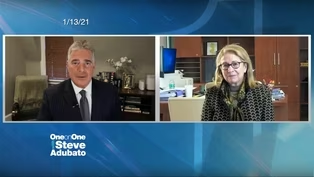
She is Judy Persichilli, who is the Commissioner of the Department of Health in the great state of New Jersey who has been along with the governor leading this effort dealing with COVID.
We're taping on the 13th of January, this will be seen later.
I'll say what I said off air, Commissioner thank you for everything that you're doing every day.
- You're welcome Steve.
Thank you for having me on - Let me ask you this, again this will be seen later in January February et cetera.
We don't know where things are going to be.
What would you say the biggest lesson you have learned as the Commissioner of Health and as a governmental leader in all this almost a year into it.
- You're right, we're almost a year into it.
And in fact it was March 4th when we saw our first case.
And I keep reminding myself and everyone here at the department, this is a novel virus.
It's something we've never seen before.
And the one thing we've learned, is that we really have to bolster up our resiliency.
This will happen again.
I hope it doesn't happen for a hundred years, but we know it will happen again.
This is a pandemic that has been predicted for a number of years.
Maybe not exactly this one, but we know that viruses are amongst us and they can take off and they can jump from species and they can end up where we are today.
And we did not have a stockpile in New Jersey, but worse we did not have a national stockpile.
So we were scrambling for equipment, for PPE, for gowns, for gloves.
We were not prepared in our state labs, public health labs or the national labs to be able to accept and turn around testing results for a new virus in a very quick period of time.
We were not prepared.
So the biggest lesson I've learned and there'll be a great after action report 'cause I have notebooks full of thoughts and ideas, is we need to always be prepared.
Our resiliency and every part of our healthcare structure needs to be bolstered, because like I said, we need to be ready for the next one.
- And in that spirit, I want to remind folks of the website, the CDC website is up.
And then as it relates to the commissioner even though she deals with the CDC all the time, the COVID19.NJ.gov/Vaccine, correct Commissioner?
- Yes.
- So, let me ask you this.
The role of public health in all this.
Again, you want to check out what's going on every day.
The commissioner is on all the time with the governor on NJ Spotlight News, MetroFocus, our public television partners, check out what's going on every day.
This program will be seen later.
The role of public health.
How do you believe it will be changed forever because of this pandemic Commissioner?
- I think it's another lesson that we've learned of the public health infrastructure out in our communities.
It has really been decimated over the years.
No one pays attention to it.
You have a measles outbreak and it makes headline, and then it fades away.
What they do every day at our local health departments to make sure that our environment is safe, to make sure that outbreaks are mitigated and contained in a very quick period of time.
They're saving lives every day.
They need more help.
We need more epidemiologists.
We need to make sure that at the local level, where all of this occurs that that infrastructure never gets back to where it was, that it has to be built up and it should be maintained.
- Let me ask you this Commissioner, as we are taping right now on the 13th of January, announcements today, the categories are changing, the specs are changing.
Go on the website, the State Department of Health website the COVID 19 website to find out exactly where things are.
But let me ask you this, the governor has been saying, and I hope that this is outdated four weeks from now, I don't know, that the supply is not what it needs to be from the federal government.
President Biden, who will be the president when this is seen and beyond, how much can a Biden administration and the federal government change the vaccine landscape in New Jersey over the next several months?
- I have to say that operation Warp Speed did work.
It did deliver vaccines within such a short period of time by putting a lot of funding all hands on deck to this virus.
I think president elect Biden, understands how important it is to, I think it's the national defense act, to reactivate that, get more money into vaccine manufacturing and making sure that there's resiliency going forward.
But the immediate need is to make sure that the manufacturers that are currently in trials for vaccine get all the help that they need to continue getting vaccines out into the public more quickly.
Right now the supply is not meeting the demand.
- As we speak-- - As we speak-- - Not what we need it to be.
- No.
No.
But as we speak, even now, we want to vaccinate 70% of the adult eligible population in New Jersey, which is 4.7 million individuals.
Or to put it more simply, about 3,500 a day need to be vaccinated in every single one of our counties.
We're not even near having the vaccine necessary to do that.
- Wow.
- But I can tell you, through the work of the Department of Health and the team here, we currently have over 259 sites ready to vaccinate between pharmacies, local health departments, federally qualified health centers.
Every single one of our hospitals have stood up, our links agencies and we will have six mega sites that can vaccinate 2 to 3000 people a day when we have the vaccine.
- Go ahead.
- We will be ready-- - I'm sorry for interrupting Commissioner, by the way we will have Governor Murphy around the one-year anniversary, we'll be taping in March with the governor.
By the way also early in March on the fourth I believe is the one-year anniversary of a very serious operation he had for cancer which was the first case of COVID and he was right on the job.
Commissioner, can you give me a minute or less on the lesson learned or the lessons learned around the decision regarding COVID patients going back into nursing homes?
- There's a lot of misrepresentation about that decision.
The decision was to return patients to their homes, which were the nursing homes to return them to the homes after they had had a stay in the hospital.
With a couple of caveats, you needed to have the appropriate staffing, the appropriate PPE and you had to be able to cohort your patients.
So in other words, all of the patients coming back had to be housed in the same wing.
That was very clear in the directive that I put out.
And it's been very misrepresented in the press and that's unfortunate, but we've learned a lesson now haven't we?
This virus is unrelenting.
It's back in our nursing homes.
We have appropriate PPE.
We have cohorting.
We have over a thousand beds to accept patients from hospitals, if nursing homes don't feel they can adequately take care of them and we still have the virus.
- Wow.
Commissioner Judy Persichilli, the Commissioner of the Department of Health, a registered nurse.
And by the way, to all the nurses and physicians and respiratory therapists, all of those on the front lines it may be, people may not call them heroes anymore but they'll always be heroes, not just in my eyes, but way more importantly in the commissioners'.
Commissioner thank you for joining us.
You honor us by your presence.
- Thank you.
Thank you so much for having me.
- You got it, I'm Steve Adubato, that's Commissioner Persichilli and we'll be right back.
- [Narrator] To watch more One on One with Steve Adubato find us online and follow us on Social media.
- We're pleased to be joined by Tom Moran, who is the Editorial Page Editor and Columnist for the Star-Ledger and NJ.com, they're tied together.
Tom, good to see you.
- Thanks Steve, good to see you.
- We're taping on the 13th of January, let's say a historic day any way you look at it, we don't know about this impeachment vote that's gonna take place, but lets talk big picture.
This show is seen a month from now six weeks from now.
What will be the significance of today in your opinion, but also January 6th?
- Well, I think that obviously the significance is that here's the United States president calling for a violent overthrow of the democratic election results.
It's something I think most of us never thought we'd see, even after watching President Trump and the way he broke norms left and right, this is head and shoulders above that.
And of course you're seeing it, Steve, right?
With a lot of Republicans who have stuck through him, stuck with him through all kinds of atrocious behavior from separating children from their parents, you know, to ignoring climate change and we could go on and on.
They're stuck with them through all that and a lot of them are breaking off now.
- Tom let me ask you this, I'm curious about it.
You know, we're in New Jersey, we're Jersey guys, a high percentage of my friends, not only voted for Donald Trump and again, the Trump presidency long-term, we'll talk about that in a second with the impact is, but no matter what he appeared to do even including what happened on the sixth and what he said around it, come on they're just words.
What do you say to people who say that words are not actions Tom Moran?
- Well, you know his words were incitement.
Incitement means using words to provoke violence.
So it's true that he didn't throw a Molotov cocktail but it's equally true that he has blood on his hands.
So I, you know the words thing doesn't particularly impress me.
- The opportunity and the challenge for Joe Biden, as we speak on the 13th, he'll be president in a few days, what's the opportunity, what's the challenge for him?
- Well, I think the main challenge obviously for him and he puts it this way, Steve right?
Is to try to unify the country, to try to put down the temperature a little bit, to find some common ground.
And when you look at polls there is plenty of common ground in this country.
We can do something about climate.
We could invest in the infrastructure we could lower drug costs.
There's plenty of things that people agree on but our leaders have been so divisive and I think it's fair to say primarily on the Republican side, that it's impossible to make deals and it feels like the country is more divided than it really is.
I think Biden needs to counter that and that's his main goal.
And I think that was his main appeal during the campaign, Steve, you know people like that.
I think people are tired of this horrifying bitterness and always this edgy threat of violence tinge with this horrifying racism.
I think people wanna get back to, okay, where do we agree?
And how can we improve our state?
Starting obviously with the virus, let's do some sensible things and moving on from there to articulate some of those items I mentioned earlier, there is common ground and I think Biden's challenges is to find it.
And now that he has control of the Senate that's a lot more possible.
- Again, we're taping on the 13th.
You look at the Star-Ledger the headline right here again, seen later, 'States of Unrest.'
So Tom let me ask you something.
It's one thing to write about politics which you've been doing for many years, check out NJ.com on the, as well as the Star-Ledger itself for Tom's columns, but NJ.com for his past work.
It's one thing to talk about politics and political deal-making and partisanship and who's agree who agrees, disagree but there are members of Congress, as we taped today who said, their vote is being influenced by their fear physically for themselves and their families unprecedented in our history.
- Yeah, Mikie Sherrill, you know freshmen from Northern New Jersey said that she saw other members of Congress giving, helping the rioters prior to the riot sort of recon the House and where the offices were, that they would seek out to attack.
And we'll find out more about that but it's just shocking, Democrats insisted of putting new x-ray machines up to access the house floor so that members what go through in case they're packing glocks as some of them say they are.
I mean, we're in a, we have crossed over into a pretty strange zone.
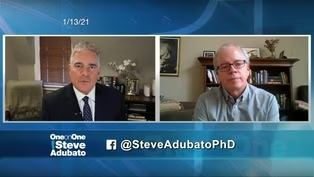
What's tough about it in particular for people like you and me, Steve who try to foment the reasonable national discussion is that the tribalism has made it impenetrable, people aren't really listening to arguments as much as they used to.
It feels people are embracing their gut feelings and their identity And they're not really thinking things through a lot.
- So let's stay on that, tribalism, not just among citizens in our series Democracy at a Crossroads, you'll see it there on the screen, tribalism in the media.
There are people who've said things about you Tom Moran online and about me because they think they know who we are and what we believe and they actually, many of them believe that we are "The enemy of the people".
Does this go with the territory or is there something different about that?
Because if people, there's a question here, trust me, if people are just gonna go to the sources of information that reinforce what they already believe, what's the point of reading Tom Moran?
What's the point of watching public broadcasting?
Let me just go to what I believe in that tells me I'm right.
Am I oversimplifying it, Tom?
- No, I think for a certain percentage of the population, that's exactly right.
The level of anger on the right has been intense prior to Trump, I think it really took off with the tea party in 2010 but it's reached a crazy level now.
And now I many more of the notes I get now are just incoherent and contrary to the facts.
Many of the anger notes, but I mean this has been brewing, Trump didn't invent this.
He just threw some more gas on it and you know, he of course has focused his fire on us Steve and the media as the enemy of the people all along.
It's a lot easier if you're going to be tribal, you can't really be open to factual challenges to your point of view, that just doesn't work.
It's more emotional.
So you take those facts and you attack the source of those facts and so they're coming at us.
- So interesting the term that way back in the day Kellyanne Conway from New Jersey use, (clearing throat) "Alternative facts," go ahead Tom, alternative facts.
We just, we just have different facts, Tom.
- Yeah, it's quite simply, it's obviously there's no such thing, but yeah, I and my circle of friends and my poker group we've taken to just making things up 'cause we figured if you can't beat them join them.
So if I lose a hand and say, "No I won that game, I had three Queens."
And you try to live your life like that, it's obviously insane, but we're governed by a president for a few more days who does.
- As we speak right now, again it'll be seen after that.
Real quick give me this, Phil Murphy, we'll be interviewing him soon at around the one year anniversary of COVID hitting in New Jersey and a serious operation he had for cancer.
Let me ask you, how has Governor Murphy doing in your view on the most substantive issues that our state faces?
Got a minute left.
- I'd go about a B minus.
I think he's gotten a lot of things done, like the marijuana bill, he's made some progress on issues that he came in on the minimum wage on you know, most of the things he's made progress on though, in my opinion are pretty easy kills with a democratic legislature.
They're gonna approve raising the minimum wage and Murphy, I don't think has done anything to sort of challenge the democratic base and he needs to do that because our fiscal situation is out of control.
It's gotten even worse on him that it was under Christie and that's going back before the COVID hit.
He's not responsible about that and so therefore he can't really push his progressive initiatives like free community college.
He can't do that because he's out of money.
Police officers are retiring with $300,000 in unused vacation time.
Yeah I don't think he's been serious about that.
I think he's sort of gone with the flow with Democrats.
On the other hand, I like a lot of what he's done.
- Complex stuff and that's why you should check out Tom Moran in the Star-Ledger.
He's the Editorial Page Editor, been a columnist there for more than a few years.
Go on NJ.com see his back material as well as his columns.
Hey Tom, thank you so much for joining us.
We appreciate it.
- Okay, appreciate the invite.
- You got it, we'll be right back right after this.
- [Narrator] To watch more One on One with Steve Adubato find us online and follow us on Social media.
- We are honored to be joined by our good friend, Dr. Jo Renee Formicola, Professor of Political Science at Seton Hall University.
Good to see a doctor.
- Good to see you too.
- So we're taping on the 13th of January.
This will be seen January, February and March.
Joe Biden will be president when this is seen.
But today is a very historic day.
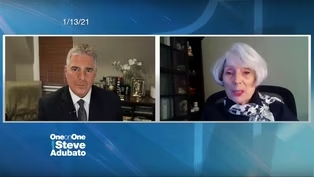
Assume for a moment that President Trump is in fact impeached for the second time by the house.
who knows what happens in the trial and the Senate.
Why is today such an important day in American democracy?
- Well, I think it's important because it's pretty much going to decide where we're gonna go in the future.
It's a way by which we decide, are we gonna move forward together or are we gonna continue in a situation where everything is just so totally divided that we can't bring ourselves together.
This is a test of what kind of people we are, what kind of a government we have, what our institutions are about.
All of that's on the line today.
- Doctor, when you were... You've been with us so many times and you're such a respected scholar in the field of democracy, representative democracy.
I happen to have in front of me is, you know, you don't need the pictures to remember.
On January 6th, as you watched what was going through your mind and your heart?
- A whole lot of things.
I, you know, I've, I'm an older woman.
I don't want to date myself but I have seen some pretty terrible things happen in this country.
I saw Washington DC being burned down when Martin Luther King was shot.
My school, where I was teaching at that time was used used as a bivouac area with helicopters coming in to try to restore order in the city of Washington, DC.
I've seen some pretty terrible things happen but this was really more of a shock because it wasn't just an attack on a neighborhood or a street or a small group of people.
This was an attack absolutely on the most powerful structures of our government and what they represented and therefore it made it shocking and upsetting.
It made me angry.
I was pretty much stunned.
And I'll say I been a professor for 35 years.
I've been involved in local politics.
So pretty much seen most of it but this was a bridge too far just too much to try to absorb - But because we're taping on the 13th of January and because there are threats of violence and we don't know what's gonna happen.
And I hope that those threats do not manifest themselves into anything beyond that.
But we don't know.
Let me ask you, what do you believe this kind of insurrection and threats of violence with members of Congress saying that they potentially would have their votes influenced by their fear of physical violence against them and their families.
Not to mention members of the media and others who have been called the enemy of the people and have been attacked by certain folks who believe they have a first amendment right to express themselves in that way.
The question here is as I see it, do you see an end to this violence?
Or do you believe that this is what the future holds?
- This isn't what the future has to hold but it's what the future can hold.
And I understand everyone wants some sort of understanding, explanation, accountability, transparency.
Everyone has a right to expect that and every rational person wants that.
The question simply is what is the means to that end?
How are we going to do that?
Are we going to do that in a way where we continue to pit ourselves against each other?
Or are we gonna try to find some sort of common ground where we can work to repair this country?
- Do you believe Joe Biden...
I'm sorry for interrupting that phone call.
To what degree do you believe President Biden has the opportunity and further the ability to help if not bring us together the way we would want to heal things just a little bit more than the way they are polarized right now?
- I'm a political scientist and so I always try to look at the story behind the story, okay?
He has the potential to bring this country together.
It's going to be his greatest challenge.
It's going to be how he secures his place in history or infamy, whichever the case may be.
But clearly this is what every president deals with which is a kind of like an X factor, not something you expected or anticipated.
Who expected 9/11?
I mean these kinds of things happen and this is where you either rise to greatness or you just fall on your face, but he has the potential of being, you know, he hasn't done anything that has made him irrevocably unable to deal with this.
He hasn't said anything or done anything or cut off his leg.
He still has the possibility.
- Dr. Formicola if people don't trust the outcome of elections, Stop The Steal.
This is a scam.
Millions of votes were hid, whatever.
Not just about 2020 election, but beyond.
If millions of Americans believe the 2020 election was stolen.
What does it mean for future elections and our system of representative democracy?
- Pretty simply, I think it says either we reform or we die.
And there were so many things that need to be reformed in this country.
From things like term limits, election reform, the way we fund organizations, PACs, financing.
I mean, I could just go on and on.
And we can't believe that the government that was set up 250 years ago is completely and totally responsive to the new context of the things that we face today.
The founding fathers weren't anticipating big tech.
I mean, well, now we're looking at questions that didn't exist 50 years ago.
We're looking at potential censorship.
We're looking at first amendment questions.
And, you know, we spent some time today looking at the McCarthy hearings.
- Few seconds.
Go ahead, doctor.
- Okay.
The McCarthy hearings, because there you saw the red scare and the reaction of people to communism and investigations, fears, blackballing people, denying them jobs, et cetera.
But you know what, the same thing is happening now except on the other side, I mean, what you're seeing, people are being tarred with recriminations because of what happened in this last event.
And so we have to be very careful that we don't react the same way as we did 50 years ago.
- And by the way, as we thank Dr. Formicola, check-out United States Senator Joseph McCarthy and the McCarthy hearings it speaks volumes about our nation and our history and what we can never go back to and also want to disclose that Seton Hall University is an academic underwriter of our programming.
Dr. Formicola, I want to thank you so much for joining us.
Best to you and your family and the family at Seton Hall.
- Okay.
Thank you so much.
- You got it, I'm Steve Adubato.
Thank you so much for watching.
We'll see you next time.
- [Narrator] One-On-One with Steve Adubato has been a production of the Caucus Educational Corporation.
Funding has been provided by RWJBarnabas Health.
The Robert Wood Johnson Foundation.
The Healthcare Foundation of New Jersey.
New Jersey Sharing Network.
Johnson & Johnson.
The North Ward Center.
The New Jersey Economic Development Authority.
NJ Best.
And by United Airlines.
Promotional support provided by BestofNJ.com And by The New Jersey Business & Industry Association.
- [Narrator] If you need to see a doctor, RWJBarnabas Health has two easy ways to do it from anywhere.
You can see an urgent care provider 24/7 on any device with our Telemed app, or use our website to book a virtual visit with an RWJBarnabas Health medical group provider or specialist.
Even as a new patient, you've taken every precaution.
And so have we.
So don't delay your care any longer.
RWJBarnabas Health.
Let's be healthy together.
Examining Tribalism in the Media
Video has Closed Captions
Clip: S2021 Ep2402 | 9m 53s | Examining Tribalism in the Media (9m 53s)
The Impeachment of Trump and the Future of Our Democracy
Video has Closed Captions
Clip: S2021 Ep2402 | 8m 55s | The Impeachment of Trump and the Future of Our Democracy (8m 55s)
NJ Dept. of Health Commissioner Discusses the COVID Vaccine
Video has Closed Captions
Clip: S2021 Ep2402 | 9m 43s | NJ Dept. of Health Commissioner Discusses the COVID Vaccine (9m 43s)
Providing Support for PBS.org
Learn Moreabout PBS online sponsorship
- News and Public Affairs

Top journalists deliver compelling original analysis of the hour's headlines.

- News and Public Affairs

FRONTLINE is investigative journalism that questions, explains and changes our world.












Support for PBS provided by:
One-on-One is a local public television program presented by NJ PBS