
MSP Racial Disparity/Whitmer's 2023 Budget/Olayami Dabls
Season 6 Episode 6 | 26m 46sVideo has Closed Captions
One Detroit covers MSP's racial disparity, Whitmer's 2023 budget and artist Olayami Dabls
One Detroit contributor Stephen Henderson investigates the changes being made to the Michigan State Police after an independent study show they stopped African American drivers at a disproportionately high rate in 2020. Then, Stephen and contributor Nolan Finley discuss Gov. Gretchen Whitmer's $74 billion proposed state budget. Plus, One Detroit catches up with Kresge Eminent Artist Olayami Dabls
Problems playing video? | Closed Captioning Feedback
Problems playing video? | Closed Captioning Feedback
One Detroit is a local public television program presented by Detroit PBS
MSP Racial Disparity/Whitmer's 2023 Budget/Olayami Dabls
Season 6 Episode 6 | 26m 46sVideo has Closed Captions
One Detroit contributor Stephen Henderson investigates the changes being made to the Michigan State Police after an independent study show they stopped African American drivers at a disproportionately high rate in 2020. Then, Stephen and contributor Nolan Finley discuss Gov. Gretchen Whitmer's $74 billion proposed state budget. Plus, One Detroit catches up with Kresge Eminent Artist Olayami Dabls
Problems playing video? | Closed Captioning Feedback
How to Watch One Detroit
One Detroit is available to stream on pbs.org and the free PBS App, available on iPhone, Apple TV, Android TV, Android smartphones, Amazon Fire TV, Amazon Fire Tablet, Roku, Samsung Smart TV, and Vizio.
Providing Support for PBS.org
Learn Moreabout PBS online sponsorship- [Narrator 1] Just ahead on One Detroit, Michigan State Police come up with a plan to correct racial disparities in traffic stops after a study shows black drivers are pulled over at a higher rate than other races.
Plus Stephen and Nolan debate Governor Whitmer's proposed budget for the next fiscal year.
And we'll meet this year's Kresge Eminent Artist, Olayami Dabls and learn more about the inspiration behind his unique art style.
It's all coming up next on One Detroit.
- [Narrator 2] From Delta faucets to Behr paint, Masco Corporation is proud to deliver products that enhance the way consumers all over the world experience and enjoy their living spaces.
Masco, serving Michigan communities since 1929.
- [Narrator 3] Support for this program is provided by The Cynthia and Edsel Ford Fund for Journalism at Detroit Public TV, The Kresge Foundation, Community Foundation for Southeast Michigan.
- [Narrator 2] The DTE Foundation is a proud sponsor of Detroit Public TV, among the state's largest foundations committed to Michigan-focused giving.
We support organizations that are doing exceptional work in our state.
Visit DTEFoundation.com to learn more.
- [Narrator 3] Business Leaders For Michigan, dedicated to making Michigan a top 10 state for jobs, personal income, and a healthy economy.
Also brought to you by... and viewers like you.
(upbeat music) - [Narrator 1] Coming up on this week's One Detroit, Governor Gretchen Whitmer unveils a record-setting budget for the 2023 fiscal year.
She's calling for a heavy investment in education and infrastructure.
Nolan Finley and Steven Henderson give their thoughts on the Governor's proposed $74 billion budget.
Also ahead, we'll pay a visit to this year's Kresge Eminent Artist, Olayami Dabls at his MBAD African Bead Museum on Detroit's West Side.
The visual storyteller talks about the history and significance of the vibrant assortment of beads, African symbols and artwork that fill the inside and outside of the museum.
But first up, Michigan State Police are making changes after commissioning an independent study that found African-American drivers were stopped by state troopers more than other races during 2020.
Black and Hispanic citizens were also searched and arrested more than white drivers.
Michigan State Police Director Colonel Joe Gasper, and Michigan Department of Civil Rights Executive Director, John Johnson, Jr. talked about addressing the racial disparities on American Black Journal.
(upbeat music) - I think that we're in a time in the country right now, really where all police departments need to be looking internally and externally to making sure that we're evolving and that we're demonstrating best practices.
Sometimes, when you engage in some self-reflection, you have reminder that sometimes it's not what you want it to be.
This would be one of those times where we saw some disparity that was concerning to us, and so we wanted to make sure that we understood it.
We hired the Michigan State University and partnered with them, and they did the analysis on our traffic stop data, and it was not where we want it to be.
Now we're in a time period here where we need to better understand it.
The goal of the report was to identify if there was disparity.
Clearly there is disparity.
Now, we've got an opportunity to understand why that's occurring.
- Colonel, I wonder if you were surprised by what you saw?
It's always, I think, a little jarring to see things drawn out in statistics and data, but I guess what I'm getting at is what was your sense of how this issue was playing out in the department before you saw the numbers?
- I think that when I looked at something like this and we see, in the beginning, the aggregate data, where it was, and, obviously that's something that we wanted to understand a little bit more.
I think when the numbers came out, I'm confident that our troopers are out there doing what they've been trained to do, and where the disparity is now, clearly it's concerning to everyone involved.
Now the goal needs to be to do what we can to reduce that disparity.
- Our reaction was not one of surprise, as you can imagine, as you've indicated, we've worked in these issues for decades, beginning with my role with the Detroit NAACP and surrounding suburbs of Detroit, where we identified with profiling going on in a number of areas, and it continues today.
This is not a surprise.
I do, however, must applaud Colonel Gasper for ordering, commissioning this report, releasing the data of it and owning up to what it says, and then making some recommendations as to what he sees needs to be done in order to improve the conditions in going forward.
We applaud him for that, and our department stands ready to work with him in any way that we can in order to actualize the recommendations that he's put forth already.
- Colonel Gasper, two of the things that jump out at me from the report in terms of recommendations, obviously, training of officers in some sort of sensitivity, I guess you might call it, to cultural differences, but then also, the racial makeup of the department itself.
Now, neither of those is a snap your finger kind of solution.
These are things that departments struggle with all the time.
Tell me what your approach is gonna be to those things.
- The training, that's probably an easier thing to accomplish.
We've already started to make some significant modifications in the area of training.
In the last couple of recruit schools that we've done, we have couple-hour block every week in the evening where we have the recruits, in the current environments, a virtual environment, and they sign on to a cultural competency or cultural awareness speaker.
We've had a number of speakers from various communities.
One, obviously, is from the African-American community, and it's been very insightful because, especially from a historical perspective.
That, obviously, is an important part of some of the challenge that we have here and making sure that our members are aware of that history is very important.
We are actually implementing a much more comprehensive history of policing in our recruit school, hoping to start that as soon as our next recruit school here in the next several weeks, and then offering that in an in-service capacity, too.
Then, just broadly paying attention to how do we bring in more specific training when it comes to cognitive or implicit bias?
The cultural awareness, there's a lot of troopers that may not grow up in a very culturally diverse area of the state or the country and would not have any way of really knowing some of that background, so that's an important part.
We feel really confident that we're gonna be able to be successful with that, and a huge component of that, too, is partnering with the community.
The recruiting, we're not where we wanna be, we're not where we need to be, we need to continue to try.
A big component of recruiting and getting people into the department is making sure, especially from a diversity perspective, that young people or people that are interested in coming into the Michigan State Police, that they can see themselves, not only as a trooper, but in various ranks throughout the department.
- There's a package of bills have been introduced in the legislature that would allow us to have more police accountability, so certainly, we embrace those.
In this instance, again, I just have to refer back to the study that was done by MSU and where it shows even post-stop, the level of searches that are involved with people of color significantly higher than those of other of other races.
I refer back to some of the recommendations made in the report, specifically, seven through nine, which deal with post-stop outcome results and recommending that the Michigan State Police track when searches are conducted, the outcomes of those searches, the disposition of those searches.
Also, the recommendation number 12, which wants to mesh the trooper's characteristic with the traffic stop database, so we can begin to get a profile of the troopers who are making these stops, in which they are a significantly higher a percentage of people of color being arrested than others, per the census and per other things.
Those are sort of the progressive sort of recommendations that could be embraced, that again, would bring more accountability, which is what we seek.
Again, we laud Colonel Gasper and laud his leadership and just the fact that he is reform-minded.
We're behind him all the way with that, and like him to embrace some of these other things, which will take the reforms to the level where there's, again, some accountability.
- [Narrator 1] A state budget surplus and federal pandemic relief funds are driving Governor Whitmer's proposed $74.1 billion budget for the coming year.
Among her recommendations are bonuses for teachers and frontline workers and funding increases for education and infrastructure.
One Detroit contributors, Nolan Finley of the Detroit News and Steven Henderson of American Black Journal sat down to discuss the record-setting budget.
(upbeat music) - Steve, this certainly is an unusual budget year in Michigan.
Lansing is awash in money.
They've got more money than they know how to spend between the surplus that Michigan brought in on its own and the billions of dollars in federal money that came flooding in in COVID 19 relief, so they're in an unusual situation.
Normally, we're talking about what do you cut?
What do you cut?
What do you cut?
You get the sense that these people are under a great deal of stress, trying to figure out how to spend this much money.
- (laughs) Yeah, it was really fun watching the reactions of the press corps there as the Governor was speaking and basically, she just went through every-- it was like an Oprah show, "You get a car," and "You're getting more money," and "You're getting more money."
What it reminded me of was a conversation I remember having with Rick Snyder when he was first running for governor, and he said, "There are gonna have to be some really hard choices made in the early years.
We've got this imbalance, and we've gotta take care of it."
And he said, "But once we do that, I think we can start to to really reinvest in things."
He talked about the kind of investment budgets that he thought would be possible in the out years.
Now, he never got there, but if you look at this budget from Governor Whitmer, I think it includes a lot of the things that he was talking about.
Increases into the foundation allowance for school districts, increases for higher ed.
He did say that once revenues recovered and we got out of the ditch we were in, he would reconsider things like the pension tax he imposed or the cutting of the EITC.
She's doing all of that in one fell swoop, and again, it's because there's all this money coming from the Federal Government, but it's also because the economy here is actually doing quite well, despite the COVID disruption and interruptions.
- The caution here is you have enduring money, money that's coming in through higher tax revenue, economic growth, and from the cuts that were made during the pandemic when we thought revenue would drop off a cliff.
And then there is the one-time money, the billions of dollars in COVID relief money.
It's important to keep those in two separate piles.
The enduring money, the money we expect to come back year after year after year, you could spend that on new programs, new initiatives, ongoing investments in education and infrastructure worker training, all the things that are on the wish lists for Michigan and the needs lists for Michigan.
The one-time money, which is, right now, the bigger pool, that money has to be kept separate and spent on one-time things, things that won't require sustainable funding from the treasury, because that money won't be there, and that will lead to cuts in other places or tax hikes.
One thing I don't think Rick Snyder would've done that the Governor proposes is restore the exemption on public employee pensions.
He was very clear that that wasn't just a revenue measure, that that was about tax fairness.
- Well, all taxpayers aren't created equal either, and I think the whole idea of exempting public pensions from taxes was that these are people who don't have the opportunity to make the kind of money that people in the private sector do.
They make sacrifices all the time throughout their careers to serve the public.
They're servants, and so the idea was to sweeten the pot, to incentivize people to do that more by giving them something that they could look forward to.
It doesn't make sense to have done that, especially when he gave this gigantic corporate tax break, that again, helped take revenue out of the treasury.
Think of the number of teachers who are walking away from the profession right now.
You can't get people to staff classrooms, you can't keep get people to drive buses, you can't get people to clean schools.
All of these things that we really need people doing right now that they don't want to do, taking that pension tax and getting it away from it is one thing you can do to tell people, "Hey, here's another reason to do it."
But you're right he said that he thought it was a fairness issue, and I think he was wrong about that.
- If you're gonna talk about it, you should talk about it for all retirees.
You have a lot of retirees who haven't enjoyed the sort of wages that public employees have, who are getting by on part-time jobs and getting by on what meager savings they have.
They should not have to support these folks that have benefits they don't have.
All taxpayers should enjoy something from this windfall the state has.
Probably more important, we should invest it in infrastructure and other things we have a terrific need for.
- There is a lot of money in this budget for investments in infrastructure and other things like that.
The conversation that I've been able to have with people about this budget, everybody seems to think that it's pretty particular in the way it spends the money, that it doesn't go and promise long-term spending for short-term funding, that it targets the things that are gonna be ongoing with money that we're making that, not this federal money.
I think the big question that remains is whether legislature, which is of course controlled by Republicans, who don't seem automatically opposed to these things, but have their own list of things that they'd like to do, how do you reconcile those things in an election year?
And whether you can get that through.
- I like the investment in pumping stations and trying to do something about this flooding that has plagued Metro Detroit over the last few years.
There's money in that.
I quibble with the fact that it's taken out of COVID relief money.
The COVID money should be spent on COVID relief, and the other money, as we said, there's plenty to go around.
I think there'll be a lot of give and take here.
I think the legislature will be concerned to make sure this money isn't being spent to buy votes for the upcoming election, but I think they'll come to an agreement.
- We'll see, we're outta time, but we'll talk more in the future.
(laughs) - [Narrator 1] Olayami Dabls is this year's Kresge Eminent Artist.
It's an award that celebrates lifetime achievement in art and comes with a $50,000 prize.
Dobls is well-known for transforming a neglected neighborhood on Detroit's West Side into an African-centered cultural attraction.
One Detroit producer Marcus Green visited the artist at his MBAD African Bead Museum.
(upbeat music) - I'm a storyteller, which is a title that comes out of Africa.
Most cultures who lived close to the land, they had people who told stories.
The concept of being an artist is relatively new, within the last maybe 500 years.
Prior to that, each culture had people that were there and their responsibility was to communicate through what that particular culture group called its symbols, their colors, and now, today, all of that has just been thrown into one big pot and referred to as art.
That term is deceptive because it's not art, it's more material culture than it is art.
When you're talking about material culture, you are actually talking about the culture group, the group itself, what they have left behind.
In most cultures, that which would be defined as art is destroyed if it does not serve the purpose because it's made to solicit or engage an idea or a concept, and if that's not achieved, no one would just keep it around because of the aesthetics of it.
It's my responsibility to remind people from which they came, and since I'm dealing with the African experience, it meant that for a period of, let's say, 500 years, our history, our culture, has been deliberately ignored, destroyed, or claimed by others.
It was only when I discovered African material culture, and I had to figure out what will I be able to talk about without getting sidetracked with the people being afraid of what I'm trying to introduce them to.
That's what the beads came in at.
There's no difference in the use of beads, textiles, carbon, sculpture, mask, and utilitarian items in Africa.
They all served the same purpose, so that's why I gravitated towards beads.
Now that I got these beads, how do I get people to take note?
Even the display of the beads, I have to go through an uneducation, uneducate myself because we based everything we are doing based on the European model.
The European model says that if you got a museum, things have to be presented in a certain way.
You gotta have captions, you gotta have a staff to research the caption.
I had to deal with this idea, do I wanna meet European museum standards?
Or do I want to display these beads so my people could see them?
I had to manufacture it so others could see it without me saying a word and yet communicating with them.
Then it dawned on me that the Europeans who traveled throughout Africa, all the things they deemed to be significant that they collected and stole or were given to them, there was no captions on these items.
Once I got over that hurdle, then I'm able to display the beads and where people can come in here and just enjoy the energy of having them around.
It's still me, but I'm displaying who I am to the people so they can see what I know.
I said, "Okay, I need some curb appeal.
I gotta put stuff on these buildings that would appeal to the pallet of African people."
Now I'm still using symbols, I'm using images that have been in our cultures for thousands of years.
When I began to put these images on the building, I was attracting anyone who saw them.
I said, "Okay, now I have all this in information in me.
I've spent 15 years at the African-American museum, studying the history of Africans in this country.
And I spent another 15 years studying the history of Africans on the continent.
I'm not so much concerned about legacy as I am impacting or influencing people during my own lifetime."
My concern is to make sense out of the nonsense stuff that I am in, and I'm beginning to figure my way out of, and I know that someone else will be able to unwrap some other information.
It is a continuation.
It took us about 400 years to get here, but each generation moves us even closer back to from which we came.
'Cause there's nothing else around here like this.
That means that it found the place in the community and it coexist with everything around it.
- [Narrator 1] That will do it for this week's One Detroit.
Thanks for joining us.
Make sure to come back for One Detroit Arts and Culture on Mondays at 7:30 PM.
Head to onedetroitpbs.org for all the stories we're working on.
Follow us on social media and sign up for our weekly newsletter.
(upbeat music) - [Narrator 2] From Delta faucets to Behr paint, Masco Corporation is proud to deliver products that enhance the way consumers all over the world experience and enjoy their living spaces.
Masco, serving Michigan communities since 1929.
- [Narrator 3] Support for this program is provided by The Cynthia and Edsel Ford Fund for Journalism and Detroit Public TV, The Kresge Foundation, Community Foundation for Southeast Michigan.
- [Narrator 2] The DTE Foundation is a proud sponsor of Detroit public TV, among the state's largest foundations, committed to Michigan-focused giving.
We support organizations that are doing exceptional work in our state.
Visit DTEfoundation.com to learn more.
- [Narrator 3] Business Leaders for Michigan, dedicated to making Michigan a top 10 state for jobs, personal income, and a healthy economy.
Also brought to you by... and viewers like you.
(upbeat music)
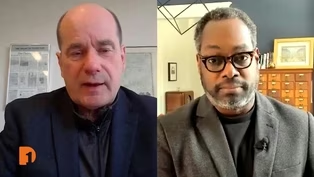
Gov. Whitmer's Record-Setting $74 Billion Fiscal Budget
Video has Closed Captions
Clip: S6 Ep6 | 7m 39s | Stephen and Nolan discuss Gov. Whitmer's record-setting $74 billion fiscal budget for 2023 (7m 39s)
Providing Support for PBS.org
Learn Moreabout PBS online sponsorship
- News and Public Affairs

Top journalists deliver compelling original analysis of the hour's headlines.

- News and Public Affairs

FRONTLINE is investigative journalism that questions, explains and changes our world.












Support for PBS provided by:
One Detroit is a local public television program presented by Detroit PBS