
Nicky Sheats, Ph.D, Esq.; Max Pizarro
5/18/2024 | 27m 22sVideo has Closed Captions
Nicky Sheats, Ph.D, Esq.; Max Pizarro
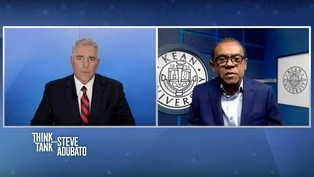
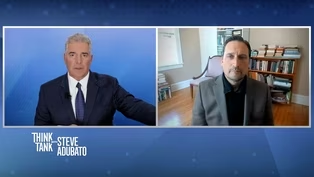
Nicky Sheats, Ph.D, Esq., Director of the Center for the Urban Environment at the John S. Watson Institute for Urban Policy and Research at Kean University, discusses combating environmental injustice in urban communities. Then, Max Pizarro, Editor-in-Chief at InsiderNJ.com, explores the end of New Jersey’s party line and its impact on upcoming elections in the state.
Problems playing video? | Closed Captioning Feedback
Problems playing video? | Closed Captioning Feedback
Think Tank with Steve Adubato is a local public television program presented by NJ PBS
Nicky Sheats, Ph.D, Esq.; Max Pizarro
5/18/2024 | 27m 22sVideo has Closed Captions
Nicky Sheats, Ph.D, Esq., Director of the Center for the Urban Environment at the John S. Watson Institute for Urban Policy and Research at Kean University, discusses combating environmental injustice in urban communities. Then, Max Pizarro, Editor-in-Chief at InsiderNJ.com, explores the end of New Jersey’s party line and its impact on upcoming elections in the state.
Problems playing video? | Closed Captioning Feedback
How to Watch Think Tank with Steve Adubato
Think Tank with Steve Adubato is available to stream on pbs.org and the free PBS App, available on iPhone, Apple TV, Android TV, Android smartphones, Amazon Fire TV, Amazon Fire Tablet, Roku, Samsung Smart TV, and Vizio.
Providing Support for PBS.org
Learn Moreabout PBS online sponsorship- [Narrator] Funding for this edition of Think Tank with Steve Adubato has been provided by PSEG Foundation.
Newark Board of Education.
PNC Foundation.
RWJBarnabas Health.
Let’s be healthy together.
Horizon Blue Cross Blue Shield of New Jersey.
Here when you need us most.
The Fidelco Group.
The Russell Berrie Foundation.
Making a difference.
Operating Engineers, Local 825.
And by The New Jersey Economic Development Authority.
Promotional support provided by BestofNJ.com.
All New Jersey in one place.
And by Northjersey.com and Local IQ.
Part of the USA Today Network.
[MOTIVATIONAL MUSIC] - Hi everyone, Steve Adubado.
We kick off the program with a compelling and important conversation about environmental justice and related issues with Dr. Nicky Sheats, Director of the Center for Urban Environment at Kean University, affiliated with the John S. Watson Institute for Urban Policy and Research.
Dr. Sheats, great to see you.
- Good to see you.
Thank you for inviting me on to your program.
- You gotta let me also share that Kean University is one of our higher ed partners, part of our series called "Urban Matters."
You'll see the graphic come up right now.
Dr. Sheats, let me ask you this, can you define environmental justice A and B?
Why this matters so much, particularly disproportionately in urban communities?
Please.
- So let me, instead of giving you a one sentence definition, Steve, let me tell you what the three key issues are in environmental justice.
The first one is a disproportionate amount of pollution that we often find in environmental justice communities.
And when I say environmental justice communities, I mean communities of color and communities with low income.
So we often find elevated levels of pollution in these communities.
And the reason why it's so important to address this, Steve, is because it is connected to persistent, recalcitrant health disparities we find in the country that are rooted in race and income.
So that's why we need to address it.
Another issue that the grassroots environmental justice movement attempts to address is the movement tries to ensure that residents of these environmental justice communities have a say in what happens in their communities, especially when it comes to environmental issues.
And third, the movement tries to ensure that the benefits produced by improving the environment accrue in these communities just as they accrue in other communities.
- Along those lines, Dr. Sheats, describe the role of the center in this important policy discussion, debate.
It's not even a debate.
This is a critically important public policy issue, please.
- So, the Center for Urban Environment, we provide support to, I referenced Grassroots environmental justice movement.
That's a national movement.
We provide support to that movement on both a state and a national level.
When I say support, I mean on both substantive issues and in building capacity, organizational capacity of environmental justice organizations.
On the substantive side, we focus on issues that include air pollution, climate change, cumulative impacts, which means how do you address multiple sources of pollution in the neighborhood, environmental justice, legal issues.
And also, as I mentioned before, increasing the organizational capacity of EJ groups.
- Lemme also share that Dr. Sheats is a leader, not just in the state, but nationally.
He's currently a member of the White House Environmental Justice Advisory Council.
The role of that council is?
- It is to advise the Biden Administration on environmental justice issues.
- Okay, along those lines, this is what I keep thinking about.
I don't wanna be self-serving about this, but there is not a whole lot of media attention, public awareness around issues of environmental justice.
Why do you think that is?
- Well, let me start off by saying I think the amount of attention that environmental justice issues are receiving has increased.
- It has increased?
- It has increased, it has increased a lot lately.
I think traditionally why that, and I'll comment more on that in a minute.
- Sure.
- But I think traditionally why there hadn't been a lot of attention on environmental justice issues is because people think of the environment and they don't necessarily connect it to justice.
They don't necessarily connect it to civil rights issues.
And the main advocates in this space have been environmental groups who were really focused on improving the physical environment.
And then the Environmental Justice Community Movement comes alone and says, wait, we need to address issues related to race, related to income.
And we're at a point now where I think the environmental justice movement has convinced folks in the environmental movement, environmental policy makers, that environmental justice issues need to be addressed.
And now we're figuring out how to address them.
Now we're trying to develop policy to address these issues.
- Along those lines, doctor, lemme ask you this.
So I've often thought about environmental issues, environmental justice issues, broader environmental issues.
But until you see it, until you experience it, until there's a crisis with our water, until there's this gray orangey plume coming across our, wait, what is that?
What could that be?
Is it dangerous to us?
What about my children?
Let's get 'em in the house.
Translation.
Is part of the challenge here that it's not an issue that grabs the public/media's attention, mainstream media, until you see it, feel it, and it's a crisis, and then often it's too late?
- That's part of the problem.
But I would say from the environmental justice point of view, a large part of the problem also is that if you're not in environmental justice communities, you don't see it as much.
Because a lot of the pollution is confined, or at least in disproportionate amounts, in communities of color and low-income communities.
So other communities don't have to face it as much.
- So hold on.
Lemme ask you this, doc, sorry for interrupting.
- No, go ahead.
- Does that mean suburban and rural legislators who don't represent the communities you're talking about right now, have you found that statewide and also you understand nationally with Congress, other policy makers on the national level, that if it's not affecting my constituents, what do you expect me, devil's advocate, what do you expect me to do if it's not affecting my community?
That's an urban representative, or legislator's, or congress member's business.
It's not mine.
That's just not true.
- And an important point you made before, it is affecting rural communities.
Not as visibly, but yes.
I think what has happened is that, because it was a lot more visible only in communities of color and low-income communities, then folks felt they hadn't, did not need to address it.
They had a buffer.
But now we're seeing that that's not true, because now we're seeing that climate change is about to affect everybody.
So no one can hide from these issues now.
But for a long time, having disproportionate pollution in communities of color in low income communities, made it at least acceptable what was happening in other communities.
It made the system all right for other communities.
But now that's no longer happening, partly because we have the environmental justice movement that's making issues more visible in our communities.
And partly because now we have a global issue like climate change that's affecting everybody.
- Dr. Sheats, how much do you think this has to do with the challenges from a public policy point of view in terms of what government needs to do, what public policy makers from all different regions across the state and nation need to do to address issues of environmental justice disproportionately in urban communities?
How much do you think it simply has to do with race?
- I'm glad you went there.
I was gonna go there if you didn't.
- Well, is there another place to go?
I mean, tell me another place to go.
- I think it has a lot to do with race.
I personally think, some of my environmental justice colleagues may not agree with this.
I think that's a lot to do with unconscious racism.
The environmental justice movement has said for a long time that one reason why there is disproportionate pollution in Black and brown communities, and low income communities, is because the lives of people in those communities have been devalued.
And so that makes it possible then, or acceptable to larger society, to have this disproportionate pollution load in environmental justice communities.
We've been saying for a long time, with the Black Lives Movement, has been saying recently and gotten a lot of attention that the lives of Black and brown people, and low income people of all colors, has been devalued to a point where the disproportionate pollution in these communities is acceptable, and it would not be acceptable in other communities.
- Along those lines, Dr. Sheats, what would you say to those watching right now who, for whatever reason or reasons, don't think a lot about these issues, don't think of themselves as engaging in racism, institutional or otherwise.
Unconscious or conscious, or otherwise.
What would you say to folks who just say, not my issue, just not my issue, who happen not to be in urban communities, Black or brown?
White folks in suburbs, what do you say to them?
- It's two things.
It's everybody's issue, because this is a systemic issue in our country.
Race has always been, I think, maybe the hardest issue to address in our country.
And we've been trying to do it for centuries.
And we still need to keep trying to do that.
This is another manifestation of a systemic problem in our country, and it's gonna take everybody to address it.
And then when you talk about environmental issues, people need to address it because there is no wall around environmental justice communities to stop the air pollution from going to other areas.
And there's nothing that's going to prevent climate change from affecting all communities.
- So again, I happen to be in Montclair, and I'm born and raised in Newark.
Newark, just a few towns away.
So folks in Glen Ridge, little tiny town up Bloomfield Avenue, Bloomfield bordering on Newark, Belleville bordering on Newark, suburban communities.
In certain cases, more affluence than others, like Glen Ridge.
They say, not my issue.
You say, that's just now.
- That it is everybody's issue eventually, and it's happening now.
Environmental issues are gonna affect everybody.
But, you know, I think more important, Steve.
- Go ahead.
- Morally from a point of view of justice, a justice perspective, that it's everybody's issue.
We need everybody to pay attention to this issue in order to solve it.
I think they have a moral obligation to help solve this issue.
And they can't accept that lives in these other communities are being devalued.
And another practical point, I think one thing that's gonna happen, it's starting to happen now.
Since we have a grassroots environmental justice movement it's not gonna be as easy to make these communities the dumping ground for our society.
Now we have an organized movement.
These communities are standing up and saying, well, no, this is not fair.
There's no law that says all this has to go in our communities.
And if it doesn't go in these communities, then the burden, the pollution burden is gonna have to be shared by everybody too.
So it's a issue that everybody is going to have to have a piece in solving.
- And along those lines, go on the website of the center to find out more about, New Jersey actually has a landmark environmental justice law.
To find out more about it, go on the website.
Dr. Nicky Sheats is Director of the Center for Urban Environment at Kean University, affiliated with the John S. Watson Institute for Urban Policy and Research, part of our "Urban Matters" series.
Dr. Sheats, thank you so much for joining us.
We really appreciate it.
- Thank you for inviting me - You guys, stay with us.
We'll be right back.
To watch more Think Tank with Steve Adubato, find us online and follow us on social media.
- Folks, we're joined once again by our good friend and media colleague, Max Pizarro, who's Editor-in-Chief at InsiderNJ.com.
We'll put up their website.
Max, good to see you.
- Great to be here, Steve, thank you.
- So many things to talk about.
You know that we don't do horse race politics per se, but we will talk about the policy implications, the significance of a couple of things.
And let's start with this, as we speak right now, the so-called party line that has existed in New Jersey, the only state in the nation that has had this practice where candidates, particularly on the Democratic side, Republican as well, but on the Democratic side, they get the party line, the party boss, the party chair in the county says, "Max Pizarro, you're our candidate, you get this spot.
You're gonna run with these people.
Adubato, you're gonna run off the line.
You're over here in ballot Siberia, can't find you."
The courts have determined, federal appeals court judge has ruled on this, and so far it's been upheld that the party line is dead for the Democrats can't use it anymore.
Why is that significant to small D Democratic...
The democratic process, A, and B, from a policy point of view, why is it important?
- I think it's significant because a lot of populist progressives who for years have lost elections off the line, Steve, now feel empowered and feel emboldened.
And this monolith that you just described of 40 organization powers signified on the ballot by the line, now is no longer all powerful or almost all powerful.
We've seen candidates in the past win off the line, namely the late State Senator Ronald L. Rice beat the machine off the line and a handful of others.
But the line has been so extraordinarily potent in our elections process of the primary.
So it does empower people who have been off the reservation, let's say.
And then the second part of your question, Steve?
I wanna make sure that I'm getting it right.
- So, the policy implications of this, so- - Yeah, I think- - Let's argue that- lemme play devil.
Max and I have a lot of conversation about politics offline, so lemme try this.
So say a legislator, someone in the state government, state legislator, a senator, lower house, assembly, there's a certain policy position they want to take or they're against a certain policy, but the party boss, the county chair of that political leader's party says, "No, no, no, no.
We don't want you to do that.
If you do that, you're off the line."
What are the implications as it relates to a whole range of issues that are dealt with or not dealt with in certain ways because of fear of reprisal from a party boss who will throw you off the line and again puts you in quote ballot Siberia, where you can't find the person.
- Right, so we just had a gas tax pass.
- That's right.
- And the bosses told the people representing the party organizations, you vote for the gas tax.
It was hustled through committee and it is...
It made it to the governor's desk.
Now, in the new environment, wherein the county organizations do not control candidates to the degree that they do now, and I'm not saying this happens next time or the time after, but eventually if this blocked voting prevails, and again, as you mentioned, this is going to play out in the court, so it's not over yet.
But if block voting prevails- - Hold on, block voting, Max, means, if Max and I are running for the US Senate along with Elvin Badger, our Director, they just block us, the three of us together, right?
That's block?
- Right, well it's a random drawing.
So if you and I are running for State Senate, let's say.
- Go ahead.
- And we're running in a primary and in the old way, one of us would receive the organization line and be on a column, right?
Yeah.
- The other one's out.
- The other one would be in Siberia, right?
- Yeah.
- Now under block voting, we are randomly drawn and we can run with the party slogans but we're not under one...
Yes, exactly.
Right, we're not bracketed under- - So it's a fair...
It's a fight, right Max?
- It's fair.
It's fair, yes.
And I think what'll happen is because that control won't exist to the degree it does now, Steve, I think there will be more populism in our governing body and it'll be harder to pass a gas tax because people who have run off the line and aren't as controlled or it'll be harder perhaps to force feed policy.
- Lemme try this one, so as we speak at the end of April, 2024, the US Senate race will play out in New Jersey.
We'll see what happens.
Big election in June, Andy Kim, Congressman Andy Kim has a sided advantage.
We'll see what happens on the Democratic side.
We'll see who the Republican nominee is to be in election November.
Do you believe any of this happens, Max Pizarro, you've been covering politics for a long time, if the first lady in New Jersey, Tammy Murphy, did not, quote, get the party line in five or six key of the 21 counties in the state.
If she hadn't gotten the line and Andy Kim had not brought this case along with others, which then went to the courts and it's being adjudicated as we speak in the courts, we know where it is based on what Max just said.
Does any of this happen if Tammy Murphy doesn't get the party line, who is now obviously not running for the US Senate any longer?
Or, am I making too much of that, Max?
- Steve, I love the question.
And I think that Tammy Murphy running for the US Senate seat is emblematic of a party organization or a process that has lost its way.
That has become disconnected from the ground game of real people and real voices, and candidly real party organizations because we saw a lot of party organizations push back.
So in a sense, Tammy Murphy was the straw that broke the camel's back.
If it wasn't Tammy Murphy, based on the performance of the bosses and looking out for themselves and not their party organizations and not the primary voters, something else would've come up to push this issue, that's my belief.
This just happened to be the issue at this time.
It was an overreach of power, Steve.
- Right.
- And with wise leadership in those positions with leadership that is primarily concerned with the party organizations, you wouldn't have this abusive power.
But this abusive power that is the belief that the wife of the governor should be senator, because that will benefit me, it'll benefit my lobbying interests, it'll benefit my private interests not the public interest, that in this case, proved to be just too much.
Particularly Steve, on the heels of the meltdown, the corruption meltdown of Senator Bob Menendez - Talk about Menendez and P.S.
the governor has said, Governor Murphy has said, "Too much has been made of the party line issue."
People can decide for themselves whether the governor is right or not on that.
But you mentioned Senator Menendez.
He runs, he doesn't run, we don't know, we're not doing horse race politics.
Bigger picture, and we also don't know how the trial's gonna play out, innocent until proven otherwise.
Question Max, what do you believe the legacy of Senator Menendez who has served in the Lower House in the State Legislature, in the State Senate, then in the House of Representatives, and now as the Senior Senator in the great state of New Jersey, what do you believe his legacy will be?
And is this it- - So, Steve, I- Right, so I should point out that these are allegations, right?
- They're allegations.
- If in fact this proves...
If this proves to be true and he is in fact convicted, I think his legacy is that he's the smartest man ever to have done the dumbest thing in New Jersey politics, which is just lose his mind and go off the rails.
And he was an extremely intelligent public official who was one of our most- - The Head of the Foreign Affairs Committee and the Head of- - Yeah.
- The Foreign Affairs Committee in the US Senate, - Right, that's right.
So this is a person who was intimately involved in American foreign policy around the world.
- Max, I would be remiss if I didn't ask you this.
We've had Senator Bramnick on, State Senator Bramnick, Mayor of Jersey City, Steve Fulop, we're having Jack Ciattarelli, all these folks are running for governor in 2025 in New Jersey.
Having Jack Ciattarelli, his third time running, Ras Baraka, the Mayor of Newark, running for governor for the first time.
We'll have every candidate who matters, Democrats, Republicans on the issues.
Max, lemme ask you something.
Senator Bramnick came on and made it clear that he would not vote for Donald Trump.
He does not believe the Republican Party is the party of Donald Trump and he abhors the persona, the public persona of Donald Trump.
Do you believe Senator Bramnick is right or he is wrong?
Is the Republican party the party of Donald Trump?
- I think we're gonna find out next year, Steve, and I want to answer your question directly, but I do think that when you look at Ciattarelli, who is affiliated with Trump and supports Trump's presidential candidacy versus Bramnick who does not, who vociferously opposes it, what'll happen is if Trump becomes president this year, you will see Ciattarelli emerge as the clear favorite to get the Republican nomination for governor next year.
If Trump loses, Bramnick will then be the favorite.
- Really?
- Because... Yeah, I think so because I think that Bramnick will be able to make the case, and this goes back to your question.
He'll be able to make the case that Republicans have aired and affiliated with Donald Trump to such a degree that the party needs to start over.
Here's Donald Trump, who lost the presidency, and can't win back the presidency.
And so the Republican party needs to begin anew and Bramnick will be uniquely positioned to make that case and Ciattarelli will not.
- And I don't want, again, I said it when I wasn't gonna do a horse race, but we'll see if there's another candidate who enters the race on the Republican side as well.
Let me let you go on this, Max.
I haven't talked about this, United States Congressman Tom Kean Jr, We used to have him on all the time when he was a State Senator, haven't seen him out much.
Doesn't hold public meetings, town meetings, as far as I know.
Not a lot of media access, but he's a United States Congressman.
Why does that matter that I wanna talk to him, that other journalists wanna talk to him and ask him policy questions where he is on certain issues, why, why not?
He's just not doing it.
Why does that matter, Max?
- It matters because we have a Congressman who's made a calculation that shunning the media actually improves his chances in the MAGA dominant Republican party.
- But that's not who he's been his whole public life, Max.
- He'll be able to or what What he can rationalize is that he's just blending into the background and that's not leadership, Steve.
Back to the point of your public life, your work, the book you wrote on this subject, Tom Kean Jr. is unfortunately turning his back on the leadership example of his own father, who actually got Democrats to go in his direction when he was governor of his state.
And unfortunately, Kean Jr. is allowing the MAGA wing of the Republican party to make him a non-entity.
- Max Pizarro is Editor-in-Chief at InsiderNJ.com, one of our longtime media partners, Max, thanks my friend.
- Thank you so much, Steve.
- I'm Steve Adubato, that's Max Pizarro, we'll see you next time.
- [Narrator] Think Tank with Steve Adubato is a production of the Caucus Educational Corporation.
Celebrating 30 years in public broadcasting.
Funding has been provided by PSEG Foundation.
Newark Board of Education.
PNC Foundation.
RWJBarnabas Health.
Let’s be healthy together.
Horizon Blue Cross Blue Shield of New Jersey.
The Fidelco Group.
The Russell Berrie Foundation.
Operating Engineers, Local 825.
And by The New Jersey Economic Development Authority.
Promotional support provided by BestofNJ.com.
And by Northjersey.com and Local IQ.
- I’m very grateful that I’m still here.
- That’s me and my daughter when we went to celebrate our first anniversary.
- With a new kidney I have strength.
- They gave me a new lease on life.
- I’m still going everywhere and exploring new places.
- Nobody thought I was going to be here, nobody.
- I look forward to getting older with my wife, that’s possible now.
- [Narrator] We’re transforming lives through innovative kidney treatments, living donor programs, and world renowned care at two of New Jersey’s premiere hospitals.
- They gave me my normal life back.
It’s a blessing.
- [Narrator] RWJBarnabas Health.
Let’s be healthy together.
Combating Environmental Injustice in Urban Communities
Video has Closed Captions
Clip: 5/18/2024 | 14m 1s | Combating Environmental Injustice in Urban Communities (14m 1s)
Insider NJ Editor-in-Chief Examines New Jersey's Party Lines
Video has Closed Captions
Clip: 5/18/2024 | 13m 13s | Insider NJ Editor-in-Chief Examines New Jersey's Party Lines (13m 13s)
Providing Support for PBS.org
Learn Moreabout PBS online sponsorship
- News and Public Affairs

Top journalists deliver compelling original analysis of the hour's headlines.

- News and Public Affairs

FRONTLINE is investigative journalism that questions, explains and changes our world.












Support for PBS provided by:
Think Tank with Steve Adubato is a local public television program presented by NJ PBS