NJ Spotlight News
NJ Spotlight News: June 23, 2025
6/23/2025 | 26m 46sVideo has Closed Captions
Watch as the NJ Spotlight News team breaks down today’s top stories.
We bring you what’s relevant and important in New Jersey news and our insight. Watch as the NJ Spotlight News team breaks down today’s top stories.
Problems playing video? | Closed Captioning Feedback
Problems playing video? | Closed Captioning Feedback
NJ Spotlight News is a local public television program presented by THIRTEEN PBS
NJ Spotlight News
NJ Spotlight News: June 23, 2025
6/23/2025 | 26m 46sVideo has Closed Captions
We bring you what’s relevant and important in New Jersey news and our insight. Watch as the NJ Spotlight News team breaks down today’s top stories.
Problems playing video? | Closed Captioning Feedback
How to Watch NJ Spotlight News
NJ Spotlight News is available to stream on pbs.org and the free PBS App, available on iPhone, Apple TV, Android TV, Android smartphones, Amazon Fire TV, Amazon Fire Tablet, Roku, Samsung Smart TV, and Vizio.
Providing Support for PBS.org
Learn Moreabout PBS online sponsorship>> funding for NJ Spotlight News provided by members of the New Jersey Education Association, making public schools great for every child.
RWJBarnabas Health, let's be healthy together.
New Jersey realtors, the voice of real estate in New Jersey.
More information is online at NJrealtor.com.
And Ørsted, committed to the -- committed to delivering clean, reliable, American-made energy.
Joanna: Tonight on NJ Spotlight News, the U.S. strikes three Iranian nuclear facilities.
Iran retaliates, targeting the largest U.S. military base in the Middle East.
What comes next in this escalating conflict?
>> The obvious things would be to destroy key U.S. forces.
A lot of the signaling out of Washington is don't do it, if you do we will continue to strike.
Joanna: Mahmoud Calio is free.
The high-profile activist at the heart of a high-profile deportation fight is finally released from ice detention.
Also the state braces for rising temperatures with many counties offering cooling centers to offer relief.
>> The program we have includes community transportation, so we are able to pick up seniors, bring them to the cooling center, and get them home.
There is limited outdoor exposure.
Joanna: New numbers shown New Jersey as having success bringing down the number of C-section deliveries.
What it means for maternal health outcomes.
>> Many states saw their rates stay the same or decrease while New Jersey saw a big decrease.
Something is going right in New Jersey.
Joanna: NJ Spotlight News begins now.
>> from NJPBS Studios, this is "NJ Spotlight News" with Briana Vannozzi.
Joanna: Thanks for being with us tonight.
I am Joanna Gagis in for Briana Vannozzi.
The big headline, the United States military conducted an air strike on Iran's nuclear weapon program, striking three nuclear facilities.
Iran responded today by firing at a U.S. military base in Qatar , the largest insulation in the Middle East.
Iranian officials gave warning before firing, signaling a more symbolic strike than actual escalation, at least at this point.
The FBI is warning of the possibility of Iran retaliating here on American soil.
Some members of Congress, including New Jersey Congresswoman and gubernatorial candidate Mikey Cheryl, criticized America's airstrikes, saying the U.S. should have engaged in diplomacy instead.
Some are calling for the impeachment of President Trump, which has brought criticism from the members of both parties, since the president does have the authority to carry out a targeted strike.
Republican gubernatorial candidate Jack Ciattarelli spoke out in support of the attack, calling the president's actions the right move.
What comes next?
I'm joined by Michael Boyle, Professor of political science at Rutgers University, to add some clarity.
Great to have you with us.
Want to talk to you about the impact of the strikes over the weekend.
What do we know about whether we have decimated Iran's nuclear capabilities?
>> The short answer is it's not clear.
U.S. and Israeli intelligence have suggested we have done substantial damage, probably set the facilities 3, 2 years back.
The real question is whether Iran was able to move important material in advance of the strike.
There is evidence to suggest they pulled out some of the highly enriched uranium, not that they could make a bomb, some of the fuels.
They were not able to remove centrifuges because they are fixed to the floor.
It's not clear that this strike, although it was large, got rid of all their material.
It's an open question about whether there is a fourth facility.
There are three facilities we have focused on, one that drew the most attention because it was the U.S. that did that strike.
Iran has been talking for a while that they are building a fourth facility.
Whether we have eliminated Iran's nuclear weapons program, my estimate is probably not.
Set it back years, forced them to move materials, but the question is whether air is a facility deep underground that has not been struck.
Joanna: So much of this attack was the element of surprise and capabilities we had to reach underground bunkers.
How do we assess given there is no more element of surprise?
Iran is prepared.
How do we assess the damage?
>> Very difficult.
There are teams on the ground, Israeli and U.S. intelligence is attempting to work through what's been happening.
There is also an attempt to study what parts of the facilities were destroyed, whether there is any evidence of radiation leaks or anything we can tell about the explosion on the basis of what we have heard.
It will be a long-term process to reconstruct how much damage was done to Iranian nuclear facilities.
This will set them back two or three years.
It's going to be difficult to quickly recover.
But it's a long-term question whether this is a devastating blow that takes four to five years or whether they can recover in a year or two years.
Joanna: In the meantime, folks at home are watching to see what type of retaliation might calm.
Iran has promised retaliation and we know there is risk to folks and military bases overseas.
What are the potential risks we face here and overseas?
>> Overseas is the greater risk than domestic United States, although you can't rule anything out.
Iran has a number of options.
The first is to use local militias where it has deep links, for instance a group like Hezbollah to strike U.S. military bases in Iraq.
They have the capacity to do this.
For a long time they were building the axis of resistance, Syria as well as collections of militias in countries that were assets for them.
The obvious thing for them to do would be to destroy key U.S. forces.
A lot of the signaling out of Washington is don't do it, if you do we will continue to strike and that will lead to your disadvantage.
The other possibility is they could close the Strait of Hormuz, very important for oil shipping.
It will affect the price of oil.
20% of the world oil goes through the Strait of Hormuz.
The interesting part, if they were to do that, if they shut the shipping down entirely or the oil shipments, that would hurt China more than the United States because the U.S. has diversified away from the Middle East to suppliers in Mexico and Venezuela.
Joanna: What is the potential of this escalating?
You mentioned the United States has warned if you attack military bases, we will escalate.
Does this have the potential to draw in some enemies, Russia, China?
At what point does Congress need to get involved?
I know that's a multipart question but what is the risk of this escalating?
>> There is a clear risk of escalating on the ground.
We have discovered there is a fourth facility.
Israel is continuing the attacks today to degrade the military structure.
The second escalation comes from the incoherence of U.S. warplanes.
Are we degrading their facilities or doing regime change?
It depends -- depending on what you read, Trump's Twitter account or something else, you get different answers.
That makes escalation very likely.
Russia and China both have a limited ability to shape this on the ground.
Russia is a leader in the Ukrainian war, China is reluctant to get involved in a shooting war in the Middle East.
Both are worried about the consequences of this escalating across the Middle East but I don't see them directly getting involved.
Joanna: We will be continuing this conversation as this unfolds.
Thank you for being with us tonight.
Another big headline, Mahmoud Khalil, the pro-Palestinian protester who was arrested and detained by ice in early March, has been released.
The case brought national attention when he was arrested at his home on the campus of Columbia University, where he protested a year earlier.
Federal officials said his actions had potentially serious adverse foreign policy for the U.S. His student visa was revoked and he was taken to a detention center before being moved to Louisiana where he is being held the last three months, missing the birth of his first child.
Attorneys filed his case in federal court in New Jersey, arguing he was targeted for criticizing the Israeli government.
On Friday the federal judge did order release.
A White House spokesperson said there is no basis for a federal judge in New Jersey who lacks jurisdiction to order release from a detention facility in Louisiana.
Even though he is free, Khalil had to turn over his documents and must attend all court hearings and still faces the risk of deportation by the Department of Homeland Security.
New Jersey implemented a language access law in January 2024 to help non-English speakers access state services.
It requires agencies to offer translation and interpretation in the five most commonly spoken languages in the state by January 2025.
We are six months past that and a new report looking at 14 state agencies showed almost all have failed to implement the language services by the deadline and some are offering no language services at all.
Only two got a passing score, the motor vehicle commission and the division of civil rights in the Attorney General's office.
Advocates are urging state leaders to boost funding and staffing to get the lawfully implemented because by January next year, the log requires translation in seven languages.
We are only a few days into the summer and a heat wave has slammed the state.
A dangerous situation for New Jersey residents.
Two dozen people had to be treated for heat related illness during a high school graduation ceremony in Patterson.
Four were taken to the hospital and the ceremony ended early.
Across the city of Patterson, more than 100 people were treated for heat exposure.
The high temperature is coming for air quality concerns.
Raven Santana has more on those alerts, who is most affected, and how communities are responding to the extreme heat.
>> We are in the early stages of a heat wave destined to last through Wednesday.
Raven: A heat wave is gripping New Jersey with temperatures past 90 degrees across the state.
The National Weather Service issued extreme heat warning for multiple counties through 8:00.
State climatologist David Robinson says temperatures could reach 100 degrees tomorrow.
Our cup is this early?
It is.
If we threaten the 100 degree mark the next couple of days, that's something rarely achieved in June.
More common as you get into July and early August.
Raven: In addition to the heat and air quality, action day for O-Zone has been declared today.
Sensitive individuals including the young, elderly, and persons with respiratory diseases such as asthma should avoid strenuous activities during the afternoon and early evening.
Robin said the intense heat isn't just uncomfortable, it can be dangerous.
>> Your body doesn't get a chance to recuperate at night when the night stays so warm.
That's the danger for people who don't have air conditioning.
Raven: Which is why Bergen County has opened several emergency cooling centers.
Anthony is the Deputy County administrator for Bergen County.
He says the county has five cooling centers open for extended hours as well as a fleet of transportation vehiclesy during theh heat waveb [INDISCERNIBLE] [INAUDIBLE] 4 -- the heatwave.
>> The plan includes community transportation, so we are able to pick up the seniors, bring them to the cooling center, and get them home.
There is limited outdoor exposure.
During the heatwave, we have extended hours in the cooling station.
We keep them out until 6:00.
Raven: Seniors I spoke with say the center also provides activities and a way to stay healthy while remaining cool during this heatwave.
>> It's a great place to stay cool because you are not just sitting there.
They have activities you can participate in.
I love the Zumba.
I love Lisa's exercise class.
We do diamond art, different kinds of painting.
It's really a great place to hang out and talk to your friends, have fun.
>> Njspotlightnews.org.
>> Do you expect it to be more crowded this week?
>> Probably.
People who don't have air conditioning will come to hang out.
I had to talk to myself because it's my age, but then you forget your age.
You want to do the things you did 30 years ago but you can't.
I said, slow down, Maria.
Don't rush, it's only a few days.
I also have a preliminary situation.
Not bad, but I have to be careful about it, so that's why I don't want to push.
>> It's estimated by the World Bank that due to increased temperatures, we are expected to have at least 21 million additional deaths that wouldn't otherwise have occurred if it wasn't such high temperatures.
Raven: The family physician making clear the deadly impact the extreme heat waves are expected to have around the world by 2050.
Heatstroke is the most dangerous related illness and can often go unnoticed.
>> A body temperature of over 105 degrees Fahrenheit, your body will kick into survival mode and will divert blood flow from your gut, from your kidneys, your muscles, your skin just to save your heart and brain.
But you can damage your kidneys permanently and people can die.
Raven: The doctor emphasizes if you suspect someone is suffering from heat exhaustion, it's important to get medical help and follow professional guidance.
Residents are urged to stay indoors between 11:00 a.m. and 3:00 p.m. when the sun is strongest and risk of sunburn and heatstroke is highest.
Joanna: Tensions abroad have spiked in the last few days.
Tensions in Trenton are also rising over a bill that would create a definition for antisemitism.
It has strong support in the Jewish community, who have experienced a rise in anti-Semitism since the October 7 attack, but Palestinian Americans and supporters say it criminalizes their support of the -- their criticism of the Israeli government.
Ted Goldberg looks at how New Jersey lawmakers are handling this controversial legislation.
Ted: For more than a year, a bill has stalled in Trenton that would adopt a formal definition of anti-Semitism.
On Monday an assembly committee switched a hearing on the bill to discussion only, with no vote at the end as originally intended.
>> I'm a bit taken aback by the decision to hold the bill for discussion.
Ted: Assemblyman Gary Scheer is the prime sponsor.
He was frustrated to see the vote was tabled.
>> As prime sponsor, it would seem that such a decision on behalf of our leadership would have included discussion with us.
>> Topics like this and a lot of other topics require robust discussion.
>> While I agree discussions are extremely important and needed for us to engage in conversation with entire body of the State of New Jersey, I feel transparency and communication is important so that when we drive down to Trenton, we are doing it fully informed of what is going to be happening.
>> Most of the bill supporters were angry and made a point to walk out of the hearing.
>> I find this process and the last-minute change to be hurtful, disturbing, and disappointing for the over 600,000 Jews who live in the great garden state.
>> The definition of anti-Semitism as devised by the international Holocaust remembrance alliance includes language calling for, aiding, or justifying the killing or harming of Jews.
It also includes language denying the Jewish people the right to self-determination by claiming the existence of a state of Israel is a racist endeavor, and any language that requires double standards by requiring a behavior not expected or demanded of any other democratic nation.
>> Whose voice?
>> Our voice.
>> some say the definition criminalizes free speech.
>> If we can say the U.S. is a racist state, we should be able to say Israel is a racist state.
>> Our community stands against anti-Semitism and hate, but this will is about silencing Palestinian voices.
>> This bill would not only further protect the policies that -- that orchestrate military and settler violence against Palestinian youth, it would suppress ability to raise awareness about it.
>> I teach students about democracy, free speech, and the importance of standing up for injustice.
This bill threatens those values by conflating criticism of Israeli government policies with anti-Semitism.
>> Judaism is a religion while Zionism is a political movement.
It has no connection.
Ted: A few supporters of the bill explained why they think the definition is needed.
>> If it is just.
>> Speech, why are Jews afraid to identify as Jews on college campuses?
With the call for the destruction of any other nation be considered free speech?
>> The definition provides clarity and gives our state a shared language to identify and can rent anti-Semitism.
>> Angry protesters have picketed outside synagogues, different cars through Jewish neighborhood, and disrupted activities on campuses.
And do it under the banners of Hamas, Hezbollah, the PLO.
Ted: A Senate version of this bill passed through committee a year ago, while its counterpart in the assembly seems stuck, despite having more than 50 lawmakers as sponsors.
I'm Ted Goldberg, NJ Spotlight News.
>> Under the dome is made possible in part by the Corporation public broadcasting, a private corporation funded by the American people.
Joanna: Nearly one in three childbirths in the U.S. happen through C-section, but as maternal and infant deaths hit alarming numbers in the U.S. and New Jersey over the last several years, there's been a major effort in the state to bring down the rate of C-sections.
It seems to be working in New Jersey.
Joining us to explain is Slawa Rokicki, who led the analysis at the Rutgers school of health.
Thanks for being with us today.
I know researchers at the Rutgers School of Public Health has been looking at the rates of cesarean section in New Jersey.
Help us understand what you are looking at and how the rates have changed recently.
>> We have been looking at the rate of low risk cesarean birth, a measure of the lady of maternal care.
In the U.S. a rate of cesarean birth has been rising.
It has gone up from 20% in the 1990's, now about a third of births are cesarean.
The worry is many of these are unnecessary cesareans.
Joanna: When you say low risk, you mean elective.
In other words, someone choosing to have a C-section rather than a vaginally birth?
>> It could be elective, it could be that the provider decided during the process of labor to encourage the woman giving birth to choose the cesarean delivery.
By low risk, I mean this measure called ntsb.
It's the first book -- first birth, a singleton, and it is full term, in the head position down.
That is the measure we look at to determine whether it's low or high risk.
Joanna: Why is the risk a concern nationwide?
>> When women have cesarean deliveries, they are at high risk of some poor outcomes.
Complications like infection were blood lots, complications of anesthesia or surgery.
Increased risk of neonatal respiratory issues as well as difficulty breast-feeding.
Emotional toll from having unnecessary surgery.
There is quite a few negative outcomes and no real benefits for these low risk cesarean deliveries.
A cesarean can be an important tool for maternal health, but in cases where it is unnecessary, it is not positive for maternal health.
Joanna: With the nurture NJ initiative at the beginning of the Murphy administration, there was a push to reduce low risk cesarean C-sections in New Jersey.
What is the state doing right to bring those numbers down?
>> that's what we have been looking at in our policy brief.
We have found a good deal of progress New Jersey has made in reducing their low risk cesarean rate from 30% in 2016 now to 27%, a 10% decrease.
It is a substantial drop compared to other states, which over this period either increased -- because COVID happened during this period, lots going on.
Many states saw their rates increase or say the same while New Jersey saw a big decrease.
There has been a range of policies that nurture New Jersey has implemented.
One of the ones is prohibiting coverage of elective cesareans in certain nonmedically indicated situations, under Medicaid, and under the state health benefit and school employees benefits program.
That's been an important factor.
There's been other policies as well.
Increasing access to do list -- doulas, who have been found to activate for their clients in reducing cesarean delivery.
Increased access to mid lives.
Midwives are associated with lower rights of cesarean delivery.
There has been quite a few different policies that have come together to result in a lower rate than we have had in the past.
Joanna: It signals a move in the right direction, although we know not all women have seen the same.
Women of color have not.
Slawa Rokicki with the Rutgers School of Public Health, thank you for that insight.
>> Support for the medical report is provided by Horizon Blue Cross Blue Shield of New Jersey, an independent licensee of the Blue Cross Blue Shield Association.
Joanna: That's going to do it for us, but you can download our podcast wherever you listen and watch any time by subscribing to the NJ Spotlight News channel, plus follow us on Instagram and blue skies to stay up-to-date on the latest headlines.
For the entire team, thanks for being without.
Have a great night and we will see you back here tomorrow.
>> NJM Insurance group, serving the insurance needs of residents and businesses for more than 100 years.
Horizon Blue Cross Blue Shield of New Jersey, independent licensee of the Blue Cross Blue Shield Association.
At by the PSEG Association.
>> NJM Insurance group has been serving New Jersey businesses for over a century.
As part of the garden state, we help companies keep vehicles on the road, employees on the job, and projects on track.
Working to protect employees from illness and injury, to keep goods and services moving across the state.
We are proud to be part of New Jersey.
NJM, we have got New Jersey covered.
>> Whatever your cancer journey, there is one place in New Jersey where our discoveries become your care.
You will have access to advanced treatments, including clinical trials thanks to our renowned scientists and multidisciplinary teams that New Jersey's only designated cancer center, the one world-class cancer program that's close to home.
RWJBarnabas health and Rutgers Cancer Institute.
Let's beat cancer together.
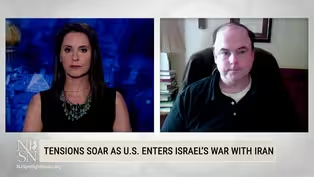
Next steps as US enters Israel's war with Iran
Video has Closed Captions
Clip: 6/23/2025 | 6m 32s | Interview: Michael Boyle, associate professor of political science, Rutgers University (6m 32s)

Vote postponed on official 'antisemitism' definition for NJ
Video has Closed Captions
Clip: 6/23/2025 | 4m 25s | Assembly bill has stalled in Trenton after more than a year of deliberation (4m 25s)
Providing Support for PBS.org
Learn Moreabout PBS online sponsorship
- News and Public Affairs

Top journalists deliver compelling original analysis of the hour's headlines.

- News and Public Affairs

FRONTLINE is investigative journalism that questions, explains and changes our world.












Support for PBS provided by:
NJ Spotlight News is a local public television program presented by THIRTEEN PBS