NYC-ARTS
NYC-ARTS Full Episode: October 26, 2023
Season 2023 Episode 597 | 27m 46sVideo has Closed Captions
A profile of Conrad Tao and a look at "Hub of the World" at the Nicholas Hall Gallery.
A profile of 29 year old Conrad Tao, a composer and pianist who has spent the last decade pushing the boundaries of classical music. Then a look at “Hub of the World: Art in 18th Century Rome,” on view at the Nicholas Hall Gallery. And a visit to the Nevelson Chapel at St. Peter’s Church, a sculptural environment created by Louise Nevelson, one of New York City’s most celebrated artists.
Problems playing video? | Closed Captioning Feedback
Problems playing video? | Closed Captioning Feedback
NYC-ARTS is a local public television program presented by THIRTEEN PBS
Major funding for NYC-ARTS is made possible by The Thea Petschek Iervolino Foundation, Jody and John Arnhold, The Lewis “Sonny” Turner Fund for Dance, The Ambrose Monell Foundation, Elise Jaffe...
NYC-ARTS
NYC-ARTS Full Episode: October 26, 2023
Season 2023 Episode 597 | 27m 46sVideo has Closed Captions
A profile of 29 year old Conrad Tao, a composer and pianist who has spent the last decade pushing the boundaries of classical music. Then a look at “Hub of the World: Art in 18th Century Rome,” on view at the Nicholas Hall Gallery. And a visit to the Nevelson Chapel at St. Peter’s Church, a sculptural environment created by Louise Nevelson, one of New York City’s most celebrated artists.
Problems playing video? | Closed Captioning Feedback
How to Watch NYC-ARTS
NYC-ARTS is available to stream on pbs.org and the free PBS App, available on iPhone, Apple TV, Android TV, Android smartphones, Amazon Fire TV, Amazon Fire Tablet, Roku, Samsung Smart TV, and Vizio.
Providing Support for PBS.org
Learn Moreabout PBS online sponsorship♪ Philippe: Coming up on NYC-ARTS, a profile of 29-year-old Conrad Tao, who has spent the last decade pushing the boundaries of classical music.
>> Improvising, at first, was just my way of being a composer before I had any sort of music theory training, I had a little mini disc recorder and a piano and I would improvise and kind of create fantasies.
It feels a little bit like throwing a stone in the water, and then observing the ripples and trying to find or follow some sort of radiating continuity, I suppose, out of that initial seed of an idea or that initial stone.
>> A look at the exhibitions already in 18 century Rome, now On View.
The exhibition priest together more than 60 works by artists who lived in, or traveled to Rome.
Knowing that time.
They include Jacinto, Piraneisi and Kaufman, and a visit to the Chapel at St. Peter's Church, the sculpture environment crated by Louise Nelson, one of New York's most subreddit artists.
>> Once you're inside, you are surrounded by her.
She was the grandmother of an bimetal art, American art, she believed in the importance of surrounded people with art.
>> Funding for NYC Arts is made possible by THEA PETSCHEK IERVOLINO FOUNDATION JODY AND JOHN ARNHOLD THE LEWIS "SONNY" TURNER FUND FOR DANCE THE AMBROSE MONELL FOUNDATION ELISE JAFFE AND JEFFREY BROWN CHARLES AND VALERIE DIKER THE MILTON AND SALLY AVERY ARTS foundation.
ELROY AND TERRY KRUMHOLZ FOUNDATION THE NANCY SIDEWATER FOUNDATION AND ELLEN AND JAMES S. MARCUS THIS PROGRAM IS SUPPORTED, IN PART, BY PUBLIC FUNDS FROM THE NEW YORK CITY DEPARTMENT OF CULTURAL AFFAIRS IN PARTNERSHIP WITH THE CITY COUNCIL.
ADDITIONAL FUNDING PROVIDED BY MEMBERS OF THIRTEEN AND BY SWANN AUCTION GALLERIES.
>> SWANN AUCTION GALLERIES.
WE HAVE A DIFFERENT WAY OF LOOKING AT AUCTIONS, OFFERING VINTAGE BOOKS AND FINE ART SINCE 1941.
WORKING TO COMBINE KNOWLEDGE WITH ACCESSIBILITY, WHETHER YOU ARE A LIFELONG COLLECTOR OR A FIRST-TIME BUYER, OR LOOKING TO SELL.
INFORMATION AT SWANN GALLERIES DOT COM.
Philippe: Good evening and welcome to NYC-ARTS.
I'm Philippe de Montebello on location at the Hispanic Society museum and library.
In the interest of truth in advertising, I should say right off the bat that I am the chairman of the board of this institution.
And I should add that having been at the Metropolitan Museum of Art for more than 40 years, I would not have chosen this position if this was not an outstanding institution in its own field.
It is located in upper Manhattan in the Washington Heights neighborhood, the Society provided free of charge access to the most extensive Hispanic art and literature collection outside of Spain and Latin America.
Here in the magnificent Main Court is an exhibition called "A Collection without Borders".
It brings together a selection of works from the Hispanic Society that celebrates the art and culture of Spain, Portugal, Latin America, Goa and the Philippeines.
Many of these works were acquired by the Hispanic Society's founder, Archer Milton Huntington Colin -- Huntington, and this was in the early twentieth century, while others were acquired through purchase or donation after his death which was in 1955.
It was the son of a railroad and shipping magnet, one of the richest men in America.
The start of his collections are found only in his private diaries, and a lifelong correspondence with his closest friend and confidant, his mother , Arabella Huntington.
It was his first trip to Europe in 1882 that started his lifelong passion for Spain and Hispanic culture.
Visits on this trip to the National Gallery in London and to the Louvre in Paris proved to be life-changing expenses that instilled in him a profound love for art and museums.
Upon his marriage to his first wife in 1897, Huntington -- Huntington's father gave the couple and estate named pleasance in Bay Chester on Long Island sound.
Huntington had a proper library, finally.
Tilting the library provided valuable, practical experience for the eventual design and construction of his Spanish museum in upper Manhattan, where we are.
Following his second marriage in 1923, to the and noted sculptor, a plan for the tradition of permanent sculpture on the terrace in front of the society today in 1927, his money mental equestrian bronze was placed in the lower terrace.
In the decades that followed, Huntington went to great lengths to ensure that the collection would be accessible to the public, and that societies -- the site -- societies library would provide unparalleled resources, which it does, for scholars interested in the Spanish and pork -- Portuguese speaking world.
A collection of Hispanic many scrubs, rigid material and scope, is the most extensive outside of Spain.
It encompasses medieval charters, Royal letters, maps of the world, sailing charts, books of ours, the Hebrew Bible, and historical and literary manuscripts from the 10th-20th century.
These include first traditions of notable works like don't Quixote.
-- Don Quixote.
Next, it Breanna Stewart spent the last decade pushing the boundaries of classical music.
The 29-year-old Conrad already has a list of the compliments too long for one introduction.
He has collaborated as both a soloist and a composer with some of the world's most prestigious orchestras, including both the New York Philharmonic and the Los Angeles Philharmonic.
In this segment, the focus is on the intimate side of Conrad's work, whether it's contemporary improvisations with a brass quartet, westerlies, or his reimagining of Goldberg variations with a dancer.
He draws connections within his diverse body of work to make one bold musical statement.
Conrad: Sometimes I think that the whole reason I ended up on the path that I am on is that I started so young that I don't remember it.
When I was 18 months old, I started picking out nursery tunes at my family's old, upright Baldwin.
And I think that things kind of snowballed from there.
Improvising at first was just my way of being a composer before I had any sort of music theory training.
I had, like, a little mini-disc recorder and I had a piano and I would improvise and I would just kind of like create fantasies.
It feels a little like throwing a stone in the water and then observing the ripples and trying to find or follow just some sort of radiating continuity, I suppose, out of that initial seed of an idea or that initial stone.
Conrad: It's not a composition in that every note has been defined ahead of time, but in the sense that there is a fairly defined form, a certain range of the piano that I want to reach, a certain cord that I know I want to reach.
How I get to that final goal can shift a lot, and that comes out of a personal desire to change things up and shouts myself, and see what else I could discover.
That is what is quite lovely about a composition that has deliberately left open room for moment to moment decision making.
Improvising with others is really different from from -- from improvising on my own, it inescapably social.
-- he inescapably social.
With the westerlies, it is simply a matter of listening very closely, pulling out tones from the air, listening -- hearing music in the environment, and trying to bring that out.
My style at the piano is informed by all kinds of music at this point.
I play the traditional repertoire a lot.
It's probably still the bulk of what I do.
I do proselytize a little bit about the value of engaging in contemporary music, because it changes one's relationship with old music.
Finding ways for the music to speak beyond what we might consider the aesthetic conventions of the genre is an expression of love for music.
It made going back to Beethoven, Mozart, Schubert, so satisfying because all of these composers are using notation in personal ways.
One working in a Schubert score means something different in a promised score.
However thing about notated music, even stuff that is densely precise, is still really informed by improvisation.
I think of every single on a score now as a window of possibility.
It is not about aiming for the single point, it's a different kind of precision.
Box variations -- Bach's variations were some of the first ones I heard and saw Caleb choreographed to.
In some ways, it is as simple as reflecting my friendship with Caleb.
But then, on some level, we are referencing the very explicit counterpoint of box music.
-- Bach's music.
>> But also the fact that the addition of tap dance layer open space for Caleb to be offering non-pitched percussive sound on top, which really works well for bock --Bach because it's rhythmically dense.
It's like anything else I'm interested in.
How can you under the historical work by offering a new gloss on it?
My most recent studio album, American rage, grew out of pieces with exquisite musical and political content in them.
Which side do you want to the letter expand by Florence Reese to the melody of an old Baptist him right after an active police intimidation.
Jeske immediately takes that melody and flings it into a blender or Kaleidoscope, it's a cacophonous sympathy -- simply need of variations.
Another thing that really drew me to the cause that they asked for an improvised cadenza, a way of building the peace to the thunderous climax.
-- the piece to its thunderous climax.
>> I feel like I am searching for a single answer to the question of what music is.
And yet, it is so obvious from the evident, diverse greatness all around us that the single answer I'm searching for would have to be a prison.
-- prism.
Finding things in relation to what I already know has been nothing but joyous and challenging in all happy ways.
And it is a -- inspiring.
>> The Nicholas Hall Gallery is located at Madison Avenue at 75th Street.
It focuses on works by European artists from the 13th through 20th century.
Currently On View is the show hub of the world, already in 18th-century Rome, which celebrates the legacy of esteemed American scholar and curator Anthony M Clark.
Considered one of the most influential museum professionals of his generation, Clark loved art from 18th-century Rome and particularly favored Italian painter Pompeo Bertoni.
It brings together more than 60 works who lived in or traveled to Rome during that time.
They included Jacinto, Piraneisi and Angelica Kaufman, bringing to life the fundamental role he played in the revival of American museums in collecting works from this.
-- time.
The expression borrows its title from ghetto.
-- Goethe, who deemed home the hub of the world, and said the entire history of the world is linked up with this city.
The works highlight Roman culture and its extraordinarily -- extra ordinary sources of artistic patronage, from Popes to cardinals to Roman aristocrats and visiting foreigners.
Clark believed in the importance of Roman art during this time, from painting, drawing and sculpture, and this passion is reflected in his writings.
As a curator, Clark created a historic context for art by showing several mediums together.
At a time when it was customary to maintain a hierarchy of the art forms and display these separately.
In collaboration with Gildea Orsi, -- Kalinina Orsi, they have gathered together many pieces arts that have provided an opportunity to experience the cosmopolitan quality of 18th-century Rome.
That includes view of the villain met at she.
-- Villa Medici.
The wonderful scotch or of the head of an angel by George Eddie -- Georgetti, and sculptures by Getzi.
The exhibition is On View at the Nicholas Hall Gallery until November 30.
Next, we visit the chapel at St. Peter's Church, a sculpture environment created by Louise Nelson, one of New York City's most celebrated artists.
Her masterwork has undergone a critical restoration and rediscovery as an oasis of peace.
Nelson considered this environment her oasis of science -- silence.
Where people find, in the middle of this incredibly busy city, some element of peace and silence.
>> Once you're inside, you are surrounded by her.
She was the grandmother of environment of Art in America.
She really believed in the importance of surrounding people with art.
>> Nevelson was one of the few women artists in the 1970's who realized public art with great success.
>> The Nevelson Chapel is the only intact environment that she ever made.
>> Louise Nevelson was born in Ukraine in 1899.
Her family immigrated when she was little girl.
Nevelson's father was a woodcutter in the old country, and once they came to Maine, he had a junkyard.
Of course, that inspired much of her work.
She would use toilet seats and bed stands and chair rails and everything that she would find on the streets of New York City, to make collages, reliefs.
That was her signature, and that is how she is best known.
She had her first breakthrough project, her first public breakthrough project in 1959 at the Museum for modern art.
Louise Nevelson was 16 -- 60 years old, it took her that long to achieve public recognition.
>> St. Peter was a neo-Gothic church that had been here a long time.
The congregation had dwindled down to 65 or 70.
It was not doing very well.
>> In the 70's, St. Peter's and Citibank came together to plan and build what was called Citigroup Center.
At the heart of that complex is Nevelson Chapel.
>> The pastor at the time was Ralph Peterson.
They wanted decorated interfaith chapel, and they were approached by pace gallery.
They said look, there's 1% for the art, quite a lot of money available for the arts.
And they knew Nevelson's work and reputation and wanted her to do it.
And Peterson knew her work also and really liked it.
The works in the chapel are not the kind of found objects, whether furniture something she found on the street.
They were shapes made to order for her.
>> Nevelson was Jewish by birth.
This is not a specifically Christian space, it's a very spiritual space.
>> I want to read you some quotes from her, because she wants to say something about how she saw her spirituality.
Abstraction allows me to transcend Christian imagery to the essential point where all religions meet.
Each element forms a hole in it self.
A deliberate expression of joy and human warmth.
For me and my work, this is a state of purity and truth.
>> The fact that they are doing a restoration would be something that Nevelson would 100% approval.
She always wanted her work to look as fresh as possible.
>> There are two major elements of the restoration for Nevelson Chapel.
The first is to deal with problems with the environment, introducing a dedicated HVAC system that will ensure that the environment is properly regulated for long-term care of the wood and paint.
The second element is cleaning the most 35 years of restoration overpaid.
But in the end, all of these sculptures will be her original pay.
-- page.
>> Has significant conservation to modernism was that Chief Ford -- her significant contribution to modernism was this part collage vision, resonant with minimalism, but all magnificent.
>> The chapel is not as well loved as it should be.
Hopefully with the restoration going on, anymore people will know about it.
-- many more people will know about it.
>> We want to assure that 60 years from now, people will find this in not a perceived condition, it's a living environment, but they will see that we have honored it and we are passing onto them, as best we can come up what has been handed down to us.
--, what has been handed down to us.
Have -- >> Next week en NYC Arts, a profile of America's premier Latino dance company, whose repertoire comes from many traditions and countries.
>> Our mission is to bring together individuals and communities to celebrate, share, explore, the joys, the heritage, of Latino culture.
>> And a at the exhibition of the formative years of 1950-1945, On View featuring 100 works by Backman, including significant prep portfolios.
It focuses on the 10 years when the artists style moved away from Impressionism to the style of the new objectivity.
>> I hope you enjoyed our program this evening.
I am filling to Montebello on location at the Hispanic society -- Philippe day Montebello application at the Hispanic Society museum and library.
Good night, and see you next time.
FUNDING FOR NYC-ARTS IS MADE possible by new THEA PETSCHEK IERVOLINO FOUNDATION JODY AND JOHN ARNHOLD THE LEWIS "SONNY" TURNER FUND FOR DANCE THE AMBROSE MONELL FOUNDATION ELISE JAFFE AND JEFFREY BROWN CHARLES AND VALERIE DIKER THE MILTON AND SALLY AVERY ARTS foundation.
ELROY AND TERRY KRUMHOLZ FOUNDATION THE NANCY SIDEWATER FOUNDATION AND ELLEN AND JAMES S. MARCUS THIS PROGRAM IS SUPPORTED, IN PART, BY PUBLIC FUNDS FROM THE NEW YORK CITY DEPARTMENT OF CULTURAL AFFAIRS IN PARTNERSHIP WITH THE CITY COUNCIL.
ADDITIONAL FUNDING PROVIDED BY MEMBERS OF THIRTEEN AND BY SWANN AUCTION GALLERIES.
>> SWANN AUCTION GALLERIES.
WE HAVE A DIFFERENT WAY OF LOOKING AT AUCTIONS, OFFERING VINTAGE BOOKS AND FINE ART SINCE 1941.
WORKING TO COMBINE KNOWLEDGE WITH ACCESSIBILITY, WHETHER YOU ARE A LIFELONG COLLECTOR OR A FIRST-TIME BUYER, OR LOOKING TO SELL.
INFORMATION AT SWANN GALLERIES DOT COM.
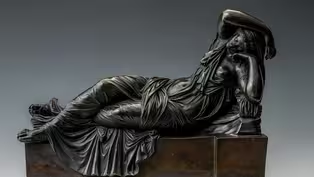
The Hub of the World: Art in Eighteenth-Century Rome
Clip: S2023 Ep597 | 3m 26s | A look at "The Hub of the World: Art in 18th Century Rome" at Nicholas Hall Gallery. (3m 26s)
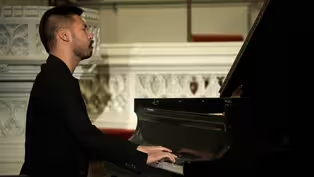
Clip: S2023 Ep597 | 9m 30s | A profile of Conrad Tao, a composer and pianist pushing the boundaries of classical music. (9m 30s)
Providing Support for PBS.org
Learn Moreabout PBS online sponsorship

- Arts and Music
The Best of the Joy of Painting with Bob Ross
A pop icon, Bob Ross offers soothing words of wisdom as he paints captivating landscapes.











Support for PBS provided by:
NYC-ARTS is a local public television program presented by THIRTEEN PBS
Major funding for NYC-ARTS is made possible by The Thea Petschek Iervolino Foundation, Jody and John Arnhold, The Lewis “Sonny” Turner Fund for Dance, The Ambrose Monell Foundation, Elise Jaffe...