
R. Joseph Huddleston; U.S. Rep. Herb Conaway Jr.
12/27/2025 | 26m 51sVideo has Closed Captions
R. Joseph Huddleston; U.S. Rep. Herb Conaway Jr.
Steve Adubato sits down with Dr. R. Joseph Huddleston, Associate Professor at Seton Hall University’s School of Diplomacy and International Relations, to examine how U.S. international aid strengthens America’s global reputation, supports diplomacy, and drives meaningful global impact.
Problems playing video? | Closed Captioning Feedback
Problems playing video? | Closed Captioning Feedback
Think Tank with Steve Adubato is a local public television program presented by NJ PBS
R. Joseph Huddleston; U.S. Rep. Herb Conaway Jr.
12/27/2025 | 26m 51sVideo has Closed Captions
Steve Adubato sits down with Dr. R. Joseph Huddleston, Associate Professor at Seton Hall University’s School of Diplomacy and International Relations, to examine how U.S. international aid strengthens America’s global reputation, supports diplomacy, and drives meaningful global impact.
Problems playing video? | Closed Captioning Feedback
How to Watch Think Tank with Steve Adubato
Think Tank with Steve Adubato is available to stream on pbs.org and the free PBS App, available on iPhone, Apple TV, Android TV, Android smartphones, Amazon Fire TV, Amazon Fire Tablet, Roku, Samsung Smart TV, and Vizio.
Providing Support for PBS.org
Learn Moreabout PBS online sponsorship- [Narrator] Funding for this edition of Think Tank with Steve Adubato has been provided by The Fund for New Jersey.
IBEW Local 102.
Celebrating it’s 125th Anniversary.
Hackensack Meridian Health.
Keep getting better.
Robert Wood Johnson Foundation.
Working to create a future where health is no longer a privilege, but a right.
The Turrell Fund, a foundation serving children.
Eastern Atlantic States Regional Council of Carpenters.
New Jersey Sharing Network.
EJI, Excellence in Medicine Awards.
A New Jersey health foundation program.
And by Operating Engineers, Local 825.
Promotional support provided by CIANJ, and Commerce Magazine.
And by Insider NJ.
[MOTIVATIONAL MUSIC] - Hi everyone.
Steve Abubato.
We kick off the program with an in-depth interview with a scholar who understands international affairs better than most.
He's Professor Joseph Huddleston, who's Associate Professor at the School of Diplomacy and International Relations at Seton Hall University, one of our higher ed partners.
Professor, good to see you.
- Good to see you, Steve.
Thanks for having me.
- Let's do this, 'cause there's so many areas I wanna talk about, but one is this.
Tell folks about the exact fellowship that you had in Washington DC with the United States Senator Cory Booker's office, please.
- Sure, yeah.
I got a fellowship from the Council on Foreign Relations.
They sponsor scholars to spend a year in government.
So once they awarded me that fellowship, I reached out to Senator Booker's office and, after a few discussions, decided to join their team, their foreign policy team for the year.
- Number one area I wanna talk about: USAID.
What is USAID?
What were the cuts to it and why does it matter?
- USAID stands for US Agency for International Development.
It was introduced, I think, under the Kennedy administration, basically to help development, health, medicine, those kinds of programs around the world, and ultimately to increase what we call soft power of the American government, meaning boost our reputation, do good in the world, and therefore get a diplomatic benefit from that.
Before the Trump administration, the budget was about $32 billion for the 2024 year.
The Trump administration cut that, I believe, by as much as 90%.
Not only that, they moved the entire organization into the State Department.
- Didn't they take the letters off the building and then just say, now you're not gonna have your own space.
They're now housed where?
Department of State?
- Yeah, they moved them into the State- - So hold on one second.
Sorry to interrupt, professor.
This was Elon Musk, DOGE, the Department of Government Efficiency.
Okay, Elon Musk not there anymore.
I don't think he has his chainsaw anymore.
With that being said, they do away with it, but then they put it in the Department of State and the Trump administration is saying, What are you talking about?
We're more efficient.
We saved money, we cut it back because America should be first.
You say what, professor?
- They didn't really save much money because a lot of the people they fired, they fired illegally.
And you know, these people were still being paid even though they were being allowed to do their work.
So that's part one.
The US government was also on the hook for a lot of contracts with what we call implementing partners.
These are nonprofits like Catholic Relief Services, Mercy Corps, World Vision.
They do a lot of the work abroad of providing these services, and they have contracts with the US government.
So a lot of the cuts to those contracts were also, you know, not, for one, they were not backed up by Congress, 'cause Congress, you know, allotted this money to be spent on international development.
And at the end of the day, it just didn't really wind up saving a lot of money at all.
It really just devastated the lives of people in poor countries.
- Be more specific, the human cost to you, professor.
- Really hard to estimate that accurately, but here's what I'll say.
Most scholars and sort of estimates of this put at least hundreds of thousands, at least 100,000.
There's a scholar at- - Wait, a hundred thousand, what?
- I'm sorry, a hundred thousand lives lost.
- How?
- In the, because of the canceling of medication, the interruption of refugee aid programs, a really big one.
The withdrawal of efforts to eradicate HIV and AIDS, especially on the African continent.
All kinds of medical programs were just totally devastated by this.
So you have women and families all across the developing world who suddenly were without medication for treating both HIV and other diseases like cholera and hepatitis and like suddenly they run into a dead end on their medication and they're not able to continue that.
So there's just this kind of slow unraveling of health programs that's still going on in places like Sub-Saharan Africa.
- Professor, there are some watching right now who say, Steve, you are a New Jersey based production operation.
You're supposed to be talking about New Jersey, domestic issues.
There are many who say, making America great first or making America great is America first.
There are many who now question why are we even talking about this and how does it relate to anyone in New Jersey or the United States of America?
You say what, professor?
- Well, look, the Trump administration gave more money to Argentina than the entire budget of USAID for the 2024- - What was the money going to Argentina for?
- The Trump administration gave $40 billion as a basic fiscal bailout for the Argentine government.
And my understanding it was basically a political gesture.
And that was more money than this money that was going to people and organizations that are dedicated to helping people and really sort of boosting the image of the United States across the world, which has huge benefits on its own.
- How?
How does it boost... How does it, how did USAID and the work they were doing, how did that boost, is your words, America's image around the world, professor?
- Well, for one, you just get this, you this reputation building effect of communities all across Africa who get just, for example, a bag of food that says given to you by the United States government.
That's millions and millions of people for many years who've had sick, desperate situations where the US government and the American flag is showing up to help them out of a really difficult situation.
So that's just as a baseline, a really good place to start managing diplomatic exchange.
You know, the Trump administration is all about building trade relations.
Soft power is really important for having those negotiations go well.
So that's one part.
Then there's actually a more concrete part, which is security issues.
Every American should care about terrorism and counter-terrorism.
And if you have communities that suddenly find themselves in these devastating situations, that tends to be a recipe for security problems as well.
- How?
- Because communities that have high unemployment, high medical problems, no legitimacy in their government, they tend to go to extremist measures.
So extremist groups like you might have heard of Al-Shabab, you might have heard of Boko Haram, they have a really easy time or a relatively easier time recruiting from communities that have no other options.
- Okay, and by the way, Boka, say it again?
Haram?
- Boko Haram, yeah.
- Is in Nigeria.
Correct?
- Northern Nigeria and in, yeah, sort of neighboring countries.
- Okay, let me, let's do this.
And I am very, I'm incredibly provincial in so many ways.
And I know I'm not alone.
I'm very New Jersey centric and US-centric.
But again, I have work to understand how things that go on around the world are important to us, and as human beings.
And by the way, obviously, you're a Catholic institution, you're a Christian institution.
What goes on around the world matters, not just for those of us who are Catholic or Christian, but for anyone who cares about other human beings.
But I do struggle with this one.
The Sudan.
- Yeah.
- What is going on in Sudan?
Is it genocide and why should we all care, professor?
- It's definitely genocide.
The State Department sort of labeled it that at the end of the Biden administration, the Trump administration has even kept that label.
There's financial sanctions against the, some of the parties involved because of the genocide.
It started- - What is, how is the genocide taking place?
- Yeah.
So in the southwestern part of the country, there's a area called Darfur.
Some of your viewers might remember Darfur from a genocide about 20 years ago.
- That's right.
- So it's not exactly the same conflict as then, but it's a lot of the same people, a lot of the same ethnic motivations for genocide.
- Who's driving it?
Who's driving it, professor.
- So there's a rebel group called the RSF that is, that has been fighting against the Sudanese armed forces, the Army.
Now the problem is that in Sudan there's still not a legitimately elected government.
You have the army facing off against this sort of rebel group.
And they both have international sponsors and they both have committed all kinds of crimes against humanity.
But only the RSF has been accused of genocide.
- And this is our business why, doctor?
- Well, so I would say there's one level which is, you know, do we care about a human life?
Do we think there's a sort of responsibility to intervene and put pressure on parties that enable this kind of conflict?
- What about it from a strategic, because what goes on in the Middle East, what matters, what's going on between the Israelis and Hamas, Israeli government and Hamas matters, the war there, the war with Russia and Ukraine matters.
Their strategic interest.
Is there a strategic US interest in Sudan, in the Sudan?
- Not like in those other places, except that we don't want to see a domino effect of the whole region of Northeast Africa and the horn of Africa falling apart.
And this conflict is so bad and the refugee situation being created by this conflict is so bad it really could destabilize several other governments around.
And that's not even thinking about the fact that there's mass famine, mass starvation, mass crimes against humanity.
- Okay, help us on this.
By the way, we're talking to Professor Joseph Huddleston, who's Associate Professor at the School of Diplomacy and International Relations at Seton Hall University, one of our higher ed partners.
I have heard President Trump say many times, let's just fact check, no opinion, no ideology, fact check.
I have solved many, the number changes, seven, eight wars.
What does he mean?
- Oh boy.
- He's working on the next one, and I think the next one is Russia-Ukraine.
As we speak around Christmas 2025, has he ended seven, eight wars?
- No, the only one I think maybe he really, his administration actually does deserve some credit for is negotiating an end of the conflict in the Democratic Republic of Congo.
And he basically did that by buying people off, and making with, you know, with the US government.
The Rwandan government was involved in that.
And he basically said, look, if we can stop the fighting here, the US is going to incentivize businesses to go invest in mining and basically exploit the natural riches of that country.
And that’s the sort of basis of the negotiation.
So that one I think maybe deserves some credit for- - What about all the, do you know the other wars he's talking about?
- I mean, he's trying to try to claim credit for Gaza.
He is trying to claim credit for India and Pakistan had a few weeks where they were exchanging fire.
So, I don't think it's fair for the US government to claim any credit or for the Trump administration to claim any credit in those.
The US is involved in negotiations on the end of most conflicts, 'cause the US is a powerful player in international politics.
But the fact of the matter is that, take India and Pakistan, they negotiated, they both recognized it wasn't in their interest to continue to fight a war with each other, and they negotiated the end to that conflict themselves.
So maybe an American was in the room, but I don't think that's enough to say that we can claim all the credit for it.
- We talk to you four months from now, will the war between Ukraine and Russia be over?
- I don't think so.
- You don't?
- No.
- Professor Joseph Huddleston, who's Associate Professor at the School of Diplomacy and International Relations at Seton Hall University.
Professor, thank you so much for joining us.
We appreciate it.
- Thank you very much, Steve.
- You got it.
Stay with us, We'll be right back.
- To watch more Think Tank with Steve Adubato, find us online and follow us on social media.
- We're honored to be joined by United States Congressman, Dr.
Herb Conaway Jr.
who represents the Third Congressional District that is in Cumberland, Gloucester, and Salem Counties.
Good to see you, Congressman.
- It's actually Burlington, Mercer, and Monmouth Counties.
- Burlington, Mercer, Monmouth.
My bad, I apologize, thank you.
Herb, first of all, great.
Thank you so much for joining us, we appreciate it.
- Glad to do it.
- You are a physician, I believe, the first African American physician with voting privileges in Congress.
We've had you on as a former state legislator many times talking about healthcare issues.
You chaired the Assembly Health Committee, in the State Legislature.
So here's the question outta the box.
From your perspective, what is the most significant impact of the Trump administration healthcare policies on the citizens of New Jersey?
First talk, let's talk cuts, and then we'll talk vaccines.
Please, Doctor.
- Well, the cuts to healthcare for Americans is unlike anything we've ever seen in our country.
It's the largest cut to healthcare in our nation's history.
Medicaid will be cut by nearly a trillion dollars.
Medicare will be cut by $536 billion.
You're gonna see cuts upwards of 150 to $200 million to the tax credits, which help middle class people, working families, working persons by insurance, particularly impactful on small business.
I think we're gonna discuss that later.
In New Jersey, our costs are gonna go up by thousands of dollars.
- Costs for what, Doctor?
- Costs for people who currently use the exchange.
Thank you for allowing me to clarify.
Cuts to people who use the exchange for their insurance.
Because the Republican Party to a person in the House voted end those tax credits, again, these are for working people, middle class people, people will see increases this year, in the current period coming up starting January 1st, cost increases over a thousand dollars.
Families, even higher than that.
And many people, our surveys show will not be able to afford those increases.
42% of people will go forego insurance because they simply can't afford those costs.
- But I also wanna be clear, Congressman.
Republican Congressman Jeff Van Drew is, in fact, supportive of what you just described.
What I mean is he's supportive of extending those tax credits, and he's also supportive of, frankly, not doing away with the Affordable Care Act, which many of his Republican colleagues have advocated, and the president has advocated that we, quote, do away with it.
I just wanna clarify that he is, go ahead.
- But he says that now.
But when it was time to vote on the big ugly bill, the big cruel bill, as I call it, Jeff Van Drew, in spite of signing a letter that said he would not vote to cut healthcare, in fact, did vote to cut healthcare.
Every Republican member of the Congress passed legislation, which did the things I described, nearly a trillion dollars outta Medicaid.
They voted to cut the tax credits for healthcare, and the budgetary policies will lead the cuts to Medicare of $536 billion.
Now, in the wake of the backlash, President Trump has floated the idea of maybe let's extend the tax cuts, tax credits rather.
There are 50 people in the Republican caucus as I understand it, who sit on the cusp of not being reelected because of this vote.
I don't know about Jeff's particular district.
He's singing a different tune now.
And I like, you know, Jeff Van Drew is a friend of mine as you know.
- I understand, but I'm gonna talk more policy than politics.
And by the way, the Congressman's talking about a 2026 midterm, if you will, election where the entire House, 435 members of the House of Representatives, including Congressman Conaway will be up for reelection.
That being said, I'm gonna get to childcare in a second, which is a healthcare issue, but I also wanna do this.
As we speak, you know, Congressman, as a former legislator and as a physician, you and I had this conversation a lot about the public health system.
There's significant distrust in the public health system.
You agree, there's distrust?
- Well, I think to the extent there's distrust in the healthcare system writ large, you know, there's certainly quite a lot of that engendered by a lot of misinformation in the media, by the way, social media in particular.
- Be more specific.
- Yeah, mm-hmm.
- Be more specific, Congressman.
- Well, you know, just take the question of vaccines.
There is a lot of misinformation on vaccines and, unfortunately, RFK Jr.
who now heads Health and Human Services.
- Health and Human Services.
- Health and Human Services is a big purveyor of misinformation with respect to vaccines.
And we have met with former officials of the CDC that came and met with their newly formed Democratic Doctors Caucus to give us inside information on what's going on there.
Many of them just couldn't stay there any longer watching so many irregular and irresponsible things being done to the American people at the behest of RFK Jr.
who runs- - Be more specific, Congressman.
RFK Jr.
has said that all we're doing is raising questions about vaccines.
And the CDC as it is right now is gonna provide information that he argues is the kind of information that has been lacking on the CDC website about the questions about vaccines, whether we're talking about the MMR vaccine, whether we're talking about the hepatitis B vaccine, which obviously the federal policy was just changed as we do this program in the middle of December.
What exactly does he have wrong, Congressman?
- What he has wrong is that he is rehashing old tropes about vaccines that have been disproven by the scientific study, scientific method, over and over and over again.
Whether it's vaccines cause autism, which it doesn't, or that there's some issue with the hepatitis B vaccine, which has been given for decades now, and aimed at preventing and eliminating hepatitis B in this country, something which will significantly reduce the risk and the incidence of liver cancer in our nation.
So, you have a choice.
Either we do something important like eliminate the risk of liver cancer by immunizing people against hepatitis B, which is one of the significant drivers and causes of liver cancer, or we don't.
Nevermind all the other issues with liver disease and illness that come from a disease which is preventable through the use of vaccines.
And he's over and over again rehashing studies, and trying to stilt by packing the studies with people who are not rigorous in terms of the science.
I'm gonna put that in quotes that they're bringing once again to these settled issues.
And as people become concerned and skeptical, you know, they might decide to forgo vaccines.
- They have.
Congressman, respectfully, the statistics show because there are fewer people getting the vaccine, or vaccines.
- There are because of this misinformation right from the top.
The CDC should be a purveyor of truth.
And what we have is someone at the top of that administration who's made a lot of money bringing, you know, cases, you know, suggesting that there are harms created by vaccines that simply have not been shown after rigorous and decades-long science saying the exact opposite of what he's saying.
- Let me switch gears.
We're involved in a public awareness initiative around childcare, affordable, accessible, quality childcare.
Now, Congressman Conaway is, in fact, part of the Congressional Dads Caucus.
You admit this, Congressman?
- Yes, I do, I'm a dad.
I'm in the Dads Caucus as it turns out, yes.
- I'm in the Dads Caucus of those of us in the media, but yours is a more important caucus.
Let's be more specific.
The initiative we're involved in is called Start Strong NJ.
The website will be up, find out more.
There is legislation in Congress to expand the Childcare Access Act, offering a refundable tax credit of up to $5,000 to help launch new family childcare businesses.
Where is that, Congressman?
- Well, it's a bill that I sponsored.
It's the first bill that I introduced in the Congress.
I am in the minority, you know.
Quite frankly, it's tough sledding.
- Minority party, which means you do not control the agenda of what gets voted on.
Go ahead, Congressman.
- Correct.
And while I have worked in a bipartisan way and passed bills through the Congress, this one, we haven't been able to get that forward.
It's probably gonna take, you know, a Democratically led House to push this through, but we're gonna stick at it.
I've been involved in legislation as you know, for 25 years before coming here.
And sometimes it's taken me three legislatures to get initiatives through, but we keep at it and we prevail in getting some great things done for New Jerseyans.
We're gonna take that same effort and commitment to the national level here in the Congress.
- 30 seconds left.
You went from the State Legislature to United States Congress, from Trenton to Washington.
Is it what you thought it would be, Congressman?
- Well, you know, yes and no.
You don't realize the enormity of interest in Washington what goes on here until you're here.
I mean, people come here from all over the world.
I learned a lot about sugar beets.
I never thought I'd learn anything about.
That's just an example.
I thought I was gonna get a candy and it turned out I heard all about the sugar beet industry in the northwestern part of the country, but, you know, to me, service is what I have been doing my whole life as a physician, as a Air Force veteran, as a legislator.
This is a continuation of what I learned from my parents who was a teacher and a nurse.
And I'm very proud to do it, and continue to do the best for my country, and the people that I'm privileged to serve.
- You're listening to Doctor, United States Congressman, Herb Conaway from the Third Congressional District.
I'm gonna get this right.
The counties again are, Congressman?
- Burlington, Mercer, Monmouth.
- Thank you.
- Central New Jersey going strong.
- Yeah, that's the Congressman.
I'm Steve Adubato.
Thank you so much for watching.
We'll see you next time.
- [Narrator] Think Tank with Steve Adubato is a production of the Caucus Educational Corporation.
Funding has been provided by The Fund for New Jersey.
IBEW Local 102.
Hackensack Meridian Health.
Robert Wood Johnson Foundation.
The Turrell Fund, a foundation serving children.
Eastern Atlantic States Regional Council of Carpenters.
New Jersey Sharing Network.
EJI, Excellence in Medicine Awards.
A New Jersey health foundation program.
Operating Engineers, Local 825.
And by these public spirited organizations, individuals and associations committed to informing New Jersey citizens about the important issues facing the Garden State.
Promotional support provided by CIANJ, and Commerce Magazine.
And by Insider NJ.
- The EJI Excellence in Medicine Awards was established in 1939, shining a light on New Jersey's health care leaders.
Current awards include the Excellence in Medicine, Research, Medical, Education and Community Service.
EJI also funds annual scholarships to medical, dental, pharmaceutical and physician assistant students throughout the state.
Learn more at EJIAwards.org.

Rep. Herb Conaway addresses cuts to Medicaid & public health
Video has Closed Captions
Clip: 12/27/2025 | 12m 1s | Rep. Herb Conaway addresses cuts to Medicaid & public health (12m 1s)
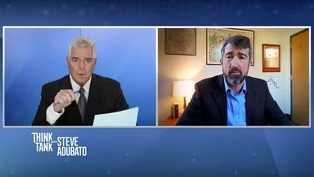
Seton Hall professor examines diplomacy & international aid
Video has Closed Captions
Clip: 12/27/2025 | 14m 46s | Seton Hall professor examines diplomacy & international aid (14m 46s)
Providing Support for PBS.org
Learn Moreabout PBS online sponsorship
- News and Public Affairs

Top journalists deliver compelling original analysis of the hour's headlines.

- News and Public Affairs

FRONTLINE is investigative journalism that questions, explains and changes our world.












Support for PBS provided by:
Think Tank with Steve Adubato is a local public television program presented by NJ PBS