One-on-One
Russo; Paladino & Dr. Libutti; Glennon and Jova
Season 2021 Episode 2443 | 26m 55sVideo has Closed Captions
Anthony Russo; Christopher Paladino & Dr. Steven Libutti; Elisse Glennon and Paul Jova
Anthony Russo shares the impact of the hiring shortage in NJ as the state reopens and the ways the workforce will adapt through the rest of the pandemic; Christopher Paladino & Dr. Steven Libutti discuss the impact of COVID on cancer care and economic development; Elisse Glennon & Paul Jova discuss the upcoming 2020 Donate Life Transplant Games and the NJ Sharing Network 5K Celebration of Life.
Problems playing video? | Closed Captioning Feedback
Problems playing video? | Closed Captioning Feedback
One-on-One is a local public television program presented by NJ PBS
One-on-One
Russo; Paladino & Dr. Libutti; Glennon and Jova
Season 2021 Episode 2443 | 26m 55sVideo has Closed Captions
Anthony Russo shares the impact of the hiring shortage in NJ as the state reopens and the ways the workforce will adapt through the rest of the pandemic; Christopher Paladino & Dr. Steven Libutti discuss the impact of COVID on cancer care and economic development; Elisse Glennon & Paul Jova discuss the upcoming 2020 Donate Life Transplant Games and the NJ Sharing Network 5K Celebration of Life.
Problems playing video? | Closed Captioning Feedback
How to Watch One-on-One
One-on-One is available to stream on pbs.org and the free PBS App, available on iPhone, Apple TV, Android TV, Android smartphones, Amazon Fire TV, Amazon Fire Tablet, Roku, Samsung Smart TV, and Vizio.
Providing Support for PBS.org
Learn Moreabout PBS online sponsorship- [Narrator] Funding for this edition of One-On-One with Steve Adubato has been provided by Horizon Blue Cross Blue Shield of New Jersey.
Here when you need us most, now and always.
The New Jersey Education Association.
Johnson & Johnson.
MD Advantage Insurance Company.
NJM Insurance Group.
Serving New Jersey'’s drivers, homeowners and business owners for more than 100 years.
The Fidelco Group.
The New Jersey Board of Public Utilities, Clean Energy program.
Prudential Financial.
And by The Adler Aphasia Center.
Promotional support provided by Meadowlands Chamber.
Building connections, driving business growth.
And by BestofNJ.com, all New Jersey in one place.
- This is One-On-One.
- I'm an equal American just like you are.
- The jobs of tomorrow are not the jobs of yesterday.
- Look at this.
You get this?
- Life without dance is boring.
- I don't care how good you are or how good you think you are, there is always something to learn.
- Do you enjoy talking politics?
- No.
- People call me 'cause they feel nobody's paying attention.
- Our culture, I don't think has ever been tested in the way it's being tested right now.
- That's a good question, high five.
(upbeat music) - Hi, I'm Steve Adubato.
Welcome to another compelling program where we talk to leaders who make a difference and right out of the box, our good friend, Tony Russo, President of the Commerce and Industry Association of New Jersey and publisher of Commerce Magazine, one of our media partners.
Good to see you, Tony.
- Good to see you Steve.
Thanks for having me.
- Tony, we're taping on the 22nd of June, be seeing later.
There will be a budget an official budget on July 1st, 2021.
Why does that matter so much to you and the members at CIANJ?
- Well, every June is always important because what the state does with our tax dollars and the programs that they're going to fund potential fees, taxes, that's something that we always pay attention to.
So what's going to happen this week in Trenton is important.
And for the first time, as long as I've been working here, the fact that the state's flush with money doesn't happen every year.
And so this is going to be very interesting to see how the money is spent.
So we're going to want to track it and monitor how that process goes.
- Tony, if you were not the president of the Commerce Industry Association and you were in fact, the governor of the state and you had this, it's not an embarrassment of riches cause nobody's embarrassed because there's a surplus, how do you believe what do you believe the best way to spend that money would be, should be?
- It's a great question, Steve.
And my response would be what our businesses do.
Whenever they have a profit, if they're fortunate to have one they reinvest in the company.
They purchase new equipment, they reinvest in their people.
So, you know, the same thing should apply with the state is reinvest in the infrastructure, reinvest in our workforce, you know, spend money save money too and that's a big component of it.
You know, our businesses obviously counting every dollar and making sure that the money is going to be there for the next crisis 'cause it's not, you know if, it's going to be when and we just want to be prepared for it.
So my advice to the governor and the legislature would be to just reinvest a lot of that money, pay down debt.
You know, a lot of our businesses do that.
And so when you have the opportunity where you have the money, then you have the cash you gotta do the right thing and really take care of debt, reinvest and take care of your employees.
- Tony, let me ask you, we've been media, you've been our media colleague for a long time and you've talked a lot about the workforce.
Dr. Joe Bowman, NJIT the president there talks about workforce issues a lot, the workforce shortage, et cetera, talent pool.
Is there in fact, a hiring shortage out there right now?
- No there certainly is and that's not a secret.
I mean, this has been going on for a few months and we tried to raise that level with the folks here in Trenton.
But yeah, I talked to Steve.
I talked to, no matter what sector of the business I'm talking to, they're always looking for new people whether it's accountants, bankers, truck drivers, operators.
So there is a shortage of workers out there and you could point out a few things, right?
And I know a lot of folks are saying that the enhanced unemployment is keeping people home, but I also think that now we have a situation where we're coming out of the pandemic, the economy is starting to pick up, you know folks want to hire.
We just need a qualified and skilled workforce and that's not easy to find.
- And by the way, childcare issues, we have a series that we're doing called Re-imagine Childcare which we're talking about quality, affordable childcare.
Don't kid, ourselves folks.
Childcare is a part of that equation as well.
Hey Tony, how about this.
The workplace moving forward, you talk to your members all the time.
By the way, let's put up the Commerce and Industry Association Website so people can check out what Tony, his colleagues are doing.
Tony, how much of it do you believe will ultimately be a hybrid situation in person, remote?
We're totally remote right now, but we're unique.
We're not unique, but not everyone can do that.
Talk to us.
- Yeah.
Look, that's the threshold issue right now that a lot of our members are facing is how do you bring employees back, right?
We represent manufacturers that have been there since day one.
You know, they can't afford to have people working remotely.
But when I talk to our service providers and insurance companies, bankers, accountant firms, what they're telling me is that you're probably going to see a hybrid model stay in place where they're going to want to give their employees that flexibility to work from home.
But you know, they stress the importance of coming back to the office, right?
There's structure there.
There is collaboration with your coworkers.
I mean, I think that's going to happen and I think it's a strict question of some companies are bringing folks back in the summer, some are waiting until after Labor Day.
You hit something very important and that's childcare.
Schools are going to be reopened.
So, you know, I think come September the fall and beyond 2022, don't be too surprised that you can see the model is a hybrid where people work maybe two days in the office and three days from home.
And then I think that's-- (device dinging) And the reason being is, you know, and a couple of members have told me this if you don't offer that flexibility, I think employees have choices and they'll leave.
So it's a question of if you want to protect your good employees, you got to provide that flexibility.
And I think what we've learned over the past year is that a lot of employees have worked effectively remotely and that number of production was there.
So it was good.
Tony, let me try this.
The whole question of moving forward, to what degree do you believe, and we talk about leadership a lot, right?
To what degree do you believe your members will be most successful who are constantly pivoting, adapting, evolving and not saying, "I want to go back to normal."
- The overwhelming majority of them are going to adapt.
And that was the lesson learned from the pandemic is if you stayed the same, you basically languished and you faded-- - You went backwards.
- Yeah, you went backwards.
And I think they realized that the name of the game in this global economy Steve, with technology changing so rapidly with the economies of the world changing so rapidly with the issues that pop up, you have to come in everyday to work and just say, "What is it that we need to do in order to stay ahead of our competitors and to stay viable?"
And I think those are the companies that are always going to be successful.
- Tony, before I let you go, the role of banks.
Speaking about evolving, the role of banks is dramatically changed, providing the, managing the PPP process, et cetera, et cetera.
Role of banks in this pandemic now and moving forward is?
30 seconds.
- They were the lifeline.
They were the ones that got it done along with the SBA and the federal government.
Without our banks, our companies didn't get that money that they really desperately needed.
So it was important.
- That's Tony Russo.
He's the President of the Commerce and Industry Association, also the publisher of Commerce Magazine.
You saw his website.
They're one of our media partners.
Hey Tony, thank you so much.
Best to you and all of your members at Commerce.
- Thank you.
Same to you, Steve.
- I'm Steve Adubato, that's Tony Russo, We'll be right back.
- [Narrator] To watch more One on One with Steve Adubato find us online and follow us on Social media.
- We're now joined by Chris Paladino, President of New Brunswick Development Corporation, otherwise known as DEVCO, and also a Dr. Steven Libutti, Senior Vice President of Oncology Services at RWJBarnabas Health and Director of the Rutgers Cancer Institute of New Jersey.
Gentlemen, good to see ya.
- Good to be with you.
- Yeah, great to see you, Steve.
- RWJBarnabas Health, a significant underwriter of Public Broadcasting, as well as the work we do in healthcare.
Chris, let me ask you.
We're about to show some renderings.
I'm gonna put this into perspective.
There is a very significant cancer center groundbreaking coming up.
This will be seen later.
What is this building, this cancer center, excuse me, and why is it so significant?
- Well, it's an extension and expansion of the legacy of the Rutgers Cancer Institute of New Jersey, which is the only NCI-designated cancer institute in the state of New Jersey.
It's gonna provide 530,000 additional square feet for research, clinical care, and for the first time, inpatient care for oncology patients in the state of New Jersey, all in one building.
It'll be a standalone cancer hospital.
And it's just going to allow the folks who work with Dr. Libutti either as researchers, as physicians, as diagnosticians to be able to provide state-of-the-art, world-class care close to home in the state of New Jersey.
- Jump in, Dr. Libutti.
- No, I think Chris said it very well.
The exciting part of this project is that the citizens of our state won't have to feel compelled to travel out of state for exceptional care and to participate in cutting edge clinical trials.
A facility like this is really something that's gonna set a new standard for the state of New Jersey.
As Chris mentioned, both inpatient and outpatient care taking place in the same building, that allows us to coordinate that entire cancer journey for patients.
If the patient is an outpatient and then needs admission to the hospital for some additional care, the same team will be caring for that patient, and so there's no need for transition of care or complicated communication.
It essentially wraps a blanket of support, reassurance, and care for that patient as we navigate them through their cancer treatments.
- Hey, Chris, explain to folks why the New Brunswick Development Corporation, DEVCO, is even involved in this in the first place.
- Well, this is another example of in New Brunswick and more and more across the state, and how we help build public-private partnerships, particularly with our anchor institutions.
This project is obviously led by Dr. Libutti and the Rutgers Cancer Institute of New Jersey, but it is a partnership with Robert Wood Johnson Robert Barnabas Health, the Middlesex County Improvement Authority.
Middlesex county has contributed to this, the city of New Brunswick.
It really has so many multiple dimensions.
As part of this project, we're building this across from Robert Wood Johnson University Hospital on this site of what had been the old St Peter's High School and then had been, for a short time, a elementary public school.
And as part of this project, we are building a brand new $55 million community school, about five blocks, for the community as part of this.
And it's just another great example, particularly of how Robert Wood Johnson Barnabas Health system really does act as an anchor institution, affecting so many of the lives of the greater community.
- Dr. Libutti, let me ask you a larger question about cancer care as we do this program at the end of June, 2021.
The impact of COVID on cancer care, describe it.
- So COVID has obviously been a major challenge across the board.
It's certainly been a challenge for those of us that are focused on cancer care and cancer research.
And one area that it's impacted tremendously is cancer screening.
So during the periods of lockdown and during the periods before we had a vaccine for patients, people were not doing the typical screening exams that are necessary to detect cancer at an early time, mammograms, low dose CT scans for lung cancer, colonoscopy.
And data from the National Cancer Institute predicts that we may see increases in cancer mortality and cancer incidents over the next five to 10 years as a result of that decreased screening.
And so one of the areas that we are particularly focused on is increasing cancer screening and early detection through a partnership we have with the state of New Jersey called Screen NJ, which focuses- - By the way, I wanna be clear, Doctor.
Sorry for interrupting.
Part of the concern is that if we miss on the early detection and there are greater risks of serious illness, if not mortality.
Am I correct on that?
- Absolutely correct, absolutely correct.
And so we tend to diagnose cancers at a later stage if we don't detect them during screening, and often at a later stage, they're much more difficult to treat and results in higher risk of mortality.
- Chris, let me ask you this.
You and I have had so many conversations offline about a whole range of issues, but when it comes to the impact of COVID on development, economic development projects, which, again, it depends upon where you are.
It depends upon a lot of variables.
But what an impact has it had, from your perspective, on economic development initiatives?
- Well ironically, with respect to this project and the New Jersey Technology and Innovation Hub, which will we're breaking ground on later this summer, we were at a period of time where working from home really didn't hurt us.
We were doing a lot of planning.
We were doing a lot of meetings.
We were able to actually learn how to use Zoom.
So we were able to move this project along.
It was very different doing, probably for this project alone, 10 public meetings to get the various approvals, and that was a bit of a challenge.
So we didn't lose any time.
What we're now facing, which is a little bit of the unknown, of the cost of material.
A lot of people are now getting projects going at one time, so I'm somewhat concerned about the availability of labor and then certainly the supply chain with respect to getting materials from different parts of the world and different parts of the country.
So there's a little bit of an unknown.
I think everybody who's involved as a partner in this project really hunkered down, and we kept it on track.
But we've got some hurdles yet.
- By the way, before I let you go, the name of the new cancer center will be?
- Dr. Libutti?
- So we're very excited.
With the generosity and commitment of Jack Morris who is a chairman of the board at RWJ University Hospital and the inaugural chair of the RWJBarnabas Health system, the new pavilion will be called the Jack and Sheryl Morris Cancer Center at RWJBarnabas Health and the Rutgers Cancer Institute of New Jersey.
And we're ecstatic to have Jack and his family associated with this project, as he has been instrumental in driving this vision forward.
- Thank you, Dr. Libutti.
Thank you, Chris.
We appreciate you being with us, and we'll continue to follow the development of this initiative.
Thanks so much, gentlemen.
- Thanks, Steve.
- Stay with us.
We'll be right back.
- [Narrator] To watch more One on One with Steve Adubato find us online and follow us on Social media.
- We are honored to be joined by our longtime friend, Elisse Glennon, Executive Director of the New Jersey Sharing Network Foundation.
and Paul Jova, Board Member of the New Jersey Sharing Network Foundation and the father of Andrew who was an organ donor.
And by the way, thank you Elisse for joining us and definitely, Paul.
We're honored by you being with us as well.
- Thank you for having me today.
I appreciate it.
- Paul, I wanna start with you.
Tell us about Andrew.
2008 he lost his life at 17 years of age.
A decision was made to donate his organs and to give the Gift of Life to so many others.
Can you talk about him and that decision?
- Well, Andrew was your typical 17 year old waiting to get his driver's license.
Being driven around by myself and my wife.
And one night, tragic accident, he decided to do something a teenager, you know, thinks he do something impossible, jump out of a car, you know, roll and just get up and walk away.
Well, it didn't happen.
He struck his head on the curb and that's the moment our lives changed my life.
My whole family's life changed.
Andrew was rushed to the hospital.
I met him there.
And for two days we were in that hospital room waiting for a miracle to happen.
You know, Andrew was a giving, caring young man.
Always full of life and energy.
And, you know, to see him sitting there waiting for life to be brought back to him really impacted my wife and myself.
His story is, you know, a story of just, he wanted to give back.
He always was looking to help other people, always.
The day of his accident, he was at a youth ministry in Camden helping other kids, you know, less privileged than him.
And he came back and this little accident happened.
And like I said, it changed our lives.
Andrew was a great kid.
- And the decision was made to donate his organs?
- Yes, the decision was made.
We were in that hospital room waiting for a miracle to happen.
And when the New Jersey Sharing Network representative approached us, my wife and I decided at that moment to donate his organs, because we didn't want another family to be sitting there waiting for a miracle to happen and not get it.
We didn't get that miracle but we wanted to help someone else.
Maybe they can get the miracle they deserve.
- Elisse.
You've known Paul for a while.
You know the story about Andrew about their family.
When you hear it in this setting and it replicates unfortunately so many other stories but on the upside, so many opportunities for the Gift of Life, not for the right reasons or good reasons but it happens.
Your reaction to listening to him.
- I'm hearing Paul.
Paul I'm hearing you talk about Andrew.
And it's no surprise because I've known you and I've known Jen for so long.
It's no surprise to me that Andrew would be such a giving boy, such a boy who was in Camden helping others that day.
Because that is how I know Paul.
That is how I know Jen.
That is who they are.
That's who the Jovas are, very giving people.
And so I've heard the story before, but every time I, you know, it's like, I'm hearing it for the first time.
And I'm wishing we were in studio right now.
So I could put my hand across the desk and, you know, reach out to Paul.
- You know, Elisse, we've had so many conversations.
We've had relationship, had a relationship for a long time with the Sharing Network, in terms of public awareness.
Creating more public awareness around organ and tissue donation.
To what degree to Paul, just send a message to so many others about what they could and should be doing to give the Gift of Life to others.
And you can do that on your license, if I'm not mistaken.
Your driver's license, correct?
Or you can go to the New Jersey Sharing Network website which is up right now.
Please, Elisse, go ahead.
- Yes, you're right.
We encourage people to learn more about organ donation.
It's a very personal decision.
You heard Paul talk about the decision that he made, with his wife, and that Andrew made, as a donor himself.
So it's very personal.
We want you to learn more and talk to people.
Listening to Paul's story, hearing someone who made that decision and why they made that decision, I think really helps someone think, you know, kind of within themselves.
And like you said, you can register at motor vehicle.
You can register at our website and you can register right on your iPhone.
- Okay Paul, what is it that you do want to say, by the way, at the Transplant Games, let's let everyone know the Transplant Games, July 16th to July 19th, at the American Dream.
Real quick, give me 20 seconds on that and I'll come back to Paul.
What are the Transplant Games and why do they matter?
Elisse.
- We're thrilled to partner with American Dream to bring our lifesaving message to that property, into the thousands of people in and around to hundreds of thousands of people in and around New Jersey and then millions around the world to share our message.
Particularly of hope.
Paul shared his story.
He talked about the family on the other side of that story, receiving the lifesaving gift and the Transplant Games are our opportunity to bring the entire community together.
On the donation side and the transplant side, to celebrate life and give hope.
- Paul what would you say to everyone else watching right now?
Who not only is moved by you, respects you and your wife, Jen, tremendously.
And trying to imagine what kind of young man Andrew was, by the way you described him, all positive, right?
What would it be the message you would want to share with everyone right now?
- Miracles can happen.
It happened in many different ways.
We can affect people's lives greatly just by taking a moment and realizing that all you have to do is check that box and you can save a life.
And you can, I've met many people that, you know, his organs and his tissue have impacted.
And their lives and their family's lives that are impacted that little ripple effect of how one little thing can shape...
It's not a little thing, excuse me.
But one thing can change so many lives for the better - By the way what do the Transplant Games mean to you, Paul?
- Well, I was lucky enough to be at the Transplant Games in Salt Lake City.
And yes, and it was one of the most memorable moments in my life to have strangers come up to me, never met them before in my life and thank me for making that sacrifice.
Not my sacrifice, but my son's sacrifice.
And my wife and I were overwhelmed with joy, that to see the life impacted by other people and how they're living their lives because of decisions made at one of the worst possible times.
You know, the Transplant Games are undoubtedly one of the greatest events around and I can't wait, you know, it's amazing.
- You know Paul, real quick, before we have to end this segment, unfortunately, because of time, the 5k Celebration of Life, I believe is on September the 12th.
Help me on this Elisse.
Listen, we'll be there.
We look forward to it.
It's been years that we've been physically there in New Providence, interviewing families and people who have given the Gift of Life.
Received the gift for life.
Tell everyone what's gonna happen that day.
- So on Sunday, September 12th in New Providence, in New Jersey Sharing Network headquarters.
We will be over 10,000 people strong.
We are excited to come back after two years, not being together.
Last time we had a 5k was back in 2019.
So, we are looking forward to seeing our whole community together.
Sharing stories together.
I'll be giving out free hugs for the day.
We haven't been able to do that in so long.
And we're so glad that you're gonna be there with us, Steve.
- And more importantly, Paul's gonna be there.
- I'll be there.
Team Andrew will be there, 75 strong.
I happen to be the co-Chair this year, but yes, 75 strong members will be there, keeping Andrew's name alive.
- Hey, we will be there.
And I look forward to being there with you, Paul and you, Elisse, and to Joe Roth and the great team at the Sharing Network.
Important work.
And the work is never done.
People are waiting across this state and nation for their life to be saved, their lives to be changed.
Waiting for an organ.
Hey, Elisse, Joe, Thank you.
Excuse me.
Thank you so much, Paul.
I'm talking about Joe Roth's on my mind as well.
Your CEO.
Thanks so much for watching.
We'll see you next time.
- [Narrator] One-On-One with Steve Adubato has been a production of the Caucus Educational Corporation.
Funding has been provided by Horizon Blue Cross Blue Shield of New Jersey.
The New Jersey Education Association.
Johnson & Johnson.
MD Advantage Insurance Company.
NJM Insurance Group.
The Fidelco Group.
The New Jersey Board of Public Utilities, Clean Energy program.
Prudential Financial.
And by The Adler Aphasia Center.
Promotional support provided by Meadowlands Chamber.
And by BestofNJ.com.
- New Jersey'’s clean energy program offers financial incentives for New Jersey residents, business owners and local governments to help save energy, money and the environment.
Learn more at njcleanenergy.com or call 1-866 NJ Smart.
New Jersey'’s clean energy program.
We'’re lighting the way to a clean energy future.

2020 Donate Life Transplant Games & 5K Celebration of Life
Video has Closed Captions
Clip: S2021 Ep2443 | 10m 24s | 2020 Donate Life Transplant Games & 5K Celebration of Life (10m 24s)

CIANJ President on New Jersey's Hiring Shortage
Video has Closed Captions
Clip: S2021 Ep2443 | 8m 10s | CIANJ President on New Jersey's Hiring Shortage (8m 10s)
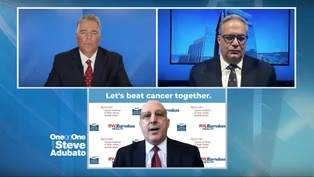
The Impact of COVID on Cancer Care
Video has Closed Captions
Clip: S2021 Ep2443 | 9m 7s | The Impact of COVID on Cancer Care (9m 7s)
Providing Support for PBS.org
Learn Moreabout PBS online sponsorship
- News and Public Affairs

Top journalists deliver compelling original analysis of the hour's headlines.

- News and Public Affairs

FRONTLINE is investigative journalism that questions, explains and changes our world.












Support for PBS provided by:
One-on-One is a local public television program presented by NJ PBS