State of Affairs with Steve Adubato
Steve Malanga; Shennell McCloud; Dale Caldwell
Season 7 Episode 22 | 27mVideo has Closed Captions
Steve Malanga; Shennell McCloud; Dale Caldwell
Steve Malanga, Senior Fellow of the Manhattan Institute, discusses shoplifting as organized crime and implementing consequences for repeat offenders; Shennell McCloud, CEO of Project Ready, addresses the lack of representation of women and people of color in public office. Later, Dale Caldwell, Ed.D., President of Centenary University, discusses the high costs and future of higher education.
Problems playing video? | Closed Captioning Feedback
Problems playing video? | Closed Captioning Feedback
State of Affairs with Steve Adubato is a local public television program presented by NJ PBS
State of Affairs with Steve Adubato
Steve Malanga; Shennell McCloud; Dale Caldwell
Season 7 Episode 22 | 27mVideo has Closed Captions
Steve Malanga, Senior Fellow of the Manhattan Institute, discusses shoplifting as organized crime and implementing consequences for repeat offenders; Shennell McCloud, CEO of Project Ready, addresses the lack of representation of women and people of color in public office. Later, Dale Caldwell, Ed.D., President of Centenary University, discusses the high costs and future of higher education.
Problems playing video? | Closed Captioning Feedback
How to Watch State of Affairs with Steve Adubato
State of Affairs with Steve Adubato is available to stream on pbs.org and the free PBS App, available on iPhone, Apple TV, Android TV, Android smartphones, Amazon Fire TV, Amazon Fire Tablet, Roku, Samsung Smart TV, and Vizio.
Providing Support for PBS.org
Learn Moreabout PBS online sponsorship- [Narrator] Funding for this edition of State of Affairs with Steve Adubato has been provided by Robert Wood Johnson Foundation.
Working for a more a healthier, more equitable New Jersey.
New Jersey Sharing Network.
Citizens Philanthropic Foundation.
Community FoodBank of New Jersey.
PSC.
Where your story is our business.
The Port Authority of New York and New Jersey.
Moving the region through air, land, rail, and sea.
The New Jersey Education Association.
Englewood Health.
And by The Adler Aphasia Center.
Promotional support provided by NJ.Com.
Keeping communities informed and connected.
And by NJBIZ.
Providing business news for New Jersey for more than 30 years, online, in print, and in person.
[INSPRATIONAL MUSIC] - Hi everyone, Steve Adubato, we kick off the program with someone we have not had on for a while.
He needs to be heard.
He is Steve Malanga, Senior Fellow at the Manhattan Institute, we'll put up their website.
also check out Steve's numerous books around a whole range of complex public policy and economic issues.
Hey Steve, I saw you on our program, the PBS series, Metro Focus with Jack Ford.
A great interview you did with him, I wanna pick it up.
And by the way, check out Metro Focus to see that interview that Steve did with the great Jack Ford.
You talked a lot about shoplifting.
Shoplifting is a national crisis.
Make the case.
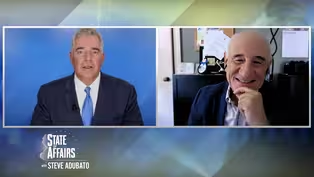
- Yeah, it's become a national crisis because it's no longer just about individuals picking up things here and there.
It's actually organized retail methods.
It's a new kind form of organized crime.
You might remember back in the day, people would like steal stuff off the back of a truck, and then they'd say, where'd you get this?
Oh, it fell off the truck.
- I have no idea what you're talking about.
- You have no idea what I'm talking about.
(laughing) But these days, because of the internet, what happens is, organized gangs are going into stores.
They are shoplifting huge amounts of sometimes everyday merchandise.
Putting the merchandise online, selling it online in an organized way, getting people to clean the money, money laundering.
And this has become so lucrative, particularly because reform laws, like bail reform laws have really reduced the sentences for this.
That what's happened is it's more than doubled in just the last five years.
And now, now we're starting to see retailers, especially in areas where this is taking off, closing stores, closing numerous stores I just wrote about.
There are more than 600 chain stores throughout New York City have closed since before the pandemic.
Not all about shoplifting, but that's part of the problem.
- So, Steve, let me ask you this.
You've been very critical, and we'll hopefully do another segment on you on how polarized our country is and where's the quote "middle", if there is any middle anymore.
Left, right, far, far apart.
You've argued that much of this is a product of extremely left-leaning progressive and beyond policies, regarding crime, no?
- Yeah, well, it's possible to go too far in either direction, right?
We can go too far and we can over police, but it's also in reaction to that we, can go too far in the other direction.
And we did things like, for instance, say, well, we're going to reduce the penalties to make a misdemeanor stealing even more than a thousand dollars of merchandise from stores now, only a misdemeanor.
And that seriously reduces the incentive for people not to do it.
In fact, one of the security experts I talked to, I quoted him as saying that shoplifting is now a low risk, high reward crime.
When you get to that situation, you tip over.
And many, many people take advantage of that.
And that's where we are now.
We've swung from one extreme, we don't want over-policing, to now we've got bail reform that has acted as an incentive for people to shoplift.
- But you know what's interesting, Governor Chris Christie running for President as we speak, things change all the time.
Taping in late December.
No, they do, they change all the time.
But Governor Christie led the bail reform effort in New Jersey.
Not a liberal democrat, a conservative Republican.
So how does party even play into this?
- Yeah, well you're absolutely right about this.
Part of the issue is just kind of misunderstanding the incentives that you're putting forward.
Now New Jersey has been lucky because New Jersey, and let's say part of this is actually because despite the new laws, New Jersey has been better at enforcing some of these laws.
In places like New York and Chicago, they've really defunded the police.
They're now taught, and now people we're talking about how that's the cause of the rise in a lot of street crime.
Street crime includes this kind of shoplifting that we're seeing.
So the incentives, it's not even a question necessarily of ideology, although clearly much of this reform has been driven by left-leaning prosecutors.
But it's possible to go back and forth too far.
We went too far in the era of policing.
We drove down crime, but then we kept driving it down in some places.
Now we've got too far in the other direction, and their response needs a new response.
- So Steve, let's be specific.
Our focus is less on politics and more on policy.
Name or identify a substantive specific policy initiative, a change in the status quo that would, if not eradicate, because it will not eradicate this massive shoplifting crisis that you talk about, that would improve the situation and reduce shoplifting, please.
- Yeah, I think it's pretty simple.
There has to be consequences for repeat offenders.
It's one thing to say if a kid steals something, and even if it's like a $500 something or other, right?
And he gets caught, well, we're not gonna make this kid pay bail.
We're not gonna let him sit in jail for six months or something like that.
But in a place like New York City where a guy was arrested in 2021, 47 times for shoplifting-- - Saw you write about that.
- Some days, right.
Some days he was arrested, released, went out and shoplifted again.
There has to be consequences for things like that.
So there's a difference between letting the kid go by who did it once or twice, and he needs to be taught a lesson and letting people create organized retail rings and do it 45, 50 times a year.
- Steve shift gears dramatically, and I don't know if it's that dramatic, but so many years when we started, we started the Caucus Educational Corporation in 1994.
We're actually celebrating our 30th anniversary in 2024.
Steve Malanga was on constantly with us, and a lot of the conversation was about the New York, New Jersey battle, the ongoing never ending battle for rateables, commercial-- - People and jobs.
- Yeah, jobs.
- Jobs and people.
- Yeah, people, employees-- - And money!
- Companies and money.
With the congestion pricing, not crisis, but battle going on, just do it, you got a few minutes left.
We'll do a separate conversation on democracy and danger, which is something I've been thinking about a lot.
Question, are we in danger of New York and New Jersey of cannibalizing each other at this point?
- Well, here's the thing.
It's ironic because it's always been a battle between New York and New Jersey.
- Always.
- When I first started writing for Crain's New York Business and coming on your show in the early 1990s, we were writing about all of the jobs that New York was losing to New Jersey.
So there has always been an interregional battle.
And various mayors and governors tried to say, we need to make peace.
And we were never able to make peace because it's really about dividing up a pie.
The problem is this, this region has been losing jobs of people to other regions.
And so rather than the pie getting bigger here, and therefore they're being less concerned when I lose something to New York, or New York loses something to New Jersey, the pie has been getting smaller in this region.
And that's part of the problem, we're now seeing it, certainly the pandemic has been a perfect example is New Jersey, New York, we're two of the leading states in terms of out migrations of jobs, and businesses, and money to other places.
So part of this, what you are seeing, this scrap, this ongoing scrap between New Jersey and New York, it's a little bit because the pie is limited, and we're being surpassed by other areas of the country.
- Real quick, before we go, isn't New York City trying to get New Jersey commuters who come into New York through one of the many ways you get into New York over the Hudson River, the shaft with this congestion pricing initiative?
- Well, I don't think that is their primary purpose because they are charging everybody else this too as a result.
But the idea here is almost outdated because it was, first of all, it was based on this notion that New York was too crowded.
Was too congested.
- That's right!
- And that's not healthy.
but that's not the case anymore after the pandemic.
If anything, New York needs to be attracting people, not repelling them, right now, New York City.
- That's Steve Malanga, Senior Fellow, the Manhattan Institute, by the way, 30 seconds.
The Manhattan Institute is, - It's a think tank, a free market think tank focused on cities and urban economics, which is not something necessarily that enough free marketers do.
- You heard that from Steve Malanga.
Hey, check out past on our website, past interviews we've done with Steve.
Hey Steve, thanks for joining us, we'll talk soon.
- Thank you.
- We'll be right back.
(grand music) - [Announcer] To watch more State of Affairs with Steve Adubato, find us online and follow us on social media.
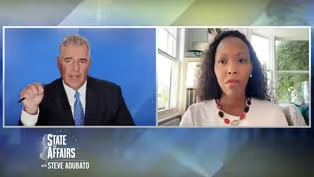
- Back by popular demand, we have Shennell McCloud, who is the CEO of Project Ready.
Good to see you, Shennell.
- It's so good to be here.
I'm very excited, because today is a very important day.
It's National Voter Registration Day.
So if you're out there and you're listening, please make sure to register to vote as we prepare for a very important election that's coming in November and beyond.
- By the way, we are taping at the end of September.
This will be seen later, but it's just as relevant.
So, Shennell, let's get right into this.
Again, there's a graphic that'll come up, Decision 2024: Democracy in Danger.
We're talking about democracy potentially being in danger for a whole range of reasons, but one of them is the inadequate, disproportionate, terrible representation numbers as it relates to women in public office.
The American Center for Women in Politics at Rutgers University put out a report that said, while 51% of the population in New Jersey happens to be women, 27% of those in elective positions are women.
What the heck does those numbers have to do with democracy in danger?
Or am I engaging in hyperbole?
- No, democracy is absolutely in danger.
And I wanna give some framing here.
What I think we see in New Jersey right now are a few things: a tipping point, a problem, and then, potentially, an opportunity.
First off is the tipping point.
As you all know, we unfortunately, and I've been devastated by this loss, Lieutenant Sheila Oliver, our lieutenant governor.
And what was very sad to me was, one, obviously the loss of such an incredible power player in the state of New Jersey who represented the issues of all, and especially the issues of Black women, but what I also realized is that we had no pipeline actually prepared in order to ensure that we could have someone who represents Black women in that seat.
I am very excited that Lieutenant Governor Tahesha Way has taken the seat, but it does leave the question, Steve, which is what is the pipeline?
And so now that leads us to the problem: New Jersey overall is still representing an old boys club.
White men hold all of the top positions of power at the state level, our governor, our senate president, our assembly speaker.
And I think Black women are at a place where we are tired of just organizing around the voting bloc and making sure that we're getting people elected into the office.
We're at a phase right now where we want to start claiming our seats at the table.
And so I think that leads us to the opportunity that exists, which is we're just a little bit less than eight weeks away from the November election.
There are over 120 seats that are open.
And what's exciting about this opportunity is there are about 30 or so seats that are open with no incumbent, which could make way for us to actually see a more diverse democracy, perhaps even us inching closer to a more fair democracy where we can start to see bedrock issues, like same-day voter registration, like, increases in equitable education.
- How about childcare?
- Yeah, I was just gonna say like childcare, and perhaps even a closure in the wealth gap that we all know deeply impacts Black women.
We can perhaps start to see some of those things shift across New Jersey, but we have to vote and we have to be working on a pipeline of Black women and/or people of color who are prepared to take these seats.
- You know, there's a male-female issue, but there's also gender issues, obviously, but there's race as well.
Just wanna clarify that we just recently had the chair of the Essex County and the State Democratic Party, LeRoy Jones, on who happens to be a former legislator and an African-American man.
But unless I'm wrong, and I know you'll correct me if I am, I don't believe there are any party chairs, I'm pretty sure in the Democratic party there are no women as party chairs, and I don't think there are in the Republican party, 21 county chairs.
I don't wanna get into the weeds, but the county chairs have a lot to say with who runs, who doesn't run, where you are on the ballot, all kinds of those things, who gets the party line.
I know it's in the weeds and the mechanics of- - No, it's important.
It's important.
- Right.
Go ahead, Shennell.
- We have to pull up.
it's important, and I think you bring up a very valid issue, which is that the party line, I believe and I believe most of us believe, actually holds us back from being able to diversify our democracy across the state of New Jersey in the spirit of being able to see New Jerseyans, and as I stand here today I'm representing Black women, to be able to see Black women actually get their issues addressed.
We have to start blowing up the party line, blowing up this concept that that is the only way that you can get your seat at the table.
Which is why- - How?
How do you blow up a system that's been in place over 100 years and say, "This isn't working," because it's clearly not as it relates to being more representative of the population, both in terms of race and gender.
How do you blow it up?
- It's a good point, and one that Project Ready, the social justice organization that I'm representing, has been trying to tackle.
We're starting off with just making sure that people are actually voting, Steve.
Across the state of New Jersey, there are over six million registered voters who are eligible to vote and who can actually make a difference.
And what we're finding is that more of our voters, specifically our youth, are not excited about voting.
We believe one of those reasons is that they don't see enough representation of themselves and people who ultimately represent them in the seats.
And so I believe the second solution, which is also something we're working on at Project Ready in partnership with our national partner, Ignite, is to actually begin to prepare Black women to take these seats, to prepare them to know that there is an opportunity, that you don't have to subscribe to the party line just to run for something.
And if we get enough voters to activate around this, then we can actually start to see a real difference, - You know, promise that you'll keep this conversation going with us because there are so many aspects to this, including the 2024 election for President.
Someone might say, "Well, why would you even talk about that?"
Because if the candidates are President Biden and former President Trump, that has implications on a lot of levels, and even as it relates to the issue we're describing right now, a more representative, if you will, democracy.
Shennell McCloud- - Yes, and, Steve, I love that.
I just wanna emphasize- - Real quick, go ahead.
- we should not just be talking about the presidential, we should also be thinking about the 2025 gubernatorial.
These are elections that seem far away, but they're actually right up close and personal.
And what we do today will dictate the future that we have tomorrow, a more equitable future.
- Shennell McCloud, CEO of Project Ready.
Thank you, my friend.
We'll talk soon again.
- Thank you, Steve.
Thanks, Steve.
(laughs) - Stay there, folks.
I love the energy.
We'll be right back after this.
(grand music) - [Announcer] To watch more State of Affairs with Steve Adubato, find us online and follow us on social media.
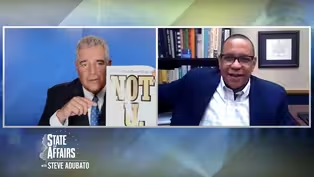
- Talking about the future of higher education with someone who knows higher ed better than most, Dr. Dale Caldwell, President of the Centenary University.
Good to see you, my friend.
- Good to see you again, Steve.
Thanks for having me.
- Hey, listen, do you mind if I do this?
Our partners at NJBIZ, our media partners put out 50 top leaders in education.
Look at who's in the top 10.
What number is that?
Nine.
You're in the top 10 of top education.
- I'm honored.
- Go ahead.
- No, man, I'm honored.
There's so many incredible people.
It's really a blessing to be there.
So it was fantastic.
- Yeah, I'm not gonna make a big deal that I made the list either, 'cause I don't like the attention.
- Well, you are a superstar.
Everybody knows you're a superstar.
So.
- Hey, Dale, I'm not fishing for a compliment, but I'll take it.
(Dale laughs) Hey, listen- - It's a fact, man.
It's a fact.
(hands clapping) (Dale laughs) - Let's do, I gotta do this.
Another publication, not NJBIZ, but the New York Times, the Future of Higher Education.
I know, Dale, and I didn't even talk about this, but we share a mind sometimes.
A brain.
He read this.
This article- - I have it right here.
Yeah, I have it right here.
(laughs) - I'm reading it again last night saying, how many people across the country are saying higher ed doesn't have the value that it used to have.
The college, the student debt that people are acquiring, and what they're making because they went to college doesn't add up anymore.
The economics are off.
College is too expensive.
"Not U."
That's what it says.
- Yes.
Yes.
- Higher ed, in danger?
Talk to us.
- Well, the reality is there are a couple things going on.
One, the middle class is disappearing.
So the relative cost of higher ed has gone up, even though the actual cost really hasn't gone up as much as people think.
But the research still shows you make well over a million dollars across your lifetime if you go to higher ed.
- So, hold on one second.
So you're saying the economics of making a million dollars more, is that, you're saying Dale, by itself makes higher ed, or college, university life warranted?
Even though we have one son at Syracuse, the other one at Fordham, not cheap, no scholarships, not crying the blues, but I'm sitting there going, "That adds up."
And we're fortunate enough to be able to do that.
Most families are not.
That's absurd, the, and I don't wanna say what the costs are.
It's crazy what those college costs are.
Go ahead.
- Yeah, no, it's very, very expensive.
But there are a couple things.
So one, innovative universities like Centenary are doing programs.
We started something, we'll talk a little later about, called the working BA.
So you can actually go ahead, work, and still get your college degree for a very affordable price.
But college also gives you intercultural competence, analytical skills, things that will help you get a better job in the future, rather than just going right to work.
- All right, try this.
The Future of Higher Education, graphic up, is also greatly impacted by the decision of the United States Supreme Court to strike down the use of race as part of the criteria that is used for high school students graduating, and others trying to get into universities, particularly prestigious universities.
What do you believe, Dr. Caldwell, the long-term implications are for, of that decision, A, and B, what are some remedies to keep the level of diversity in higher ed?
- Well, I actually wrote an article really immediately after that decision.
I was actually at the New President's Program at Harvard, about 61 other presidents, and I sent it out to them, and they said, "What we have to move to is something called life circumstances admission, LCA."
And the idea is to really look at the life circumstances, maybe it's race impacts, it may be gender, sexual orientation, poverty.
But we need to look at every single candidate to see if they have grit, if they have what it takes to succeed.
- Grit.
- It's not just the test scores.
- Describe the grit.
I'm a big fan.
You did our Lessons in Leadership show, our sister program with my colleague, Mary Gamba.
You and I talked about grit.
You and I believe in grit.
You're old school, I'm old school.
Which just sometimes means we're old, but the reality is we believe in grit.
Define it.
- It's the persistence to work through any problems ahead of you.
It's having emotional resilience, is that no matter what curve balls have been thrown at you, you're able to try to work through them, and you have a commitment to success.
And that's learned, it can be learned or it can be innate, but it's a critical component for being successful.
We wouldn't be on here, Steve, if we, if both of us didn't have grit.
It's a key to succeeding in the world.
- Also, the other key to succeeding in higher ed is collaboration, innovation partnerships.
You have a partnership, Dr. Caldwell, I want you to talk about.
Is it the Cyclones partner?
What does the Cyclone Partnership, and what does that have to do with football?
- So we actually, our mascot are the Cyclones, Sussex County College are the Skylanders.
So we call it the Sky Clones Program.
And it's an incredibly innovative, we were the first to do it, where we have now a hundred football, and basketball players from around the world who come to Sussex College, but they don't have any place to stay.
So they're staying on the Centenary campus, they're eating on the campus, they're benefiting from our social, emotional development.
And it's been an amazing way to integrate very diverse populations in this university.
So we've become a very diverse university in one of the least diverse parts of the state of New Jersey.
- Dale, the other thing about your background, as you've been in state government, you've been in the private sector, but you also have volunteered, if you will, as a board of, were you the President of the Board in New Brunswick, President of the Board of Education?
- Yeah, President of the Board of New Brunswick.
Yep, absolutely.
- Okay, so you get it from the community level as well.
Why is, shifting gears dramatically, why are New Jersey schools among the most segregated schools in the United States of America?
It is not a new issue.
It's been going on forever.
Do we, Dale, my longtime friend, choose to live separately, and send our kids to schools that we choose to send them to?
And it just winds up, they're segregated, this is all the years after the 1954 Brown versus Board of Education, separate does not mean equal, not okay.
Right?
- Right.
- I mean, what's going on in New Jersey?
- Well, I mean, the reality is that I wrote a book on influence, and people are influenced, it's not, it's influence-cism rather than racism or other things.
Is that, "I wanna be with this group."
So we're the sixth most segregated school system in the country.
Mississippi has a more diverse public school system than we do.
And so I've been president for six years of the New Brunswick Board of Education, which is 95% black and Latino.
East Brunswick is 80% white and Asian.
Those two right next to each other, in a lot of states they'd be combined, and you'd have a very, very diverse school system.
- What happens if you propose that, Mr. President?
You're the president of the board, you propose it and you say, "Let's come together."
- There are a lot of jobs that people, we hired, actually, Jordan Glatt is my VP of advancement.
Jordan, as you know, is one of the dollar a year paid czars of shared service.
That's one of those things.
It doesn't mean you have to lose your control of your local town.
You can really have some interaction- - And people, sorry for interrupting.
But part of it's economic and jobs, and sorry for interrupting, but I gotta do, is part of it that people do not, many people do not want their kids going to school with other kids who don't look like their kids?
- And the reality is that people have assumptions about groups.
They have assumptions that said, "I don't wanna be in those."
I will say a reality about New Brunswick, I love New Brunswick, but up until middle school, most of 'em, it's actually fairly diverse.
But in middle school, at the end of middle school, a lot of the white folks go to, they used to go to Catholic schools, now, they're going to other schools.
So the high school has very few white students in New Brunswick.
- Dale, I wanna thank you for joining us.
We'll continue the conversation with Dale, and that's it for this edition.
That was an awkward close.
I know, I've been doing this 30 years, you should get it right.
(Dale laughs) We'll see you next time, folks.
Thank you, doctor.
See you next time.
- [Narrator] State of Affairs with Steve Adubato Is a production of the Caucus Educational Corporation.
Funding has been provided by Robert Wood Johnson Foundation.
New Jersey Sharing Network.
Citizens Philanthropic Foundation.
Community FoodBank of New Jersey.
PSC.
The Port Authority of New York and New Jersey.
The New Jersey Education Association.
Englewood Health.
And by The Adler Aphasia Center.
Promotional support provided by NJ.Com.
And by NJBIZ.
Every person and organization has a story to be told.
Not just famous people, but business leaders, public servants, doctors and nurses, educators and coaches.
At PSC, your story is our business.
For more information, visit Princeton SC.com.
The Cost and Future of Higher Education
Video has Closed Captions
Clip: S7 Ep22 | 9m 18s | The Cost and Future of Higher Education (9m 18s)
Shoplifting as Organized Crime and Consequences Needed
Video has Closed Captions
Clip: S7 Ep22 | 9m 46s | Shoplifting as Organized Crime and Consequences Needed (9m 46s)
Why We Need More POC and Women in Public Office
Video has Closed Captions
Clip: S7 Ep22 | 8m 42s | Why We Need More POC and Women in Public Office (8m 42s)
Providing Support for PBS.org
Learn Moreabout PBS online sponsorship
- News and Public Affairs

Top journalists deliver compelling original analysis of the hour's headlines.

- News and Public Affairs

FRONTLINE is investigative journalism that questions, explains and changes our world.












Support for PBS provided by:
State of Affairs with Steve Adubato is a local public television program presented by NJ PBS