The Double World of Magpie Murders
short | 05:32 | CC
"Is Atticus in her imagination?...Is he a dream or is it magic?" Author, Writer, and Executive Producer Anthony Horowitz explains the link between Susan Ryeland and Atticus Pünd.
(suspenseful music) (engine roars) - Hmm.
- Hmm.
- Do you mind getting out?
- Hmm.
- I'd like to talk about the relationship between Susan Ryeland and Atticus Pund because when at the very start of the process I realized I was going to have to bring together the world of the 1950s and the modern world of Susan Ryeland and publishing, I saw that Atticus and Susan would be on the screen in alternate scenes, and I began to wonder would that be good enough?
Why was it that if they're just seconds apart from each other, shouldn't they be, perhaps, at some stages together?
And so I began to think of this idea of Atticus crossing over into Susan's world, which he does for the first time in episode one, there's just a brief glimpse of him in London.
But then in episode two, suddenly he's in her bedroom at the foot of the bed trying to tell her that actually Alan Conway has been murdered.
And the relationship develops as the series goes on, until, towards the end, I think they are really very close.
It's almost like, sort of, a love affair across two dimensions.
That was sort of in my head.
- So why are you so angry now?
Let me give you some advice, Miss Ryeland.
- Yes, all right.
But can you please stop calling me Miss Ryeland?
It's so bloody '50s.
- I think it's interesting that Susan doesn't exactly have a side gig, but she does have Atticus.
And I'm asking the viewer, really, to make up their mind for themselves.
Is Atticus in her imagination?
Is he crossing the dimension?
Is he a dream or is it magic?
I mean, it's up to you to decide.
- I was only putting forth certain possibilities.
- Yes, well, I don't want to hear them!
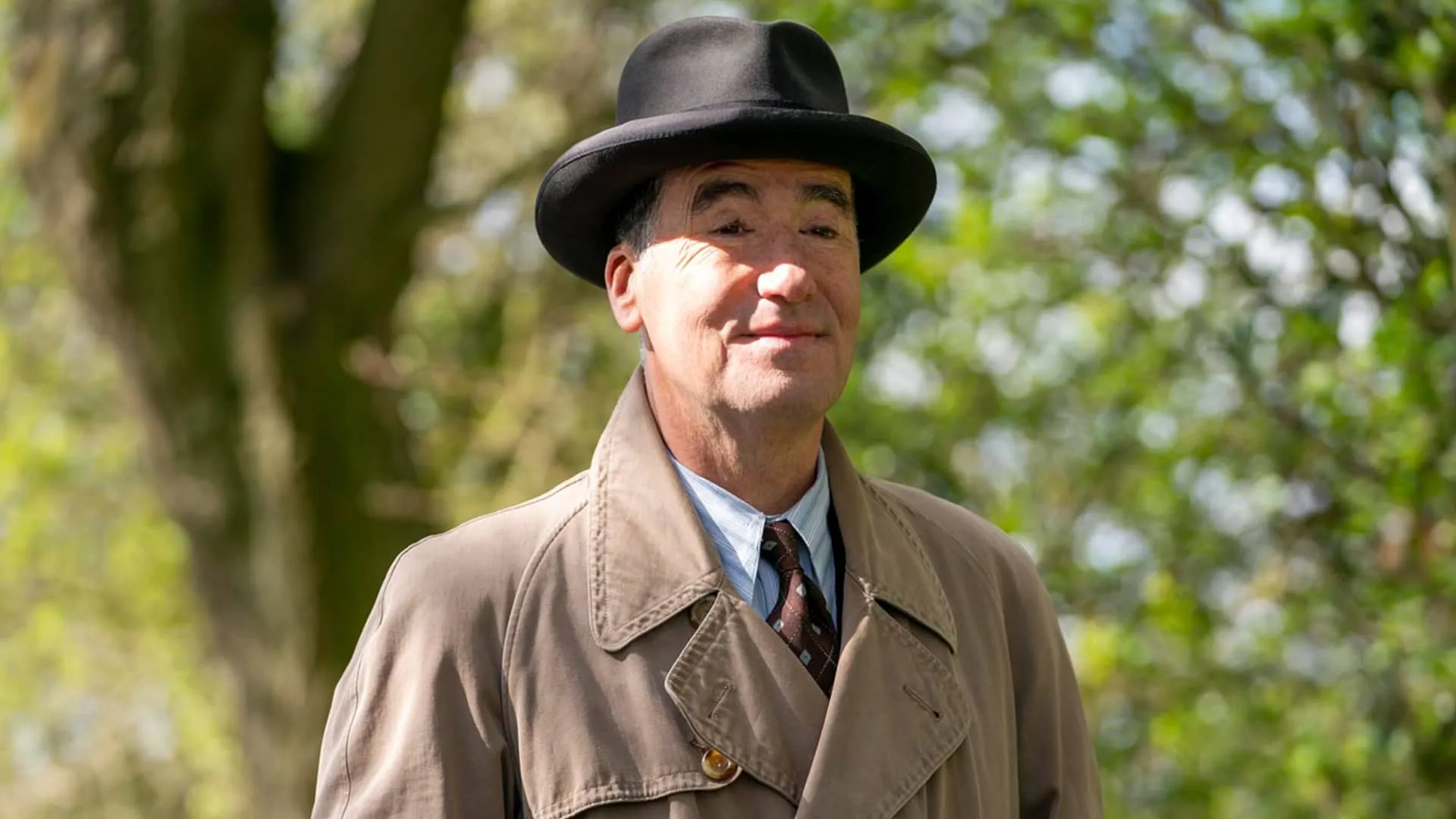
- Pund is very much Susan's mentor.
I mean, after all, he is a detective and she isn't.
But I think what also makes the relationship interesting is that he only exists in the book.
And anything that is not in the book must therefore be outside his experience.
A good example is that she quotes at one stage from a poem by one of my favorite poets, Stevie Smith.
The poem is "Not Waving but Drowning."
And, of course, because that poem was written after Atticus Pund has died, and after "Magpie Murders" has finished, he cannot even have heard of that poet and knows nothing about it.
And so it's quite interesting that his knowledge of everything only comes out of what is written in the book, which has huge ramifications for Susan when she discovers that her father was also one of the characters and that her life has been dragged into it by Alan Conway.
- She's in the book?
My father?
They're both there, aren't they, all of it?
Oh, my God.
- We tried to make the two worlds as seamless as possible.
And working with Peter Cattaneo, the director, and with the script editors and with the producers, we tried to find ways that we would cross from one world to another without anybody really even noticing.
The magpies were very useful for that, because a magpie could take off from Susan's garden in London and fly into the air and then land at the church in Saxby-on-Avon, having traveled back in time 60 years, and would now be back in, sort of, 1955.
But again, you know, we had characters who might walk up to the door of Pye Hall and ring the bell.
But when it's open on the other side, it's actually Abbey Grange, and it's again jumped forward or backwards in time.
- I'll go down if you like.
- Oh, thank you James.
- Visually, it is the sort of the joy of this series.
I'm not sure that anybody has ever done it before.
This murder mystery that plays in two completely separate universes which have a number of invisible bridges between them.
- [James] You are maddening, Pund.
If you know something, why can't you just spit it out?
- To know something is not enough, James.
It's when I know everything that I will speak.
- I was very aware of the fact that I couldn't have two massively complicated mysteries in this one show.
So, in the book, for example, the death of Sir Magnus Pye has got many, many more suspects than actually appear in the TV series.
I had to really thin them down.
- [Atticus] You have made some progress.
- No, no leads.
- The 1950s stories, there are all sorts of different motives for wanting to kill Sir Magnus Pye, whether it's his sister who is jealous of him, or the villagers who want to stop Dingle Dell being developed, his wife who can't stand him and might be having an affair, all these sorts of things.
I was less interested, I think, in the nuts and bolts of the who done it in the modern world.
I mean, that's part of the fun and the pleasure of Golden Age Detective Fiction, these, sort of, larger than life characters with their extraordinary motives and their emotions.
But in the modern world, which I wanted it to be more realistic, so I had to invent a whole area of new material, particularly around Susan, to sort of give her more to play with.
So, the story of the father doesn't actually appear in the book.
Katie does appear as a character in the book, but the relationship between the two of them, and this, sort of, secret in their own past and the circumstances surrounding the death of their mother and all that was added onto the modern section of it, in other words, to give it, if you like, an underlay, an extra depth, so it wouldn't just be about who killed Alan Conway.
(suspenseful music)
RELATED CONTENT
MASTERPIECE Newsletter
Sign up to get the latest news on your favorite dramas and mysteries, as well as exclusive content, video, sweepstakes and more.