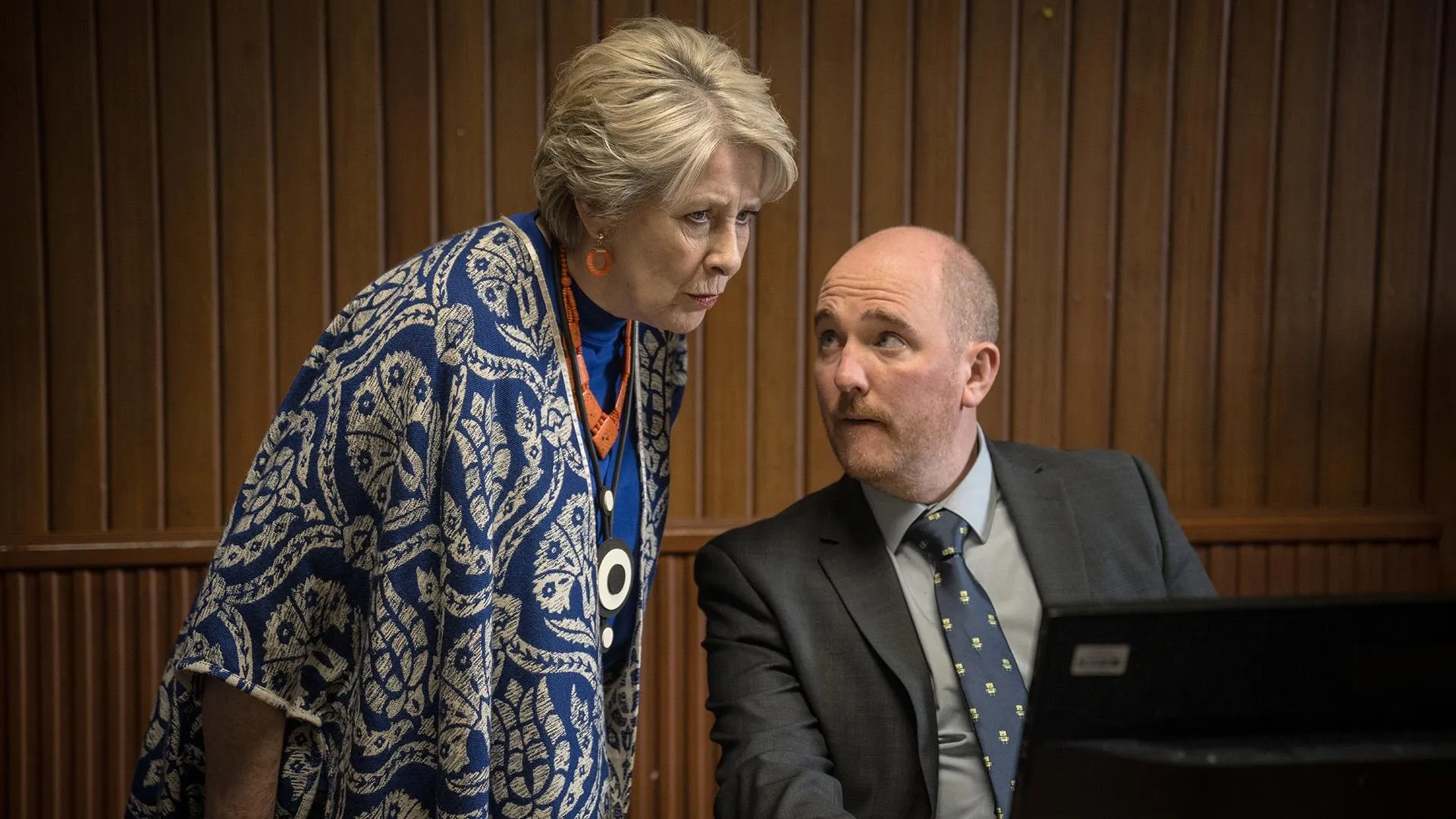
Kate Phillips & Rachael New, Miss Scarlet Season 6
Released February 19, 2026 NaN:NaN:NaN
WARNING: This episode contains spoilers for Episode 6 of Miss Scarlet Season 6.
At the start of Episode 6, Eliza Scarlet and Alexander Blake are told they cannot work together and be romantically involved. But things have a way of working out for Eliza Scarlet. In this bonus episode, actor Kate Phillips and writer Rachael New return to the podcast to look back on this riveting season, and glance towards the future where all the stars seem to be aligned for our favorite Victorian-era private detective.
This script has been lightly edited for clarity.
Jace Lacob: I’m Jace Lacob and you’re listening to MASTERPIECE Studio.
An ominous darkness enshrouds the dilapidated Faversham Asylum. As Eliza Scarlet skirts her way through the abandoned building’s serpentine hallways and into the cavernous basement, whose crumbling walls are held upright by decades of cobwebs, a mounting suspicion tells Eliza she isn’t alone.
CLIP
Eliza: Hello? Who’s there? Alexander? What are you doing here?
Blake: Well, I received an urgent note to come to this address.
Eliza: As did I. Condemned Asylum. I can think of nicer places to meet.
Miss Scott: Welcome to my office.
The elusive intelligence operative Miss Scott has summoned Eliza and Blake on an urgent top secret matter. The two are to work together on an unofficial, off the books government case. Blake is promised more resources and Eliza twice her normal fee. But, there is one catch.
CLIP
Miss Scott: This investigation is strictly off the books. Do whatever you need to do, just, um... be discreet. Oh, there is one more thing. That unpleasant business of the young lady caught spying around Scotland Yard means there will be some changes coming down the line. All officers will be made to sign a declaration of interest, outlining any relationships with those they deal with in the line of duty. So, given the two of you are now... romantically involved, this will be the last time you work together.
Throughout the case, Miss Scott does her best to talk some sense into Eliza, telling her not to fall in love as her business and reputation, everything she’s worked so hard for, will be compromised. In the end, Blake and Eliza solve the case and Blake is promoted to Superintendent, ensuring the future of both their romantic and professional relationships. But Miss Scott's words of advice rankle Eliza: perhaps she does need to be more ambitious. And so Eliza makes plans to expand her private detective agency and welcomes a sea of prospective applicants, all of whom are women.
CLIP
Eliza: Welcome everyone! Please, please do come in.
Applicant: Morning.
Eliza: Hello.
Today, we’re joined by Miss Scarlet star Kate Phillips and creator Rachael New to look back on this riveting season, and glance towards the future where all the stars seem to be aligned for our favorite Victorian-era private detective.
Jace Lacob: And this week we are back once again with Miss Scarlet star Kate Phillips, welcome.
Kate Phillips: Hello, hi.
Jace Lacob: Hi. So, Episode Six opens with a meeting at Faversham Asylum with Lindsay Bennett-Thompson's spy, Miss Scott, who throws a spanner into Eliza and Alexander's romance thanks to new rules about fraternization. She says,
CLIP
Miss Scott: All officers will be made to sign a declaration of interest, outlining any relationships with those they deal with in the line of duty. So, given the two of you are now... romantically involved, this will be the last time you work together.
Jace Lacob: What's at stake here for Eliza in this episode?
Kate Phillips: A number of things. Her business is the obvious one. Without access to Scotland Yard, she doesn't have many other avenues for means of work. And even if she's found work elsewhere, she often has to work alongside Scotland Yard. So it really just means the end of the business if she's no longer allowed to work alongside Scotland Yard and well, alongside Blake.
Interestingly enough, there's not really a very serious conversation about breaking up, which I think really goes to show that their relationship has reached a level of real commitment. If I'm remembering correctly, I feel like they talk about it in a very mature way, she doesn't lose her head over it. But also, I think with Eliza, she's quite resourceful, and I feel like she probably thinks we'll work something out. There's always another avenue. There's always an underground. There's always someone to get her in the back door, you know?
Jace Lacob: She does take it in her stride. She says, “If this is to be our last case, we ought to make it count.” Really just the whole sentiment behind it is, well, we're just going to make this one count. And she doesn't fall apart. She doesn't overthink it. And as you say, they don't consider breaking up, like the heart has trumped over the purse.
Kate Phillips: You know what it really has. And that's not something that we've seen before. So good on her!
Jace Lacob: Good on her, good on her. I mean, Miss Scott seems to be emblematic of the restrictions imposed on women in the Victorian era, or even in the modern era. Eliza wants the romance, she wants the career. But Miss Scott indicates that she can have either, but not both.
CLIP
Miss Scott: Are you in love with him?
Eliza: Pardon?
Miss Scott: It’s a simple question.
Eliza: And one that bears no relevance to the investigation.
Miss Scott: I'll take that as a yes. So, may I give you some advice? As two women working in the underbelly of this great city, I am sure we have faced similar challenges. One of which being loneliness. And of course, each man carries his own, uh, merits when it comes to passing the short amount of time we have on this earth. But to love someone fully, completely, that would be a mistake. For a woman, financial independence is everything. Do not make the mistake of trusting in a man. Any man. They will always put their own needs above ours. Without exception.
Eliza: That's a rather bleak view and one that I don’t share.
Miss Scott: Yes, you do.
Jace Lacob: What did you make of Miss Scott's role within the narrative here, and what she's representing for Eliza?
Kate Phillips: I think the role of Miss Scott is an interesting one because she herself is a woman that's had to fight for her voice, for her position, for her role. And I think perhaps she looks on Eliza sort of having it all, having a relationship, having a successful work life. And perhaps she finds it quite threatening. And whilst Miss Scott, in Eliza's eyes up until now, has been a real kind of beacon of, oh, look, here's a very strong, independent woman carving her way in this very masculine world. I think Miss Scott actually struggles perhaps to look on Eliza's choice to be and to prioritize a relationship. I think she finds that very difficult and doesn't understand it. And maybe she's right. Maybe she's right in saying that they can't work together. However, I think she's clearly making a point to Eliza about enforcing that rule.
Jace Lacob: I mean, she tells her flat out not to fully trust Blake. And she offers Eliza one more piece of advice,
CLIP
Miss Scott: You have made your decision about Inspector Blake?
Eliza: I won't be giving him up. Not for anything.
Miss Scott: In that case, your fee will not be twice the normal rate as agreed. It will be a great deal more.
Eliza: Why?
Miss Scott: Because you’re going to need it. And because I like you, Miss Scarlet. You’re good at your job. Use the money however you see fit, but please... be ambitious.
Jace Lacob: How does Eliza interpret that counsel, that urge to be ambitious above all?
Kate Phillips: Certainly her initial response is she just doesn't share that viewpoint. I think Eliza has come so far in her life now. I think that would have been true with her relationship with the Duke. But I think she's come to love and respect Blake and recognizes that there are many men that Eliza has encountered over her time that she would not trust and that probably are all those things that Miss Scott has called out. But I think that Eliza is very sure that Blake is not one of those. And that she's come this far and maybe with just a little bit more work, she can have both those things.
But I think it shakes her a little bit. I think it makes her question it, and then she goes on her journey. And I think what we're pleased to discover is that she comes to a conclusion where maybe Miss Scott has just been so badly damaged over the years that she's lost her trust. But again, what we love about Eliza is that she never loses her faith in humanity and people. And she can be cynical, but in her heart, she's got real warmth and she continues to improve on herself. And I think she sees the best in people.
Jace Lacob: I think she takes a different piece of advice from Miss Scott than the intended one. She's going to hire some new detectives, and it's a sea of women who Eliza greets as they walk up the stairs to her office, and Eliza smiles and closes the door. And this is really the dawning of a new age, I think, in this narrative and in this world. How surprised were you by this ending to Series Six when you read the scene in the script?
Kate Phillips: My reaction was to weep for joy. It's so cool. It's just great. I mean, the image of all of these women arriving on the page was really thrilling. And then when it happened in reality, it was just great. It's really exciting. There are so many moments of Rachael's writing that just give me tingles, and that was one of them.
Jace Lacob: That scene to me cuts to the feminist underpinnings of Miss Scarlet as a narrative, paying off the very conceit introduced in Season One. Eliza may finally have gotten her own shingle earlier, but here she gets to control her own destiny and that of the women she hires. And we see that with Ivy's promotion, with Sophia's perspicacity, with Eliza hiring this pool of smart young women. Does it feel like the world is changing in Victorian London for women?
Kate Phillips: You know, it's difficult to know what was really happening in Victorian London at that time, whether the emancipation of women was really being felt in the streets, in people's homes, in people's offices. But I think in the world of Miss Scarlet, I think you do feel that really richly. In her home, you have a woman who was originally a maid who couldn't read or write, who now runs her own department at Scotland Yard. You have a younger woman who's running her own business and who is employing a number of other, well, you'd hope, a number of other women, they're in her employ. And so, yes, I think in the world of Miss Scarlet, times are changing. And there has been a real sense of movement that feels like a real rich movement in that direction.
Jace Lacob: Kate Phillips, thank you so very much.
Kate Phillips: Thank you.
MIDROLL
Jace Lacob: And this week we are joined once again by Miss Scarlet writer, director and executive producer, Rachael New. Welcome.
Rachael New: Hi, Jace. Thanks for having me.
Jace Lacob: So, before we dive into the final episode of Miss Scarlet Series Six, I want to take a moment to reflect on Episode Five, which I think is a high point for the series. It is written and quite magnificently directed by you, which takes place at Scotland Yard. What was the idea behind this claustrophobic bottle episode, and how did it come together?
Rachael New: Well, you said it. We wanted something that did feel claustrophobic. We wanted to put Blake at the center of this and push him to his limits, and just to really kind of peel away those layers. We've seen him in the previous episode up against it. He's broken up with Eliza. He's almost lost his daughter. He's very stressed. And now, in Episode Five, we see that most of his men are off sick. There's a storm coming. So we're just piling as much on poor old Blake as possible because that's where the best, the most juicy drama is.
Jace Lacob: Sam Buchanan told me this was actually the first episode he shot on Miss Scarlet. How did scheduling play a role in kicking off production with this immense installment?
Rachael New: It was pretty tricky. What we did do with Sam and Isabel, so Isabel Summers, the lady he meets at Scotland Yard and falls in love with, we actually shot their scenes first so that they could actually at least meet and give the actors something to grab hold of before then being thrust into Episode Five, where everything comes to to a head. But Sam did it just wonderfully. He just embraced it. It was quite something, the new kid on the block, and then suddenly he's thrust into this quite central role. And it's a different type of Scarlet episode. There's a lot of action in it, lots of two-handers with him and Blake. So, yeah, he wasn't given the luxury of building up his relationship with Tom, who plays Blake, or Grace, who plays Isabel. But he just embraced it, and he just did a beautiful job.
Jace Lacob: It is very action packed, but I think it's also a very emotional episode. It is an episode that offers a real showcase for Sam and Tom Durant-Pritchard. And I asked both of them about the very emotional scene that they shared at the gate. But I'd love to get your read, because to me, this is such an extraordinary piece of both acting and writing. To have these two Victorian era men allow themselves to be vulnerable with each other. Where did the idea for this scene come from, and how do you feel Tom and Sam brought it to life?
Rachael New: Well, I was absolutely delighted, their performance was absolutely stunning. And added to that, just to give you a little bit of behind the scenes, there was an awful lot of special effects in this episode. We had to do a kind of a reverse of Scotland Yard, and that was all special effects. So there were lots of green screens. There were rain machines. We had the lightning. I don't know why I agreed to direct it because once I was in it, I was like, what have I done? Why did I do this? Luckily, we survived it.
So there were a lot of elements thrown at them during this very, very emotional scene. And it's beautifully done, I think, because they keyed into their characters. They're both essentially pretty much kind of single, not single parents because obviously Willows’ sister is at home, but they're both… Willows is sort of guardian of his sister's baby looking after them. Then you've got Blake, who is essentially a single parent, so they both understand what it is to be a father, and they're both looking at, are they going to make it through the night?
So the episode is like this pressure cooker and that is bringing everything to the fore, where these two men who have grown to become trusted colleagues and I would say friends, they are sharing this very tender moment because they don't know what's ahead of them at this point. They're standing there with their rifles and not knowing how things are going to turn out. And they've both got children at home that they love and that are reliant on them. So, I think that just brings out this very tender moment between them. And yeah, it’s really moving to watch. When I was in the edit, every time I watched it, it was like the first time I saw some little nuggets of something new. It was very special.
Jace Lacob: I love it. The betrayal by Isabel Summers is such a delicious rug pull for the audience, and I had no idea that this new pairing, which begins with what seems like the most innocent of meet-cutes, would end in betrayal and heartbreak. Was Izzy's betrayal always baked in from when you started to break the story for Series Six?
Rachael New: Yes, absolutely. We knew we knew she would be a traitor in the end. And we wanted the audience to invest in her. It also gave us an opportunity because they literally meet in their first moment on their first days in their new job. So that binds them together automatically. She's lost and asked for directions. And he says, well, this is my first day too. So straight away they're bonded. And then this very sweet relationship begins between them. And yeah, it's lovely and seemingly innocent and she does have feelings for him, that's quite clear. But she was placed in there by Dylan Cooper. And that was always going to be the case where he would call on her when it was needed. And that's what happened.
Jace Lacob: This week does see the return of Lindsay Bennett-Thompson's spy, Miss Scott. She surprises Eliza at Faversham Asylum. And I asked Kate about this, but I would love to dive in with you as the show's creator. Miss Scott is emblematic of the restrictions imposed on women in the Victorian era, or even in the modern era. And Eliza wants romance. She wants a career. But Miss Scott indicates she can have either, but not both. How did you, as the show creator, look to use Miss Scott within the narrative?
Rachael New: I just wanted her to give Eliza a bit of a reality check so that whatever decision she makes, she's not just sort of floating around on a cloud of love, just going with it. Eliza is quite a cerebral woman. And I think the governess, in saying, look, I'm older than you, I've been around. I know through bitter experience that men will let you down. And you've got a choice, it's your career or your love life. And this does hit Eliza quite hard. And she does chew on it. And I think that's really needed with her. She needs to process, she needs to digest so that when she does choose Blake and chooses to stay on this road that she's been set on, it comes from an absolute certainty that this is real love. He is a really decent man, and she does believe she can have it all. So in some ways, even though it's harsh, I think the Governess is really crucial to someone like Eliza, how how she ticks, how her mind works.
Jace Lacob: Do you see her as offering a dark reflection of Miss Scarlet, of what Eliza might become should she choose to walk alone? Or is Miss Scott right, and Eliza would be better off alone and self-sufficient?
Rachael New: I think there's a point where what she's pointing to is almost what Eliza used to think. We've seen Eliza reject love in the past. And because she knew that it would affect her job and it would affect everything for her being an independent woman. And it's a kind of cautionary tale that just, I think, sets her even more determined on a path of having the man she loves and having the career she loves. She doesn't want to end up like Miss Scott.
But the truth is whether she would end up like her or not, who knows, but Miss Scott's kind of, in this particular era, she's probably right. What happens to her is what would happen to most women. Most women wouldn't even have a career. And if they did, they certainly wouldn't have a man to stand by and watch them have a career. So I think it's a combination of many things, but at its core, it convinces Eliza even more. I don't think it's her saying, well, I don't want to end up like you, bitter. I think it's just a case of her being even more sure that this is what she wants and that she can trust in it.
Jace Lacob: So Series Six begins with Eliza and Alexander in their bubble, looking to keep their relationship a secret, and it ends with an episode in which they believe they must declare their relationship officially to Scotland Yard to Blake's daughter, Sophia. Is the bubble well and truly punctured at this point, or is their relationship stable enough to withstand any pressure?
Rachael New: I think their relationship, they're home and dry by this point. They're working together. They're going to prioritize this relationship that they've got. They're willing to make sacrifices. I think when they broke up in Episode Four, and then got together at the end of Episode Five, that was confirmation for both of them how deep their love is for each other. They're solid. They're solid in this episode, and they're working together and they're accepting that that's life. And they'll just muddle through if they have to.
Jace Lacob: So Blake won't have to tell the superintendent about their relationship, but only because Blake has been promoted to the role himself. He says it's what he wants. And Eliza won't have to stop working with Scotland Yard, as he won't be the detective hiring her. Does it feel like everything worked out to Eliza, or does it feel like there's another shoe to drop?
Rachael New: At this point, everything has worked out for both of them because for her, she can carry on working for Scotland Yard. And as for Blake, he's got a daughter. He doesn't have a hero complex. He likes the idea of more money, more stability to raise his daughter. So it's the best outcome for both of them at this point.
Jace Lacob: We come to my favorite part of the series. Eliza is going to hire some new detectives, and it's a sea of women that Eliza greets as they walk up the stairs to her office, and she smiles and closes the door. And it is the dawning of a new age. How long did you have this image in mind, a queue of young women looking to be hired by Eliza, which to me underlines the entire feminist underpinnings of Miss Scarlet?
Rachael New: For quite a long time. It was always a scene that we had in mind. It was just always a case of when would we play that? But that was always the aim, that she would employ women to come and work for her and be detectives and give them the opportunity that she really had to fight tooth and nail for. I'm sure the writers have this on every show, but there's always those key moments and those key scenes where you can visualize it. It was beautifully directed by our director, Ivan Zivkovic, with the flow of women. We see it from Eliza's point of view and we see her shock that all these women have turned up. And again, it's a bit of a rug pull because I'm hoping the audience thought it was going to be a stream of men. And that was the point, it was always going to be women. But yes, Ben and I had that in our mind for a long time. It was just a case of what we needed to build to in order for that to be earned.
Jace Lacob: Willows might snicker about a woman running the yard, but with Ivy's promotion, Sophia's perspicacity, and Eliza's hiring pool of smart young women, it does feel like the world is changing in Victorian London for women. At this point in the show's run at the end of Series Six, how important was it that we feel that change?
Rachael New: Yeah, I think you just have to keep progressing and keep giving something because it's no different to now. Things do change, things do progress. And it's one of those things where you just want to feel those shifts. And there is a shift happening. So I think that's super important. We've tried to do that throughout the seasons, even when Patrick Nash arrived all those seasons ago and was basically saying, I couldn't care less whether you're a woman or not, are you good at your job? So just to see those little moments, those little shifts are hugely important in every season.
Jace Lacob: Rachael New, thank you so very much.
Rachael New: Absolute pleasure. Thank you, Jace.
Next time, the holiday spirit is alive and well in Darrowby as everyone races to finish their last-minute Christmas tasks.
CLIP
Tristan: Do you know the best place to buy a Christmas tree?
Mrs. Hall: Well there could be a couple left on the Square. Why?
Tristan: Oh some drunken idiot was supposed to get one for The Drovers and he forgot.
Mrs. Hall: Oh Tristan.
Join us next week for a warm and cozy special Christmas conversation with All Creatures Great and Small stars Gaia Wise and Callum Woodhouse.
Miss Scarlet Podcasts
4 More Podcasts



MASTERPIECE Newsletter
Sign up to get the latest news on your favorite dramas and mysteries, as well as exclusive content, video, sweepstakes and more.