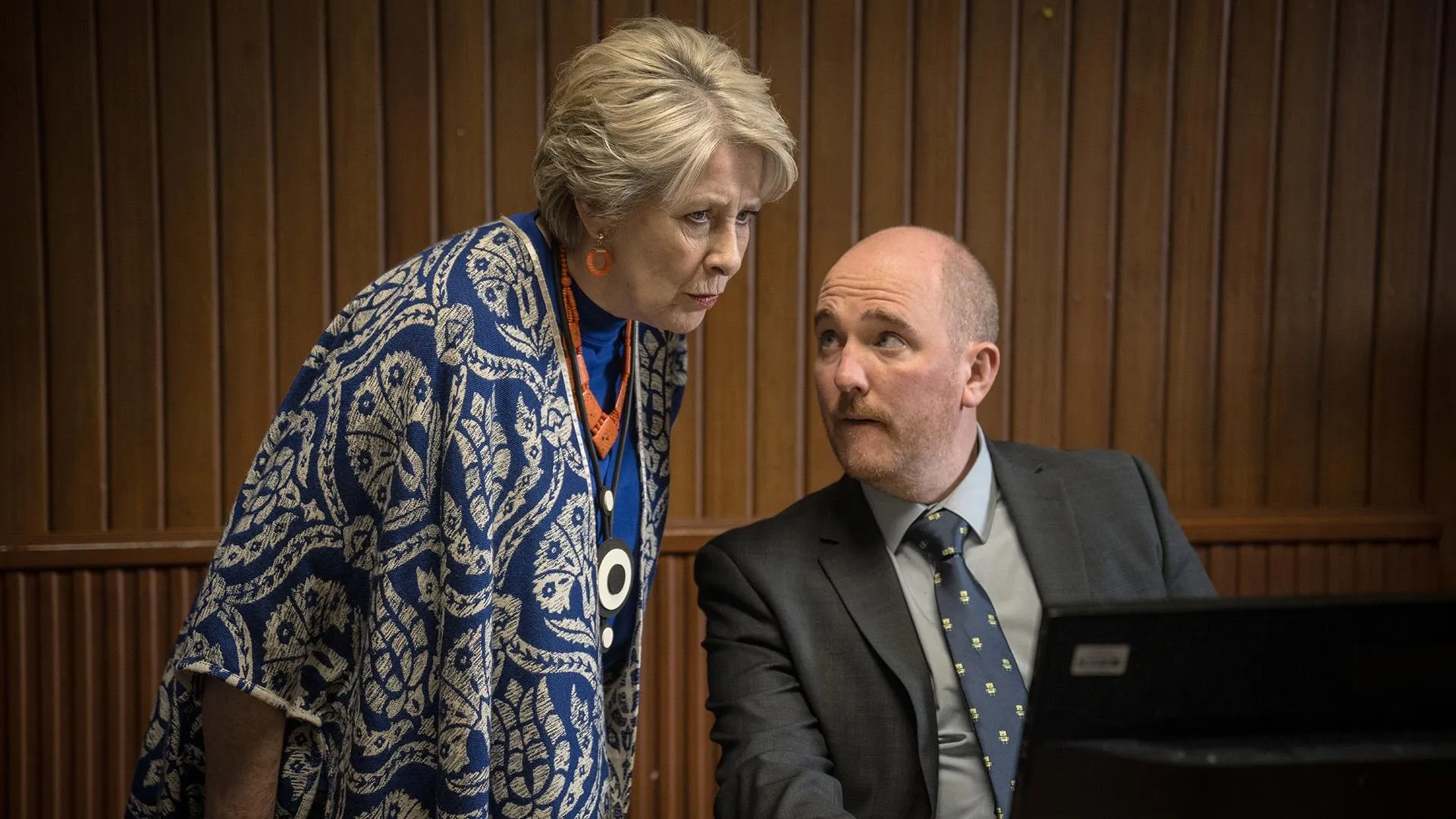
Rachael New, Miss Scarlet Season 6
Released February 1, 2026 NaN:NaN:NaN
WARNING: This episode contains spoilers for Episode 4 of Miss Scarlet Season 6.
Miss Scarlet writer and creator Rachael New likes to have fun with her Victorian-era mystery series. Whether it’s having Eliza out of her element in a new relationship, or watching Moses and Clarence team up on a jewelry caper, Rachael delights in juxtaposing these moments of humor alongside serious crimes. In this episode, Rachael explores the twists and turns in this labyrinthine season of Miss Scarlet.
This script has been lightly edited for clarity.
Jace Lacob: I’m Jace Lacob and you’re listening to MASTERPIECE Studio.
Season 6 of Miss Scarlet has kept us on our toes. Eliza Scarlet has entered uncharted territory as she and Inspector Blake are officially a couple, Moses Valentine and Clarence Pettigrew teamed up to solve their first case together, and the loveable yet somewhat prickly Barnabus Potts has traded in his coroner’s scrubs for a fountain pen. Let’s just say that some of these new ventures have played out better than others.
CLIP
Mr. Potts: Yet another rejection of my memoirs! “Whilst we very much enjoyed your book we do not feel that our publishing house is the right home for your work.” Well, I’m utterly befuddled. If they very much enjoyed my book, why won’t they publish it?
But the twists and turns don’t end there. DS Charlie Phelps has been promoted to Detective Inspector at the City of London Police, a position he has been coveting for years. And while he basks in the glory and power of being a detective inspector, with more power comes more responsibility, and more difficult decisions. Rather unexpectedly, given their work history, Phelps hires Eliza Scarlet to help with a case about a missing chorus girl. His only leads are that this missing woman had two regular gentlemen callers.
CLIP
Phelps: One was a high ranking member of the Galanis crime family and the other... was my uncle.
Eliza: Dylan Cooper?
Phelps: Word on the street is my uncle took exception to his girl seeing his rival and put a bullet in her. Which makes him our prime suspect.
Eliza: Which puts you in a rather difficult position.
Phelps: Any other statements of the bleedin’ obvious you wanna make?
Eliza: I see promotion hasn’t improved your manners, Charlie.
Meanwhile, DI Alexander Blake has had his eye on the infamous Dylan Cooper for quite some time now, waiting for just the right moment to put the notorious mobster behind bars. But he’ll need more than a theory to get the job done.
CLIP
Blake: I think you were romantically involved with Miss Lorenzo. And when you found out she was betraying you with a member of a rival gang, you went to her lodging rooms and shot her and her lover, Philip Galanis. You dumped his body on the street and left Natalia to die, but unfortunately for you, she survived.
Cooper: Mm. That’s quite an imagination you got there, Inspector Blake. It’s pure fantasy, of course. Unless you’ve got any evidence to back it up?
Today, we’re joined by Miss Scarlet writer, creator, and executive producer Rachael New to dive deeper into this labyrinthine season.
Jace Lacob: And this week, we are joined by Miss Scarlet writer, director and executive producer, Rachael New. Welcome.
Rachael New: Hello there, Jace. Lovely to be back.
Jace Lacob: Lovely to have you back. So we are taking a closer look at the first four episodes of Miss Scarlet this series. Without spoiling the final two episodes. What were the broad strokes for Series Six in terms of the narrative? How were you looking to position the show this series?
Rachael New: Well, we were in a slightly, I was going to say tricky position, but it wasn't tricky actually, it was an interesting position, which was, there's only so long you can keep a will-they-won't-they going. And we, when I say “we”, myself and Ben knew that we wanted to get Eliza and Blake together. So it was more about working out where we land with them, how we reveal that. Obviously there's lots of different options that you can choose, but we loved the idea of just coming in hard with it and just starting kicking the season off. And so this season is very much about how they navigate this new relationship, whilst also working the jobs they work in. So I would say that this season is definitely about them at its core, about their relationship issues, their highs and their lows.
Jace Lacob: I'm so glad you said that about that conversation between you and Ben, because one of the things I love about this series in particular, is that we do advance the romance between Eliza and Blake off screen between Series Five and Six, and it does puncture the tension of that will-they-won't-they. Why did you feel it was important that we start Series Six with them clearly coupled while still keeping that a secret to everyone else?
Rachael New: Generally we try to see where the fun can be. And neither of us really wanted to do a kind of drawn out, it builds to the end of Episode One, you know, maybe they share a kiss or get together or… There's lots of different ways of doing it and we wanted the audience to be shocked because that's always really fun.
But also, we wanted to explore in Episode One what that would look like for them. And we had lots and lots of conversations about what would be the most fun, the most meaningful way to dramatize that. And it just seemed too good an opportunity to miss that actually, out of the two of them, it's Eliza who is the one struggling. Blake definitely this season, he's pretty cool anyway, but he seems to up his coolness even more and he's much more laid back than Eliza is and there's just so much fun.
The investigation of Episode One is a serious one, but yet we were still able to really enjoy their dynamic, and Blake's telling Eliza, you’ve really got to calm down. Just relax, everything's fine. And she really struggles with it. And Kate's got lovely comedy chops. They actually both have. But she did it so beautifully, under this pressure of trying to do everything perfectly so that nobody finds out about them because she's desperate to keep it quiet, because she wants to make it work.
Jace Lacob: They are in that early relationship bubble at this point. And she doesn't want Ivy or anyone else to be involved to puncture that bubble. But it takes a whole episode before Eliza does feel secure enough to tell Ivy that she and Alexander are officially a couple. What does it take for her to admit that to Ivy at the end of the episode, and how does it reflect a confidence in their relationship?
Rachael New: I think there's a combination of things. Ivy makes it clear that she is a little hurt or upset with Eliza about something. And even though in the moment, Eliza sort of gives this look of, what's the matter? She's smart, she's super intuitive, something will be itching at her so that when Blake suggests in the end saying, look, maybe if you were to confide in somebody, maybe that would help you feel a little calmer, feel a bit more secure.
And Eliza is pretty sure that Ivy knows something. And obviously Ivy is her mother figure, her confidant. There's no one else, really, that Eliza would trust and confide in. And there's a really beautiful moment right at the end where they're in the kitchen, and Potts comes in and he's sort of making dinner.
CLIP
Potts: Bottle o’ sherry!
Ivy: Barnabus, Inspector Blake is joining us for dinner.
Potts: Ah!
Ivy: I invited him.
Potts: The more the merrier! We can enjoy a nice long game of gin rummy after dinner. The four of us, all evening, putting the world to rights! Won’t that be marvellous?
Ivy: Marvellous!
Eliza: Marvellous.
Rachael New: So she's willing to keep that secret of Eliza's, even from her own husband. And that's why Eliza loves her so much. Eliza gives her this really appreciative smile. And yeah, it's a really lovely relationship they've got.
Jace Lacob: So you mentioned Potts. At the same time that Eliza and Blake have gotten together, you have a new domestic status quo. They're a couple, Ivy and Barnabas are married, they're living in Eliza's house. Barnabas is fired from his job, and he takes up a new career as a memoirist. What was behind your decision to further push the domestic tension in Series Six?
Rachael New: Potts is such an interesting character because he obviously is funny. But also, Simon is a brilliant performer, and we just wanted to push him a little bit, we wanted to see that range. And I think he does it so beautifully. The mortuary is his life, his job is, obviously Ivy is the love of his life, but his job means everything to him. It's his status. He would have come from pretty meager beginnings. So we just wanted to explore that a little bit more. And also, it's always fun and I think important as well, where it would be pretty dull if you didn't sort of put the spanner in the works a little bit. So it was about testing Ivy and Potts's relationship.
And obviously you have the lovely dynamic between Eliza and Potts, as well, now having to live in the same house. And she's pretty patient with him because she loves Ivy and she knows Ivy's happy and wants Ivy to be happy, but Potts is quite infuriating. I wouldn't want to live with him, put it that way. So yeah, we wanted to explore that, we wanted to explore their relationship, and I think it worked out really nicely. Some of my favorite scenes are of Mr. Potts grappling with the idea that maybe he's going to be unemployed and if he's not the clerk at the mortuary, then who is he? He definitely has a crisis of identity.
Jace Lacob: Episode Three brings what might be my favorite line of the show to date. And it comes, not surprisingly, from Clarence.
CLIP
Moses: It’s going to be dangerous. Very dangerous.
Clarence: Which is why we need a detailed plan and one person in charge.
Moses: And that should be you?
Clarence: Well, I’m no stranger to this kind of thing.
Moses: You’re an accountant!
Clarence: My role has expanded in the past few years, not just with Mr. Nash but with Miss Scarlet too. I now offer a broad range of services.
Moses: Oh really?
Clarence: Yes, really! These days I know the streets as well as the balance sheets.
Jace Lacob: What was behind the idea for this episode, which finds Paul Bazely's Clarence teaming up with Ansu Kabia as Moses to acquire the 100 carat diamond from Venezuela sent by Patrick Nash?
Rachael New: It's a brilliant episode. I was so delighted with it. We wanted to probably rest the Eliza-Blake story for a little while. And everybody loves Moses. And indeed, everybody loves Nash. So we sort of got Nash in there through the kind of back door as it were. And we knew that Clarence and Moses would make a cracking duo. And then comes this tornado, this new character, Florence.
And we just wanted to have an episode that was actually more like a caper. Most seasons of Scarlet there are a fair few sort of quite serious episodes, but we always like to pepper it through with something a bit lighter. I don't know if you remember the hotel episode we had, St Marc's. And there have been various episodes where you just take the brakes off the drama a little bit, and you just enjoy the more colorful characters. And having that trio at the center of it was just joyous to write. There's no other word for it.
Jace Lacob: One of the reasons I love that episode is that I think it does play to the strengths of Miss Scarlet. You've got this fantastic cracking mystery, but it's got humor and emotion, and it balances that very effectively with the mystery drama stakes. And Clarence and Moses don't seem like a natural pairing, but Paul and Ansu are so hilarious together here. Was this just an opportunity for you and Ben to fully indulge in that kind of caper atmosphere, the humor, and really push that within the episode?
Rachael New: Definitely. Absolutely. Moses is at his best when he is surrounded by really irritating people. And we didn't just give him one, we gave him two. And it was just so lovely to have him back. Everybody loves him. I'm pretty sure if I look at social media, he's probably the most popular character. Everybody loves him. All the fans love him.
So having him return and then be placed in this position where he starts to feel out of control, which he does not like. He likes to know where the exits are way ahead of time. And suddenly he's in this completely chaotic situation where he really doesn't know what the truth is. He's working with people that he doesn't know. So because of that, it's all the ingredients for just a delicious caper that's got so much fun in it. And you're right, there’s lots of emotional resonance going on as well. So it was the perfect episode to write.
Jace Lacob: There is, to me anyway, a very Dickensian influence here, albeit a satirical one. We've got the very loud, very indiscreet “merry widow” Florence, who is not what she seems. The weird eye patch Fagin guy with a gang of kids. We've got two diamonds, one that's real and one that's fake. There are double crosses, assumed identities. It felt like, in the best possible way, a mash up of Miss Scarlet with Oliver Twist and The Mystery of Edwin Drood. Were you and Ben in writing this, intentionally spoofing that Dickensian influence here?
Rachael New: I think we're always influenced by that, but yes, absolutely. With the kind of Fagin character with his street boys, it just brings so much flavor and color to it. But yeah, that's always at the back of our minds. That is Victorian London. Nobody has done it better. But yes, it's heavily influenced by Charles Dickens.
Jace Lacob: You mentioned Patrick Nash. Felix Scott doesn't appear in this episode as Patrick Nash fled London in Series Five. But how does “the ghost of Patrick Nash” and I'm using that in scare quotes, “the ghost of Patrick Nash” hover over Episode Three?
Rachael New: He's everywhere. You can just feel him, obviously through Florence's presence. He's connected to these three people, they're three close allies to him, and he is the mastermind behind what the set up is. Then obviously, the rug is pulled from you with the reveal at the end with Eliza. So he's just got his finger in every single pie. And the wonderful thing about writing Patrick even when he's not even there, is that you can pretty much do anything, because I think the fans have bought into the fact that he just has contacts everywhere. He crosses, and double crosses, and triple crosses. There's just so many opportunities. When he's involved, whether he's present or not, there's so many opportunities for huge amounts of fun and intrigue, and nothing's ever quite what it seems.
MIDROLL
Jace Lacob: And we’re back with Miss Scarlet writer and creator, Rachael New. While I miss Evan McCabe's Oliver Fitzroy, I think that Sam Buchanan's George Willows is such a great addition to Miss Scarlet. How did you look to make this character distinct from Blake's last partner, and what does Sam bring to the mix as an actor?
Rachael New: Well Sam, I'm going to sound very old when I say, Sam is a really lovely young man. He was so lovely to work with, so enthusiastic, really. I was lucky enough to direct him in one of the episodes and it was just such a pleasure, it really was. And when we were coming up with the character, we didn't want somebody like our beloved Fitzroy, we wanted something slightly different. And I think we came upon it looking at it from, what would be interesting for Blake, what new character would bring out something in Blake?
And it's very much almost like a fatherly figure. Blake starts to rely on him. He's solid, he's clever. But also he's got this backstory of, he's a young man with family issues that we sort of touch upon, we hint at. And it just gives him that little bit more depth, I think. So, in choosing how to introduce this new character, it was about, what's the dynamic? What will the dynamic be between this new character, Willows, and Blake? And I think it suits them very well. It was similar with Duke and what person would we get the most out of, and that was Fitzroy. So it was a similar kind of process for us.
Jace Lacob: I think he is a fantastic addition. Speaking of returns, Episode Four features the return of Tim Chipping’s Inspector Charlie Phelps, who we learn is the nephew of notorious criminal underworld figure Dylan Cooper. Was this always going to be revealed eventually, that familial link between them, or did you decide that when breaking the stories for Series Six?
Rachael New: Yeah, I mean, it was always going to be there. I really missed Tim for this series, this season, but I always knew that we were going to have a very Phelps heavy episode. He’s such an interesting character to write for, and I think probably one of the characters who has the most journey, the most emotional journey. We've seen him through thick and thin. He starts off as a bit of a bully and then we saw him develop this friendship with Fitzroy, and we can see he's a good copper and we know about his background. So, it's probably not a huge surprise that his uncle is this sort of underworld mob boss.
But yeah, it was always there for us that he would have these connections. And what we love is the idea of, he had a choice when he was a kid. He could have either gone one way or the other. And that's what makes him such a good copper, is that he chose the other way. He didn't choose the easy way to go the way of his cousin and his and his uncle.
Jace Lacob: I had been missing that aggressive energy that Tim brings to the role of Phelps. And I do think, yeah, we get to peel back some of the character's layers here and get that vulnerable core as he finds out his mother is dying. And I love the fact that, as you say, he is sort of trapped between his duty as a police officer, his duty to his family, and to me, that's one that I think is very familiar to south London coppers in particular. How does Tim's portrayal capture that sense of tension between, as you say, that choice that he made to choose justice over his family?
Rachael New: Yeah, he's a complex character with many layers. Tim brings everything to the role. He really is astonishing when he comes on set. When, for example, when we were rehearsing the scene where he is with his mother, we opened the episode where he's with his dying mother in hospital, and it was literally just a rehearsal, he just burst into tears as he was doing it. Like, he just brings everything to every single take. He must be exhausted by the end of the day!
And he's really feeling it. He's really feeling the dilemma and the conflict. Like, this is what drives him on in this episode, which is whilst his mother is alive, he doesn't want her to see her baby brother go to the gallows. So, he's very conflicted, which is why he turns to Eliza. And he's an old time copper. His shtick, I suppose, for want of a better word is, he doesn't suffer fools gladly, he can be quite rough and ready, but there is a moral compass within him. And I think that's what makes him such an interesting character to write for and to watch.
Jace Lacob: That is interesting. I think Phelps and Eliza, though, have never been easy allies. What do you think it says about the complexities of his relationship with Cooper that he has to turn to Eliza, of all people, for help?
Rachael New: Yeah, he's never been sure of Eliza, but he's just old fashioned. And it's just another reminder that we're in the 19th century. It would be beyond the realms of possibility that a woman could be working in the same field as him. And it takes him a long time to respect that. And he grudgingly, over the seasons, has respected that. And he sees she's proven herself again and again and again, and they do end up having a kind of unlikely friendship. And he knows that beyond anybody else, he can trust her because she is so solid. Her word can be trusted, and she's extremely good at her job. So it's a no brainer for him to turn to her in his hour of need.
Jace Lacob: I am always genuinely terrified by Steven Hartley's Dylan Cooper, and that is no different here. While you don't direct Steven Hartley here, you do direct him in next week's episode, and I am curious, what is it like directing Steven?
Rachael New: When he first came on set, one of our wardrobe ladies went up to him and said, you're really scaring me, because his resting face is so kind of rough and stern and stuff. But when he smiles, honestly, just everything lights up. He's a really, really nice man. We're so lucky with our cast. They're honestly just so professional and lovely to work with. And Steven is the same. He takes it extremely seriously. He's so open to notes. You never feel with him that it's like it's my way or nothing. He's very collaborative and clever with his craft. So I absolutely loved working with him.
Jace Lacob: One of the most heartbreaking lines is the one that Cooper tosses at Phelps here,
CLIP
Cooper: I need time to talk to the Galanis family. Things haven’t been good lately. I need to sort it out. It’s bad for business.
Phelps: If you’re asking me to stall the investigation...
Cooper: I’m being set up and you know that. I’ll find out who did it, I just need time. You owe me this, boy. When you was a nipper, when your dad passed away and your mum couldn’t put food on the table, who was it who kept you out the workhouse?
Jace Lacob: How does this episode help to recontextualize Charlie Phelps as a character? Does it explain a lot of the behavior we've seen over the course of the series?
Rachael New: I think it does, yeah. And I think we've had, the previous episode a few seasons ago when he was running a boxing club and was accused of, well, he actually did plant a watch on a suspect, but he is somebody that has had a really tough upbringing. And we again, point to it here so that the audience can really understand how high the stakes are for him and how conflicted he is, the dilemmas he's looking at.
And also, he's embarrassed. He doesn't want people to know that he's related to this family. We already knew that his cousin, again a few seasons ago, was dodgy. So we sort of knew that he had a background where he could have chosen a different route. But in this, we really point to it that he's had a tough life and he does owe his uncle a lot, like his uncle was there for him. And his uncle was pretty much like a father figure.
There's a moment where his uncle says, I'm proud of you. And Charlie is sort of, yeah, all right, whatever. But deep down, he knows he is proud of him. So he has these ties, but he almost has to try and push them away because, again, like Mr. Potts, his job is everything. We saw him previously, his wife left him. He has very little. He's built for the job. Scotland Yard is his life and he does not want to lose that.
Jace Lacob: There is a beautiful moment when Phelps learns of his mother's death. And it's Cooper, of all people, who tells him. He says, “It's your mother. She passed. I'm sorry, son, sorry.” And Phelps cries. And to me, it's a moment that humanizes both of them, both Phelps and Cooper, given the sympathy that he offers here to his nephew. Where did the idea for this emotional confrontation come from, considering most of the episode they're at each other's throats?
Rachael New: Well, I think we wanted to strip away and say yes, they're both doing their jobs, Cooper's a gangster, Phelps is a copper, but there is a long, deep family connection between them. He wasn't just some distant uncle. This man was in his life. He was in his childhood for many years. So, it was just a moment to say, look, he's lost his sister, who, as he said, ruled the roost and was probably like a mother figure to him. And Charlie's lost his mother. And that just binds them. It's that blood connection. It's that family connection. So that's where it really comes to the fore, you know, the mystery has been solved, and now we're just in this very simple, pure emotional moment between these two men that have a shared history.
Jace Lacob: Sophia goes missing, and Blake immediately blames Cooper, as he had intimated he knew where Blake lived and about his daughter. But fortunately, Sophia is fine, though it's all Eliza's fault, as she had told Sophia a story from her youth when she skived off from school to spend the day with the ancient Egyptians at the British Museum. Does Eliza see her influence over Sophia, or does she take it for granted at this point?
Rachael New: She definitely takes it for granted. Eliza is on a steep learning curve; not only is this her first serious relationship, but she's dealing with a potential step-daughter and she hasn't got children of her own. She's got no experience of children. And again, I think it's so important that we do see her flaws and we do see that she's not this kind of Mary Poppins character. Like, she struggles with things and she's used to doing what she wants when she wants to do it. She's spoken to Sophia, perhaps in a way that would have been better for an older child. She hasn't judged Sophia's age and how Sophia might look at Eliza and be impressed with her and want to be like her. So yes, this was a real misjudgement on her part.
Jace Lacob: Blake cancels dinner. He tells Eliza that Sophia went to the British Museum and he says very bluntly,
CLIP
Blake: Would you mind if we cancelled dinner? I should be with Sophia.
Eliza: Of course! I could come to you or...
Blake: She went to the British Museum. She said you missed school once to go there.
Eliza: Well yes, but I, I didn’t mean for her to do the same.
Blake: She’s a child, Eliza. She has no mother to guide her. You must realise how much she looks up to you?
Jace Lacob: And he tells her that maybe they could do with some time apart. And he leaves her standing there in shock. Was this break a long time coming with the many secrets between them, or is it just a blip, a misunderstanding?
Rachael New: I think we see slight cracks begin at the end of Episode Three outside Eliza's office when he says to Eliza, why didn't you tell me about Nash? And we hinted maybe it's a little bit of jealousy, he's a man, he's a 19th century man. But also I think he's hurt that she didn't confide in him. So this just starts to crack things a little bit. And then in Episode Four, when he finds out that she's working for Phelps, this is like another dagger for him. Him and Phelps at this point are very competitive. And it's again it's a little bit of bruising on Blake's ego, but the fact that she won't share details of the case of what she's found out with him, that's something that he is struggling with because obviously they're in a relationship.
So it's almost like at the beginning of the season, it was sort of Eliza struggling to know how to navigate this ship of love. And then we turn it around where it's Blake who is struggling. So the cracks had just started, and then what happens with Sophia, who is obviously the most important person in Blake's world, she's non-negotiable. And it's really made him think about, is this going to work? Can I really be with this woman no matter how much I love her, is she going to be the right woman for me and the right stepmother, I guess, for his beloved daughter?
Jace Lacob: I'm not looking for overt spoilers, but I am wondering what can audiences expect to encounter in the final two episodes of Miss Scarlet the series?
Rachael New: Well, an awful lot. It's a hell of a second part to the series coming up in Episodes Five and Six. And we explore what happens with this love affair. There's an awful lot of action as well. A lot of emotions running high. It's pretty explosive, this next section coming up.
Jace Lacob: Rachael New, thank you so very much.
Rachael New: Thank you Jace.
Next time, it’s all hands on deck when a mysterious stomach bug spreads through Scotland Yard.
CLIP
Isabel Summers: Hope you feel better soon, Maggie. Ah, I think she's got that stomach bug. Poor thing.
Detective Willows: Oh, it's a nasty one, from all accounts. Half the men have gone home sick with it. Anyway, I just came to see if you wanted to go for a cuppa on your break.
Isabel Summers: I'd love to, but Inspector Blake said I've got to ring round the other precincts, see if they can spare any men. Not having much luck, though. Most of them aren't even answering.
Detective Willows: It'll be the riots in the rookeries. What with the sickness, we're badly undermanned.
Join us next week as we’re joined by one of Scotland Yard’s newest members, Detective Willows himself, actor Sam Buchanan, to talk about the unexpected twist his character faces in this episode. Plus, actor Tom Durant-Pritchard returns to talk about this gripping one-of-a-kind episode of Miss Scarlet.
Miss Scarlet Podcasts
4 More Podcasts



MASTERPIECE Newsletter
Sign up to get the latest news on your favorite dramas and mysteries, as well as exclusive content, video, sweepstakes and more.