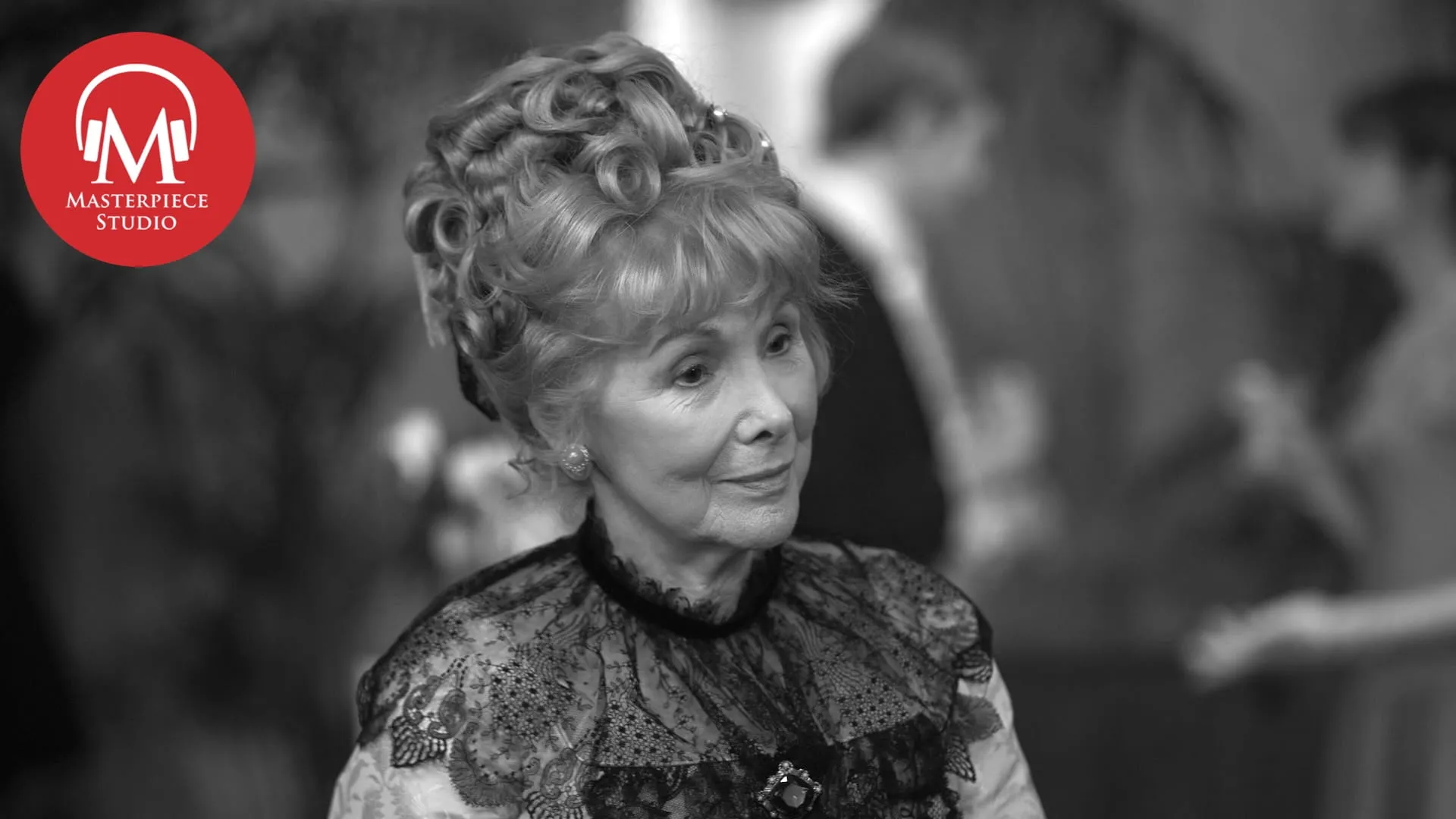
Susan Hampshire, The Forsytes, Season 1| MASTERPIECE Studio
Released March 22, 2026 NaN:NaN:NaN
WARNING: This episode contains spoilers for Episode 1 of The Forsytes Season 1.
For acting legend Susan Hampshire, playing Fleur in the 1967 adaptation of The Forsyte Saga was a huge moment in her career. Now, nearly 60 years later, she returns to the story as the wealthy Lady Carteret in The Forsytes. In this conversation, we talk about how Susan approached playing Lady Carteret, as well as her decades long career.
This script has been lightly edited for clarity.
Jace Lacob: I’m Jace Lacob and you’re listening to MASTERPIECE Studio.
London, 1877. The illustrious Forsyte family gathers as young Jolyon Forsyte, heir apparent to the family stockbroking firm, awaits his fiancée Frances’ progression down the aisle. The pair are to be wed in this strategic alliance as Frances, a queen of high society, was hand-picked to cement the Forsytes’ status among London’s elite. However, despite their wealth, alliances, and appearances, London’s old money families do not entirely welcome the Forsytes with open arms, particularly Lady Carteret, of the well-heeled Carteret family.
CLIP
Frances: Ah, Lady Carteret.
Lady Carteret: Oh dear. We were hoping to keep Miss Louisa to ourselves.
Frances: My apologies.
Lady Carteret: Do you know Mrs. Frances Forsyte and her daughter, June?
Louisa: Good day to you. How do you do?
Frances: We need a gown for June’s 18th birthday ball. I hope you received our invitation?
Lady Carteret: So kind. Try not to let Mrs. Forsyte monopolize you.
Ten years on from her wedding, Frances, now settled into life as a shrewd and calculating member of the Forsytes, has grand plans of uniting the Forsytes and the Carterets though a marriage between her daughter June and Lady Carteret’s grandson, Horatio. But Lady Carteret isn’t too keen on shortchanging her grandson’s future.
CLIP
Frances: And what are Horatio’s plans after Cambridge? I hope we’ll see more of him in London.
Lady Carteret: My grandson and his sister have a very full calendar, as I’m sure you’ll appreciate.
Today, we’re joined by acting legend Susan Hampshire to discuss playing the wealthy Lady Carteret in The Forsytes, as well as Fleur, nearly 60 years ago, in the 1967 version of The Forsyte Saga.
Jace Lacob: And this week we are joined by The Forsytes star, Susan Hampshire. Lady Kulukundis, welcome.
Susan Hampshire: Thank you. And I'm very excited to be here because this is the first time I've ever done one of these. Is it called a podcast?
Jace Lacob: I get to be your first? That is an honor. Yes, Welcome to this, your first podcast. And I hope you feel relaxed and comfortable as we take a trip through The Forsytes and down memory lane as well. You are no stranger to the story of The Forsytes, as you played Fleur Forsyte in the 1967 adaptation of John Galsworthy's The Forsyte Saga. We'll talk about that in a bit. But here you are in 2026 in The Forsytes as the dowager Lady Carteret. How did this turn of events come about, and what drew you to accept the role of Lady Carteret?
Susan Hampshire: Well, it's really quite exciting. On a Friday evening, after business hours, my telephone went and Susie Pariss, who does the casting, rang and said, are you free? This is an offer, are you interested? You'd have to go to Bristol to film. And would you like to have a small part in The Forsytes? And I said yes. And over the weekend we sorted out the contract. On a Monday I went to the read through. You’ll realize that Lady Carteret is large in the minds of the Forsyte family, but not very large on screen. So, you blink and you could miss me. But nevertheless, I'm absolutely thrilled to be doing it, because The Forsyte Saga was an extraordinary turning point in my life. The original was 26 episodes, and I was only in the second half playing Fleur, who was Soames' daughter.
And when the second half was about to be shown in America, PBS took me over to New York, and I was about four months pregnant then. I think it was in 1970. And I toured the country, not every city, but the major cities. And it was really the most exciting and adventurous thing because I kind of felt I was famous. It was really exciting! It sounds pathetic to say now, but, you know, our careers are not always what we want them to be or what we expect. And when you suddenly have a moment in the sun, it's very thrilling.
Jace Lacob: I mean, your moment in the sun has been hardly a moment. You have been omnipresent on television for many, many, many years. And even, as you say, if your screen time in The Forsytes, particularly in the first episode, which we're going to discuss, isn't huge, your presence is felt very much so. In the first episode, Lady Carteret runs into Frances Forsyte and her daughter June at Louisa Byrne’s dressmaker shop. And in just a pair of words dripping with the most polite of venom, Lady Carteret conjures the entirety of her dynamic with Frances. She says, “so kind.” What did you make of Lady Carteret, and how does this exchange with Frances sum her up?
Susan Hampshire: Well, Lady Carteret is a snob. She's old money and the Forsytes are new money. And, I think she rather enjoys being a little bit mean. She's not nasty, but she's just always a little bit short on kindness as all I can put it. But she does adore her son, which we don't see in this series. But in this season we see her two grandchildren who are gorgeous, by the way. And they are with her quite a lot in the scenes.
Jace Lacob: Frances has designs on Lady Carteret's dull grandson, Horatio, as a potential husband for June. Such a match would clearly suit the Forsytes more than the Carterets and Lady Carteret seems determined to stop it. Does she view Frances as a rival, or is merely just a social impediment to be overcome, this sort of nuisance?
Susan Hampshire: I don't think Lady Carteret is intelligent enough to know what an extraordinary human being Frances Forsyte is. I mean, it's one of the most interesting characters in the whole series, and it's actually brilliantly played by Tuppence. And it is the most rewarding part. And you could think that she's a very nasty woman, she is not. She's just a woman protecting her territory and doing everything in her power to please her in-laws and also have a successful marriage. Her first husband, Frances’ first husband died, and she has a child who is just about to come out, that means come out into society, who's 18. And I think she navigates the world of the rich Forsytes who are only thinking about money and her heart extremely well. But she was the most important character.
The scripts concentrate on three main women. Of course, it concentrates actually on most of the women with, let's say, about five or six. I think the scripts are, I can't swear, but I was going to say something strong, wonderful. Absolutely wonderful. And Debbie Horsfield has done a brilliant job of drawing us in emotionally. And once the audience accepts that this is not The Forsyte Saga, this has taken characters from The Forsyte Saga, and it's the women's characters, and imagined their story before the books began. And so that means for the first couple of episodes, there's a lot to absorb. But the payoff for the final episodes is phenomenal. It's so emotional and gripping. And I think it's thrilling. I mean, I wish I was young and playing one of those parts again.
Jace Lacob: So you mentioned the women. I do want to talk about the relationship between Lady Carteret and Ann Forsyte, played by Francesca Annis, which is slightly more ambiguous. What do these two matriarchs think about each other, and how did you approach your scenes with Francesca?
Susan Hampshire: Well, Francesca is absolutely adorable, and I have to say, she looked absolutely amazing. Her costumes were, I mean all the costumes are great, but her costumes were simply stunning. And her wig and makeup and everything. And she was allowed to wear eye makeup and I wasn't, so I was pretty envious of her, is all I can say. I think that neither Francesca or I totally understood our relationship. We were a little bit mystified, but that's quite good, because then the audience can decide for themselves.
But both of us often used to say, I'm not quite sure why we're being so nasty to each other or why we're not more friends. And then we would say the lovely lines we were given, but we were both mystified as to why we had to be mean to each other since we were both women of a certain age. Of course, I am a lot older than… I was supposed to be playing somebody younger than her and in fact, I'm ten years older than Francesca. So I was having to pull my shoulders back and my stomach in and all of the things you try and do when trying not to look 100. But anyway, she was such a lovely person to work with, and she was very nice and I was very lucky to have scenes with her.
Jace Lacob: After time away from television, was it daunting to step back onto a television production set again? Even given the career you've had, was there any sense of trepidation or nervousness about joining a cast again?
Susan Hampshire: Yes. I have to be honest, I was very, very, very nervous my first day. The reason that I stopped work for 20 years was that I was looking after my husband, who had dementia. So, of course I wasn't in the business anymore. The last thing I had done was Monarch of the Glen and an Oscar Wilde play. And so I just wasn't used to working, and so therefore I find it quite challenging. But I loved it. I loved being back in the business. I loved the smell of the sets being painted and the costumes, and, I don't know, I went back to my old life because I did my first film when I was nine, so it was lovely for me to go back to work.
Jace Lacob: You once said in an interview, “I often start off understanding a character by learning what she has to say. The more you speak the sentences, the more the character evolves.” How did you look to use that process with Lady Carteret? How did you feel the character evolved through that use of repetition?
Susan Hampshire: There were three things that I find my way into a character. One is by moving around and pretending I am the character. So my body is helping me to remember the lines, and my body is being the character. The other thing is, if my costumes express the character, which, if the hat isn't right or the fit isn't right, then you never feel the character. And thirdly, is through being very familiar with the words.
And I remember when I was working with Albert Finney doing Night Must Fall, he said, the important work you do for any role is the homework that you do in learning your lines and preparing yourself before you go on the set. And I think that's quite old fashioned now because the youngsters come on the set, I'm not talking about in this program, but in some programs, and they sort of wing it, really.
Jace Lacob: I think there is a spirit of improvisation that has taken over the entertainment industry, that you say what you feel rather than what's possibly on the page. And I think a lot of actors have really leaned into that feeling, that ethos, that I am the arbiter of my character. I know what my character would say, rather than through repetition, through rehearsal, living the character, being the character, so that the reality comes through the words on the page.
Susan Hampshire: Yes, and particularly going back to the Galsworthy books when I was playing Fleur, it was fantastically useful. Apart from the fact that Donald Wilson had done the most wonderful scripts for the 1967 version, and I think Debbie has done the most wonderful scripts for this. And we had to be word perfect for the Debbie scripts, and certainly with Donald Wilson we had to be word perfect. And I found going back to the books, the Galsworthy books, there was so much, maybe just a tiny sentence where she shrugs her shoulder and shakes her head, something which would so enrich what one did with the character. And I can only say how lucky I was to have played such a complex, difficult, unsympathetic woman as Fleur. She was a girl, actually, but I completely understood her. I'm not anything like her. But I just loved her.
Jace Lacob: While Lady Carteret is a creature of the Victorian era and Fleur Forsyte a modern, flapper aged woman of the 1920s, what do you think these two would have thought of each other had they somehow crossed paths?
Susan Hampshire: I think Lady Carteret would have been absolutely appalled by Fleur Forsyte. She would have thought she was the most awful creature, and I don't think they would have got on well at all, although they both have a little bit of sting in their tail. Just, pst, both of them.
Jace Lacob: A little scorpion venom.
Susan Hampshire: Yes, yes, a little bit. Yes.
Jace Lacob: With your presence as Lady Carteret, you provide a thematic link between The Forsytes and the 1967 adaptation of The Forsyte Saga, a role that earned you an Emmy Award for your turn as Fleur. How does Galsworthy's story of family rivalries and social mobility reflect the times we live in, whether that be the 1960s or the 2020s?
Susan Hampshire: I do think that a good family story with family conflict, their need for money, their ambitions, their love affairs and everything, is universal. I think these emotions that happen within a family are the same, they're just governed by different rules of etiquette, manners, the fact that we have television now, we have mobile phones, all of these things slightly change one's life. And therefore, we're less respectful, we communicate in a different way, but I think what is in the heart of us remains the same. And the need for love, the need for food on the table, it doesn't change.
Jace Lacob: So, The Forsyte Saga was a colossal hit around the world, including here in the States, where its success led to the creation of MASTERPIECE itself. At the time when you were filming those final 13 episodes of The Forsyte Saga that you were in, did you have any inkling that the program would be so huge or alter your career so significantly?
Susan Hampshire: I didn't really because I was so into the role and I was just about to get married. And actually, that wasn't the distraction. It was the fact that I was completely obsessed with playing Fleur. And I remember Maggie Tyzack, who played Winifred, saying to me, remember Susan, I think this is very, very special. This whole series is very special. And when it went out, of course, it hooked the nation, 20 million viewers, which was, you know, everybody would give their eye teeth for today. And they had to change the time of the church services because people weren't going to Evensong. And quite a few things changed, and we were sort of famous all over the world because it was sold to Russia, Nicholas Pennell and I were invited to Sweden, and we met the great film director Ingmar Bergman. And when we got to the stadium, 30,000 people there to greet us, and the airport was mobbed. You know, it was very exciting for us. I mean, obviously it happened to the Beatles and it happens to pop stars now, but it doesn't normally happen to working actors, and it was thrilling.
MIDROLL
Jace Lacob: And we’re back with actor Susan Hampshire. It is momentous to me that you are on screen in The Forsytes on MASTERPIECE in 2026, 55 years on from the show's creation. Given how important a role you played in MASTERPIECE's beginnings with The Forsyte Saga, which aired before MASTERPIECE was created, and then The First Churchills and Vanity Fair. To what do you attribute your career longevity?
Susan Hampshire: I think I was lucky, first of all. I mean, luck is a huge, huge part of one's working life, and there could have been other people who would be better for the palaces or to play Fleur. Although it was quite exciting, I had just made a film, I'm digressing, I just made a film in France with Charles Aznavour called Paris au mois d'août, Paris in August. I eventually married the director of this film. And because I spoke fluent French by now, at this point, when I was interviewed for the part of Fleur, Donald Wilson said, I just knew you were my Fleur because you spoke French. I don't know why I've digressed so drastically, but anyway, that was one of the reasons that I got the part, because I spoke fluent French, and we were in a French restaurant for him to interview me for the role.
There's luck for you, isn't it? I didn't speak fluent French before, but I spoke fluent French when I met Donald Wilson who'd written the scripts for our version of The Forsyte Saga. And, you know, I got a job, which was an amazing part. It's luck, isn't it? It's luck. Other people could have been better for it you know, prettier, with a better voice, blah blah blah. Who knows?
Jace Lacob: I want to talk about Vanity Fair. You played Becky Sharp in that adaptation, which was the first drama serial to be broadcast in color on television in the UK. Did that feel groundbreaking for drama serials and for you personally being broadcast in color after your experience in black and white?
Susan Hampshire: It was really, really exciting because all the focus was on what we look like on screen. Sometimes our makeup was coming out green, sometimes the wig, which was red, was coming out purple. I mean, rushing down from the control box to us on the set was, you know, what are we going to do, spray her with brown so her hair doesn't look orange? Whatever. And certainly, we had to wear almost white makeup sometimes because otherwise we were coming up very bright pink. It was exciting, actually. Even the clothes, which were exquisite, really pretty, were coming out odd colors. And obviously when Becky Sharp goes to court, the dress needs to be white. The plumes in the hair need to be white, and they don't need to come out slightly gray or something.
Anyway, I loved doing it. I loved Becky Sharp. She was a woman way before her time. I just love women who have some get up and go in them. I just loved the fact that she was ambitious and she worked so hard to get where she got. And you don't get anywhere in the world without putting your shoulder to the wheel, do you? You have to really not expect it to come to you on a plate. And she came from a poor background and she was nothing really, but she made the most of herself.
Jace Lacob: Throughout your career, whether that's Fleur in The Forsyte Saga or Lady Glencora in the Pallisers or Molly MacDonald in Monarch of the Glen or Lady Carteret, you've been adept at playing patrician, well-heeled characters. As a real life Lady yourself, what is it about you do you think that makes casting directors say she's perfect for this posh role?
Susan Hampshire: Well, in the old days, probably because I wasn't particularly pretty or anything, but I sounded right. Now, I don't think anybody knows I'm alive, so I'm very happy to be talking to you today! I think we all have a moment that we may have a few years in the sun. And I was very lucky to have my time in the sun.
Jace Lacob: I'd love to talk about your childhood. You grew up at Dolphin Square in Pimlico, in a flat you shared with your mum and three siblings, where you've said, “the loo was four floors up”, but you were presented at court and named Deb of the year. Looking back, how did your childhood shape you and your aspirations?
Susan Hampshire: Well, first of all, I must say my mother was a remarkable woman. And she came from a very, very poor background. And because her father was rather violent, her mother wouldn't let her go to school because she was frightened to be left alone in the house. So my mother left school, whatever schooling she had at 14, and she managed to start a school of her own, teach dancing to some of our great, great ballet dancers like Anthony Dowell and Maina Gielgud, and have a wonderful educational school which had lots of clever children in it.
And when I was little, my mother never gave up on me. And I think children who have a difficulty in life, whatever difficulty it may be, if they're lucky enough to have a teacher or a parent, a mother or a father who supports them and encourages them constantly, those children will do really well in life. And I was very, I'm still very dyslexic, but I was very, very lucky to have the huge support of my mother and my two sisters, who were also very, very kind to me and my brother. And without that support system, I would have just been in the gutter really, because at that time nobody knew what dyslexia was.
And I didn't actually know that I was dyslexic until after my son was born. And we went to the pediatrician and he said, oh, are there any family illnesses? And I said, oh, nothing, except I can't read or write. But apart from that, we're all pretty healthy. And it just happened that this man, this doctor, was trying to do research on getting dyslexia medically recognized. So he diagnosed me and I knew that I was dyslexic and not an idiot. It was quite exciting, really.
Jace Lacob: I mean, you’re aged 30 when you got that diagnosis?
Susan Hampshire: Yes.
Jace Lacob: You've said your dyslexia, “let you see the world in a different way.” And I remember hearing that you wanted to become a nurse, but the course required Latin. How did your dyslexia influence your career, given the swaths of dialogue you'd have to memorize as an actor?
Susan Hampshire: I think when you want to do something, no matter how many hours you spend learning your lines or preparing, you don't mind. It's no effort. I mean, when I was young, I didn't go to parties or go out with people in the evening. All I was ever doing was learning my lines, and I never wanted to be the person that arrived on the set, not knowing what I had to say next.
Being dyslexic made me realize I did not want to be at the bottom of the pile. Okay, so I couldn't be a nurse because I couldn't do the Latin. And I was very ambitious when I was young, for survival. It wasn't to be a star. It was just to survive and earn a living and do the job I love. I had made my first film when I was nine, quite by accident, playing Jean Simmons as a child.
But really and truly, I suppose. I left school at 15, and I was prepared to do, sweep the stage, make the tea, do the odd jobs. I was often asked to be “on the book”, which means you have to prompt people if they go wrong. And can you imagine anything worse than having a dyslexic teenager prompting? I couldn't even find the word on the page let alone read it out! So that was pretty disastrous. But I was prepared to take any job in the acting profession, whether it was one line or a walk-on, or being the back row of… often ballet companies just have people to be in the crowd scenes or opera companies. You might get five quid for doing it. And I'm not ashamed to say, I'm a workhorse. And I was prepared to do anything to survive, really. And luckily I did survive, which is…
Jace Lacob: And thrived.
Susan Hampshire: …a great privilege. Yes.
Jace Lacob: I want to ask, while filming 1963’s The Three Lives of Thomasina, you met Walt Disney himself. What do you recall of the meeting, and what was Walt like in person?
Susan Hampshire: Well, it was like being in the presence of a king really, because he was very kind, very polite, very, very family orientated. And I was honored that, obviously he saw the rushes when I did the film tests, and I was chosen to be in the film. It was exciting. I didn't realize at the time how exciting it was to meet such a huge person in the film industry, but often, you do things when you're young and you don't appreciate how important they are.
Jace Lacob: One of your best known roles is that of Molly McDonald in the beloved early 2000s BBC drama Monarch of the Glen. One of my favorite television shows of all time. With 20 years since the series ended, how fondly do you look back at Molly and on your time on Monarch of the Glen?
Susan Hampshire: Well, first of all, I look back on it and realize that Richard Briers is an absolute comic genius. I mean, he could make anything funny, and he was absolutely amazing. And when I used to travel up to Scotland, because it was all filmed in Scotland, and people would meet me at the station and say, oh, we love your show, and I'd say yes, isn't the scenery wonderful? And they would say, oh yes we just turn off the sound and look at the pictures. And I'm thinking, I'm up all night learning my lines and they're looking at the pictures. But the scenery was exquisite. The midges were horrible and several times people had to be taken to hospital because the midges had bitten them so badly. And I didn't find it easy my first year up there, but I adjusted as time went on, and I was very happy to have done seven seasons of the show. Very lucky.
Jace Lacob: You've said luck. I would say talent. But looking back at a career such as yours, do you have a favorite performance or a role of which you're really particularly proud from the past 60+ years? Is it possible to choose?
Susan Hampshire: I loved playing Nora in A Doll's House. I loved doing Mrs. Anna in The King and I. I loved more than anything playing Fleur, and I loved Becky Sharp. And before that, I did quite a few television series for the BBC, and one was called What Katy Did, which were children's books about a kind of naughty schoolgirl. And that was also a very good part. I mean, she was so lively and energetic and naughty and full of fun. Not boring at all. So I've done lots of things.
And I suppose in a way, doing Paris in August with Charles Aznavour was a really important part of my working life, because I met Pierre, who's the father of my son, Christopher. But then obviously it didn't work out. That's life, isn't it? And then eventually I married a very, very sweet man called Eddie Kulukundis. And he's the person that I was only too happy to look after for the last 10, 12 years of his life. And I would do it again in a heartbeat, because that's what loving is, I suppose.
Jace Lacob: Did that experience in some way, then feel like you had come full circle with your early aims to become a nurse? Was that drive to care, to love, always a part of your life, whether or not it was your profession?
Susan Hampshire: It's very interesting you should ask me that because yes, when I was doing The Forsyte Saga my sister said they couldn't look after mummy, who was with terminal cancer. And so I did the nights and looked after my mother. Then I looked after Eddie's mother. Then I looked after Eddie, a pleasure. And then I looked after my other sister. So it's interesting. I obviously found my nursing role inadvertently, but it was my gut to do it. It's something that, obviously, I think we can have a gene in us, which is a caring gene.
Jace Lacob: The caring gene, I love that. And I would argue you absolutely have that gene. It is very clear to me to see.
Susan Hampshire: Thank you, thank you.
Jace Lacob: Susan Hampshire, Lady Kulukundis, thank you so very much.
Susan Hampshire: Thank you so much. You're such a darling. Thank you very much.
Next time, Frances Forsyte does all she can to keep it together after receiving some life-changing news — news that she must handle with the utmost care.
CLIP
June: So I was thinking, mama, I need a new riding coat so shall we visit Miss Louisa today?
Frances: Oh, I think not. She mentioned last night she’s booked up for several months in advance.
June: Well, she’ll fit me in. And I wanted to take some bonbons for the children.
Frances: No!
Ann: No?
Join us next week as we talk with The Forsytes writer Debbie Horsfield to discuss how she reimagined John Galsworthy’s novels in this modern adaptation of the landmark British family saga.
The Forsytes Podcasts
1 More Podcasts
MASTERPIECE Newsletter
Sign up to get the latest news on your favorite dramas and mysteries, as well as exclusive content, video, sweepstakes and more.