The Countess of Carnarvon | MASTERPIECE Studio
Released May 17, 2026 30:47
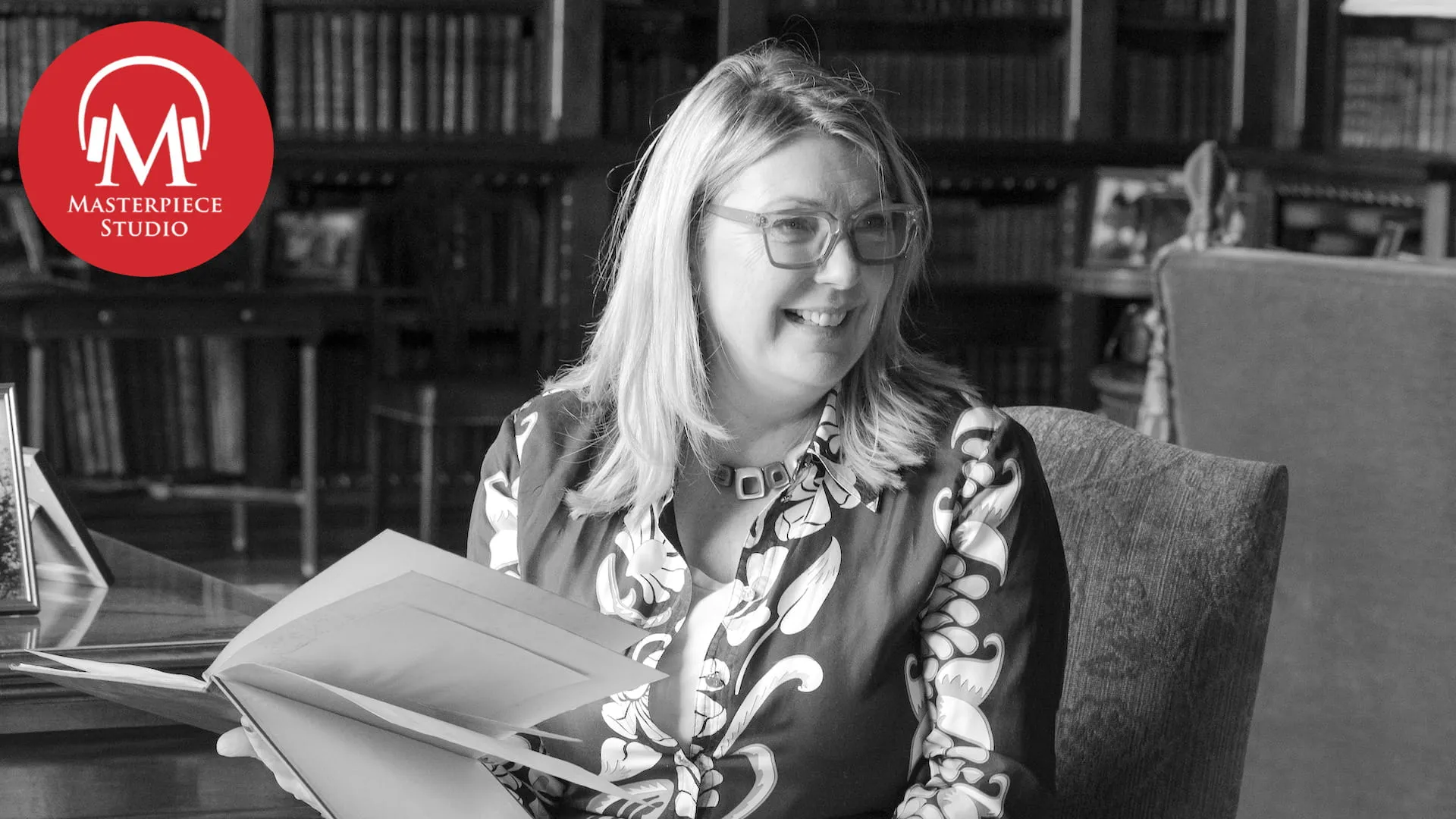
The 8th Countess of Carnarvon wears many hats including author, chartered accountant, social media influencer, gin magnate, and impeccable hostess. Lady Carnarvon and her husband, the 8th Earl of Carnarvon, are the latest stewards of the historic Highclere Castle, which you may recognize as the primary filming location for Downton Abbey. In this episode, Lady Carnarvon discusses her new book, A Year At Highclere: Secrets and Stories from the Real Downton Abbey, and shares what it’s like to call this piece of living history home, as well as all things ghosts, gardens, King Tutankhamun, Downton Abbey, and more.
This script has been lightly edited for clarity.
Jace Lacob: I’m Jace Lacob and you’re listening to MASTERPIECE Studio.
It’s likely no surprise that Downton Abbey, the beloved period drama, is the most-watched MASTERPIECE series and highest-rated drama in PBS history, with the final season on MASTERPIECE bringing in more than 26 million viewers. Across its run, it racked up 69 Primetime Emmy nominations, and 15 Emmy wins across the six seasons, along with countless other awards.
Downton Abbey might be the story of the Crawleys, the venerable family struggling to keep their family estate intact and thriving amidst the upheaval of the 20th century, but it is also a story about a distinct place and the people who live and work there. After all, this period drama isn’t called The Crawleys for a reason: at the drama’s heart is the mighty edifice itself, which ebbs and flows over the years along with the changing tides of history. Much like the real-life Downton Abbey itself: Highclere Castle.
Highclere Castle has become synonymous with life above and below stairs in the Yorkshire of the early 20th century depicted in Downton Abbey… even if the real-life castle itself is located in the South of England, just outside Newbury and a 40-minute drive from the dreaming spires of Oxford.
This is a place of significance, a striking and now iconic house with a rich history that sits in a 1000-acre parkland designed by Capability Brown, but — like Downton Abbey — this stately home is also very much a home. In this case, it’s home to the 8th Earl of Carnarvon and his wife, the Countess of Carnarvon, who are the latest stewards of this historic property.
Lady Carnarvon: The house, the estate, the landscape is not just for us. It never has been. It's for others as well. And I always think it's not our world, it's the world’s. And I think the astronauts in outer space have put it so well, so often, what a beautiful world we are all living on. And it is a world in which we're all privileged to live and look after small spaces within it in order to hand on. But it's not ours to pillage, it's ours to care for.
In addition to being an impeccable hostess, a gin magnate, a social media influencer, and a chartered accountant, the Countess is the author of several books, including her latest, A Year At Highclere: Secrets and Stories from the Real Downton Abbey, in which she takes readers behind the scenes of Highclere and through the rhythms of the year, bringing to life the stories and people that make Highclere Castle what it is today.
In this episode, Lady Carnarvon discusses her new book and shares what it’s like to call this piece of living history home, as well as all things ghosts, gardens, King Tutankhamun, Downton Abbey, and more.
Jace Lacob: This week, we are joined by the 8th Countess of Carnarvon, the author of A Year At Highclere: Secrets and Stories from the Real Downton Abbey. Lady Carnarvon, welcome.
Lady Carnarvon: Thank you so much. It is a joy to be on with you.
Jace Lacob: So, in the introduction to the book you write, “Highclere is about storytelling — the history of the house, the timelines of the ancient trees, the farmland, wildlife, and how they all fit together.” By the end of the book, you demonstrate rather remarkably how these elements of life fit perfectly. While you've written other books about the history of the house and its inhabitants, what was the impetus behind writing A Year At Highclere?
Lady Carnarvon: I wanted to write about life here today, all the things that we do to try and steward a house such as this, rather than just focus on some of the historical tales, although I do start with history. I wanted to share life today because I've asked so many questions about it. What's it like to live in a castle? Are there any ghosts? What was it like to live with a film crew? So I thought at the end of this particular run of Downton Abbey, it was great to stop, to stand still and gather many thoughts together before I lost them.
Jace Lacob: I love the fact that A Year At Highclere isn't a literal month by month diary for a calendar year, but instead you capture the cyclical rhythms, the ebb and flow of life at Highclere, using each month as a way into a meditation about dogs or ghosts or the landscape, or, as you say, filming. How did you decide to organize the book in this fashion?
Lady Carnarvon: I suppose it comes from thinking that more of our life is or should be cyclical than linear. I think we impose all the linear data on ourselves, but the very day through which each of us lives, the very month, the year, it's actually got a circular structure to it. And I think it's important to live within the seasons. We live better. It's healthier for us to do so. And I think it helps with mental health as well. So there was actually quite a lot of underlying thought to that.
Being here at Highclere, much of our life is spent outdoors, although much of Downton Abbey was filmed indoors. But equally well where they could, they went outdoors. And I wanted to reflect that because again, living here, you'd think that for centuries, most of our ancestors spent much of their life out of doors, doing things, farming, creating things, building things. And it's only us who've come inside to look at the ceilings of the house, of our sitting rooms and everything else, whereas our predecessors didn't. So I suppose I'm really interested in how our ancestors have lived and that sense of continuity. And I always want to feed that into how we live today and perhaps find touchstones to live better today and with less anxiety.
Jace Lacob: You mentioned stewardship. So, like the Crawleys of Downton Abbey, you and your husband, the 8th Earl, look upon yourselves as custodians of this stately home. You write, “Geordie and I have taken both words to heart, stately home. It is a home once more and a gracious one, which we share each year, all year, with thousands of visitors.” You ushered in a new era for Highclere. What sense of responsibility of stewardship do you and his lordship share about maintaining this stately home for the generations to come?
Lady Carnarvon: I don't think I really knew what I was taking on when I firstly married my husband, then when his father suddenly died. But perhaps that's a good thing, actually, not to know, not to have that crystal ball. I think I was brought up with a sense of duty and service and to do what you can by others. So I suppose that was inculcated by my own family and upbringing. And then from there, it's looking at the bigger picture because the house, the estate, the landscape is not just for us. It never has been. It's for others as well. And I always think it's not our world, it's the world’s. And I think the astronauts in outer space have put it so well so often, what a beautiful world we are all living on. And it is a world in which we're all privileged to live and look after small spaces within it in order to hand on. But it's not ours to pillage, it's ours to care for. So I think that underlies so much of what I try to do every day, although much of each day is just caught up with the melee of just living each day.
Jace Lacob: At the end of the book, you quote an ancient Sanskrit mantra, “Lead me from the unreal to the real.” So, I want to begin in that fashion as well. Moving from the unreal that is Downton Abbey to the realities of life at Highclere. Downton Abbey might be Highclere, but Highclere is not Downton Abbey. How do you deal with the overlap in the public consciousness between the two?
Lady Carnarvon: I think I accept and enjoy where we are and then wish to just enhance people's enjoyment of coming to see a film location set and where Maggie Smith as the dowager stood with where Lord Salisbury or the late Queen or Queen Caroline, who was married to George II in the 18th century, or Winston Churchill or George Patton might also have stood. So it's trying to layer the history into a costume drama. And I think both muddling it together and then extricating one layer and story from another just to make people ponder and think and enjoy themselves.
So it is a bit of a muddle. And some tours I'm focusing more on, this was where Lord Grantham stood, and this was the blue marker on the carpet of where he was standing to say something. Or this is where Maggie Smith said something excoriating to Sybil or something or Lady Edith. So it is a muddle. Downton Abbey was a costume drama. It's not a historical documentary, but as a costume drama, it entranced us all. And I've obviously thoroughly enjoyed its progress on PBS. And I'm a supporter of PBS. I think it's a great platform in America, whenever I'm there to watch TV. It's great. Lovely programs. And it's so interesting. It's a mixture of interesting, entertaining and educational. But often in order to be educational, you have to be entertaining. And Downton Abbey is really entertaining and you worry about what's going to happen to the characters next.
So I hope I've learnt from the entertainment to try to be entertaining at Highclere, and I think learning some lessons or stories or histories from it comes next. But it is this balance of entertainment and education or reality which does get muddled. And I suppose that's what drove me to write to start with after Downton came out, because what they were portraying did not actually happen. But what actually happened to Lady Almina in The Real Downton Abbey was so meaningful and it just made me cry. It was so deeply emotional. All that little lady did for other people, I wanted to share what really happened. And sometimes the unreality spurred me to share the reality, but make that reality entertaining. So I am so deeply embedded in the psychology of it, if you like, but try to retain the sense of fun at all times.
Jace Lacob: I want to dive into that a little more. You mentioned Lady Almina and like in Downton Abbey, Lady Almina, the 5th Countess Carnarvon opened the house as a hospital during World War I, which you wrote about in your book, Lady Almina and the Real Downton Abbey. Similarities like this do tend to blend truth and fiction. Do you feel like Highclere's own history informed or inspired that of Downton?
Lady Carnarvon: Well, I know Julian Fellowes was actually staying with us, he's a good friend, which is how the whole thing came about. Although, they looked at another 400 houses before returning to the first house they'd seen, being us. And when he suddenly was going to be writing the second series, he knew we were a hospital. So in Downton Abbey was a convalescent home. Thus he didn't have to deal with amputations or operations, which was what really happened. Amputations as little as possible, but the operations and the nursing as much as possible.
I think I was sharing with him that one of the nurses was awfully pretty and found in one of the patient's bedrooms. So I think none of us owns stories, and I think the way they come about is fantastic. So I can see a few things popping up here and there, and you can do a compare and contrast, but I think each stand on their own two feet. And that book about that amazing, extraordinary woman really spurred me to continue to write. So she was a learning curve in terms of turning myself into an author. But I thought if she can do what she did for real, contributing most at points of other men's, other people's husbands, brothers, fathers, sons life when good nursing was most needed, I can at least finish a book about it.
Jace Lacob: Of the experience of seeing the first Downton Abbey film at a screening in New York you write, “The home that we loved never put a foot wrong in a single scene.” What was it like seeing Highclere not on the telly, but on the big screen that first time? And what would your late in-laws have thought of the experience?
Lady Carnarvon: Golly, you're right. I mean, I cried, actually. I found it so moving. And even talking about it now, I always find myself close to tears because it was such a beautiful opening scene, and everybody in that audience, those hard bitten New Yorkers, clapped and applauded. And I think my father in law, my parents, would have been so proud and my father would have loved it. He was always full of optimism and ‘can do’ attitude in particular. And he'd been through so much, he'd lived through World War II and survived it. And every day was a good day. And he had a very positive and forthright attitude. You mind your P's and Q's, but he was great. He would have absolutely loved it. And so would Geordie's grandfather. He would have adored it.
Jace Lacob: This story doesn't appear in your book, but in Series Three of Downton, Matthew Crawley and Tom Branson visit the estate office to learn more about the estate. Is it true you loaned them some of the actual Highclere/Beacon Hill maps to use as a prop?
Lady Carnarvon: I did loan them. And actually, what's more, I then suggested to the two of them, why don’t they hop in my car and let's go up to the top of the hill and look down at what they're talking about. And I then obviously, because it was over their lunchtime said, okay, I'll grab some smoked salmon sandwiches and a bottle of champagne. So the three of us hopped in the car, and I drove pretty quickly to get up to the hill because there wasn't that much time, showed them the map, showed them where they were, we drank champagne, we ate smoked salmon sandwiches. And then I got a call from Liz Trubridge, who's one of the executive producers, saying, where are you? And the answer was, we're bloody miles away. So we then had to head back down again. But it was very funny. I always feel guilty because I didn't mean to get anyone into trouble at all, and I don't think we were that long. But it was good fun. I always think if you kind of feel and know what you're trying to act, you have that stronger sense of place, which I think comes through. You have slightly more authority when you're delivering your lines.
Jace Lacob: And I'm sure the champagne didn't hurt either.
Lady Carnarvon: Oh, the champagne was very important. It's always important, champagne.
MIDROLL
Jace Lacob: And we’re back with Lady Carnarvon. During filming on Downton, the late Dame Maggie Smith was given a little sitting room with a heater that she could use between scenes and where she could take tea. What is your fondest memory of Dame Maggie at Highclere?
Lady Carnarvon: I think in one of the very early scenes when Mrs. Crawley, Penelope Wilton, was arriving and there was a sort of line up of Robert Grantham and Cora Grantham and the Dowager, they were lined up in the saloon and they were getting into their places and everything else. And Dame Maggie was standing beside me by the stairs opposite where she was going to be. And she was saying to me, what do you think? Do you think she'd have shaken hands or…? She was thinking how she was going to play the scene out loud. I can't remember what she asked me now, I wish I could remember. But of course I blooming can't remember because you thought it was just one small moment and there'll be many more small moments, which there were. But because it seemed to keep going, I didn't remember with enough detail what I should have remembered.
But I just have that very strong sense of standing with her and then watching her go into place, and then watching how she played out the scene, which was hysterical and really set the tone for how her continuing relationship went on. So I think it was watching the ultimate professional actor at work. She never had a script with her, actually. She knew it. She knew the words, the scene, and she knew how she was going to deliver it. She had a real instinct for it. But what an amazing lady to have for so many years at Highclere.
Jace Lacob: Incredible. There is a brilliant story in your book involving Shirley MacLaine, who played Martha Levinson on Downton and who is well known for her belief in reincarnation, coming to Highclere to film. And upon arrival, she requested a bottle of red wine and an Anubis from the Egyptian collection. What do you recall of this unusual encounter?
Lady Carnarvon: It was very funny. I thought she was extraordinary because she got off a plane, was staying at a hotel, and she was straight into quite a complicated arrival scene where there's quite a lot going on and it's outside, and then you're competing with the weather as well as a whole cast of people and the arrival of Shirley MacLaine. She was a great woman, took that straight on.
But at the end of the day, Liz Trubridge once more came up to me and said, Lady Carnarvon, I've got a huge favour to ask. And I thought, oh my God. And I said, absolutely, how can I help? And she said, would you have any red wine? I said, oh yes, yes, that's great. Yes, easy. And do you by any chance have an Anubis in the Egyptian exhibition in the cellars? I said, yes, we do, we do. So that was easy. Very happy to please. And then I took Shirley MacLaine and her party around the Egyptian exhibition, which was great fun, actually. And she thought she was the reincarnation of an Egyptian princess. And she had a little dog called Terry, I think.
Jace Lacob: Terry the terrier.
Lady Carnarvon: Terry, yes. Terry the terrier. And round we went. And anyway, luckily I got as far as the Anubis, which made her very happy and I think she really enjoyed it actually genuinely. The 5th Earl of Carnarvon discovered the tomb of Tutankhamun. So she had Highclere and the cellars and the exhibition on her agenda. I suspect she'd marked her card before she arrived.
Jace Lacob: As we move through the unreal, there are allegedly ghosts at Highclere Castle. Many, including Pat Withers, the decorator, have experienced occurrences in parts of the house that have yet to be explained. My favorite of your ghost stories involves the local spirit Grampas and the one of you and your son Eddie, going behind the green baize door and into the basement. What do you recall of that ghostly encounter below stairs?
Lady Carnarvon: Well, that was quite early on when Eddie and I had our first encounter, or I had my first encounter, with something or someone I didn't expect to be there. And I suppose Eddie must have been two or three years old. He had one of those big, rather wonderful electric bikes, quad bikes, which go all of two miles an hour, because some of the corridors at Highclere are very long. And when you move from a baby to a toddler, they get actually quite heavy without being able to cover much ground. So this was my more advanced pram and he loved it too.
So we'd gone down. We were the only ones in the castle. I left my husband and the photographer to be filming in the… they were taking some photographs for the guidebook actually in the smoking room. I went down a very old set of stairs in an old part of the castle, went through some doors, turned to the right, and there's another juncture where again, I turned to the right. And I glanced along the corridor to the left, and I saw a figure there, I suppose a little bit taller than I, quite slim, with some sort of cravat, some sort of paler cravat around his collar. And I turned over to the right and, Eddie, darling, put your foot down on the bike. Which he did, happily chattering. And I was then pushing him. So I was between him and said figure, ghost. And I said to Eddie, can you go a bit faster, darling? Can you go as fast as you can? And I was then pushing him as well. And this chap was following us along the corridor, which wasn't entirely brilliant. And we kept going. I think I was pushing him ever faster. And we came to some fire doors on the other side of the fire doors, Percy, our Labrador, was barking like I don't know what. And he would not bark obviously at Eddie and I. We swung through the fire doors and thanks be to God, the ghost stopped at that point and went on.
And obviously I gathered myself together and didn't want Eddie to know what had happened, and was definitely very disconcerted by it and didn't fancy going along that corridor very much again. So I used to take long, circuitous routes round and go in by other doors and I thought, this is silly. So I rang up a friend who rang up a friend at Westminster Abbey and asked if it was possible to wish this ghost well and at the same time, perhaps bless the house, because I think that would be a really good thing to do.
So, Father Peter came down, an Anglican priest, and blessing a house is just wonderful. If any of you haven't done it, it's so worthwhile. It just makes you think of what a home is. It's a place to welcome people, so there we bless the entrance hall. The place where you sit and eat, so there we bless the dining room. We bless the center of the house. There are 50 to 80 bedrooms, so we chose one bedroom and that was a bedroom which once had a séance. So I thought, let's try and do that at the same time. So we'll have a go at that bedroom, so we did. And then we went downstairs to where I had seen this ghost. So at this juncture I'd asked Father Peter to see him on his way and say he could go and rest, and everything was fine. And I think on the whole he is. Sometimes he has come back, and you sort of sing cheerily and think, maybe I'll not go along here at the moment. But overall it's much better.
Jace Lacob: Terrifying and amazing. The 7th Earl, your father in law was known as the Lord of Porchester. And Porchey had a special bond with Her Majesty Queen Elizabeth II. You had but nine months to get Highclere ready for a royal visit from the late Queen and Prince Philip, which you write about. Did you feel an innate connection to Lady Almina, who herself had to host a royal visit from the Prince of Wales at Highclere back in the day?
Lady Carnarvon: It was fascinating. I think I did feel closer to it. She was 19 years old when she welcomed the Prince of Wales, who became Edward the 7th to Highclere. But she had her father, Alfred de Rothschild’s help and a huge amount of money and resources. I'm not sure my husband was completely aware of how much I felt we needed to do, but we set to. And I heard that at some point the Queen said, “Why is it that everywhere I go it smells of fresh paint?” And I just think that's because everybody like me is busy painting!
But anyway, it was such an honor. And we welcomed her more than once. And to start with, it was panic stations, I think, because I had so much work to do, I never had a chance to properly panic because that doesn't really help. But when I look back, I think, goodness me, how did we do that? But it was a tremendous honor and something I never expected in my life to be doing. So that was really special.
Jace Lacob: Incredible. Highclere sits in a 1,000+ acre parkland plan by Capability Brown. “Gardens retain memories of people, places, and time,” you write. What do you hope the gardens of Highclere will remember of you one day?
Lady Carnarvon: I hope that we've unearthed some of the legacy of our predecessors here and created a space and peace and places for people to sit, to dream, to spend time out, to chill, to wander, to laugh and talk with their friends. We've planted, I don't know, hundreds of thousands of bulbs, and we've just committed to the next bulb planting. It is a joy and a passion. I never stop, and I'm just about to plant a little garden in memory of a very special lady called Daphne Dormer, who, after my own parents died very young, was always there in the background for me.
So, I think gardens are very special. They are a way of communicating with our predecessors because they mattered. The Romans thought that if you had a garden and a library, you could want for nothing in life. So we do need gardens and outside space. They are to be enjoyed and shared and watch the primroses come through now, all the cowslips, look forward to the roses. So I hope people will continue to think and be happy that George and I have planted a few trees, planted more ribbons of bulbs, and they'll be there for generations to come to see.
Jace Lacob: “Nature owes us nothing but we owe nature everything,” you write. You raise the notion that Alfred Lord Tennyson's “The Lady of Shalott” can be interpreted in two ways; Camelot the place, and Camelot the symbol of perfect peace and happiness. In Highclere, have you ultimately found both?
Lady Carnarvon: I don't forget the world outside, which is particularly, I think, anxious-making for all of us, challenging, frightening, fearful for many people. I hope that Highclere offers time out in such a difficult time. And I think Downton Abbey did as well. I think the more we understand the past and the geography of where we live, perhaps the better we can help place ourselves in a better position today. I can't lay any great claims to anything other than, I think, trying to do my best.
And I remember that my father, I'm one of six girls, but our father died very young. I'm already older than him. And our mother died later. Both of cancer. And after my pa died, one of his friends rang me up and he was obviously so nice to me. I was at the office at the time and I burst into tears and he said, Fiona, why are you crying? And I said, well, I just can't cope. And he said, have you done your best today? I said, well, I've tried. And he said, well, God doesn't ask any more. So I think it's simply that I wish to try each day to do my best. And I think the kindness which we all should show to each other lies at the heart of everything we do here at Highclere. And when we get it wrong, which we often do, it's just saying sorry. So I think those basic human ways of living and bringing us all together are what really matters. And we all saw some of them in Downton Abbey. But at Highclere, they're really real.
Jace Lacob: I love that. Lady Carnarvon, thank you so very much.
Lady Carnarvon: You are very kind. Thank you so much for inviting me onto your show.
You can find A Year At Highclere by The Countess of Carnarvon in bookstores now. And don't miss the drama filmed inside the castle — all six seasons of Downton Abbey are available to stream with PBS Passport and with PBS MASTERPIECE on Prime Video, and will re-broadcast on PBS on Sunday evenings beginning May 17, 2026, at 10 p.m. Eastern. Check your local listings for details.
Next time, we travel back to 1963 to join our favorite cop and vicar duo in Grantchester, where intuition seems to be sending this pair a message.
CLIP
Alphy: When I wake up, I have this feeling.
Geordie: Of what?
Alphy: Dread.
Geordie: Oh, that’s normal. I wake up with dread every single day.
Alphy: That’s not normal Geordie.
Join us on Sunday, June 14th for the final season premiere of Grantchester.
MASTERPIECE Newsletter
Sign up to get the latest news on your favorite dramas and mysteries, as well as exclusive content, video, sweepstakes and more.