For tens of millions of years, tyrannosaurs stayed tiny—despite dwelling amongst larger meat-eating foes like Allosaurus.
And then, in the blink of an eye compared to the expanse of evolutionary history, tyrannosaurs experienced a major growth spurt. A major 20-million-year gap in the fossil record has left scientists wondering how this creature could have possibly become so huge.
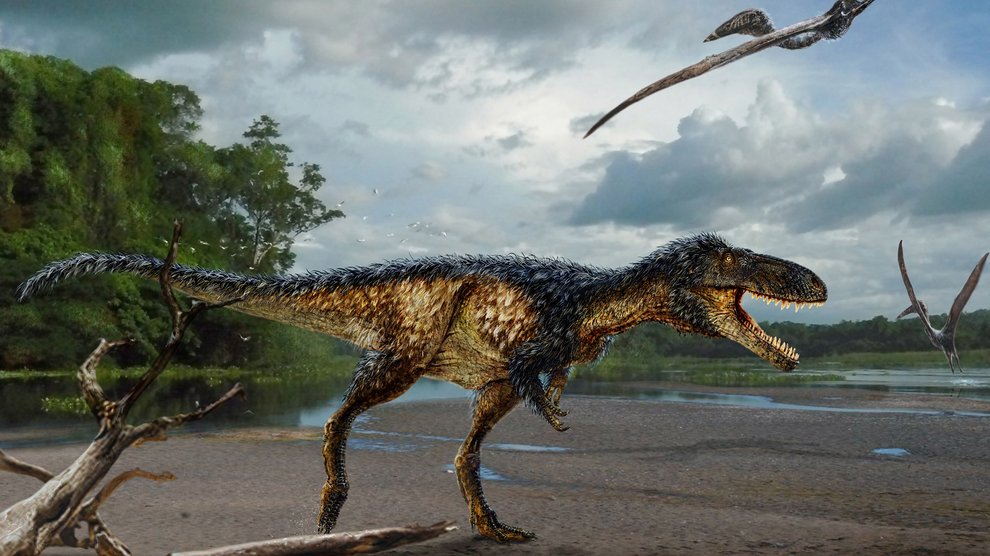
In 2004, they came across a clue—a part of a tyrannosaur skull from about 90 million years ago, smack in the middle of the fossil gap. A team led by Hans-Dieter Sues of the Smithsonian National Museum of Natural History and Alexander O. Averianov of the Russian Academy of Sciences discovered the fossil in the Kyzylkum Desert in northern Uzbekistan. The fossil’s owner,
Here’s Kenneth Chang, reporting for The New York Times:


Based on a few scattered bones, the scientists estimated that Timurlengia was about the size of a horse, like earlier tyrannosaurs, weighing about 600 pounds, with long legs and blade-like teeth. Lithe and fast, it probably chased down plant eaters like early duck-billed dinosaurs also found in the region.
But a CT scan of the braincase showed that the shape of the brain was similar to that of the later tyrannosaurs, and that the inner ear structure was tuned to low frequencies.
“We were very surprised it already had this sensory organization associated with T. rex and related animals,” Dr. Sues said.
So while the finding does not explain how T. rex grew to such a gargantuan size, it does refute a previously-held notion among paleontologists that its prehistoric success could be attributed its large brain and ears (having the latter enables one to pick up low-frequency sounds that smaller animals can’t). But the team’s paper , published in Proceedings of the National Academy of Sciences, suggests that Timurlengia euotica already had these traits—its brain was arranged in the same shape and proportions as T. rex ’s—and the only noticeable difference is that T. rex ’s body and brain are bigger.
At the same time, it may not be true that T. rex capitalized on Timurlengia euotica ’s neuro-improvements. Instead, T. rex may have evolved elsewhere on the planet, and not from T. euotica at all. Still, T. euotica is an important departure from what scientists have assumed to be true about dinosaur evolution—which brings us a step closer to understanding how dinosaurs came to dominate this planet.
