
Quick Change Artists
If
you're what marine biologist Roger Hanlon calls "a yummy hunk of
protein swimming in the ocean"—unprotected by a hard shell, prickly
spines, or other armor—being able to change your looks in an instant and
blend into your surroundings is an invaluable trait. Hanlon and other
biologists think the ancient predecessors of modern cuttlefish may have evolved
the ability to alter the colors, patterns, and even textures of their skin
because such tricks kept them hidden from predators. Today, however, various
species of cuttlefish use their powers of transformation for more than just
camouflage. In this slide show, see cuttlefish caught in a variety of acts of
quick-change artistry.—Susan K. Lewis

|
|
It's Here Somewhere...
But
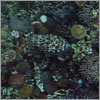
where? Try to spy the cuttlefish in this image of image of a coral reef in the coastal
waters of Indonesia. To see if you're right, proceed to the next slide.
|
|
|
Gotcha!
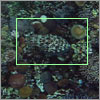
Because cuttlefish are such masters of disguise, they are elusive study subjects in the wild, and some species may yet be undiscovered. (There are thought to be roughly 100 species worldwide, living in oceans almost everywhere except the icy poles and the Americas.) Cuttlefish tend to live in complex environments with ample hiding spots like coral reefs and mangrove swamps. But the variety of colors and textures in these environments also tests their quick-change abilities.
|
|
|
Animal or Plant?
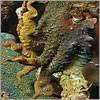
A cuttlefish's skin
can be as smooth as a polished rock, as bumpy as a brain coral, or as spiky as
seagrass, and all these different textures can appear on a single animal,
morphing from second to second. Cuttlefish rely on special cells in their skin
called papillae to carry out these transformations. The cuttlefish at right
also seems to be crimping the eight legs on its head to mimic the surrounding
environment.
|
|
|
Solids, Checks, and
Stripes
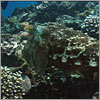
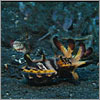
Matching the color
patterns, as well as the tones, of its background is key to the cuttlefish's
camouflage success. Its skin can show dozens of seemingly different patterns,
but according to biologist Roger Hanlon, all these patterns fit into three
basic types: uniform, mottled, and disruptive. Hanlon thinks this simplifies
the task of blending in; a cuttlefish can quickly perceive enough visual cues
to jump into one of the three modes, then take more time to refine the pattern
it needs to stay hidden.
|
|
|
Standing Out
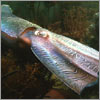
The Flamboyant
cuttlefish, Metasepia
pfefferi,
seems like no other. This diminutive creature, just a few inches long, walks
rather than swims, and it sometimes uses its skin-changing skills to call
attention to itself. Like all cuttlefish, it has pigment-containing cells
called chromatophores, and it changes its skin color by contracting or
expanding the muscles around various chromatophores. But the Flamboyant often
opts for flashy reds and yellows when predators are near, signalling to them
that it is poisonous
|
|
|
Macho Males
When thousands of
Giant cuttlefish, Sepia
apama, congregate
in the waters of South Australia to breed, male rivals display their bravado
with striped body patterns. They can maintain these zebra stripes for hours and
seem to wear them like war paint to intimidate challengers. Big males,
stretching well over three and a half feet long, indeed look menacing even to
human divers.
|
|
|
Cross-Dressing
Males
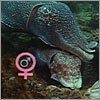
With between four and
11 males for every female on the breeding ground, competition among Giant
cuttlefish is fierce. Smallish males, rather than duke it out, take on the
guise of females and try to sneak their way to matings. In this image, a male
with the mottled color pattern of a female cruises under a large male and
toward a female. Females are usually quite receptive to these mimics, and the
mimicry is so effective that it sometimes fools other cross-dressers, leading
two mimics to try to mate with each other.
|

|
|
A Dazzling Show
A few species of
cuttlefish, including the Broadclub cuttlefish, Sepia latimanus, and the common European cuttlefish, Sepia officinalis,
use their skin-changing abilities to mesmerize prey. All cuttlefish have in
their skin not just chromatophores containing pigment but also two kinds of
reflective cells, iridophores and leucophores, which influence color and, even
more remarkably, can make the skin appear luminous. As they hunt, the Broadclub
and European cuttlefish seem to turn on virtual strobe lights in their bodies,
and shrimp and other prey fall victim to the act.
|
|

We recommend you visit the interactive version. The text to the left is provided for printing purposes.
|


