

Brain Geography
- Teacher Resource
- Posted 09.26.03
- NOVA
This interactive feature from the NOVA: "Coma" Web site shows you how to make a model of the brain, using just your hands, a ball, and a pencil. With your newfound knowledge of brain anatomy and function, you will then diagnose the types of head injuries your patients have, given the specific symptoms each presents.


- Media Type: Interactive
- Size: 1 byte
- Level: Grades 6-8
-
Log in to Teachers' Domain to download, share, rate, save, and match to state standards.
Source: NOVA: "Coma" Web site
This resource can be found on the NOVA: "Coma" Web site.
Background
Until recently, what doctors and scientists knew about how the brain works came from observing what stopped working when the brain was injured. Neuroscientists studied thousands of head-trauma victims and methodically mapped specific functions onto various structures of the brain. They found, for instance, that when the frontal lobe of the brain was damaged, patients suffered a loss of motor control. An injury to the temporal lobe of the brain often caused patients to lose the ability to comprehend language and to recognize objects, even though they could still see them. Similarly, researchers found that damage to the limbic system deeper within the brain affected a patient's emotional state.
Obviously, this type of research was painstaking and crude. For starters, head injuries are seldom confined to just one part of the brain but, rather, often involve multiple areas. In addition, different areas of the brain have no visible boundaries between them even when healthy, making the job of correlating structure and function more difficult.
Today, however, neuroscientists can look deep within the human brain without having to wait for a patient with a specific type of head injury to come through the door. They can now observe both properly functioning and improperly functioning brains, including those of children, and make comparisons based on what they see.
One of the latest technologies that allows scientists to do this is called Functional Magnetic Resonance Imaging (fMRI). fMRI scanners detect changes in the oxygen level of the blood flowing through the brain. The level of oxygen in the blood in a given area of the brain is directly related to the level of brain activity in that area. For example, the more oxygen being delivered to the cerebral cortex, an area in the upper middle of the brain, the more active that area is.
Researchers might see this pattern of activity if they asked a patient to read or write. In the brain of a person who has a reading problem, however, they might observe a different pattern of activity. Such observations can improve the accuracy of a diagnosis; in a case like this, a doctor would be able to correctly attribute the patient's reading problem to a problem in the brain, as opposed to poor vision or some other reason.
Questions for Discussion
- Students could be asked to design quiz items in reverse of the ones on the Web. For example: Design a quiz item for which the right answer is the limbic system.
- Why do you think the brain has many different parts?


Related Resources
-

How Does the Brain Work?
Investigate the psychology of magic tricks, magnetic wands that treat depression, artificial intelligence, and more.
-

Compare the Brains
How does the hobbit's brain measure up to those of a modern human, a chimp, and others?
-

Bird Brains
Clues to the origins of human language are turning up in the brains of birds.
-
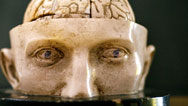
Brain Trauma
Even so-called "mild" head injuries can lead to serious concussions with long-term consequences.

