
|
|
|
|
|
|
This two-hour program is divided into 13 chapters.
Choose any chapter below and select QuickTime,
RealVideo, or Windows Media Player to begin viewing. If
you experience difficulty viewing, it may be due to high
demand. We regret this and suggest you try back at
another time.
Technical Help
|
Feedback
|
Program Credits
|
Program Transcript
|

|
|
|
|

watch chapter 1 in
Quicktime
RealVideo
Windows Media:
hi
|
low
|
|
Beginnings
This chapter:
-
notes that Percy Julian was captivated by plants,
particularly by their ability to produce powerful
chemicals.
-
states that Julian's parents were teachers, and his
father provided the family with books because public
libraries were closed to African-Americans.
-
reviews Julian's early education, which occurred at a
time when black children in Alabama were not allowed
to study past the 8th-grade.
running time 7:02
|
|
|
|
|
|

|
|
|
|

watch chapter 2 in
Quicktime
RealVideo
Windows Media:
hi
|
low
|
|
Black & White
This chapter:
-
states that Julian entered Depauw University in
Greencastle, Indiana, and reviews the difficulties he
faced there.
-
points out that the first African-American to earn a
PhD in chemistry, St. Elmo Brady, was a great source
of inspiration for Julian.
-
reports that after four years at Depauw, Julian earned
a bachelor's degree in chemistry and graduated Phi
Beta Kappa and first in his class.
-
recounts the challenges Julian faced prior to and
while earning his master's degree from Harvard
University in 1923.
running time 8:09
|
|
|
|
|
|

|
|
|
|
watch chapter 3 in
Quicktime
RealVideo
Windows Media:
hi
|
low
|
|
Alkaloids
This chapter:
-
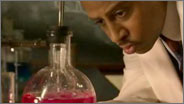
reports that Julian won a fellowship to study at the
University of Vienna in Austria in 1929, where he
collaborated with Josef Pikel in natural products
chemistry.
-
tells that in Vienna, Julian worked with
alkaloids—powerful plant chemicals that evolved
to protect plants—to investigate their potential
medicinal uses.
-
explains that Julian focused on the difficult task of
isolating and identifying the chemical structure of
the active alkaloid in Corydalis cava.
running time 8:51
|
|
|
|
|
|

|
|
|
|

watch chapter 4 in
Quicktime
RealVideo
Windows Media:
hi
|
low
|
|
Rumors & Ruin
This chapter:
-
reports on Julian's move back to Howard in 1931.
-
points out that Julian was determined to publish
research while at Howard.
-
relates the university politics and scandal that led
to Julian's resignation from Howard and heralded his
return to Depauw to work as a research fellow.
-
portrays Julian as an exceptional lecturer and orator
and relates how he put Depauw on the map for
undergraduate research.
-
reports why Julian was forced to stop teaching and
notes that he turned to a high-stakes research project
that would either make or break his career.
running time 6:12
|
|
|
|
|
|

|
|
|
|

watch chapter 5 in
Quicktime
RealVideo
Windows Media:
hi
|
low
|
|
Race for the Synthesis
This chapter:
-
describes Julian's efforts to revive his career by
taking on one of the world's leading organic chemists
in a race to synthesize the alkaloid physostigmine.
-
points out that synthesis—the construction of a
molecule one step at a time from simple building
blocks—was the highest calling for a chemist.
-
details how Julian refuted the work of his
competitor—the first to publish physostigmine
synthesis—and was determined to accurately
synthesize the molecule.
running time 8:30
|
|
|
|
|
|

|
|
|
|

watch chapter 6 in
Quicktime
RealVideo
Windows Media:
hi
|
low
|
|
Julian lands at Glidden
This chapter:
-
reports on Julian's elegant synthesis of
physostigmine, achieved in a minimal number of steps.
-
identifies the continuing racism Julian faced in his
pursuit for employment before he was hired as director
of research at the Glidden Company in Chicago.
running time 6:47
|
|
|
|
|
|

|
|
|
|

watch chapter 7 in
Quicktime
RealVideo
Windows Media:
hi
|
low
|
|
The Soybean
This chapter:
-
points out that soy is used in a wide range of
products, from food and medicine to paper and
plastics.
-
describes Julian's strong work ethic and his drive to
encourage those who worked with him at Glidden.
-
looks at how corporate chemical research began to
change the way in which people lived.
running time 8:34
|
|
|
|
|
|

|
|
|
|

watch chapter 8 in
Quicktime
RealVideo
Windows Media:
hi
|
low
|
|
Steroids
This chapter:
-
explains that although Julian was extremely successful
at Glidden, he wanted to pursue his own research.
-
emphasizes Julian's desire to synthesize steroids,
including progesterone, because the work would benefit
human health.
-
relates that in the mid-1930s, scientists realized
that plant steroids could be converted into animal
steroids.
-
reports on Julian's work to synthesize progesterone
from plant steroids after his accidental discovery of
a method to isolate steroids from soybean oil.
-
explains that some companies began making hormones
from giant yams, which led to the development of the
birth control pill.
running time 10:31
|
|
|
|
|
|

|
|
|
|

watch chapter 9 in
Quicktime
RealVideo
Windows Media:
hi
|
low
|
|
Oak Park
This chapter:
-
states that Julian's work at Glidden won him national
acclaim.
-
specifies that Julian's isolation of the alpha protein
from soy led to the development of several new
products, including a life-saving fire-fighting foam.
-
notes that Julian was named to the boards of a half
dozen colleges and universities, won the prestigious
Springarn Medal from the NAACP, and was named
Chicagoan of the Year.
-
reports on Julian's move with his family to Oak Park,
Illinois—a cultured, privileged, and mainly
white community outside of Chicago—where his
house was set on fire and bombed.
running time 10:25
|
|
|
|
|
|

|
|
|
|

watch chapter 10 in
Quicktime
RealVideo
Windows Media:
hi
|
low
|
|
The Miracle Drug
This chapter:
-
describes several treatments for rheumatoid arthritis,
most of which were ineffective.
-
relates the success of Compound E for rheumatoid
arthritis sufferers.
-
tells how scientists searched for an easier and less
expensive way to make cortisone, a natural hormone
made by the adrenal glands.
-
details the path Julian took to try to synthesize
Compound S, a steroid that required only one
additional step to make cortisone.
running time 8:51
|
|
|
|
|
|

|
|
|
|

watch chapter 11 in
Quicktime
RealVideo
Windows Media:
hi
|
low
|
|
Success
This chapter:
-
notes how Julian's team was upstaged by the Upjohn
Company after researchers there found that a common
mold could complete cortisone synthesis.
-
explains that Compound S became a very important
material, and Julian had the process to make it.
-
reports that Upjohn decided to produce cortisone from
progesterone made using the Mexican yam.
-
reveals why Julian left Glidden in 1953 to start his
own business, Julian Laboratories.
-
notes that Julian received a contract to make Compound
S for Upjohn, but a rival company, Syntex, refused to
sell him the root extract he needed.
-
presents the obstacles Julian had to overcome to make
his business succeed.
running time 10:04
|
|
|
|
|
|

|
|
|
|

watch chapter 12 in
Quicktime
RealVideo
Windows Media:
hi
|
low
|
|
Julian Laboratories
This chapter:
-
details how Julian came to use barbasco root from
Guatemala to obtain the necessary extract to make
Compound S.
-
notes that Julian undercharged when selling Compound S
because he wanted medicines to be available to as many
people as possible.
-
recounts that the U.S. Department of Justice's action
against Syntex allowed Julian to open a plant in
Mexico.
-
reports on the eventual success of Julian's company.
- details Julian's fight for racial equality.
running time 8:46
|
|
|
|
|
|

|
|
|
|
watch chapter 13 in
Quicktime
RealVideo
Windows Media:
hi
|
low
|
|
Julian's Legacy
This chapter:
-
recounts that Julian received 18 honorary degrees,
more that 12 civic and scientific awards, and was
elected to the National Academy of Sciences.
-
points out that while racial discrimination prevented
Julian from having the academic research experiences
he would have liked to have had, he made the best life
in chemistry that he could for himself at the time.
-
states that Julian died in April 1975 of cancer.
-
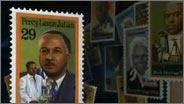
reports that the U.S. Postal Service honored Julian in
a stamp in 1993, and in 1999, the American Chemical
Society named his synthesis of physostigmine one of
the top 25 achievements in the history of American
chemistry.
running time 5:45
|
|
|
|
|
|


