|
||||||
|
|
|
|
||||
|
|
||||||
|
|
|
|
||||
|
|
|
|
||||
|
|
|
|
||||
|
|
Gallery of Auroras |
|
||||
|
|
|
|
||||
|
|
|
|
||||
|
|
|
|
||||
|
|
|
|
||||
|
|
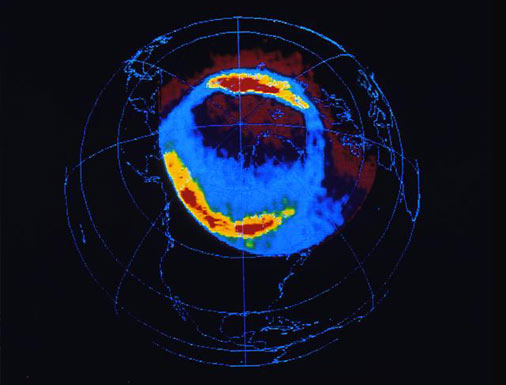
NASA's UltraViolet Imager, an instrument on the Polar spacecraft, captured this image of the aurora borealis' distribution across the North Pole on April 6, 1996. Remarkably, it shows auroral activity in both the night and day hemispheres of Earth at the same time—the daytime side being the Western Hemisphere, which is visible in the lower part of the image. Though reflected sunlight would drown out the daytime aurora in a visible light image, ultraviolet light picks it up. The intensity of the aurora's concentration is color-coded from purple (weakest) through blue, green, yellow, and red (strongest). A sub-aurora, the large red area that appears in the upper part of the image, displays mostly in the night sky. |
|
||||
|
|
||||||
|
|
|
|
||||
|
||||||