
Read Transcript EXPAND
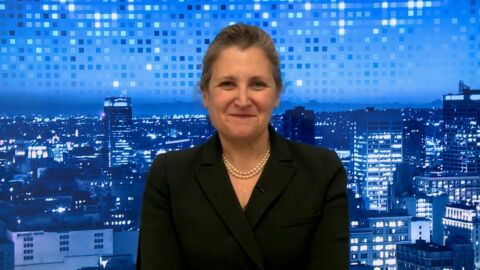
BIANNA GOLODRYGA: Well, as the world reacts to the spiraling situation in the Middle East, our next guest says that it is part of the wider collapse of international rules-based order. Chrystia Freeland is an economic adviser to President Zelenskyy, having previously served as Canada’s Deputy Prime Minister and Foreign Minister, and she joins Walter Isaacson.
WALTER ISAACSON: Thank you Bianna, and Chrystia Freeland, welcome to the show.
CHRYSTIA FREELAND: Great to be here, Walter.
ISAACSON: This attack on Iran by the United States has produced a response from Canada. Your prime minister, Mark Carney – you were once foreign Minister of Canada. I’d like you to explain it to us. What the Canadian Prime Minister said was that “Canada supports the United States acting to prevent Iran from obtaining a nuclear weapon and to prevent its regime from further threatening international peace and security.” Explain what Canada’s position is on this war.
FREELAND: Well, look, Walter, important for me to be very clear, I stepped down from the cabinet in the fall and from Parliament a few weeks ago. So I’m not here speaking on behalf of the government of Canada, and I wanna be really, really clear about that. But I am a Canadian. I am a liberal and proud of both things. I think a really important starting point for me when it comes to Iran is recognizing the incredible suffering of the people of Iran. Recognizing how oppressive this theocratic regime has been and how hard and how bravely the people of Iran, time and time again, have been fighting this regime and rising up against it, including in recent weeks. There’s a large Iranian Canadian community here, many of them my friends. And I have to say over this weekend, while no one knows what the future will hold – and you know, Iranian Canadians, many of them have family in Iran. They’re very well informed. They are as smart as any analyst you will talk to about knowing that there could be all kinds of difficult and hard to predict developments in the future. But one thing that I did hear from my friends this weekend is celebration that a tyrant has died. And from my perspective, all of us need to really start there and recognize that.
ISAACSON: One of the things that the Russian officials have been saying is that this kind of unleashes them to do regime changes and attacks. You’re obviously – we’ll talk soon about Ukraine. You’ve just come back from there. But they even said on Estonia, maybe now Russia will start acting this way. Is that something you fear?
FREELAND: I think we need to be worried about a few things. One is, if what – if the precedent that is being set is any country with superior military force simply has the right to take out the leadership of another country, that’s really, really troubling. I think there are also some real concerns that we should be talking about, about nuclear proliferation, because if you are a smaller country that is concerned about this precedent, it is pretty, it’s going to be pretty tempting for countries to think that in a world where there are no rules, where there are no rules of war, where that post-war liberal order, imperfect as it was, is now completely being disregarded. If that’s the world we’re in, it’s going to be hard for smaller countries to resist the view that they need to develop nuclear weapons. And that makes the world more dangerous for all of us.
ISAACSON: Let me unpack something you just said, which is that this notion of a strong power deciding to take out the leadership, in other words, to kill the leadership of another country, is that a line that’s been crossed here that’s somewhat unusual and may have a dangerous precedent?
FREELAND: Well, you know, Walter, it’s not that unusual. It is after all what Vladimir Putin tried to do in Ukraine, and thanks to the remarkable resistance of the Ukrainian people in February of 2022, he did not succeed in taking out the Ukrainian leadership. So this has happened before. What I do – you know, it is pretty trendy right now, Walter to say, oh, you know, that rules-based international order that we had after the second World War, it wasn’t really real anyway. It was hypocritical. It was actually just a mask for American hegemony and lots of bad things happened anyway in that post World War II era when this rules based international order ostensibly existed. And I think those criticisms, of course, are just. Of course, terrible things happened in that period. But I think, I hope that we will all now start to reflect on the fact that there was an order of some kind.
There was a view that a degree of international consensus was necessary. There was – of international consensus was necessary before acting, before intervening in foreign countries. There were rules of war. And I think that all of us need to be very, very thoughtful about supporting the creation of a world where anything goes and might makes right. And you know, I’m especially glad to be talking to you, Walter, because you are American and America is still the preeminent power, the superpower, the global hegemon. You really can do pretty much what you want. And I hope that this is a moment for Americans to reflect on the fact that the rules-based international order, which did act as a constraint on American power, also provided America with some meaningful protection.
ISAACSON: So do you think this was a violation of the rules based international order?
FREELAND: Look, this was a military action undertaken by the US and Israel without consultation. I do wanna come back to the fact that it was an action that also removed a tyrant. And, you know, in reflecting on the rules based international order, and liberal actions in that order and something that I think we do need to reflect on is, you know, I’m a big believer in liberal democracy. I believe in liberal democracy in my country. I think that liberal democracy has to be ready to stand up and fight for itself. And one of the things we have observed over the past two decades is maybe, maybe in the shadow of the war in Iraq, liberal democracy became scared of standing up for itself. We saw that in the non-reaction to the Russian invasion of Georgia. We saw that in the fact that when Assad crossed red lines in Syria, there was no response. We saw that in the tepid reaction to Putin’s initial invasion of Ukraine in 2014. We saw that in the fact that Ukraine was never given enough, has not to this day been given enough support to actually win. We’d even seen that in the previous reactions, and the previous actions towards Maduro.
You know, as foreign minister, I was very active in the Lima Group which was a Western hemisphere initiative to support the Democratic opposition in Venezuela. And we did a lot, but not enough. And so I do think liberals like me, liberal democrats, need to also reflect on the fact that for two decades, Putin was a better ally to have than Washington. If you had him on your side, you could stick around. So, you know, these are really, really tough questions. What I’d like to come back to is the people of Iran. They have been fighting very, very hard for democracy. They have suffered massacres. And I really think it’s very, very important to have their wellbeing, their struggle at the center of the conversation.
ISAACSON: You’ve just stepped down from the Canadian parliament to become an unpaid advisor to President Zelensky in Ukraine. If Russia, looking at what we just did in Iran, decided, why don’t we just send in large amounts of planes and drones and track Zelensky and kill him and everybody. Do you think that’s possible for them to do? And might they be encouraged to do it by what we did in Iran?
FREELAND: Vladimir Putin needs no encouragement to go after Ukraine and President Zelensky. He has been trying to subdue Ukraine, to conquer, to decapitate the government since February of 2022 and the full scale invasion. And in fact, since 2014, it has been an explicit effort to control Ukraine and to unseat the government. So Vladimir Putin needs no encouragement. He has already throwing everything he has at Ukraine. And it is a testament to the strength of the Ukrainian leadership and the Ukrainian people that after more than four years of war, they are still strong and independent. President Zelensky has been publicly clear and supportive of this attack. At the Munich Security Conference, he singled out Iran as a country which is supporting the Russian full scale invasion of Ukraine. And he is right. It is Iranian Shahed weapons which are being used to reign down death on the Ukrainian civilian population. That’s, you know, important to remember that that alliance exists. President Zelensky has been clear that this attack is an attack on the Iranian, North Korean, Russian, Chinese alliance that has been doing so much harm to Ukraine. He’s also said that Ukraine has a lot of expertise in shooting down Shahed drones and would be happy to lend that expertise to the US and Israel.
ISAACSON: You’ve just come back from Ukraine. Tell me what you saw on the ground.
FREELAND: Walter, I saw people who were really tired. As I’m sure your viewers know, what has been particularly horrible about this winter is that Russia attacked the power grid. It attacked the power grid in major Ukraine cities, including the capital Kyiv. And that meant that a lot of people in a winter where the temperature dropped to 20-below zero Celsius, a lot of people went for hours and hours, days, even without heating in their apartments. This is a city of Soviet skyscrapers. So when the power is out, the elevator doesn’t work either. Often the water doesn’t run as well. There was a real personal hardship for people, and you could see it on people’s faces. Everyone I talked to said they were really tired. But what I was also struck by is, being tired didn’t mean that people weren’t fine to going up. What really, every single person I spoke to and that includes – I spoke to a lot of soldiers, I spoke to a lot of their commanders. Every single person I spoke to said, yes, we’re tired. Yes, we hate this war. Yes, the cost is very, very high. But we can’t give up because the alternative to fighting is to be subjugated. And we’re not going to accept that.
ISAACSON: Do you think what’s happened in Iran will make it more likely this gets resolved, or will it continue to drag on for another four years?
FREELAND: You know, Walter, no one gave me a crystal ball when I was a cabinet minister, and no one gave me a crystal ball when I stepped down from elected politics. So I’m not gonna make a prediction. But – and I think, actually, the international outlook is more volatile and harder, pre harder to predict than it has been for a long time. It’s one of those moments, you know, that great Yeats line: The worst are full of passionate conviction, the best lack all intensity. I think people who tell you that they know exactly what’s gonna happen are either ignorant or liars. And I’m gonna try to avoid both.
What I will say though, about Ukraine and a very smart Ukrainian civil society leader, someone who was a Russian prisoner of war for a couple of years – and that is a horrible thing to be. The torture is really vile. And he today is a civil society activist, a writer, a historian. I spoke to him over the weekend and he said something I thought was very powerful to me, which is he said, Ukraine has already won this war. We didn’t know. We didn’t know how, as a society, we would respond to a full scale Russian invasion. And now we know we have consolidated as a society. There’s a high degree of social solidarity. And also what Ukrainians have learned about themselves is, they’re pretty good at fighting. You know, it is actually remarkable. The Russian army, the second largest military in the world, has been basically held to a standstill by the Ukrainian military for more than four years now.
So I would say, people of Ukraine are exhausted. They’re bleeding, they’re wounded, they’re paying a high price, but they are absolutely determined to maintain their independence, their sovereignty, their democracy, and I think they’re very confident that they will succeed. They don’t know how long the war will last. They don’t know if there will be a ceasefire in the near future, and then a further Russian invasion in the years to come. But they’re confident. I think that the bigger challenge now, the bigger question is not whether Ukraine can resist Russia. It is whether there will be, in the future, a further Russian incursion into other parts of Europe, and how prepared Europe would be to resist such an incursion. I think that’s the big question now.
ISAACSON: Chrystia Freeland, thank you so much for joining us.
FREELAND: Thank you. It’s wonderful to be with you. A real honor.
About This Episode EXPAND
As the world reacts to the spiraling situation in the Middle East, Chrystia Freeland says it is part of the wider collapse of international rules-based order. Freeland is an economic adviser to President Zelensky, having previously served as Canada’s Deputy Prime Minister and Foreign Minister. She joins Walter Isaacson to explain why she’s sounding the alarm.
WATCH FULL EPISODE