

Read Transcript EXPAND
And now, President Trump's strikes on Iran are bringing back memories for some of George W. Bush's war in Iraq, minus the ground invasion at this time.
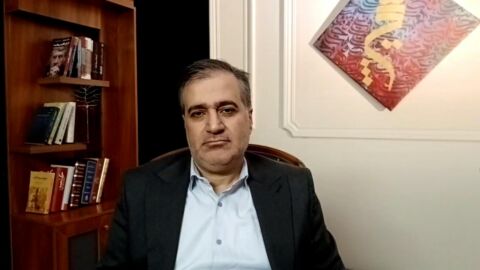
David Frum, a special assistant to Bush, played a key messaging role in that conflict, coming up with the famous term "axis of evil."
A Trump critic, Frum says this war could empower what he describes as an untrustworthy president with a contempt for the law.
Here he is with Michel Martin.
Thanks, Christiane.
David Frum, thank you so much for talking with us once again.
Thank you.
You are a staff writer at The Atlantic.
Your latest piece, you wrote, "The Paradox of Trump's Iran Attack," and you wrote that President Trump has launched a war that offers opportunities to the Middle East and threatens constitutional freedom at home.
So walk us through that tension.
- Well, let me give you, let's start with this, the danger here at home.
There is now an alleged shooter identified in the Austin, Texas, mass shooting attack.
The alleged shooter reportedly wore an Iran t-shirt as he committed the attack.
Now, I don't for a moment believe that the shooter, the alleged shooter is in any way connected to the government of Iran.
But it's not hard to imagine how when you are fighting a war with the world's leading state sponsor of terrorism, a country that does have networks all over the world that has carried out terrorist attacks on foreign soil, including here in the United States, that the president would say, you know what, we need to ramp up Homeland Security activity to head off a terrorist threat.
And everything you've seen in Minneapolis and places like that to date is just the opening course, the overture to what now must come to protect Americans against Iranian terror attack.
I think that is going to be a really severe risk in the days ahead.
You've described Trump's foreign policy as being driven by fantasy and image more than strategy in the Iran case.
Is there a clear example of that?
The fantasy that drives him is he does have the sense of himself as this great figure in history who is beloved at home and commands respect abroad when obviously none of that is very true.
And he is attracted to cheap and easy successes.
Look, last year when he struck the Iranian nuclear program, that was a short, sharp strike, and then he said, "It's done."
And many people who are more experts said, "Well, that's not done.
If you're going to start this thing, it's going to have to be finished, and it's going to be a much bigger project to finish it."
And so, duly, a year later, President Trump is like, "You know that thing I told you was cheap and easy and free last year?
Turns out we paid one installment, but there are now more installments that must be paid."
Well, Ukraine being an example where during his campaign for his latest term, the president said that he would solve this problem within a day, and clearly it is not yet solved.
Do you see an example in the Iran case of where the president seems to have a notion that doesn't seem to be borne out by facts as they're understood by others?
Well, we're getting some clues about his idea of an end state, is he thinks he can do what he did in Venezuela.
So in Venezuela, you had a corrupt authoritarian, brutal regime, which was massively unpopular with its own people.
In fact, as you will remember, there was even, the regime attempted to fake an election a year ago, and they were so unpopular, they couldn't even win a faked election.
And it became clear there is an agreed, democratically legitimate leader of the Venezuelan people.
But Trump did not want her to be the leader because it would be more difficult, more work, and maybe she wouldn't be as amenable to his will as the next thug in line was.
So in Venezuela, he struck, removed one thug, replaced the thug with the next thug in line, and he's got a situation he finds satisfactory, although the Venezuelan people are no better off than they were before.
He may have something like that in mind in Iran.
Knock off, in this case, the top 40 or 100 thugs, find thug 101, hope that thug 101, and I'll say he because it's going to be a he in Iran, that thug 101 or 102 is a big crook and that you can therefore do Trump-style business with this big crook.
That's a hope.
Maybe it's more than a hope, but it's not a very attractive future if you're an Iranian who has risked life or sacrificed the life of yourself or your loved ones to say, "We want freedom," on Trump saying, "Well, no, what we're going to give you is the next crook in line."
You served in the administration of George W. Bush.
This seems to be following a pattern where Americans have this notion that the people on the ground will finish the job.
Americans will start, they will finish.
Did you, just sort of being honest about it, did your administration have a similar notion when it came to Iraq?
There was a big fight about this.
The George W. Bush administration had people who wanted to be involved in the future of Iraq and people who did not.
And basically, the people who wanted to be more involved were able to win the argument about should we go to war, and they then lost the argument about what should happen after the war.
And so, I think the people who...what ended up happening was the Iraq war became a kind of raid.
Rush into Iraq, get Saddam, topple the Baath regime, then get out as fast as possible and count on the Iraqis to sort things out.
But Iraq was a badly damaged society.
They'd been under tyranny for so long.
The institutions of state were smashed.
Basic amenities like water and electricity were in ruins.
The country-and of course, when you have as cruel a government as Iraq had, it leaves behind a legacy of vendetta.
There are people who have suffered terribly, or their relatives have suffered terribly, and they have payback impulses.
And it's gonna take a lot of policing to keep those payback impulses under control.
I fear that very much in Iran.
And Iran is a more cohesive society than Iraq was.
The vast majority speak the same language, the vast majority speak 60% Persian, but most Iranians are Shiite Muslim, most of them speak some form of Persian, and it's much more urbanized.
But there is a lot of pain left behind, and there's a lot of damage.
Tehran doesn't have enough drinking water.
How do you keep the power on?
There are pensions that have to be paid, hospitals that have to keep working, children need to go to school.
It's an advanced society.
All those things need to happen.
Who's in charge of delivering those results?
When the existing regime, horrible, brutal, cruel, corrupt as it is, when it falls apart, who keeps the lights on?
What do you think should happen at this point?
How do you think Congress should react?
I understand why Democrats are very angry about the way the president has treated them.
I mean, he gave a State of the Union address full of stunts and insults.
He did not ask Congress's consent for this war.
He did not invite debate.
He went to war anyway.
And now he's going to need a lot of money to pay for it.
And he's going to ask Congress to vote money that it was not allowed to debate in advance.
And there are a lot of Democrats who feel they can't trust him and want to impose war powers restrictions.
And there are a lot of them who will feel at fear, as I do, the use that Trump will make of his war powers at home to suppress dissent, to compromise elections.
That said, there is no undoing what has been done.
There is no return to the pre-war status quo.
You can't stop this.
It's on.
And so getting to a better tomorrow does not allow wishing to go back to yesterday does not get you to a better tomorrow.
So I think Congress has to take decisive action to take more charge.
And here's the lever.
Speaker Johnson does not have a Republican majority to fund this war.
There'll be enough Republican defections.
You cannot get supplemental authorizations or appropriations for the war through the House of Representatives on Republican votes alone.
So he is going to need Democratic votes to pay for the war.
And for all practical purposes, the Republican majority is over.
It is not a majority House anymore.
So the House has to run its affairs as if it had to be bipartisan, as if there's now a joint Republican-Democratic coalition majority to fund the cost of war, and Democrats have to have equal voice in a war that they're going to be indispensable to funding.
The Military Religious Freedom Foundation says it's received more than 200 complaints from service members alleging that some commanders framed the Iran mission in religious terms, including one briefing where troops were reportedly told that President Trump had been "anointed by Jesus to light the signal fire in Iran to cause Armageddon."
Sort of unquote.
And I just wonder what you make of that.
Well, personally, if I were going into battle under a commander, I'd want a commander who thought our job was to prevent Armageddon rather than to cause it.
That's not like, "Oh, if we're on the path to Armageddon, maybe we should be on some other path."
Look, people, it's a big military.
There may be all kinds of lower-ranking people who say crazy things.
The question you have is, what about the senior-most leadership?
Secretary of Defense, or Secretary of War as he styles himself, illegally, Secretary of Defense Pete Hegsa, gave a press conference at the beginning of the week in which he said, "The United States will not do democracy building.
It will not do state building in Iran."
And you think, well, if you're not doing it, who's in charge of that?
And then what happens once you've smashed up the existing leadership?
There's a lot of perhaps democratic capacity within Iranian society, but to get from here to there after all these years of oppression, in the midst of a battle zone, that's not going to happen automatically.
And if it's not the American job, whose job is it?
And if it doesn't happen, the United States will not escape the consequences of it not happening.
And what might those consequences be for people who have not or would prefer not to spend a lot of time thinking about that?
- Here are two.
One is I mentioned that 60% of the population of Iran is Persian, you can do the math, 40% is not.
Some of them may have separatist sympathies or separatist inclinations.
There's also a problem that there are tens of thousands of Iranians who have lost people they love to cruel butchery by the authorities.
If the authorities are defenseless, what will the people do?
Well, some of them will pray and mourn, but some will take action.
Some will take up whatever weapons that come to their hand and go to a police station and chop up the police officers.
And that's a natural human impulse, I think, after what they've been through, but it leads to carnage in the streets and possible civil war.
And what might be the consequences for the United States?
Iran is crammed with weapons.
Most people can't get them because they're held by the police or the authorities.
If the police and authorities are defeated, those weapons become available.
There's fissile material present in Iran.
There's a lot of people with the skills and know how to do terrorism on a global scale who will now be unemployed.
You know, we saw what happened when the Ba'athist officers in Iraq lost their jobs.
They went and did what they knew how to do best, which was terrorize fellow Iraqis.
But the people in Iran who may be about to lose their jobs, what they know best is how to inflict terrorism worldwide.
It loops back to this notion that there really is no plan.
There's really no strategic thinking.
There's this sort of this sense of do this thing, do the thing, make a big discussion or show of it, and then what happens next?
And there doesn't seem to be any afterthought about that.
But there needs to, and I would say, what I would hope people would take away from our conversation that I am most concerned about is there's no going back to where the United States was a week ago.
There's no undoing this thing.
So Trump has locked us all in the car, locked the steering wheel and driven off the cliff.
You can't say, "I wish we were back up there on the cliff."
All you can do is say, "We now need a plan to land the car."
And cars weren't meant to fly, so this is gonna be a kind of a Thelma and Louise moment maybe, but someone needs to say there has to be a real plan and that's going to come from Congress to say there needs to be oversight, there needs to be a plan for an end state, there needs to be a plan to make sure that the war powers that Trump now has got are not abused at home, that there need to be guarantees that the 26 elections will not be suppressed or perverted, that DHS will not use the fear of Iranian terrorism as an excuse to crack down on the liberties of American people, to shoot more Americans on the sides of the streets.
If terrorism is a real risk, you need professionals at DHS, people who tell the truth and who don't steer contracts to their friends.
A Reuters/Ipsos poll this week found that just 27% of Americans approved of the U.S.-Israeli strikes on Iran.
A CNN/SSRS poll conducted over the weekend showed that 59% disapproval overall, more than 80% of Democrats opposed.
President Trump responded by telling the New York Post, "I don't care about polling."
But he does care.
I mean, he does care about how he is viewed.
And I just wonder whether public opinion will play a role.
Given everything you just said, you said, look, we're already in the car, the car is already moving, but would public opinion, could public opinion offer some break on this or offer at least some guide about what could happen next or might inform the president's thinking?
There's no break because the decision has happened.
So you can't break it because it's happened.
We're in the middle of it.
But what I think public opinion signals is, look, one of the ways that people know whether something is workable is if they see a broad consensus in the U.S.
government that something can work.
And that's always been the way it's been in the past.
When presidents make important decisions, they try to show, look, this is not just my idea, and it's not just me and the people I personally hired.
See, I've got here the leaders of Congress from both parties.
I've got a bunch of governors here who also agree this is a good idea.
I've got police chiefs or firefighters.
I've got a range of, I've got business leaders.
A lot of people in whom you should have confidence, who've earned your confidence, they all think this is a good idea.
That's not a guarantee that they can all be wrong too, but at least there's something here more than one person's whim.
Trump has made this war one of one person's whim, and it's a person who most Americans don't trust for excellent reasons.
So if this war is going to continue for more than a few more hours, he's going to need to find a way, and this is not in his nature, so someone is going to need to do this for him, to put this administration on a different kind of footing where it tries to speak for the nation rather than just a fragment of the nation.
So near the end of the piece you write, "A free Iran and a free United States.
Americans should seek both.
If we can get to a free Iran fast, Trump's plot against American freedom will have less scope to operate.
If the war to free Iran falters or slows, the attack on free institutions at home may expand and accelerate."
What should people listening to our conversation, what should they do?
Well, so if 72 hours from now, whoever has control of the guns in Iran says, "Okay, we're done.
Let's make a deal."
Then any Trump idea of using this war to suppress freedoms at home is not going to work because the war will come to some kind of resolution.
But if they're still fighting two months from now, three months from now, four months from now, real fighting, if there are terrorist plots being discovered in London, Paris, Hamburg, on American soil, then President Trump's going to have a lot of modalities in his hand to do real damage to American liberties, worse even than he was successfully able to do in 2025.
So this is a midterm election year.
People have the opportunity to vote.
This must be challenging for you as a person who had identified with the Republican Party for such a long time, but the reality of it is that people are voting.
I mean, is this something that they should be carrying with them as they make their decision?
They inevitably will because one of the effects of this war is that things are going to get more expensive.
Energy prices will spike for at least for a little while.
So gasoline will cost more, fuel will cost more.
One of the, we pay so much attention to the gas price because you can take a picture of it at the pump.
We don't pay as much attention to the price of electricity because that shows up on everybody's bill and everybody's bill looks different.
But in 2025, if I remember this right, the average electric bill went up by more than 10% for the average American family.
It may go up more in 2026 and that's a big cost.
And it's not one you can avoid by simply taking the bus.
I mean, you have to heat your home.
I have to keep the lights on.
Food prices will be more.
And America is going into this war.
It's got Israel by its side, but the network of alliances that the United States relies on to supply troops.
You may say, how important is Spain?
Which has said it wants no part of it.
But American supply vessels do set down on Spanish islands and Spanish territory, or Portuguese islands and Portuguese territory.
The United States is used to doing military action in giant coalitions of many, many capable friends.
And sometimes some friends do more, some friends do less, but you can always, even the people who are doing less, in the past, you've always been able to say, help us just with this one special thing, we need you to do it.
And they usually do it.
In this case, the United States is isolated in a way that is very different from any way it's fought a war in the recent past.
Thank you so much for talking with us once again.
About This Episode EXPAND
Correspondent Fred Pleitgen reports from inside Iran. Iranian human rights activist Mehdi Mahmoudian discusses his hope for the future of Iranian leadership. Former US Ambassador to Israel Dan Shapiro talks about the expansion of the war and Russia’s involvement. The Atlantic’s David Frum explains why he fears that this war abroad could erode American civil liberties at home.
WATCH FULL EPISODE