
Read Full Transcript EXPAND
Hello, everyone, and welcome to Amanpour and Company.
Here's what's coming up.
We are being sold a story of transgender people as a group to fear, when the reality is, is that we are a group that is almost nowhere impacting other people's lives, and we're just trying to live our own lives.
Trump targets trans people.
I speak to activist Chase Strangio about pushing back against the president.
Then... Partners in art and in life, the inimitable Gilbert and George give us an up-close look at their weird and wonderful world.
Plus, they believe that America was founded as a Christian nation and should be a Christian nation.
And so there is a sort of less interest in reaching out to to non-Christians.
Anti-Semitism, Christian nationalism and the Republican Party.
Reporter Tom Gjelten tells Michelle Martin about this dangerous intersection of religion and politics.
(upbeat music) - Amanpour and Company is made possible by committed to bridging cultural differences in our communities, and by contributions to your PBS station from viewers like you.
Thank you.
- Welcome to the program, everyone.
I'm Bianna Goldrige in New York, sitting in for Christiane Amanpour.
Donald Trump came back into office nearly a year ago, determined to change the face of America, undoing a slew of Biden's policies and approaches to issues, including trans rights.
The US president has made no secret of his lack of sympathy for trans people, vilifying the small population and calling into question their very existence.
Transgender for all is a great, great thing for the Democrats to be talking about.
Transgender for every member in your family.
If they're not feeling well that night, let's just change their sex.
Many red states are following suit, passing more and more anti-trans bills, attempting to restrict their legal and medical rights.
LGBTQ activists and allies are deeply concerned about a White House so laser-focused on targeting this group, especially given trans people, particularly trans youth, are at heightened risk of suicidal thoughts and attempts.
Chase Strangio is a well-known lawyer and activist, the first openly trans person to argue in the Supreme Court, and he joins me now from New York.
Chase, thank you for taking the time to join us.
As I mentioned there in that introduction, trans people make up such a small share of the population, yet they're facing hundreds of targeted bills nationwide.
Why have trans people and this issue become such a central political and legal battleground in your view?
Well, I think you're absolutely right to highlight the fact that we are such an unbelievably small population that has been the subject of an outsized fixation by every branch of the federal government now, as well as state governments.
And I think the reason for that is twofold.
The first is that what we see is an effort, particularly from the Trump administration, to use this fixation on trans people and the sense that trans people don't have allies outside our community to try to expand their own power and authority, that we really are the canaries in a coal mine for an unchecked executive that is seeking to erode civil rights for everyone.
And then I think the second reason is because there is a lot of misunderstanding about who trans people are.
And we're seen as a population that is easy to target as a way to try to reinforce regressive gender norms for everyone.
We're living in a time when we're seeing efforts to roll back bodily autonomy for all women, to try to entrench gender roles that look more like the 1950s than 2025.
And targeting trans people is an entry point for that type of overall regressive enforcement of gender roles writ large.
And you just noted that there seems to be a lack of understanding, confusion about who exactly trans people are.
If you were to be asked that question now and asked to explain who trans people are to our audiences, what is your response?
I mean quite you know sort of simply trans people are people who live as a sex different than the one that we were assigned at at birth and I think when we talk about what it means to be trans in this country the most important thing for people to understand is that they have been fed a very large amount of misinformation about our community whether it's about the way in which transgender young people access medical care that is a very small percentage even within the small percentage of transgender people and that care is being consented to by their parents and recommended by doctors whether it's about participation in sports.
We're talking about an exceedingly small number of people who ever participate in sports.
And yet we're seeing hundreds of millions of dollars in ad spending making people scared of trans people.
So really I think what people need to understand is that we are just people going about our lives and that actually us existing in our bodies, us going to school, us going to our jobs does not affect other people but we are being targeted so that people are driven by fear so that they get in line with this larger project that we're seeing from the federal government in particular to erode our rights across the board.
I want to play a moment from President Trump's inaugural address as he speaks to this issue.
Let's play it for our viewers.
As of today, it will henceforth be the official policy of the United States government that there are only two genders, male and female.
And on his first day in office, he signed an executive order to that effect.
What do you think is driving this focus from the commander in chief on down?
I really think it's an effort to use fear to distract people from the realities of a presidency that is enhancing the wealth and power of billionaires, that is making the cost of living more expensive in this country, that is increasing the price of everyone's health care, that is making people less safe, less secure and less free.
And what the president is doing and what this administration is doing is using the maligning of transgender people as both a distraction and an opportunity to expand his power to continue to make this country less hospitable for everyone.
And how does that impact your day to day life when the government essentially is mandating your gender choice?
I mean, first, for transgender people, there are serious material consequences to what the president is doing.
The president is coercing hospitals, coercing states to try to cut off health care that people need.
There is a serious consequence to that.
People's anxiety, depression and risk of suicidal ideation increases.
When the president forces people to carry identification that does not match who we are, there are material consequences to that.
So all of these policies have serious impacts for the transgender community.
And I think it's very important that people realize these policies have serious impacts for you, too, because what we're doing is ceding to our government the ability to control our choices, to erode our bodily autonomy, to make it easier to have restrictions on access to birth control, to have restrictions on how we inhabit our bodies and the choices we make in terms of family formation and otherwise.
And so this is of course a targeting of transgender people with impacts far beyond the transgender community who again represent an exceedingly small population.
And yet it's a population that for I would say noble reasons, many in the progressive movement over the last few decades have really shown a light on and really tried to integrate into the society and into more everyday conversations.
And you say, though, that visibility without protection can be a trap.
Just talk us through that and how what many described as identity politics became sort of a negative for Democrats going into the last election and where that leaves the trans community, given all of the attention that they've received, without any of the legal rights that you say makes you feel as if you're placed in a very unstable and unsafe reality.
Well, so I would point first to remarks made by Representative Sarah McBride after the House passed a felony ban on medical care for transgender adolescents.
And what Representative McBride said is that the Republican Party is seemingly fixated on transgender people.
They think about transgender people more than transgender people think about transgender people.
And so what that means is that when you're hyper-visible, particularly when that hyper-visibility is being used to weaponize your existence and make you a target, that visibility is not providing the material support you need for survival.
And in fact, it's eroding your survival opportunities.
So we need far more than visibility.
We don't want to just have support in name or sort of hyper-visible moments.
What we really need is for this country to ensure that everyone, transgender people and not, are able to have access to health care, to housing, to safe job opportunities.
And that's something that I think everyone is concerned about.
As we enter the holiday season, we want people to be able to care for their families, to have an opportunity to rest with their families and not worry about their health care premiums going into the new year.
That is something that transgender people also care about.
So it's not about us being visible.
It's us being included in the basic promise of this country and being respected and treated like the human beings that we are.
You mentioned Democratic Representative Sarah McBride.
She also said the movement has lost the art of persuasion as disinformation has surged.
Would you agree with that take?
I don't agree necessarily that the movement has lost the art of persuasion.
I think we're living in a moment of incredible misinformation, toxic discourse online and in our communities across the board, not just when it comes to how we think and talk about transgender people and our rights.
I think, in general, we have to return to a time of care, empathy and just basic respect for our fellow human beings.
And so I think my experience within advocacy for transgender people is that every time we enter a space, we're met with efforts to categorically ban us, whether it's from the restroom, from the sports team, from accessing our medical treatment.
And so, ultimately, this is a project that we all need to be a part of to ensure that everyone is able to access the basic goods that they need to survive.
And the persuasion aspect of that is returning to a point when we see our common humanity.
And we've heard enormous political rhetoric, advertisements made.
The president has spoken about this, but not just the president, a number of politicians about trans athletes in particular.
Yet NCAA data shows that fewer than 10 out of 510,000 athletes are transgender.
What does that gap between reality and rhetoric tell you about how this issue is being used politically?
I think what this tells us is that we are being sold a story of transgender people as a group to fear, when the reality is, is that we are a group that is almost nowhere impacting other people's lives, and we're just trying to live our own lives.
There are fewer than 10 NCAA athletes who are transgender, and yet we see hundreds of millions of dollars targeting transgender people, making people afraid of trans participation in sports.
And the reality is that in some states, there are more bills targeting trans athletes than there are trans athletes.
That is a huge gap between the story we're being told and the reality on the ground.
And a similar story is true with respect to access to medical care for transgender people.
You have about 2,000 young people receiving puberty blockers in this country to treat gender dysphoria, and yet you have this sense, this outsized fixation of a problem that is really about families making decisions, informed decisions for their children, parents who know their children best.
So I think what we're seeing, if you take a step back and look at the facts, is that we are being sold a set of lies about the trans community with a huge amount of money being put into those lies.
And that is impacting what people experience of trans life, when really we're just a small population trying to survive.
So what do you say then to members of the trans community, especially younger members who are witnessing all of this and experiencing it firsthand?
You know, I think that when I talk to trans young people, it's so painful because what they're experiencing is a country that's telling them that they don't belong.
But the message that I want to tell those young people and that I want others to join me in telling those young people is that they are a beautiful and important part of the American promise that we are going to fight for them because we want them to survive into adulthood.
We want them to contribute to our legal profession, to our medical profession.
We want them to see Representative McBride and know that they too have the possibility to become a member of Congress.
And so that is what we want to be telling transgender young people, that we believe in them and that this is just a moment of fear mongering and scapegoating and we will get to the other side.
We mentioned the politics of this.
As you know, a lot of concern has stemmed mostly from the Republican Party, but there are even members of the Democratic Party that have said perhaps the country, the party went too far and in a sense conversations about who should be allowed to play what sports and identifying bathrooms doesn't help ultimately the trans community right now and it didn't help the Democratic Party either.
How do you go about and how do you suggest that constructive conversations and maybe even debates around this matter are acceptable while also drawing guardrails and limitations about how far they can go?
Well, I think we have to be accurate in the stories that we tell and the history that we tell because what happened in this country over the last 15 years is that as soon as the Supreme Court allowed marriage equality to be the law of the land, the next step for our opponents was to target our efforts to pass non-discrimination legislation.
And as soon as we, as the LGBT movement, tried to ensure that we could be protected in housing and in our workplaces, our opponents weaponized our existence to make people afraid of us by using the bathroom and the sports team to erode basic civil rights protections.
And so we have to understand that this is a strategic ploy to make people afraid and that we are not pushing this narrative of sports or restrooms as an effort to try to alienate others.
We are trying to ensure that people can go to work without being fired, that they can rent an apartment without being kicked out of that apartment.
And so, as we move forward, we have to tell a truthful story about how we got to where we are.
And we can have conversations about what it looks like to ensure that we can balance fairness and equality in sports.
But the answer to that question is not categorically banning young people from participating in sports with their friends.
We should note you argued U.S.
versus Gremetti.
The Supreme Court ultimately let Tennessee's ban stand.
But as it relates to executive orders from this particular administration, also on day one of President Trump's new term, he signed an executive order banning all trans people from the military service.
You weren't serving in the military at the time, and this doesn't apply to you directly, but I wonder how you view this and how those in the trans community view this for those that did want to serve or do serve, who feel now that they can't and are excluded.
Yeah, I mean, this was an executive order that was so damaging, both in impact and in rhetoric.
The order claimed that transgender existence is inherently incompatible with an honorable life of service.
And you have tens of thousands of people who have openly and honorably served the United States through the military who are then being denied their benefits who are being discharged from service simply because of who you are.
And I come from a military family.
My brother served in in in the United States Army.
And the thing I learned from my family is that our armed services benefit from accepting any who are able to meet the fitness and other standards of service.
And what we have here is absolutely counter to that and is harming the people who have served, who have relied on the benefits of their service.
And then what's more is having the rhetoric of casting us as transgender people as inherently dishonorable.
Trace Strangio, we really appreciate the time.
Thank you so much for joining the program.
Thanks for having me.
It seems the people cannot get enough of the wonderfully eccentric artists Gilbert and George.
Yes, two people, one artist.
A new exhibition at London's Hayward Gallery is displaying their unique work, which is thought to be some of the UK's most progressive and contemporary.
The duo, who are romantic partners as well, take pride in the unusual way they interact with the world, as Christiane saw up close when she sat down with them in their permanent exhibition space in East London.
Gilbert and George, welcome to our program.
Thank you very much.
One artist, two people.
I think people are fascinated by that.
Tell me how it works, because you are Gilbert and George and you create as one.
Is that right?
Yes, but it's the most usual arrangement in the world, including the animal kingdom.
We're all in twos.
And what George doesn't do, I do.
And what I don't want to do, George does.
Are there any examples that you can bring to mind?
I mean, let's face it, we're in this unbelievable new exhibition of yours.
Can you tell me how to pronounce it?
Paradisical or paradisical?
Paradisical.
It comes from paradise.
Yes, of course.
We realised that most people think of paradise as the after party.
So we thought we would use these pictures to launch the whole enterprise, to begin with it.
And it's very interesting because when we were creating these pictures, we were very conscious that we wanted to address the people who are great believers in the hereafter and the people who don't, the people who believe in the here and now.
So we try to be equally respectful to those two communities.
We are here and now ourselves.
Yes.
And I mean you're speaking somewhat religiously, does religion come into it?
Religion is there, we're part of the free world, very proudly so, and that was sort of invented a long time ago with the Judeo-Christian background.
So you could say that we as artists are Greco-Romano-Judeo-Christian secularists.
But non-believers, that's very important.
That's like having your cake and eating it too.
So tell me about Paradisical, the Paradisical.
This is just amazing, the amount of color.
This is a brand new gallery museum and it's right near your home where you've lived I think what 50 odd years?
Half a century.
So tell me about it.
What was the idea as living artists, a living artist, to build this space now?
It's very simple because new museums they don't have the space anymore and it is limited what they can show and we as artists, what you call, we started out with the idea that we wanted to be seen and that's why the only way to be seen is you build your own little museum.
Okay that is, so the museums weren't big enough for you, is that what you're saying?
No they are too full up for other artists.
Really?
And we're also very conscious that we're part of a generation of artists who came about believing that they go to their studio every day, work away day after day and one day someone will knock at the door and propose an exhibition for them.
We never believed in that, we always thought it's up to us to speak through our art and that the art should reach people.
Art for All was one of our earliest slogans.
That's why at the beginning we were able to make art walking the streets of London.
That's what I want to understand.
What does that mean?
We were the art, we made ourselves the subject of our art and it's quite exciting.
We are living sculptures.
- Which could be somewhat egotistical or it could be this unbelievable dynamic that you guys have created.
In every single picture, you are depicted, correct?
- Yes, because it's our world, our journey.
It is a journey towards the end and we are doing it and we are showing ourself and what surrounds us.
- It's the power of culture.
Dickens wrote all of the Dickens books.
He didn't let anyone else write either.
Vincent van Gogh painted all of his pictures.
So when you go to a museum, somebody is at this very moment, probably in a different time zone, and they're looking at a gnarled tree and some blossom in the background.
That is van Gogh speaking to them from the grave.
The Western world, the Western Triumph, where we are all safe and free, unlike most of the territories in the world, was created through culture, not through the policemen and not from the vicar.
The music, the painting, the art, the theatre, the ballet, the opera, that created a safe and free world.
How privileged we are.
It's extraordinary, this journey that we did ourselves.
They invented, we invented the form even, the living sculpture form.
And we went in the form for Art for All, that everybody could be involved in it.
And it's just fantastic.
When you say Art for All, do you mean sort of, for instance, I understand this exhibition, this gallery, will be free for people to come?
Yes.
Is that what you mean by Art for All?
Partly that, but it's also our intention, when we were baby students at St.
Martin's School of Art, we realised that all of the fellow students and the teachers believed that art was another form in life.
It wasn't part of life.
It was to do with shapes, colours, angle, surfaces.
They didn't think it had anything to do with death.
Hope.
Or life.
Fear.
Or death or hope or any of those things.
They thought it was to do with form.
So you could take those artworks out of the college onto the street and it would have no meaning.
We wanted art that would address anyone wherever they lived in the world.
So tell me the meaning of this then because most of the art that I've seen of yours anyway is all about living things and mostly nature.
Or am I wrong?
- And people.
- And people.
- But mostly the people are you.
And dirty streets and dirty skies and sun and everybody else.
And us turning into what we call the sovereign humanity of human beings.
We're trying to express ourselves as human beings.
Like everybody else.
We don't want to be different, but the journey is ours.
As we speak, somebody's having a funeral somewhere in London or somewhere else, and the person who's being buried is going to be promised eternal life by the vicar.
As we speak, people are being promised life everlasting.
These pictures are about that subject, and it also addresses the belief that here and now is it.
We're trying to deal with equal courtesies to those two groups of people.
It feels like walking into the Garden of Eden, but where is she?
She's not there.
It's not the Garden of Eden, it's not the Garden of Sodom.
Where are we going to go?
Talking about Sodom, you do use some pretty outrageous words, at least many people might think they are, on many of your paintings.
You know, irreligious words if you like, some profanities.
Yes.
Why?
Oh, because it's normal.
It's totally normal.
Everybody's using it, no?
We are just using it as part of art, but out there it's all the time, day and night.
Behind me, I mean, this is one of my favorite ones actually.
It is the best one.
But I'm somewhat offended by the name, Date rape is a very important picture for us because we know when we read our newspaper in the morning and when we watch television news at 6 o'clock every day, that there's a lot of very bad behavior in the human world.
And when we occasionally get exhausted during the day and watch a nature program in the afternoon, we see there's a lot of bad behavior in the animal world.
And we wanted with this picture to explore what is it in the plant world.
They must do extraordinary stuff.
The fruit and the flowers and the buds, we don't know about bad behaviour without, do we?
And this picture suggests that maybe there are possibilities.
I'm sure they do.
They're flinging their seeds all over, aren't they?
They're calling out to the bumblebees to help them.
It's extraordinary.
Maybe it's another world we don't know about.
One day we will know the language of trees and flowers.
And the very word 'rape', you can hardly open a newspaper anywhere in the world without finding that word.
Even the Bible, non-stop.
And not about animals, what they call flowers, not about humans, but us.
You have called yourselves conservative.
And at one point you said, maybe we've written our death warrant or signed our death warrant in the artistic world.
Do you believe that?
I mean, is it that weird to be conservative artists?
I think in the art world, I'm not sure about all over the world, but I think in Britain, for many, many years, it was a bad thing to say that you were conservative.
It was as if you were weird or something.
We always vote conservative because we like to vote for the winning party.
And for quite a few years, we've been on the winner.
And when there were Labour governments, what were you?
We think conservative is more normal.
The other side is more foreign, it's more revolutionary, it's more communist or more atheist or something weird.
Conservative means normal, average.
That's why everybody's, "Oh my God, they have these beautiful shoes and they behave like fantastic people."
But behind the scene we did amazing stuff.
Part of your living sculpture is this clothing that you wear.
You are able to go through airports very easily.
Very rarely searched at airports.
Because of the way you dress?
Yes.
Because you look like upstanding citizens?
Yes.
And you can get a table at any restaurant in the world.
Because of the way you dress or because they know that you're a very important artist?
No, no.
You can go into a... We went to... In Portugal.
By chance, a few years ago, we were in Lisbon, where we'd never been before.
And somebody at the hotel said, "You must try the restaurant at the other hotel."
And we went, and it was an extremely grand place.
And we found the restaurant, which was also very grand, and at the restaurant door there was a very sophisticated, snooty head waiter with a leather-bound wine list under his arm.
And I said, "Good evening, do you have a table for us?"
And he said, "We always have a table for great artists.
"This way, gentlemen."
- Well, they recognized you then.
Would you call yourself eccentric?
- Certainly not.
No, no, we're normal.
- You'd be called normal?
- Normal weird.
We don't want to be weird, 'cause traditionally all the artists were weird, you know, with sandals and tobacco pipes and things.
And we don't want to be normal, 'cause who wants to be like everyone else?
But to be weird and normal at the same time is a good balance, we think.
Normal weird.
I'm going to pocket that one.
That's good.
Can I ask you, because again, you've lived in this neighbourhood, the east end of London, very, very, very rich culturally, whether it's Brick Lane or Spittlefields, where we are now, rich culture of the city of London.
You have gotten your inspiration a lot from this part of London, right?
That's what I understand.
In what way?
Because we think the centre of the world is Spitalfields.
We're always there now.
Everything is not important.
Spitalfields is the centre of the world.
Yeah, but why?
Because everything is there.
All the cultures of all over the world, they're all there, all end up here.
They have been starting from, I don't know, when the French were chucked out of France, and then we have the banditry, then we have the artistic people like that, and now we have the most sophisticated here.
- We live on a French street built on a Roman cemetery.
Brick Lane is where Oscar Wilde used to buy his drugs.
We live a 10-minute walk from the house of the founder of the Free Press, John Wilkes.
We also have a 10-minute walk from the tomb of the most famous, least read book, Pilgrim's Progress.
The most famous, least read book.
Yes.
I think so.
And William Blake.
William Blake is in the same cemetery.
It's also the dissident cemetery, not the regular cemetery.
Dissident.
So we're living not in the East End, not in Spitalfields, but in an amazing world of culture and history and past.
We believe in the past, present and future rolled into one.
You are of Italian heritage, is that correct?
I come from the mountains.
Does that whole melting pot aspect of this part of London mean a lot to you?
It's very simple.
When I was... I come from the Dolomites, we have this special mountain.
But when I was young, I always wanted to be an artist.
So I started out in one art school in Italy, then Germany, then Austria, then Germany, and ended up in England.
And you two met at an art school in '67?
At an art school in the Charing Cross Road.
On the top floor, where all the eccentric artists used to be.
What drew you to each other?
I think we have a very similar sense of purpose, a very overdeveloped sense of purpose.
Maybe George took pity on me because I couldn't speak English.
Certainly not.
You couldn't speak English at the time?
No.
The school that we were at, St.
Martin's School of Art, was so famous in that brief period.
There were camera crews from all over the world filming in the studio.
We were amazed.
It's produced some of the great artists and fashion designers of all times.
We felt we were at the center of the universe as we always do.
That's why I wanted to be there.
That's exactly why.
No other reason.
On the top floor of Central Martin School of Art where I met Gjelten.
And after leaving Central Martin School of Art, what did I do there?
Nothing.
So we started to walk the streets of London every night together.
And then we created that we could be the art, the living sculpture.
And that was it.
That was our invention, that we are still doing it.
And not only are you doing that and did you do that as a professional partnership, but you are also a romantic life partnership as well.
Yes.
That's why we found a certain truth, beauty and power when we were walking the streets of London.
a secondhand shop and it was filled with the detritus of human life.
All of the things that you don't want when you leave a flat, that you leave behind.
That's all they sold.
And in that shop was a pile of old gramophone records and the top one had the title 'Underneath the Arches' and we knew what that meant because we were living in the East End where people were living underneath the arches.
Homeless?
People damaged by the First World War, elderly ones.
Lots of people damaged by the Second World War.
Lots of people damaged by the sex laws pre-decriminalization.
- Well, yes, I was going to say, you met in 1967 when homosexuality was decriminalized.
What was it like living in a so-called illegal state before that, and then having, you know, and then I guess having the world open to you.
It didn't matter in that way, because I remember from all of us being decriminalizing ourselves for some years.
But the good thing was we took the gramophone record home, found a friend who could play it, and we were amazed by, as I was saying, the truth, beauty and power of the words, because it matched how we felt life should be in general.
And the words were, "The writs I never sigh for, the Carlton they can keep."
There's only one place that I know, and that is where I sleep.
Underneath the arches, I dream my dreams away.
Underneath the arches, on cobblestones we lay.
Every night you'll find me, tired out and worn.
Happy when the daylight comes creeping, heralding the dawn.
Sleeping when it's raining, and sleeping when it's fine.
La dee dee dee da da da da da.
Pavement is my pillow, no matter where we stray.
Underneath the arches, I dream my dreams away.
That was it.
That helped us all along the way.
We never changed from there.
I don't even know how to top that.
I don't know how to come back.
But I do know that you guys are completely in sync.
I mean, you've finished each other's sentences, you burst into song at exactly the same time.
Only when we're being interviewed.
Okay, not at home.
How do you behave at home?
It's also very interesting that that group of people, all those people living under the arches, have gone.
They've all died.
It's been replaced by another group, similarly disenfranchised, similarly enchanting in a strange way.
And they're a young group of drug addicts.
And they also have a feeling for life that we understand.
The Tramps felt they understood us.
They never went to an exhibition, but they felt they were on our side.
And so do the young drug addicts.
Who do you want to come here?
Everybody.
Everybody who wants to.
That's it.
It's open.
The drug addicts, whatever.
We were very moved.
We were walking in Whitechapel last week and along the pavement in the other direction came a young drug addict with torn trousers and some horrible blood coming out of his ear.
He looked very run down and bad and as he came along and then he recognised us and made a comment on our art as he fled along the way.
He came along all staggering along with Paul Chapman and then he said, "I like the s*** ones best!"
We laughed and then we went home and cried.
Where is he now?
Where is he now?
Where's his mother?
Amazing.
Gilbert and George, thank you very much.
You were very good.
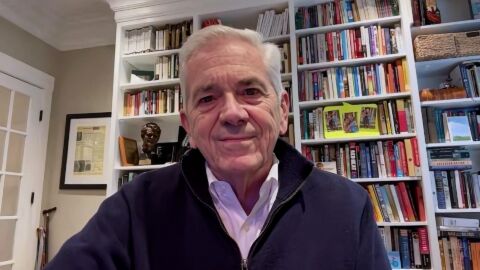
And now to the United States and the intersection of religion and politics.
Reporter Tom Gjelten is shining a light on the dangerous rise of anti-Semitism in the Christian nationalism movement and the Republican Party.
It's the focus of his cover story for Moment magazine.
And he sits down with Michel Martin to discuss.
Thanks, Bianna.
Tom Gjelten, thank you so much for talking with us.
Great to be with you, Michel.
So, Tom, you're a veteran journalist.
You've spent a lot of years covering lots of different things, international affairs, religion and politics.
In a recent cover story for a Moment magazine, you dig into what you call the new Christian right.
When you describe the new Christian right, what specifically are you talking about?
We're familiar with the Christian right and the role that evangelical Christians in particular have played in American politics for the last 40 years or so.
And what I'm saying in this article is that we have a new Christian right.
It's not the same as the old Christian right.
I mean, you remember, Michelle, the moral majority in the 80s, and of course, the important support that evangelical Christians gave to Donald Trump in his 2016 and again, 2020 and 2024.
But we've seen kind of a transformation of Christian conservatism in the last few years.
And what I say is it's taken on a much more of a nationalistic tone.
Whereas in the past, conservative Christians were really focused on a number of policy issues, abortion, same-sex marriage, school choice.
Now, Christian conservatives are more interested in actually taking power and bringing government sort of under Christian control at the local level, the state level, the national level.
And so this is a really -- it's a different phenomenon.
And what I have tried to do is sort of describe how that evolved, what it means, and where it's going.
You know, you referenced the moral majority.
Yeah.
Is the idea for this new Christian movement that they are the majority, but that their views are not being reflected in public policy per se?
Or do they have the sense that they are an embattled minority and therefore they need to claim power in order to sort of protect themselves?
Or is it something else?
No, I think, Michelle, I think that the Christian nationalists that I'm writing about feel that they are beleaguered.
You know, there is a prominent Christian writer by the name of Aaron Wren who has laid out sort of three world views that have prevailed in the last 30 years.
And those world views have to do with the attitudes towards Christians in society.
He saw a positive world in the 80s and the 90s where sort of Christians felt that the world saw them in positive terms.
And then the next phase was kind of a neutral world where they weren't seen in either positive or negative ways.
And now he says, he writes, and this is very important, he sees that the world is negative towards Christians.
So the Christians that sort of follow this line of thinking, see themselves as being under siege and needing to kind of create their own institutions, take a much more active and kind of fight approach to defending their interests.
And that that means that it's you know, it's it's harder for them to sort of compromise because they see themselves as being beleaguered and needing to stand up for themselves against their enemies and they see their enemies on every side.
You attended a conference in Washington a couple of months ago.
Yeah.
What struck you about being in that room?
What did you notice?
Well, Michelle, this was a national conservatism and interestingly enough it's a movement that was begun by two conservative Jews who saw themselves as Jewish nationalists, certainly with respect to Israel.
But the kind of unifying theme was that nationalism is a good thing, that countries need to have a kind of a core central or religious or cultural identity in order for them to be cohesive as a nation.
And even though the founders, as I say, were Jewish, they actually reached out to Christian nationalists to make it clear that they were welcome in this world, because nationalism is, in their view, is a good thing.
And what's happened, however, is that as Christian nationalists have become more important, they have sort of emphasized their own Christian identity to the exclusion of others.
Hardcore Christian nationalists are actually rejecting the notion of a Judeo-Christian tradition.
They believe that America was founded as a Christian nation and should be a Christian nation.
And so there is a sort of less interest in reaching out to non-Christians.
And I think one of the things that I saw at this conference is there was a sense among the Jewish supporters of this movement that maybe Christian nationalism was a little bit more of a threat to them than they had originally anticipated.
That's one of the ironies of your piece for a movement that sort of had its roots in these two Jewish thinkers.
One of the things that you wrote about is how openly anti-semitic ideas are circulating.
In the piece you wrote, you quote a pastor writing, "The Jews killed the Lord Jesus.
Anti-semitism be damned."
He goes on to write, "The vast majority of Jews in America are Marxists who support the democratic agenda."
Did you get a sense in your reporting of how widespread or how fundamental those ideas really are to the movement?
Well, one thing I noticed, Michelle, is that this conference, National Conservatism, has been around for a few years.
And in the beginning, Tucker Carlson was one of the sort of featured speakers.
He's been absent for the last couple of years because he has moved much more in a direction, I won't say anti-Semitic, but sort of, what, anti-Semitic adjacent, maybe, is the word.
And characters like Nick Fuentes, who considers himself a hardcore Christian nationalist.
And you mentioned some of these pastors who are hardcore Christian nationalists who are now very open in their own anti-Semitic views.
And as these views came to be more important within the Christian nationalist movement, some of the original Jewish supporters, as I say, became more alarmed.
Yoram Hazoni, who is the founder of the National Conservatism Movement, at this conference in September, stood up and said, "You know, a year ago, I wasn't worried about anti-Semitism on the right.
I thought anti-Semitism was really a phenomenon on the left.
I was mistaken," he said.
And another prominent Jewish supporter of the movement, Josh Hammer, told me that the concerns about anti-Semitism on the right are a five-alarm fire.
And what's interesting about this, Michelle, is that a lot of these sort of conservative Jews saw conservative Christians up until now as co-belligerents.
They saw them as kind of political allies in the fight against wokeism, in the fight against political Islam, in the fight against globalism.
So, you know, even though they came from different religious traditions, they saw themselves as being sort of politically on the same side.
That alliance has now really eroded.
Now one of the reasons this is interesting is because I think that historically, evangelical Christians in the U.S.
were often strongly pro-Israel, and even sort of seeing Jews as God's chosen people, and Israel as having a special biblical status.
Now that's well attested, you know, for theological reasons, okay?
But this worldview that you're documenting here really breaks from that tradition.
Why do you think that is?
That's a fundamental point, Michelle.
I mean, conservative Christians for a long time were actually sort of philo-Semitic.
I mean, they actually loved Israel.
And there was-I mean, we can sort of get theological about this.
They were part of what's called the dispensationalist tradition.
They believed that God did sort of promise Abraham and his descendants the land of Israel for generations to come.
Conservative Christians accepted that covenant.
There was a movement, Christians United for Israel.
You'd see people like Mike Huckabee, the current ambassador to Israel, came out of that tradition.
So, as you say, for a long time, conservative Christians really were super pro-Israel.
What has now happened within the Christian Nationalist movement is that old tradition has really weakened, and now Christian Nationalists say that Christianity has superseded Judaism as God's chosen faith.
So they reject, they fundamentally reject that idea that Jews have some sort of biblical claim to the land.
Now that is not necessarily anti-Semitic.
In fact, that would be sort of overlap with a kind of an anti-Zionist view of Israel, that Israel is just another country.
But once you begin to see Jews as just another people without any sort of biblical significance, political, biblical claim to their land, that kind of opens the door to some of the more explicit anti-Semitism that we have seen.
I do want to push against one of the arguments, the argument that a critique of Israel is of necessity anti-Semitic.
I mean, there are plenty of Jewish groups, Jewish citizens who have deep concerns and profound critiques of the way Israel has conducted itself in a number of spheres, particularly in the wake of the Gaza war.
So is the argument here and the argument even that Israel should be treated like another country, or any other country, is that inherently anti-Semitic?
What's the line here?
It's not - no, not at all.
In fact, as I said, you know, I would argue that kind of an anti-Zionist position is not per se an anti-Semitic position.
But what is, I think, alarming is that among these Christian nationalists there is a really a determination, it's kind of Christian supremacy is what is alarming.
The idea that Christians should be in a supremacist position, and the idea that Christianity should be favored over Judaism.
So that's kind of the reflection, that's where it gets taken into a more alarming direction.
One of the things that I found in talking to a lot of these Christian nationalists is their rejection of the idea of a Judeo-Christian tradition.
I was told that, you know, a number of these Christian nationalists believe that the destruction of the temple in Jerusalem in A.D.
70 by the Romans was actually an act of God, a punishment to the Jewish people for having rejected Christ.
Now, when you have sort of a viewpoint like that, then distancing yourself from Israel becomes a sort of a more problematic position to take.
In the piece, you quote somebody named Stephen Wolfe, who is a political theorist and author of The Case for Christian Nationalism.
You say this is a book that's become influential in Christian nationalist circles.
And he writes, quote, "Non-Christians living among us are entitled to justice, peace and safety, but they are not entitled to political equality."
Ellipses there.
"Public space should be exclusively Christian."
How widespread is this is this belief?
Well, let's put that in a broader context, Michel.
For a long time, sort of the notion of what it means to be American and what America stands for has been defined in kind of ideological terms.
There's a sort of a creed that is enshrined in the Declaration of Independence, the Bill of Rights, the Constitution.
And essentially anyone, any immigrant, let's say, regardless of their ethnic background, their religious background, any immigrant who fully commits to the American idea, the idea of the American creed, can legitimately claim to be American.
What we have seen in the last few years is a move toward more of a kind of an ethno-nationalist approach, where, and J.D.
Vance expressed this pretty clearly in a speech at the Claremont Institute, where he said he rejected that idea of a creedal identity to America.
He instead is emphasizing that America is a homeland for people with ties here.
And he explicitly rejected the idea that anybody can become an American simply by sort of believing in the American idea.
This is a really a fundamental change and one that kind of calls into question a lot of the kind of democratic principles that have been the foundation of the American identity for a long time.
The question I have, though, is how this translates into public policy.
Why should other people be concerned about this?
The Trump administration in the second term, just a month into its second term, established what they call a task force to eradicate anti-Christian bias in the government.
And then a few months later, another task force to promote religious freedom.
Both of these task forces take an explicitly Christian sort of view of the world, and they kind of are laying the groundwork for Christian nationalist attitudes within the U.S.
government.
So, you know, this is not something that we have seen before.
I mean, the task force to eradicate anti-Christian bias does not concern itself with anti-Semitism per se, with Islamophobia.
It has got a very narrow focus on promoting Christianity and eradicating what is seen as a kind of a bias against Christians.
The Religious Freedom Task Force is all about promoting sort of more space in the public square for the exercise of Christianity.
So, you know, the supporters of these task forces would not say that they represent a Christian nationalist viewpoint.
However, they are kind of setting the stage for increasing the influence of Christianity within our public life.
So Tom, your piece was from Moment magazine, which is a journal of Jewish thought and ideas.
Your piece comes at a time when there has been a rise in, globally, of anti-Semitic incidents, and even as we are speaking now, a mass shooting in Australia, in which dozens of people were injured and 15 people were killed.
I mean, just a horrifying event, but not the only one.
But for people who are not part of that community, what would you say is a reason to pay attention to this?
Well, I think that one of the alarming developments is that there's been a kind of a confluence of anti-Semitism on the right and anti-Semitism on the left.
They've sort of come together.
You know, one person I talked to talked about this kind of horseshoe effect, where you know, extremes on the right and the left seem to find common ground.
And I think one of the places where we are seeing that is in sort of a suspicion of Jews.
You know, I mean, we just saw a couple of months ago, horrific murder here in Washington, D.C., of two young Israelis coming out of the Jewish Cultural Center, who were gunned down by, you know, somebody sort of in the name of the Palestinian cause.
So, you know, I have highlighted in this article the day the growing danger of anti-Semitism on the right.
But I don't mean to downplay the danger of anti-Semitism that we have seen on the left, sort of in the context of, you know, what's been happening in Gaza in the last three years.
So I think that, you know, any, anytime you see sort of extremists on the right and the left sort of finding common ground, that is an alarming situation.
- Tom Gjelten, thank you so much for speaking with us.
- Always good to see you, Michel.
- And that's it for our program tonight.
If you want to find out what's coming up on the show each night, sign up for our newsletter at pbs.org/amanpour.
Thank you for watching Amanpour and Company on PBS.
Join us again next time.
♪♪