

Read Full Transcript EXPAND
BIANNA GOLODRYGA, ANCHOR: Hello, everyone, and welcome to “Amanpour.” Here’s what’s coming up.
(BEGIN VIDEO CLIP)
ABBAS ARAGHCHI, IRANIAN FOREIGN MINISTER: We have lost our trust to the United States as a negotiating partner.
(END VIDEO CLIP)
GOLODRYGA: Is Iran on the cusp of a deal with the U.S., or will Washington strike Tehran, as its supreme leader warns of war if attacked? Historian
Abbas Milani joins me.
Then —
(BEGIN VIDEO CLIP)
DONALD TRUMP, U.S. PRESIDENT: Cuba’s a failing nation.
(END VIDEO CLIP)
GOLODRYGA: — Cuba on the brink. Trump threatens its reeling economy with an oil blockade. Patrick Oppmann reports on how it’s affecting ordinary
Cubans, and analysis from an expert.
Plus —
(BEGIN VIDEO CLIP)
CHARLES DUHIGG, PULITZER PRIZE-WINNING JOURNALIST AND WRITER, THE NEW YORKER: They’ve built a very sustainable, very durable movement that will,
frankly, outlast Donald Trump.
(END VIDEO CLIP)
GOLODRYGA: — what MAGA can teach Democrats. New Yorker reporter Charles Duhigg tells Michel Martin.
Welcome to the program, everyone. I’m Bianna Golodryga in New York, sitting in for Christiane Amanpour.
Will the U.S. strike Iran or make a deal? That is the key question as the U.S. continues to build up its military presence in the region. Diplomatic
efforts are also ramping up, with senior Iranians and U.S. officials potentially meeting in the coming days. This after Supreme Leader Ali
Khamenei’s warning that if America attacks, it could spark a regional war. Here’s what President Trump said in response to that.
(BEGIN VIDEO CLIP)
DONALD TRUMP, U.S. PRESIDENT: Why wouldn’t he say that? Of course, he would say that. But we have the biggest, most powerful ships in the world
over there. Very close. A couple of days. And hopefully, we’ll make a deal. If we don’t make a deal, then we’ll find out whether or not he was right.
(END VIDEO CLIP)
GOLODRYGA: Iranian Foreign Minister Abbas Araghchi wrote on Telegram, quote, “Tehran is ready for diplomacy.” But Iran is insisting on focusing
talks on its nuclear program, while Washington is pushing for limits on developing ballistic missiles.
So, can a deal even be reached? Correspondent Fred Pleitgen sat down with the Iranian foreign minister in Tehran to understand Iran’s expectations
from the U.S. and get his reaction to the prospect of a conflict.
(BEGIN VIDEOTAPE)
ABBAS ARAGHCHI, IRANIAN FOREIGN MINISTER: So, I’m not concerned about war. What I’m concerned of is miscalculations and military operation based on
misinformation and disinformation campaigns. It is obvious to us that there are certain elements, certain parties who want to drag President Trump into
this war for their own benefits. And I think President Trump is wise enough to make the correct decision.
FREDERIK PLEITGEN, SENIOR INTERNATIONAL CORRESPONDENT: How can a meaningful negotiation process be jump-started right now?
ARAGHCHI: We have lost our trust to the United States as a negotiating partner. There are now some intermediators, some friendly countries in the
region who are trying to build this confidence. So, I see the possibility of another talk if the U.S. negotiation team follows what President Trump
said, to come to a fair and equitable deal to ensure that there is no nuclear weapon.
PLEITGEN: So, if this confidence is built, if you get to that stage, you are ready and willing to sit down directly with the American side, with
someone like Witkoff, and talk?
ARAGHCHI: No, the question of directly and indirectly is something else. That is the form of negotiation. And we have to —
PLEITGEN: That is what they say they want.
ARAGHCHI: Yes. But we have to take care of the substance of negotiation, and that is more important.
PLEITGEN: President Trump says that negotiations are already going on. Would you say that these talks that are going on right now are fruitful?
ARAGHCHI: I think, so far, yes, fruitful.
PLEITGEN: Things like enrichment, things like ballistic missiles, things like proxy forces in the region, is that completely out of the question for
you or is that something you could at least talk about?
ARAGHCHI: President Trump said no nuclear weapons, and we fully agree. We fully agree with that. That could be a very good deal. Of course, in
return, we expect sanction lifting. So, that deal is possible. Let’s do not talk about impossible things.
PLEITGEN: What do you think the consequences would be if there was a full- on military confrontation between Iran and the United States?
ARAGHCHI: If war starts, that would be a disaster for everybody. In the previous war, we tried hard to limit the scope of war between Iran and
Israel. This time, if it is between Iran and the U.S., since the U.S. bases are spread all over the region, then, inevitably, you know, many parts of
the region would be involved, engaged, and that could be very dangerous. Being prepared doesn’t mean that we want war. We want to prevent a war.
(END VIDEO CLIP)
GOLODRYGA: Meanwhile, the brutal crackdown that killed thousands of protesters last month appears to be almost forgotten. Let’s get into all of
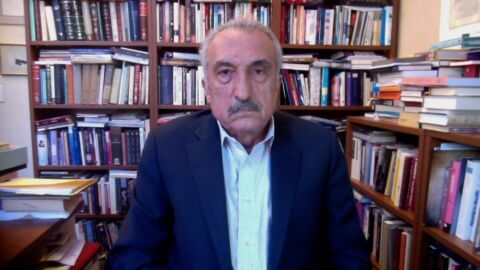
this now. Abbas Milani is an Iranian-American historian and author of the landmark biography of the former Shah, which I’m almost through reading
right now. It is a phenomenal book. And he’s joining me now from California. Abbas, thank you so much for joining us.
I mentioned there in the introduction that the murder of thousands of protesters is all but forgotten. I know that’s not the case with people
like you, with so many of those Iranians who have fled the country, who are living abroad, and for so many of the Iranians that remain in Iran right
now, watching things unfold.
On the one hand, you have a massive show of force, as we have reported, the president even calling it a massive armada ready for action. On the other
hand, you have efforts being made for continued diplomacy and talks, Steve Witkoff headed to the region now, perhaps even further talks with other
U.S. officials and Iranian officials later this week. How are you interpreting this? Is this Washington looking to prevent military strikes
or just stays away from commencing them?
ABBAS MILANI, AUTHOR, “THE SHAH” AND DIRECTOR OF IRANIAN STUDIES, STANFORD UNIVERSITY: I have a hard time understanding why and what Washington is
trying to do. If you carefully listen to what Mr. Araghchi just told your interview, this is a discussion that is absolutely destined to fail. The
minimum conditions the U.S. has set are three. Araghchi basically said they won’t accept any of them. The minimum conditions the French foreign
minister has set are even more. He says human rights, the death of these people, the tens of thousands who are now in prison must be on the table.
Araghchi says we can guarantee that we won’t build a bomb. Well, they have guaranteed that they won’t build a bomb for 35 years, and they have lied.
They three days ago went on television and said we can build a bomb overnight if we want to.
So, I don’t understand the logic of this meeting. Maybe only, as you said, they’re trying to prepare all the place, army in place. But to the people
of Iran who have suffered enormously, giving this regime another chance and lying is betraying the trust that they have put in the International
Community to stand for them. People did not go to their death so that the U.S. can get a better deal. People went to their death and are still
fighting in order for a democratic Iran.
Without a democratic Iran, this regime will make another deal and will cheat as they have on every deal that they have made over the last 35
years, including nuclear deals.
GOLODRYGA: And on the nuclear front, it’s hard to see how President Trump views it as a victory that he walks away with, even if Iran agrees to once
and for all end its nuclear enrichment program, because the president just described the same program as completely obliterated just a few months ago
following the strikes by the United States. So, that may be difficult for the president to view as something that he walked away with without having
to go to war or strike Iran again.
But to your point about the Iranian people not taking to the streets because of the nuclear program, what is it, in your view, that the United
States should be doing right now, even in terms of the language from the president on down, and then your thoughts on whether you think a strike is
an appropriate response?
MILANI: I think what the United States and the International Community should do right now is tell the Iranian regime that this will not stand.
You cannot kill thousands of people, arrest tens of thousands, and think it’s normal.
Mr. Khamenei went on television the other day and declared that these people who came to the street, these tens of thousands who came to the
streets, some would say several million, were part of a coup d’etat, an ISIS-like coup d’etat, and they were rightfully suppressed.
His president says these were innocent Iranian people who should make peace with them. The International Community should tell Khamenei that this is
not a coup. This is a massive resistance against a corrupt, despotic, incompetent regime. The economy is collapsing. People are suffering in
Iran. That’s what the International Community should be, I think, in a unified language, tell this regime.
Read — I suggest Mr. Witkoff read some of the material that has been put on Khamenei’s website within the last 48 hours. I read those. It’s very
clear they think they’re not going to give up any of those three things. And the idea that they will give up the bomb, as Araghchi says, is
repeating the lie that they have been telling the International Community for 40 years.
The International Community should build its effort towards making a democratic Iran, not by military attack. The people of Iran want to have
democracy. Help them. Make the playing field more equal. Instead of putting lifelines to a murderous regime that right now, again, I say go to their
website. Go to Khamenei’s website. He said we won the 12-day war and we’ll win this one and we’re not going to give up any of these. We won’t give up
proxy. We won’t give up enrichment. We won’t give up missile program. So, what are you negotiating for?
GOLODRYGA: Yes, President Trump publicly put down a red line and the Ayatollah bulldozed his way over it weeks ago. That was January 3rd when
the president said that there would be a response if more civilians were killed, and the supreme leader all but ignored that and continued to mow
down his own people.
In terms of what a democracy in a day after could look like, I want to get your thoughts on what was written in The Economist by a dissident, Amir
Hossein Ganjbakhsh, and he says the key is dismantling the Islamist theocracy and the ayatollah himself right now and that the solution in
terms of what tomorrow looks like in toppling the ayatollah would be something he describes as a coalition from Pahlavi to Mousavi, and that is
uniting the crown prince, also living abroad here in the United States, Reza Pahlavi, with the former prime minister to push a referendum forward
for a new constitution. He says that would give them more legitimacy with the Iranian people. Is that, do you think, a plausible bridge, or is it
fantasy?
MILANI: Well, in the way he is articulating it, I think it is a fantasy, but the idea has been around for several years. Many people have been
arguing that what can dislodge this regime is what is historically called a pacted transition, like something that happened in South Africa, something
that happened in Poland, something that happened in Chile, where the opposition agrees with the regime, some in the regime, some in the regime,
who realize the game is up, they can’t continue, and they together find a path forward towards democracy. I think that is an idea.
But right now, I think, the situation has become radicalized by Mr. Khamenei’s killing of thousands. I think part of why he went to this
extreme action, why he killed so many people and so brutally and so brazenly, is precisely to make that impossible. He wants to radicalize. He
wants to polarize. Mr. Mousavi, that he refers to, just issued a very brave announcement, basically saying he is willing to support a referendum,
basically saying that Khamenei has to stop, has to be stopped, basically saying something even more important. He asked the Iranian military to put
down their guns and not kill the people. But then he said, we want to go back to an Islamic state, and that has caused the ire of thousands.
Go on social media and see how they have attacked this guy, who has been in prison for 14 years now, for even broaching the idea of an Islamic state.
That’s how angry people are at this regime. And anything that even smells of Khamenei and his regime. But that idea, I think, the idea of a
transition that connects the Iranian diaspora, now more than ever united around Prince Reza Pahlavi, and the opposition in Iran.
People like Mousavi, people like Narges Mohammadi, people like Nasrin Sotoudeh, there are many people who have fought this regime for 40 years.
Everybody has to come together, and I think get rid of this regime, which will then, and only then, solve the nuclear problem.
The nuclear problem has one solution. Iran’s nuclear problem has one solution, a democratic Iran, nothing else.
GOLODRYGA: And to your point about the goal here from Khamenei to sort of radicalize people, that is something that is already being described as
potentially the groundworks for a civil war in the country. I’d like to read from the reporting from The Economist and their take on this. And they
write, the mayhem that followed the Western toppling of tyrants in Iraq and Libya also offers a cautionary tale. Nor is the exit of Mr. Khamenei likely
to be enough to satisfy the regime’s opponents. They want the edifice he built to fall with him. Meanwhile, Iran’s rulers have seen the consequences
of eviscerating the ruling class as happened in Iraq after Saddam Hussein’s overthrow in 2003. In Iran, too, expect them to fight to retain their power
and assets. Either way, chaos looms.
Of course, Iran is not Libya. Iran is not Iraq. But do you share those concerns?
MILANI: I share those concerns, but I also share very firmly that Iran is not Libya. Iran is not Iraq. Iran is a country that has been fighting for
150 years for democracy. Iran today, as we speak, has one of the most remarkable women’s movements anywhere in the world. In the world, Iran has
a civil society. Iran is intimate, savvy. Iran has developed a discourse of pluralism. Inside Iran and even outside Iran, there are people outside
Iran, there are people inside Iran, who want to continue this bloodshed, who want to kill — talk about killing every mullah and every IRGC
commander. That’s not going to get us to a democratic Iran.
We have to allow people who want to change their ideas to change their sides, to join people, to get rid of this curse that is called the rule of
the clergy.
GOLODRYGA: And what is the — obviously, this is something that has to come internally, but it’s pretty clear at this point, and the president has
said as much, that the U.S. will respond if these atrocities continue, which they did against the Iranian people, and the threat of Iran remains
pernicious to its neighbors and the world. So, what is the best thing that the United States can do right now in terms of effectively aiding Iranians
to that democracy you speak of?
MILANI: Again, as I have said even in your program before, I think right now we need to equalize the playing field. This regime is having a go at
the Iranian people at will. We have to stop it. We have to give people access to internet. This regime has created literally a social media iron
wall around Iran. The internet is shut down. Phones are shut down. The assets of this regime, of the oligarchs connected to this regime, have to
be frozen. These things, more than any attack, will give the people of Iran hope that the International Community is helping.
GOLODRYGA: And final question quickly. When Khamenei says that an attack on Iran would trigger regional war, this is an existential threat for him
and his regime. Is that a bluff, or is that something that you think should be cautioned by the United States? And what does a regional war look like?
MILANI: I think it should be taken seriously because I think Khamenei does feel existentially threatened. And he is the kind of a murderous ruler who
is willing to destroy the country, kill thousands more if it prolongs his power. But I think the military has responsibilities for that. This regime
is far more diminished now than it was two years ago when it was making these threats. So, the threat has to be taken seriously.
But we must also be aware, and I think that was evident in what President Trump suggested, that of course he’s going to make threats. Of course, if
you’re being threatened and you’re a bully, as this regime is, you’re going to make threats to make people afraid of attacking you. They should be
worried about this, but they should realize that this is a much, much, much diminished regime than it was ever before.
GOLODRYGA: And a regime that, you know, given Iran’s long history, is relatively young, 46, 47 years old. All of this can be found, again, more
detailed in your phenomenal book, which I highly recommend. Abbas Milani, thank you so much for joining us.
MILANI: It was a pleasure. Thank you.
GOLODRYGA: Now, in Venezuela, one month after the capture of Nicolas Maduro and his wife, there appears to be a sense of stability as the United
States asserts its presence and power. The government has approved a new law enabling easier foreign investments into the country’s oil reserves.
But meanwhile, Trump is trying to cut off Cuba from this lifeline, threatening tariffs on any country supplying the crucial resource. Cuba’s
government declared an international emergency. As without oil, Cubans face very harsh living conditions. Correspondent Patrick Oppmann reports from
Havana.
(BEGIN VIDEOTAPE)
PATRICK OPPMANN, CORRESPONDENT (voice-over): In the U.S. attack on Venezuela to capture Nicolas Maduro, over 100 people were killed, among
them 32 Cuban soldiers, including Maduro’s closest bodyguards operating there in secret.
Now Cuba’s closest ally and more importantly its biggest oil supplier appears to be under de facto American control. And this is sending a chill
through Cuban society about what may be next.
DONALD TRUMP, U.S. PRESIDENT: Cuba is really a nation that’s very close to failure.
OPPMANN (voice-over): It is a prediction many U.S. presidents have made. But the revolution founded by Fidel Castro has endured.
I’ve been a foreign correspondent in Cuba for 14 years, a country that suddenly feels very different to me. And I want to find out what the
operation in Caracas means for the future of 9 million Cubans who live in this island nation.
The Cuban government received the remains of their fallen soldiers from Venezuela with a hero’s welcome after decades of denying their presence
there. Thousands of people lined the streets that day and waited hours to pay their respects.
OPPMANN: This direct confrontation between the U.S. and Cuban soldiers, that’s not something we’ve seen for decades. And it’s left many people here
wondering, you know, the loss of their ally in Venezuela, how is that going to impact them?
OPPMANN (voice-over): Outside in the line, I meet Iliana Medrano.
OPPMANN: What would happen if there was an invasion of Cuba by U.S. troops?
ILIANA MEDRANO, CUBA RESIDENT (through translator): We would confront whatever comes. We don’t know what will happen, but we are willing to die.
OPPMANN (voice-over): Cubans are no strangers to economic hardship. Since Fidel Castro’s 1959 revolution, they have weathered America’s embargo and
their own government’s disastrous economic missteps. After the Soviet Union collapsed, Venezuela emerged as Havana’s lifeline.
Here’s how the agreement worked. Cuba sent thousands of doctors, teachers, sports trainers, as well as military and intelligence officials to
Venezuela in return for oil.
OPPMANN: Now with Maduro in jail and out of the picture, it’s not clear if Venezuela can or will continue the oil shipments that the Trump
administration has vowed to block.
OPPMANN (voice-over): To make matters worse, Havana’s second largest oil supplier, Mexico, has also reportedly suspended oil shipments. Already we
are witnessing the impacts, it can take weeks to get a spot in a gas line using an online system. Gerardo tells me he’s waited 29 days.
GERARDO (through translator): Things are going to get tough. I’m glad I was selected today, because I don’t know if I will be next time.
OPPMANN (voice-over): As night falls, many here will be left in the dark. And so longer and longer apagones, blackouts, are becoming the new normal.
In many parts of the island, the power is off more hours a day than it is on. Some people tell us they are fed up, but they’re too scared to speak to
us on camera.
The Trump administration vows the pressure will continue on Cuba. For now, the Cuban government is defiant, calling for one of the largest
demonstrations outside the U.S. Embassy in Havana in years.
UNIDENTIFIED MALE (through translator): Cuba does not have to make any political concessions.
OPPMANN (voice-over): Even some of the younger people in the crowd, like Ivan, say they feel the mood in the country has changed.
OPPMANN: When you saw bombs falling on Caracas, how did that make you personally feel?
IVAN ERNESTO BARRETO LOPEZ, CUBA RESIDENT: In the 21st century, seeing this kind of actions violating totally the international law, acting
unilaterally, that’s something very worry.
OPPMANN (voice-over): For those of us who cover the normalization of diplomatic ties between the U.S. and Cuba under the Obama administration,
there’s a sense of whiplash.
OPPMANN: I’ve even heard from a U.S. Embassy source that diplomats there have been advised to, quote, “have their bags packed” as the Trump
administration explores new ways to stabilize the Communist-run government.
(END VIDEOTAPE)
GOLODRYGA: Patrick Oppmann reporting there. When contacted for comment, the U.S. State Department said that it would not comment on internal
meetings, but that there were no indications of any embassy drawdown in Havana.
Let’s get more on this now. Michael J. Bustamante is an associate professor and chair in Cuban studies at the University of Miami, and he’s joining me
now from Miami. Michael, it’s good to see you. This is obviously a region, a country you have covered well for years now. You are still talking to
sources there in Cuba. Obviously, a large Cuban population, many dissidents and family members of those who fled the country still remain in Florida
and in the Miami area.
What are they telling you about what life has been like and what’s changed since early this year when the president of the United States ordered the
raid and the seizure of Maduro, and then now, obviously, the focus, the blockade on Cuba?
MICHAEL J. BUSTAMANTE, CHAIR, CUBAN STUDIES, UNIVERSITY OF MIAMI: It’s good to be with you. I’m hearing all kinds of things, from excitement and
even hope to real worry and a grave sense of preoccupation. I’m in touch with family who are still on the island, friends who are still on the
island, and lots of family and friends also who have left the island in more recent years, so I think it’s a real mix.
It seems, you know, the lead-in reference, the normalization period from 10 years ago, that just seems like such a lifetime ago. Cuba is in such a
different place, and there are some real hard choices facing the Cuban government and the Cuban people right now. It strikes me whether they like
it or not.
GOLODRYGA: Well, President Trump now says that the United States will, quote, “work a deal” with Cuba as he cuts off their lifeline to Venezuelan
oil, putting additional pressure on Mexico to do the same. Will this coercive pressure work? And I guess more importantly, what does a deal with
this regime look like?
BUSTAMANTE: That’s the million-dollar question. I mean, traditionally, the Cuban government has always rejected the idea that they would make any
changes to their internal political or economic order in a kind of coercive negotiation with the United States.
They have always insisted that they are willing to negotiate in good faith with the government of the United States, but on the basis of mutual
respect. The days of mutual respect are over. Under this administration, we’re seeing a revival of the Monroe Doctrine, the Donroe Doctrine is being
called, the exertion of unilateral force, and Cuba is outmanned and outgunned, simply put. So, the question of sort of just resistance
indefinitely comes with really, really grave risks.
As to what a deal could look like, I’m not sure. Because unlike in Venezuela, to use that comparison, there’s not such an obvious natural
resource space that the United States wants access to. Unlike in Venezuela, at least it seems, there’s not such a clear figure like we have in Delcy
Rodriguez that comes from within the current Cuban government that would be seen as an honest broker by that government and also someone to sort of
carry a situation forward.
And I’m not sure that for Cuban American elected officials or the secretary of state, that the idea of dealing with any remnants of this government in
Havana is appetizing, certainly something that they’ve opposed for a long time for the entirety of their political careers. So, it’s really hard for
me to envision what the shape of that negotiation might look like and what might satisfy the Trump administration’s demands.
GOLODRYGA: Well, this comes under the direction now and leadership of Marco Rubio. The president has made that clear. The president’s secretary
of state, national security adviser, and himself a Cuban American. His family fled Cuba and moved to the United States, and he has made clear
throughout his political career that the focus on Cuba, regime change there, bringing democracy, restoring democracy to that island has been a
primary foreign policy focus for him.
And when he was asked about what the day after plan, what the U.S. plan in general is for Cuba, as recently as last week when he was testifying before
the Senate, he didn’t really give concrete answers. Here’s what he said.
(BEGIN VIDEO CLIP)
MARCO RUBIO, U.S. SECRETARY OF STATE: Regime change?
UNIDENTIFIED MALE: Yes.
RUBIO: Oh, no, I think we would love to see the regime there change. We would like to. That doesn’t mean that we’re going to make a change, but we
would love to see it change.
(END VIDEO CLIP)
GOLODRYGA: Does that suggest to you that there’s a plan? Is it reassuring? I mean, I’m not expecting that he would divulge everything to his former
colleagues there in the Senate, but there wasn’t much detail.
BUSTAMANTE: I agree. There wasn’t much detail. It seems to me that the Secretary of State in those remarks was, in a way, saying something he said
all along, which is that he and others would like to see regime change in Cuba, but sort of keeping their options open.
I think one thing that Venezuela has made quite clear and is quite interesting is that this administration and the Secretary of State have
determined or recognized that in order to perhaps get a political transition in Venezuela, they’re going to have to deal with some remnants
of the Maduro government. It’s sort of a transition period, they’re calling it.
In Cuba, I would argue, something similar would have to take place. There would have to be some kind of a pact, but when the sort of foreign policy
position of your entire career has been based on the idea that any negotiations at all are sort of morally objectionable, it’s hard to see
what a negotiation with Cuba in particular would look like.
GOLODRYGA: And what somebody like Delcy Rodriguez would look like. I mean, Cuba’s got a tighter state security, a weaker civil society, and not much
of an opposition at all. I mean, we’ve spent so much time focusing on the weakened opposition in Venezuela, but it is still alive and kicking. We
don’t have that same factor in Cuba. So, does that make the option of some sort of defector or somebody that will actually work with the United
States, does that eliminate that option?
BUSTAMANTE: I don’t know if it eliminates the option so much as makes it the only way forward. You’re right, that to compare, it’s difficult to
compare the state of the opposition for Cuba without a Venezuela. There is a Cuban opposition, both on the island and in the diaspora, but a great
part of that opposition has been either exiled or imprisoned.
So, they are in even less of a position than the Venezuelan opposition was to sort of force a transition that they might like to see, which it seems
to me leaves the U.S. government just a couple of options. Either you’re trying to use pressure to force a negotiation with a Cuban government
insider, and some sources suggest that U.S. diplomats are suggesting that that’s one of the things they’re exploring, or you are actually trying to
precipitate a kind of humanitarian crisis that would then bring about the need for a more forceful U.S. action. I think the latter is something that
the White House would certainly want to avoid, but whether they can find a negotiating partner inside Havana, that’s still, as I’ve been saying, a
huge question mark here.
GOLODRYGA: Well, and the White House is reportedly considering now a naval blockade as well, which would essentially mean direct military
intervention. How significant and how risky would that be given the 1962 missile crisis? I mean, this is something clearly that Donald Trump doesn’t
want to repeat from JFK.
BUSTAMANTE: Yes. I think there were some news stories last week suggesting that an actual military naval blockade was under consideration to block oil
shipments. They opted for, I guess, a less dramatic step first, which was to threaten tariffs, which, of course, is still a very dramatic step in its
own right. You know, it seems that one of the primary targets of those tariffs, Mexico, which remained a significant oil supplier to Cuba, is
backing off. So, maybe the Trump administration will conclude that they’ve gotten what they wanted to. I think it’s still a question.
One country that is in a position to ostensibly provide some oil relief for Cuba, which, again, that oil is critical for its energy system, is Russia.
And in a scenario in which you have an actual naval blockade and Russian steamers, ships, you know, heading toward Havana with oil shipments, it
does give one a sense of deja vu from 1962. I don’t think we’re there yet, but, you know, cooler heads prevailed then than hopefully they would now if
we find ourselves in a similar scenario.
GOLODRYGA: Yes, but if we were to follow Russia’s reaction response to Venezuela and an ally there, didn’t really come to Maduro’s aid, and now we
see things unfolding. With regards to Iran, the two aren’t necessarily allies, but they clearly have cooperated, and Russia has relied a lot on
Iranian drones throughout its war on Ukraine, and so it would be interesting and quite stunning if Moscow did intervene when it comes to
Cuba.
We’ve also seen the Cuban military now perform drills and really ratchet up its own rhetoric and propaganda on television. Is this fear, from your
perspective, of this administration, or is this an administration in a regime that has gone through past crises and feels that it can survive yet
another day?
BUSTAMANTE: To me, these military mobilizations or exercises seem largely performative. I think in a circumstance of actual military confrontation,
there’s no question which side would win. This is about trying to sort of rally the population around the idea of national defense and around what
are objectively, you know, challenges to international law as it’s typically understood.
But I think there is a sentiment, what I hope is that there’s a sentiment in Havana that, like it or not, this time is different, and that cutting a
deal of some kind might be the way to a greater catastrophe. I would note that despite this sort of strong, intransigent rhetoric coming from Havana
initially, yesterday there was a much cooler statement issued by the Ministry of Foreign Affairs suggesting that they are willing to negotiate
and want to cooperate with the United States on issues of national security.
I don’t think it’s too much to really get this administration’s attention yet, but the shift in tone was noticeable and perhaps lends credence to
some of the rumors that are circulating that there are perhaps some quiet talks happening somewhere.
GOLODRYGA: While I know you are hearing from so many Cubans and Cuban- Americans and those that are on the island right now commending the president and his focus on Cuba now, if they were, or if you were, to
advise this administration on one thing to avoid this turning into a massive humanitarian crisis and backfiring against the U.S., what would
that be?
BUSTAMANTE: Well, it’s difficult to just advise one side of this conflict without advising the other. It takes two to tango. I’m very concerned that
the actions that the United States is taking in terms of the pressure on oil shipments, for example, are going to have grave humanitarian
consequences. Humanitarian consequences are going to be felt by Cuba’s people by and large more than its government, certainly in the short-term.
So, I would urge any U.S. administration to try to keep a focus on humanitarian issues, to try to create wide exceptions, to try to target
whatever pressure you might want to exert and however objectionable others might find it on individuals within the government and to not use the Cuban
people as sort of cannon fodder.
But on the other token, I would advise the Cuban government that part of the reason they are so vulnerable to this kind of pressure right now is
that for 30 plus years since the fall of the Soviet Union, they have delayed deeper reforms to their economic and political model that they
need, not because the United States says it, but because Cubans say it and Cuban economists say it. So, I think some willingness to move the ball
forward internally would also help the dynamic with Washington.
GOLODRYGA: Michael Bustamante, we’ll have to leave it there. Thank you so much for the time and your expertise. Appreciate it.
GOLODRYGA: Now, could Democrats learn from the MAGA movement? That’s the question our next guest is asking in his latest piece for The New Yorker.
Pulitzer Prize-winning reporter Charles Duhigg argues that recent right- leaning movements have thrived by building local networks with lasting community impacts. While, on the other hand, he says Democrats have focused
on large, flashy shows of force that have failed to produce durable impact. He explains to Michel Martin what he believes it would take for the left to
build broader, more resilient coalitions.
(BEGIN VIDEOTAPE)
MICHEL MARTIN, CONTRIBUTOR: Thanks, Bianna. Charles Duhigg, thanks so much for joining us.
CHARLES DUHIGG, PULITZER PRIZE-WINNING JOURNALIST AND WRITER, THE NEW YORKER: Thank you for having me.
MARTIN: You know, your writing for The New Yorker often kind of unpacks the way systems work, right? How does the system actually work? In your
latest piece, it’s titled, “What MAGA Can Teach Democrats About Organizing and Infighting,” what made you think about that?
DUHIGG: Well, I was really curious about why — Democrats have obviously been turning people out into the streets for the last eight years and in
some of the largest protests we’ve ever seen. And yet, Donald Trump’s victory, his most recent victory, and the fact that MAGA has such a
sustainable life around it made me curious what was going on because I didn’t see a lot of MAGA protests. And as I got deeper into this, I
realized that there was a science behind social movements. There’s a science behind why some movements attract millions of people and sustain
and why others are a flash in the pan and disappear.
MARTIN: You make an interesting point because you remember when Donald Trump and Kamala Harris had their debate, Kamala Harris, the Democrat,
correctly pointed out that Trump’s rallies weren’t that successful, like they were having to find smaller venues. They were — a lot of people would
leave early. And a lot of people sort of saw that as a sign as kind of waning interest, and that turned out not to be true at all.
And as a tool of analysis, you open the piece by contrasting DARE, which is this nationally funded, top-down anti-drug program that spread rapidly
through the schools in the 1980s, and you contrast that with Mothers Against Drunk Driving, which is a volunteer-driven group that grew locally,
grew unevenly after a personal tragedy. What made you think of those two groups?
DUHIGG: Well, I think they’re perfect examples of what are known within the academic literature about social movements of mobilizing and
organizing. DARE was really good at mobilizing, right? They could get millions of people to show up for rallies. They got President Ronald Reagan
to declare the first National DARE Day. They got lots of donations.
But over time, the program just kind of petered out. It wasn’t very effective at changing people’s behavior. And much more so, schools just
abandoned it. MADD, on the other hand, was really good at what’s known as organizing, pushing down leadership, training local people to build
communities and become leaders in their own right, and in doing so, building these durable communities that end up having prolonged impact.
And when we look at the contemporary politics, what we see is the same thing. Democrats are very, very good at mobilization, right? They’re very
good at turning people out into the streets and having these large rallies. But when everyone goes home, they stop talking to each other. They don’t
make new connections at those rallies. They feel like they’ve done their part, and so they stop working hard.
Whereas on the Republican side, very much under noticed and quietly, MAGA has spent years and years building a network of small groups that work on
local levels, that have empowered tens of thousands and millions of people to become leaders of the conservative ideas within their own community. And
in doing so, they’ve built a very sustainable, very durable movement that will, frankly, outlast Donald Trump.
MARTIN: You write, for a social movement to create real change, it helps to be skilled at both mobilizing and organizing. But that doesn’t mean that
both skills are equally important. How did you kind of come up with that idea?
DUHIGG: Well, there’s an academic I love named Liz McKenna at Harvard who says that protest is a tactic in search of a strategy. And what she means
by that is that when we protest, it should be the outgrowth of a community that’s built together and has become outraged and wants to take to the
streets. The protest is not the goal of the movement. The protest is a symptom that you have a community that’s coming together and is getting
stronger and stronger and stronger.
Now, when you prioritize that protest, when you push people into the streets, when you use Twitter and the Internet to organize and thereby
scale very quickly, but sidestep the infrastructure building that’s really, really important to making a movement durable, that’s when you get what we
have right now, which is that people feel very passionate on the Democratic side about being anti-Trump and standing up against ICE. And yet, we’re not
seeing the widespread change that those people had hoped for because they’re also not at the same time organizing and building those communities
that allow people to work day in, day out, every week with their neighbors to create change.
MARTIN: You know, that’s one of the weird ironies that you point out in your piece is that many right-leaning groups studied and adapted strategies
that were first perfected by Democrats. How did the right-leaning groups figure out what to do, and how did Democratic or left-leaning groups lose
it?
DUHIGG: Absolutely. I think in a lot of ways, for the contemporary period, we can go back to Barack Obama’s election in 2008. At the time, Barack
Obama basically turned campaign conventional wisdom on its head by saying, instead of telling volunteers what we’re going to do, we’re just going to
make them into franchisees of the campaign and say, do whatever you think is best. Take the leadership initiative yourself. Go out and experiment
with things.
And as a result, they were able to get over 2 million volunteers who turned to their neighbors over 25 million times to encourage them to vote for
Obama and brought about one of the sweeping victories for Democrats in both the legislature and the White House. But at that moment, two things
happened.
First of all, we start to see the roots of the Tea Party, and the Tea Party was a very decentralized movement that ended up being very, very
successful. And also, you saw folks like Ralph Reed, the former head of the Christian Coalition, look at the Obama election and say, look, they’re out
organizing us. We got to get better at this.
So, what Ralph Reed did is start an organization known as the Faith and Family Coalition that very much was modeled on the Obama playbook, but for
the right. And in fact, one of the things that many of these groups do, including Turning Point USA, the Charlie Kirk organization, is that when a
leader joins their group, they make them read this book called Groundbreakers, which is all about the Obama campaign and very glowingly
about the Obama campaign. And they say, don’t pay attention to the ideology, just steal the ideas about organizing.
And so, with the Tea Party and groups like the Faith and Freedom Coalition and Turning Point USA, we saw a prolonged emphasis on creating these small
groups across the nation of neighbors who are coming together in order to be active, not just on politics, but on all types of things. Faith and
Freedom has expanded by focusing on evangelical churches and gun clubs and homeschooling organizations. And in doing so, what they’ve learned is that
when neighbors have one issue they care about, like guns, that it’s much easier to persuade them when the election rolls around to vote for the
Republican candidate. But the point is they’re doing year-round organizing.
MARTIN: But the other point that you make in the piece is that MAGA’s strength comes in part from a tolerance for internal disagreement. And this
is something that you’re hearing Democrats complain about constantly, particularly national Democrats, is this sort of a stringency around
opinion that is enforced.
DUHIGG: Yes, a purity test.
MARTIN: But you look at the Women’s March, for example, which fell apart, which is a huge mobilization in the wake of Trump’s first election, huge
mobilization, far outstripped in numbers, the people who attended his first inauguration. And the group fell apart over all this sort of internal
disagreements about who was right and issues like sort of Israel.
You know, what’s interesting, though, is that you really don’t — I’m based in Washington, so I don’t get the sense that Donald Trump tolerates a lot
of disagreement about anything.
DUHIGG: So, it’s important —
MARTIN: So, it’s interesting that, you know, you’re saying that the actual organizing structure that keeps him alive and viable politically actually
does. Can you say just a little bit more about how that works on the ground?
DUHIGG: It’s important to distinguish between MAGA and Donald Trump. You’re exactly right. Donald Trump brooks no dissent within his group. And
yet, if you look at the MAGA movement, they welcome almost everyone as long as you’re willing to put on the red hat, right? And for many of them, they
actually opposed Trump when he first rose up in the first presidential campaign.
And they’ve now come around to being boosters of his because he’s the guy who’s winning. It’s great to jump on his coattails. But MAGA is a very
different movement from Donald Trump as himself. And you’re exactly right, MAGA says if you wear the red hat, you’re allowed in. We don’t care who you
date. We don’t care who you love. We don’t care if you’re pro-choice or pro-life. We don’t care if you’re pro-trans rights or anti-trans rights. As
long as you wear the red hat, you’re welcome within our camp.
And if we contrast that with what’s happening oftentimes on the left, what we see are these purity tests, right? That if you are a pro-life Democrat,
you are excluded from almost every social organization that should be welcoming you.
If you’re someone who has questions about DEI initiatives or January 6th or says, you know, I don’t like Elon Musk, but maybe shaking up the
government, maybe there’s something there. There’s no place for you to really participate in the Democrats, and they make you feel like you are
excluded.
What we know about political movements and political parties is that they succeed when they become big tents. And MAGA is very focused on being a big
tent. All you have to do is say you’re going to vote for the guy at the top of the Republican ticket, and you’re a member. Democrats are much more
focused on ideological purity, and it’s to the detriment of the party.
MARTIN: How did that start? How did it happen that somebody like Obama led this movement that was very inclusive, and then all of it became sort of
ossified into these purity tests? How did that happen? Do you have a sense?
DUHIGG: I think two things happened. I think that first was the election of Donald Trump was such an overwhelming shock to the Democratic system
that Democrats started saying we absolutely have to be unified against Donald Trump. We have to show that there’s no dissent within our ranks
because we feel like that’s the way that we prove that we are the resistance. And that’s an understandable instinct, but it’s exactly the
wrong thing to do.
And then on top of that is COVID and the racial reckoning that happened after George Floyd. There was a lot of upheaval in how we thought about
social issues. And you’ll remember during COVID that it became a sign of faith on the left that you should absolutely wear a mask and that we should
close the schools. And states, Republican states, that didn’t enforce mask wearing and didn’t close their schools were almost demonized.
And now, we know, looking back, this is a complicated issue. It’s a sophisticated issue. Some people should be wearing masks. Others don’t have
- Maybe in some places, we close schools. In other places, we shouldn’t close schools. But there was this emphasis on unity on the left that became
dogmatic. And we still haven’t grown out of that. In fact, the fact that Donald Trump won by being anti-woke is evidence of how much this perception
of a need for ideological purity still exists. And people are either endorsing it or reacting in contrast to it.
But it’s important to note that this hasn’t always been true, as you point out. It wasn’t true under Obama. It wasn’t true under Clinton. We all
remember the sister soldier moment, right, when Clinton very visibly broke with some of the core constituencies of the Democratic Party. This used to
be something that we saw as a good sign that a party is alive and is breathing and is changing. And the Democrats need to get back to that if
they want to succeed.
MARTIN: And what about Minneapolis? I mean, we’ve seen an intense kind of grassroots mobilization. These are people saying, this is unacceptable to
- My neighbors are being harassed and persecuted. I’m not tolerating this. And this is, of course, after two U.S. citizens have been shot by
federal agents under circumstances that the people who witnessed this consider absolutely unacceptable and that many people have now seen for
themselves.
So, what do you make of it? Did you think this has some meaningful impact or not?
DUHIGG: Absolutely. And what’s interesting about Minneapolis is that it’s not all groups on the left that have ignored the wisdom of grassroots
organizing. And, in fact, in Minneapolis, we see a number of groups that for years now have been organizing grassroots in local communities.
One of the one of my favorites is a group named Isaiah, which has brought together child care workers, college students, East African refugees,
Islamic centers and churches, groups that normally would never come together. Isaiah has been bringing them together for over a decade and has
been helping them organize among themselves and saying, look, you share values together.
And if we work together, we become stronger. And those are the groups that right now are leading this mobilization. A social movement can’t exist
without both organizing and mobilizing. That mobilizing is really important. But what’s happened in Minneapolis is that the organizing has
been going on for a decade on the left.
And so, now when they mobilize, it’s not just a one-day show up and blow your whistle, it’s a prolonged, consistent attempt to change what is
happening in that city and in this nation. And it’s that durability, those unsung heroes of local people who show up and take out their phones and
blow their whistles day after day after day because they see their friends there, because they see their neighbors there. That is what creates real
change.
MARTIN: Charles Duhigg, thanks so much for talking to us.
DUHIGG: Thank you for having me.
(END VIDEOTAPE)
GOLODRYGA: And finally, home at last. Five-year-old Liam Ramos and his father returned to Minneapolis after being held for more than a week at an
immigration facility in Texas some 1,300 miles away from where they live. Seized from their driveway earlier this month, the incident drew outrage
when images of Liam in his blue bunny hat and Spider-Man backpack went viral.
Their release does not ensure they won’t eventually be deported. But the family’s attorney says they are in the U.S. legally as they pursue a claim
for asylum. Democratic lawmaker Joaquin Castro picked them up from the detention center and escorted them home. And in a note to Liam, he said
this, I hope you will judge America not by your days at Dilley, the detention center, but by the millions of Americans whose hearts you have
touched, even as a young boy, you have moved the world. Hopefully, Liam is reunited with his friends and classmates as well.
All right. that does it for now. Thank you so much for watching, and goodbye from New York.
END