
Read Full Transcript EXPAND
CHRISTIANE AMANPOUR, CHIEF INTERNATIONAL ANCHOR: Hello everyone and welcome to “Amanpour.” Here’s what’s coming up.
(BEGIN VIDEO CLIP)
DONALD TRUMP, U.S. PRESIDENT: It’s a deal that people jumped at. Really fantastic for the USA.
(END VIDEO CLIP)
AMANPOUR: Crisis averted over Greenland. President Trump drops his tariff threats after an agreement with NATO. I asked former Danish Prime Minister
Helle Thorning-Schmidt if they’re out of the woods yet. Then —
(BEGIN VIDEO CLIP)
UNIDENTIFIED FEMALE: They were shooting at us from the top of the building and the Ashrafi-Esfahani Bridge. They were aiming with lasers and the
shooters were shooting people in the face. They massacred people.
(END VIDEO CLIP)
AMANPOUR: — the night Iran went dark, two weeks into an internet blackout, we have a special report hearing from protesters who witnessed
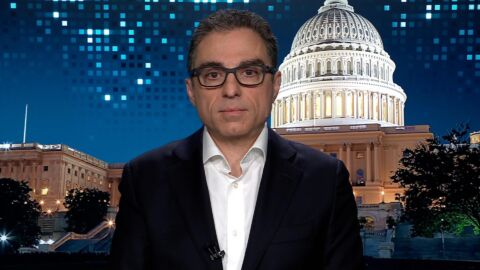
the regime’s violent crackdown. And we get insight from Iranian-American Siamak Namazi, held for almost eight years inside the notorious Evin
Prison.
Plus —
(BEGIN VIDEO CLIP)
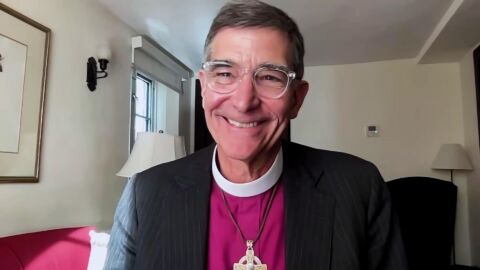
- ROB HIRSCHFELD, BISHOP, EPISCOPAL CHURCH OF NEW HAMPSHIRE: Simply we have a freedom of assembly, we have freedom of speech. Those are not
crimes. They shouldn’t be in this country.
(END VIDEO CLIP)
AMANPOUR: — the VP visits ICE as clashes continue across American cities. Bishop Rob Hirschfeld of New Hampshire talks to Michel Martin about the
power of peaceful protest and standing up for the most vulnerable.
Welcome to the program, everyone. I’m Christiane Amanpour in London.
Drama in Davos. Could peace be on the horizon for Ukraine? U.S., Ukrainian and Russian officials will meet in the UAE tomorrow and Saturday for talks.
While the threat of war among allies over Greenland appears to have abated, here’s their prime minister welcoming a deal between allies but refusing to
sell out.
(BEGIN VIDEO CLIP)
JONATHAN MOTZFELDT, GREENLAND PRIME MINISTER: I know that we have not a high-level working group working on a solution for both parties. We have
said from the beginning in Greenland, we have some redlines. We cannot cross the redlines. We have to respect our territorial integrity. We have
to respect international law, sovereignty. We are ready to cooperate more in economics, in other areas, but that’s something we have to talk about in
mutual respect.
(END VIDEO CLIP)
AMANPOUR: This after President Trump announced that he had agreed on a security plan with the head of NATO and walked back his military and tariff
threats on any country opposing him. But the details are still unclear.
(BEGIN VIDEO CLIP)
DONALD TRUMP, U.S. PRESIDENT: It’s really being negotiated now, the details of it, but essentially, it’s total access. It’s — there’s no end.
There’s no time limit.
(END VIDEO CLIP)
AMANPOUR: The president also unveiled his so-called Board of Peace, originally intended to oversee Gaza reconstruction, which he called a
quote, “beautiful piece of property.” Critics worry though that the body will evolve into a rival to the United Nations. Fewer than 20 nations
actually attended the signing ceremony today in Davos. Tonight, E.U. leaders gather in Brussels for an emergency summit.
Joining me now to discuss all of this is the former Danish Prime Minister Helle Thorning-Schmidt. Welcome to our program from Copenhagen.
HELLE THORNING-SCHMIDT, FORMER DANISH PRIME MINISTER: Thank you so much, Christiane. It’s great to be with you.
AMANPOUR: Yes, you know, you must have been really involved, at least sort of emotionally and politically, even though you’re not actually in office,
because you sat in that position for many, many years as prime minister. Do you believe that all that we’ve heard from the Greenland prime minister,
from President Trump, from the current Danish prime minister, means that it’s settled, that you’re out of the woods?
THORNING-SCHMIDT: Yes, first of all, yes, I have been deeply engaged and always deeply engaged in these matters for the kingdom. Obviously, if
you’re prime minister in Denmark, you have been to Greenland. I’ve been to the American base in Greenland. So, this is something that is very close to
our hearts, I would say.
In terms of the current crisis, yes, I will say that we are in a better place tonight, as we speak, than we were yesterday morning. And there’s a
few reasons for that. First of all, it was very clear when the president spoke yesterday that he said he would not coerce or invade Greenland, which
was very, very important for Greenland, and for the Kingdom of Denmark.
It was also very important that he said that it was about defense. It wasn’t about rare earth elements or minerals, it was about defense, because
that is something that is easier to tackle, I think, moving forward.
And another thing I’ve been encouraged by over the last few days, basically, is that this is no longer only a question for the Kingdom of
Denmark and Greenland in a bilateral relation with the US. This has become a European issue. And what I saw this week was actually the NATO countries
asserting themselves and sticking up for each other. And that’s why I’m also quite positive towards this agreement that is said to have been taking
place between NATO and the American president yesterday.
AMANPOUR: Can I just ask you, can it be dealt with? I mean, you’ve just talked about the kingdom of Greenland, the right of the Greenlanders —
sorry, the Kingdom of Denmark, the right of the Greenlanders. This deal or agreement was between President Trump and the head of NATO. Do they have
the authority to negotiate or come to an agreement over something that directly involves your sovereign state?
THORNING-SCHMIDT: No, they don’t. And of course, the NATO Secretary General, Mark Rutte, who I respect enormously, I know him very well from
the time I was prime minister. Of course, he hasn’t entered into any negotiations around sovereignty or the territorial integrity for Greenland
or the Kingdom of Denmark. I feel quite certain that that has not happened.
But I think what Mark Rutte has done is shown that there is a path for U.S. engagement and to protecting and be a strong Arctic nation without actually
invading Greenland or without coercing neither Greenland or Denmark. So, I hope that is what happened. And I think that is what has happened.
And let’s be clear, everything that the Americans could want in Greenland is actually accessible to them without coercion or invasion. There is an
old agreement from 1951 that I think most people have understood exists now. We have known that for a long time, which actually give access for the
Americans to create bases in Greenland. They used to have a base there where there was 10,000 staff members. Now, they’re back to 200 because the
Americans themselves have scaled back over the years.
So, there is an open door to becoming a strong Arctic nation for the Americans and, of course, in collaboration with NATO.
AMANPOUR: I want to play a soundbite from your current prime minister, who was in the U.K. in London with the British prime minister before attending
the E.U. summit in Brussels. This is what she said today.
(BEGIN VIDEO CLIP)
METTE FREDERIKSEN, DANISH PRIME MINISTER: Everybody recognizes that it has been quite a difficult time for us. And to know that you have good friends,
strong allies, and that Europeans stand together, don’t get divided, and stick to our — as you said, our common values, even in a world that is
changing rapidly, is extremely important for all of us. We got to get by with a little help from our friends, also in this situation.
(END VIDEO CLIP)
AMANPOUR: So, Helle Thorning-Schmidt, a Beatles fan she is. But do you think —
THORNING-SCHMIDT: Aren’t we all?
AMANPOUR: — that she is right, that actually the Europeans and allies did present a unified front and did say one way or another to President Trump
that this was not acceptable? Do you think that’s what worked?
THORNING-SCHMIDT: Yes, I think it is. I think as soon as President Trump made this a European problem, and also a British problem by looking into
tariffs, there was no going back from Europeans working together. It is very interesting to note that there was no one from the Danish government
in Davos this week. And I think they actually stayed away, because this has now become a European issue. It’s not only between Denmark — the Kingdom
of Denmark and the U.S., this has become a European issue.
And what I’ve seen is basically that NATO and Europe have asserted itself and tried to look like a collective this past week or these past two weeks.
And that’s why it’s so important that this diplomacy is taking place.
I mean, the Danish prime minister and foreign minister, they’re traveling all over Europe to make sure that our European friends stick to our roots,
our values about respecting the sovereignty of another state, particularly another NATO member state, respecting international law. And this is what
happened this last week. I think this has become a European problem, and a European issue. And it’s much better than just being a problem between the
Kingdom and the U.S.
AMANPOUR: Exactly. Now, in this emergency summit, which is apparently about Greenland, even though these — you know, President Trump has backed
off his most aggressive threats, what do you think will be discussed? For instance, as you say, the United States, through that 1951 treaty, does
have access anywhere, anytime, you know, obviously in agreement with you all, but nonetheless, it has access and you just said it could put its
10,000 troops or maybe even more if it wanted to do so.
So, what details — if you were the prime minister, what details do you think need to be worked out to make this — you know, to sign, seal and
deliver it?
THORNING-SCHMIDT: Well, I think there’s a long time till we can sign, seal and deliver, because there’s so many parties in this. Let’s not forget that
Greenland belonged to the Inuit people, belong to the Greenland people. So, we must not forget that in all this talking about meeting as European
leaders, there is a strong voice that needs to be heard from the Greenlanders. And no, nothing should be decided without, of course, the
Kingdom of Denmark, but particularly the Greenland government being part of those decisions. So, that’s very important.
But everyone knows now that the fire might have been extinguished, but the embers are still there. So, what I think the European leaders should do
tonight is basically confirm their solidarity, confirm that this is a European issue and a NATO issue, and then do a little bit more than what we
have done until now. That means creating a European Danish Kingdom taskforce that deal with this issue, make sure that we are present in
Greenland and show that we can be part of this Arctic defense if it is needed, and show that this is a NATO task.
So, there are a few things that need to be done, and I don’t consider this crisis as blown over. There’s a lot to do, but we’re in a better place
right now than we were yesterday.
AMANPOUR: OK. Let me move on to Ukraine, which is obviously the really beating heart of a lot of this problem. Certainly, the threat from Russia
for Europe is very, very paramount, and President Trump claims that it is, you know, in the Arctic waters as well.
Trump and Zelenskyy met. They said there’s still ways to go. He’s sending his special envoys to meet Putin in Moscow, and then there’s this
trilateral meeting scheduled for the weekend in the UAE. But here you are talking up the unity and the strength and the resolve of Europe. Zelenskyy
had a bit of a different take. Let me play what he said.
(BEGIN VIDEO CLIP)
VOLODYMYR ZELENSKYY, UKRAINIAN PRESIDENT: Europe remains a beautiful but fragmented kaleidoscope of small and middle powers. Instead of taking the
lead in defending freedom worldwide, especially when America’s focus shifts elsewhere, Europe looks lost, trying to convince the U.S. president to
change.
(END VIDEO CLIP)
AMANPOUR: What do you make of that? He’s obviously had a rough time with President Trump, and it’s existential for him, this situation now.
THORNING-SCHMIDT: Absolutely. He had a rough time in general for years now, so I can understand that he comes out and is quite frustrated at this
time. I would like to say that I actually think that Europeans have stuck together on Ukraine as well. It was so — it would have been so easy from
the beginning not to engage and basically have chosen some kind of random piece where Russia had won rather than justice for Ukraine. And I still
think that Europeans are on the side of justice for Ukraine, and many countries have been a staunch supporter of Ukraine and also the Ukrainian
government and president.
So, it’s true that we are small and medium-sized member states. We can’t change that. But I do think European nations are working so hard on Ukraine
and now on Greenland as well to try to keep it together. I’ve been myself at a meeting like what’s going on tonight in Brussels. We are not one
nation. We are different member states with different foreign policy priorities. But despite that, we have actually managed to stick together.
So, I’m quite proud of the European effort in this. You can always want more. You can always want more unity and to scale up our actual physical
help for Ukraine. But I do think that Europeans have held together in this massive crisis.
AMANPOUR: Can I do a quick swerve very quickly? Also, today, President Trump unveiled this Board of Peace. It was designed for Gaza. Maybe it’ll
replace the U.N. I mean, that’s what they’re kind of implying. But most critically, are you a CEO of Save the Children? And you know what happened
to Gaza. And you also know that Israel has now put huge and very, very restrictive conditions on NGOs who try to help people in Gaza, whether
they’re medical or other humanitarians.
What do you think about that? How do you think the people of Gaza will get help if the NGOs are squeezed out?
THORNING-SCHMIDT: Yes, thank you for asking me that question, because it’s so close to my heart. Also, I’ve seen so many children in war and conflict
zones. I’ve met those families, those mothers, those children. And I really urge the Americans. They have so much power at this stage in the world. The
American president talks about how much power the U.S. has. And that is true.
So, I’m urging the Americans, not only the president, but the whole administration and everyone who is elected in the U.S. to try to get NGOs
and humanitarian organizations to get onto the ground in Gaza. It shouldn’t be that hard. We are talking about a group of people, children who have
been pushed so hard into a situation that is unsustainable. There’s hunger. There’s a lack of health supplies and medical support. I really urge this
strong America that we consider our friend. And on the side of trying to help and peace, please push the Israelis to get medical aid and
humanitarian organizations into Gaza.
AMANPOUR: Thank you very much. Former Danish Prime Minister Helle Thorning-Schmidt. Thank you very much indeed.
THORNING-SCHMIDT: Thanks for having me.
AMANPOUR: Now, to Iran, where an internet blackout still remains in place, two weeks on from the regime’s brutal crackdown on protesters. Tens of
thousands had taken to the streets for weeks over the cost of living, and then it grew into rallies against the government itself. At least 4,622
protesters were killed, according to a U.S.-based human rights group, and the full number could be much higher. The Islamic Republic itself admits to
3,000 deaths and claims they were forced to respond after rioters killed security forces and carried out violence. But with the internet still
restricted, such claims are hard to verify.
Correspondent Jomana Karadsheh has this report on what happened the night that Iran went dark, and of course, we warn you that some of the images are
distressing.
(BEGIN VIDEOTAPE)
JOMANA KARADSHEH, CORRESPONDENT (voice-over): It was 8:00 p.m. on Thursday, January the 8th. Just as these incredible images were emerging
from protests in Tehran and other cities, Iran went dark.
Under the cover of the digital darkness it imposed, the regime launched one of the bloodiest chapters in the history of the Islamic Republic.
KIRARASH, PROTESTER: I saw the army and they were attacking us. I saw shotguns, I saw heavy guns. They didn’t allow many of the injured bodies to
go to the hospital.
KARADSHEH (voice-over): This protester spoke to us from an undisclosed location after leaving Iran. Kirarash is not his real name, but for his
safety, we’re not identifying him. He’s one of the countless Iranians who joined the protests.
KIRARASH: The blood was all over the streets. Three bodies collapsed. A girl on my left hand. Another girl, just two steps, she was near me, and a
guy was like four meters away.
KARADSHEH (voice-over): Kirarash took to the streets again, after a day spent in Tehran’s largest cemetery, where scenes like this played out.
Surrounded by grief, anger and chaos, he searched through the dead for the body of Nassim, a family friend who was shot in the neck.
KIRARASH: I saw two layers of dead bodies. In my eyes, I can say minimum 1,500 up to 2,000, just in one warehouse, and small bags. I realized that,
oh, my God, these small bags, they’re children’s, many of them.
KARADSHEH (voice-over): His harrowing account is consistent with other testimony and verified visual evidence collected by CNN and human rights
organizations from various reported protest sites across the country, pointing to a widespread coordinated armed attack by regime forces, turning
the streets of Iran into something that resembled a war zone.
UNIDENTIFIED FEMALE: They were shooting at us from the top of the building and the Ashrafi Esfahani Bridge. They were aiming with lasers and the
shooters were shooting people in the face. They massacred people.
UNIDENTIFIED MALE: We started hearing gunshots and feeling tear gas from behind. In Iran, we call this the scissor. They sent forces to the back of
the protests to start hitting people from the back and the front.
UNIDENTIFIED MALE: From 12:00 a.m. Thursday night onward, the type of injuries changed. The live rounds started. I’ve never seen anything like
this. The sound of heavy machine guns in the city is something you only see in movies.
KARADSHEH (voice-over): Little video that has broken through the regime’s wall of censorship not only captures the horror, it also shows the forces
and weaponry deployed to suppress protest in major urban centers like Tehran and Mashhad, a tactic not previously seen on this scale outside of
minority-dominated border regions. This is a regime that has never tolerated dissent, one with a long history of crushing protests violently.
But this was like nothing anyone had ever seen before.
MAHMOOD AMIRY-MOGHADDAM, DIRECTOR, IRAN HUMAN RIGHTS: It’s a completely different level of violence and brutality.
KARADSHEH (voice-over): Mahmood Amiry-Moghaddam has spent his life documenting atrocities committed by the Islamic Republic. He says this
crackdown is unparalleled in scope and lethality.
AMIRY-MOGHADDAM: Everywhere we have had witness testimonies, they have been going — doing it the same way, you know, using live ammunition,
military-grade weapon, with the aim of killing as many as possible, even those injured on the ground.
KARADSHEH (voice-over): Iran’s leadership has admitted that thousands were killed, but blamed the deaths on rioters and agents of Israel and the U.S.
They’ve released video like this on state media, claiming to show violence committed by protesters. The regime has long used the narrative of a
foreign plot to justify its crackdowns. This time, it had an exiled opposition and a U.S. president urging a revolt.
AMIRY-MOGHADDAM: I think that the regime has never been closer to a fall, to a complete regime change. They are doing it for survival, but also to
prevent more protests in the coming years. The aim is to traumatize a generation.
KARADSHEH (voice-over): Even for those who know the regime’s brutality all too well, this is just too much to bear.
KARADSHEH: I’m so sorry.
AMIRY-MOGHADDAM: We have no other option. Those who have lost their loved ones, but they still speak out, and that inspires us.
KARADSHEH (voice-over): The world may never know the real scale of the loss and pain as a scarred nation slowly emerges from the night Iran went
dark.
(END VIDEOTAPE)
AMANPOUR: That is a very dramatic report, and it is stuff that we have not seen yet, but we’ve heard a lot about it. Human rights activists have
reported that tens of thousands of people have been arrested by authorities, and my next guest knows this terror firsthand. Having been
locked up in a notorious Evin prison in Tehran for almost eight years.
Siamak Namazi is an Iranian American businessman and was jailed by the Islamic Republic on false charges back in 2015. He was finally released as
part of a deal between the U.S. and Iran in 2023. In a new article for the Middle East Institute, he explains why he believes that, quote, “regime
collapse is likely, democracy is not.” And he’s joining me now from Washington, D.C. Siamak Namazi, welcome back to our program.
SIAMAK NAMAZI, IRANIAN-AMERICAN BUSINESSMAN AND IMPRISONED IN IRAN FOR EIGHT YEARS: Thank you very much, Christiane. It’s a pleasure to be here.
AMANPOUR: Yes, hard to watch that, though. What did you —
NAMAZI: There you go.
AMANPOUR: Just give me your impression of that testimonial.
NAMAZI: I’m at a loss for words. This is — these are the images that we have been seeing for the past few weeks or past couple of weeks coming out
of Iran. And I would say there’s far more violent and gruesome things that we’re seeing and hearing, obviously. The Islamic Republic has effectively
turned into an occupying power. I mean, it’s trying to substitute violence for governance and terrorize people back into their homes.
But it’s just at a scale, even though we’re used to seeing the violence and the horror that the Islamic Republic is capable of. This is just at a scale
that has us all pause. And as you can see, I’m just at a loss for words.
AMANPOUR: Well, let me just intervene then. You know, clearly, as you said, and as many people who study, you know, authoritarianism and
totalitarianism and, you know, the ability of this kind of group to stay in power, it is all about sowing terror. That’s why they put that stuff on
state TV, as the eyewitnesses were saying, to keep people away and off the streets.
Siyamak, can you remember, because I can, back in 1979 when the Islamic Republic came into being after the fall of the Shah, you know, the
revolution then, I remember them putting on state television pictures of executed former leaders of the Shah’s regime, whether they were military or
political, our hangings, you know, it was very, very bloody in the immediate aftermath of the revolution. And I guess I didn’t fully get it
back then that this was not just showing the world, but it was to show the world that this was how power was being cemented.
NAMAZI: That is true. I want to mention that, you know, the Shah for all his faults made a clear choice that he left the country instead of
submitting to slaughtering people and trying to retain power. The Islamic Republic has no such compunctions and has absolutely no problem murdering
people. And as you say, its very existence started with a reign of terror. The era you’re talking about is when a certain group, hardline group within
the revolutionaries consolidated power, essentially by terrorizing and murdering the other groups.
But again, within my lifetime, and I think my parents’ lifetime at least, this is just at a scale that we haven’t seen before, and I’m afraid it
could be just the beginning.
AMANPOUR: Beginning of what? Let’s talk about that, because obviously the people, the majorities, and we’ve documented it, we’ve done the reporting
on the ground, I’ve covered the elections, you’ve been there yourself, you’ve spent a lot of time in jail hearing it from even the people within
who are in jail, we’ll get to that in a minute. But they’ve wanted change and freedom. They were exhausted, I remember them telling me after the
revolution of ’79, and they weren’t looking for another revolution then, they just wanted freedoms and change and to be a normal country.
But now, they — you know, 47 years later, they clearly, their tolerance for change has increased. But you write, Iran’s coming reckoning, quote,
“Regime collapse is likely, democracy is not.” Explain that. First of all, regime collapse.
NAMAZI: Sure. What I saw in eight years of sort of being in the belly of the beast, I gained an understanding of the Islamic Republic where it has
been a — it’s a hollowed-out regime. It’s a kakistocracy defined as rule of the — those least qualified to rule. It is a regime that Mr. Khamenei,
the supreme leader, has been trying to promote or promoting yes men and basically taking anyone who has been semi-qualified away.
It’s — besides being a murderous state, it’s an incompetent state, and that’s the main distinguish I talk about in the article, with the Pahlavi
regime, or the former Shah, where for all the grievances that caused the 1979 revolution, that was a competent regime. The current one is not. It’s
a hollowed-out shell of a regime left. The only pillar left that it’s relying on is mass murder, and I think it’s fair to call them at this point
occupying power.
I was reading statistics and realized when Saddam invaded Iran in September of 1980, less people were killed to take over Khorramshahr, then the
Islamic Republic slaughtered in two days the other week.
AMANPOUR: Gosh, that’s a horrible statistic and a horrible thought. They obviously say that they had been infiltrated. They were violent agitators
and agents of foreign powers. I mean, do you think there’s even a grain of truth in that because we know what has been done. The Israelis claim it
proudly. You remember in June, they even bombed Evin Prison where you were, and you spoke out against that because it killed the wrong people. It
didn’t liberate people.
But does that — so, I guess the question is, what does outside interference do to a regime that blames everything on outside interference?
NAMAZI: Look, clearly there will be outside interest in Iran, and they will do what they can do to protect their interests. But to say that the
reason people were out in the street was because of an outside influence is ridiculous as far as I’m concerned. The reason people are out in the street
is because this is an illegitimate, murderous regime that needs to go. It is failing to provide for even the most basic of needs. The water of the
country, Iran is getting to — cannot supply basic water, electricity, energy, basic goods, medicine. This is bad governance.
People — we were seeing Iranian people call for change, as you say, for decades, and the supreme leader and the Islamic Republic has made it very
clear there is going to be no change. The game is to keep the status quo, Mr. Khamenei’s version of what he wants, and at any cost. And so, people
are out in the street because they don’t see a tomorrow unless they go out on the street.
AMANPOUR: Siyamak, you were in prison in Evin on false charges, bogus charges, you called yourself a hostage. Anyway, finally, finally, you were
released in a deal between Iran and the United States. But you write about the people you met in jail, and honestly, I was quite surprised. You met —
you talk about regime insiders. I don’t know how they got to jail, but you can tell me, whose brains you were able to pick. And talking about the
economy, which is what actually started these protests, and the supreme leader accepted the fact that there was, you know, economic hardship, and
the president did, and everybody did. They know that.
But you — what is it that you learned from jail? I mean, we also know about the international sanctions, which have crippled the country. But the
mismanagement that you learned about from regime insiders in jail.
NAMAZI: That’s correct. The first — your first question, how come these regime insiders end up in prison? Essentially, what I saw is that the
Islamic Republic, over the past few decades, has been transformed to a mafia system. So, you can see the Islamic Republic, or understand it, as a
group of competing underbosses. And essentially, when one underboss gets weak, the other ones take him out, as they would say, nothing personal.
They want their turf. They say, let’s knock out this guy and take over his multi-billion-dollar portfolio.
So, you do see, you know, powerful former officials, who maybe a week earlier could have met with a supreme leader, ending up in prison. You also
see a lot of the bigger economic businessmen, et cetera, in prison, all walks of life, from activists, human rights lawyers, journalists. So, I
think it’s really — they call it Evin University for a reason. You do get exposed to quite an array of Iranian society and get an understanding of
how that system works, or doesn’t really work.
AMANPOUR: So, what did you learn specifically, in terms of what you said and what you concluded in your article, that regime collapse, yes,
democracy probably not? Why not? What do you think would happen in the event of a regime collapse?
NAMAZI: I don’t see it as an event — in the event of, I think this regime will collapse. And I argue in the article, that which cannot go on, won’t.
I do see too much incompetence for this to continue. I explained — when I got out, I remember a friend asking me what was the most surprising thing,
or what shocked me the most.
And if you recall, I used to be a consultant. I did a lot of political risk work for Iran, for the better part of a decade. But even with that
understanding of Iran, when I went in, the level of corruption that I saw, just shocked me. I mean, the numbers are astounding. The entire country,
any sector that I looked at, resembles a Ponzi scheme of sorts. Everything is gamed.
I explained the banking a bit, where all of Iran’s banks, I’m not exaggerating, they are all solvent. I mean, it’s — if someone bribes in
order to — I’m sorry, the base of all loans in Iran, to secure them, they use property deeds. And these property deeds are highly inflated, about
tenfold. Then the bank takes them, you get the loan, and obviously, when the time comes to pay them back, the person who took the loan, with a
bribe, then says, forfeits the property. The bank then sells that toxic asset, with a profit, to the next bank, which knows it’s buying garbage,
but sells back their toxic assets, and they all, therefore, log false profits.
But they are all bankrupt, and that’s just one sector. We can look at the pharmaceutical sector, the petrochemicals, all of it is in that kind of a
mess. And that’s why this country, that regime cannot continue the way it is, especially when you consider that more and more, over the past 20
years, especially, the supreme leader has put yes men in charge.
AMANPOUR: We’re going to have to leave it there, but people should read your article, because it really is fascinating. It’s a whole different take
on all of this, and clearly, we’re going to continue to watch this. Siyamak Namazi, thank you very much, indeed.
AMANPOUR: Now, as Trump’s immigration crackdown continues in Minnesota, even children are getting caught up in the surging ICE tactics there. This
is a five-year-old, Liam Ramos, a preschooler, who was detained with his father in their driveway on Tuesday. This despite having a pending asylum
case, according to their attorney. He’s one of four young kids who’ve been detained by ICE in Minnesota over the past two weeks.
As outrage grows and protesters face off against ICE, Bishop A. Rob Hirschfeld has called on all the clergy to stand up for the vulnerable. And
he spoke to Michel Martin about the power of speaking out at this critical time.
(BEGIN VIDEOTAPE)
MICHEL MARTIN, CONTRIBUTOR: Thanks, Christiane. Bishop Robert Hirschfeld, thank you so much for speaking with us.
- ROB HIRSCHFELD, BISHOP, EPISCOPAL CHURCH OF NEW HAMPSHIRE: It’s wonderful to be here. Thank you.
MARTIN: So, you oversee congregations across New Hampshire, and I’m sure you travel even more widely beyond that. I mean, this is a moment that’s
very, I don’t know how to describe it, polarized. That’s one of those words that comes to mind. You know, some people are very supportive of the
aggressive actions that this administration is taking. Other people are deeply shaken by it, deeply disturbed by it, and feel morally challenged by
- So, as you talk to your congregants, what are they telling you?
HIRSCHFELD: What they’re saying mainly is — setting aside any policy differences, is they’re expressing deep and profound grief, frustration,
and sadness at the polarization among us and within us, and this sense of splintering that’s happening within their communities. They’re talking
about no longer being really able to talk with their neighbors.
What Timothy Snyder once wrote about in that little book on tyranny, taking lessons from the 20th century, that one thing that happens is that
neighbors become suspicious of one another. You don’t know where they stand, and you don’t know if you’re going to be vilified because you’ve
been labeled liberal or conservative, Republican or Democrat.
And I think people have been coming to the Episcopal Church because, generally, we want to learn how to be neighbors again. It’s been something
that has been a hallmark of our congregations for generations, maybe to the point of maybe not appearing at all relevant or having any kind of traction
in the society. We’re not typically engaged in the polemics, but we’re showing up with greater numbers. I’m definitely hearing that.
MARTIN: Well, you came to national attention after remarks you made at a vigil for Renee Macklin Good, who’s the American woman, you know, wife,
mom, mom of three, who was fatally shot by an ICE agent earlier this month. So, the first thing I wanted to ask is, what brought you to that vigil?
HIRSCHFELD: You know, I’m not an activist. I find myself — I try to be a man of prayer and study of the Bible and a pastor. And I spent a week with
other bishops in the Episcopal Church in a monastery in Schuyler, Nebraska, St. Benedict’s Center, and there were just a few bishops, one of whom was
the current bishop of Minnesotam and we were in prayer and studying God’s presence and spending a lot of time in silence.
On Wednesday morning of that week, Bishop Loya, Craig Loya, was called out of the meeting of our sessions because of this slaying of Renee Good, and
he needed to respond. Then it was just off the airplane from that retreat when I was asked to speak at this vigil on Friday night. It was a cold,
rainy, dark night in Concord, right in front of the Statehouse, when a number of things were said. And I spoke — I was speaking primarily, I was
addressing the Christians who were in attendance at that vigil, because I thought it was important that I talk about our own tradition and our own
faith.
MARTIN: Here’s what you said. You said, I have told the clergy of the Episcopal Diocese of New Hampshire to get their affairs in order, to make
sure they have their wills written, because it may be that now is no longer the time for statements, but for us with our bodies to stand between the
powers of this world and the most vulnerable.
I have a couple questions, which is, had you gone there prepared to make the statement? Had this been in your mind and on your heart at that time,
what was it that brought that forward?
HIRSCHFELD: Well, I’ve made some statements before. I remember making statements during the first Trump administration, especially when he went
across the street to talk in front of St. John’s Episcopal Church in Lafayette Square and claimed the power of God behind him holding a Bible.
What I said was no different, and nothing to what I have told the clergy or the congregations I’ve served for 35 years of ministry, that our baptismal
vows tell us when we bless water over the water of baptism, we say, in this water, you are buried with Christ. You share in his death. And in this
water, you are also raised by him in his resurrection.
We talk about, you know, sharing our life for others. And Jesus talks about taking up the cross. He talks about it to St. Peter. You know, this is not
just a moment of, you know, pick up your cross and relax. I’m going to Jerusalem, Jesus says.
This is at the core of the Christian faith, Roman Catholic, Orthodox. It’s what I live and breathe. So, it wasn’t anything new. In fact, the clergy in
New Hampshire, they heard me talk about getting their spiritual place, you know, being — dwelling in that presence, that life-giving, death-defying
presence of God, and having their wills prepared, getting their affairs in order, as much as their spiritual affairs in order.
I told that to them most recently in September and October. It was shortly after the Charlie Kirk assassination. It was when we had just heard of a
poll done saying that Americans now believe that the way out of this political crisis that we’re in is through political violence, and that even
Democrats are the fastest-growing segment of those polled who believe that.
So, it was an acknowledgment that we’re living in very violent, fraught, perilous times just by living our lives, just by, you know, dropping off a
child at school, that whatever we’re doing, we’re not seeking to stand in front of a loaded gun. But that is part of our tradition. I didn’t come
necessarily prepared. I had no prepared remarks at that moment, except what was in my heart.
MARTIN: You also used the phrase, a new era of martyrdom. And when you talk about martyrdom, what are you trying to name?
HIRSCHFELD: Well, today, I’m in a monastery in Cambridge right now, and we just celebrated the feast of Agnes and Cecilia, two young girls who didn’t
marry in the way their parents or their local civic authorities wanted them to behave. And they were beheaded or enslaved. You know, they weren’t
looking for that.
Jonathan Daniels, a white, middle-class seminarian from New Hampshire, was simply wanting to come alongside Blacks in Selma and Hayneville, Alabama,
gets thrown in jail and takes the blast of a shotgun from a deputy sheriff who was aiming at a black girl. How many black people or people of color
or, you know, other minorities who were simply driving their car are accosted and don’t survive the drive? Do we call them martyrs or not?
I see, Renee Good, possibly history will decide whether martyr, whether Charlie Kirk’s a martyr. But if we live our lives in freedom and love who
we’re called to love, stand with whom we’re called to stand by, without fear of the authorities of this world. And if that costs us our
appearances, our status, perhaps our lives, we’re to be ready.
MARTIN: So, Bishop, I know you’re aware that among the reactions are there are those who say that your words inflamed tensions or have the possibility
of inflaming tensions rather than calming them. I mean, to that end, the spokesperson for the Department of Homeland Security, which oversees ICE,
called your remarks absurd and said that if you really want to take a stand for the vulnerable, you should stand by ICE agents who are increasingly
under attack. Like, what do you say to that?
HIRSCHFELD: Well, first of all, I’d say what St. Paul said is that the cross, the way of the cross, according to Paul, is always foolishness. It’s
always absurd. It’s always going to upset those who have weapons at their disposal. It’s always going to frustrate the way of the powerful.
So, you know, I think the absurdity of it, I’ll take that. Yes, it is absurd. It doesn’t make any sense that the way of those who are without
power, without — who are unarmed, I pray, at these protests, I hope, are going to frustrate ICE and all the machinery that’s behind them.
I meant in no way, shape, or form to inflame or incite, but to stand alongside those who find themselves vulnerable to the powers of this world,
who are seeking alongside those who find themselves vulnerable to the powers of this world, who are seeking unjustly, and unfairly, and
violently, to exercise oppression. And it’s to be said that way.
MARTIN: The White House, as — is their want, has doubled down. They issued a statement saying, no one should follow advice encouraging them to
commit crimes. Anyone who interferes with federal law enforcement operations is committing a crime and will be held accountable to the
fullest extent of the law. That comes from Abigail Jackson, who’s a White House spokesperson. What do you respond to that?
HIRSCHFELD: I think we are — I think those who are showing up in Minneapolis and who may show up in other places, simply we have a freedom
of assembly. We have freedom of speech. Those are not crimes. They shouldn’t be in this country. Freedom to exercise our religion. I don’t see
it as a crime.
MARTIN: It’s interesting, this administration is very — it takes a very sort of expansive view of what constitutes a crime. But their argument
seems to be that people who are, you know, following ICE agents, photographing ICE agents, et cetera, objecting to the way they’re
conducting themselves are committing crimes. And in some cases, they even called Renee Good a terrorist, a domestic sort of terrorist.
We can now see, because there are so many cameras, including the officer’s body cam footage, several, we’ve now seen this event from multiple angles.
So, I’m just wondering, why do you think it is that people look at the same thing and see such different things?
HIRSCHFELD: I’m not not a social scientist. And I haven’t really looked — you know, studied the video. I — but it’s — I mean, I’ve seen it enough
to know, to feel, to be convinced that the powerful inflicted vengeance and rage on the powerless. That we are all infected by human sin. We all act
out of a sense of self-protection.
Renee Good was, if she was in Minnesota and not in New Hampshire, which is live free or die, she was living free. And she was bearing witness — I
understand she was a Christian, but she was, bearing witness to American freedom. And this is the kind of oppression and tyranny that the best part
of America rails against.
And she was made in the image of God, as was the ICE agent. And they — you know, we are caught up in a maelstrom of brokenness and catastrophe. And my
— the only way I can see through it is through peaceful resistance. And that may mean that many of U.S., some of us will give up their lives. Other
of us may just give up their reputation or their comfort level by going to a school board meeting or a town meeting where they, you know, are talking
about educational policy or segregation or voting rights. That’s a kind of martyrdom itself. And it all emanates from being steeped in this source of
God’s love for us, that’s a kind of being grounded in the love of God, which is stronger than death.
Jesus’ whole message was come close, come close to the life of God. And it may take you to places you don’t want to go. So, be ready.
MARTIN: Bishop Rob Hirschfeld, thank you so much for talking with us.
HIRSCHFELD: Thank you. I’m honored to be here and keep the faith.
(END VIDEOTAPE)
AMANPOUR: Keep the faith indeed. And finally, performance to heal the scars of war. This is the Kyiv-based veterans theater, a group of 15
soldiers turned actors performing a Ukrainian adaption of Virgil’s Aeneid. Trading guns and the front line for audiences and scripts. These maimed or
injured vets are searching for rehabilitation on stage as the war against Russia grinds into its fifth year. And judging from the boisterous ovation
they received on opening night, it seems it might be working.
And turning now from the stage to the big screen, the 2026 Academy Award nominations are out. And we know two films telling the stories of countries
at war and conflict. “Cutting Through Rocks,” the documentary about a female firebrand fighting the patriarchy in rural Iran.
And from Gaza, “The Voice of Hind Rajab,” the future film about a Palestinian girl’s desperate plea for life.
(BEGIN VIDEO CLIP)
HIND RAJAB (through translator): They’re shooting. Come get me, please.
(END VIDEO CLIP)
AMANPOUR: It’s her real voice. The film pushes audiences to bear witness to the tragedy of that war’s youngest victims. And here’s what director
Kaouther Ben-Hania told me about the power of Hind’s voice.
(BEGIN VIDEO CLIP)
KAOUTHER BEN-HANIA, DIRECTOR, “THE VOICE OF HIND RAJAB”: Her voice was so alive, so immediate that the feeling I had when I understood the situation
was unbearable. You know, hearing a child pleading for life and I was — I felt helpless and I hated when I feel helpless. So, I asked myself, what
can I do? I’m a filmmaker, you know, I can do — I can give a space at least for this little girl to be remembered and to be heard.
(END VIDEO CLIP)
AMANPOUR: And they have been heard by the Oscar judges. That is it for now. Thank you for watching, and goodbye from London.
END