

Read Transcript EXPAND
CHRISTIANE AMANPOUR: Now, an exhibit featuring people enslaved by George Washington must be restored in its original place. That’s the ruling from a federal judge after the Trump administration removed the display from Philadelphia’s National Historical Park last month. This follows new presidential guidance for the Interior Department to quote, “restore truth and sanity” to American history at national sites and institutions across the country. Our next guest, renowned presidential historian, Jon Meacham, argues this is part of the administration’s attempts to sanitize America’s history. And he’s joining Walter Isaacson in conversation now.
WALTER ISAACSON: Thank you, Christiane… and Jon Meacham, welcome back to the show.
JON MEACHAM: Thank you.
ISAACSON: Your new book is titled “American Struggle,” and I thought, Okay, fine, title. And then I realize you actually mean that. To what extent has “struggle” been an animating force in our history?
MEACHAM: It is the animating force. It is — we’re a popular government which implicit in a popular government is that people form it. We are of different dispositions politically. Jefferson said that people have divided themselves into Whigs and Tories and Have’s and Have not’s since Greece and Rome. And so partisanship — political conflict — is part of the air we breathe. The issue has to be — and the reason the founders and Benjamin Franklin, your man, and so many of those critical figures at the end of the 18th century — their great insight was that reflexive partisanship was an enemy. Reflective partisanship was fine and what we should do. And I go back again and again now to, in our own moment, to Alexander Hamilton’s dichotomy where he wrote in The Federalist, This is a test to see whether reason and deliberation can take a stand against force and accident.
ISAACSON: And Hamilton, in that Federalist Paper too, kind of foreshadows the possibility of a tyrannical leader, right?
MEACHAM: They, as you know, they expected this. I think it would’ve surprised them it took this long. I was struck by looking at Lincoln’s first major speech, 1838. And it’s a kind of, it’s a reflective address to the Springfield Lyceum. And there was this moment in the 1830s where this was the first post-founding generation. And they were worried. Lincoln called them the Men of Iron. And they wanted, they wondered whether they would be commensurate to the task of continuing the work of the founders. And Lincoln says in that speech, that a towering genius could appear within the United States, within the Republic and destroy that republic.
ISAACSON: You think that’s what’s happening now?
MEACHAM: I think it is — we are running it far too close to the wind, I do. I think I remain fundamentally hopeful about the life of the country and, and the durability of the Constitution, the relevance of the Declaration. But it would be foolhardy and unreasonable for those with eyes to see, and ears to hear, not to accept the fundamental fact that illiberalism, that a tyranny of a particular partisan and personal interest, is imbalancing the republican — lowercase “r” — structure. Absolutely.
ISAACSON: I’ve just written a book about — I call it the greatest sentence ever written — about the Declaration of Independence. And it’s about: that we hold these truths to be self-evident, that all men are created equal. And as I went through your book, I was stunned how many times that sentence — which was not true at the time they wrote it — becomes a forcing mechanism. I think that David Walker uses it in your book, William Lloyd Garrison. It’s used in the Seneca Falls 1848 declaration about women’s rights. Lincoln, of course, four score and seven years later invokes it. Kennedy, King, Johnson. How is that secular sentence sort of the forcing mechanism of the American struggle?
MEACHAM: It’s as you wrote in that wonderful book, it’s the essential insight. We didn’t have to declare that our nation state was going to be founded on an idea. We could have done it any number of ways. The Declaration of, you know — John Adams thought that the day we would all celebrate — classic lawyer. He thought that the day we would all celebrate would be the day that we reorganized the state governments, you know, woo. But Jefferson, with that poetic sensibility, elevated it. And it’s why we are here.
And Dr. King, as you say, comes to it in the March on Washington. I think it endures because we innately understand that it’s right. That our conscience — Frederick Douglass talked about how the conscience of the nation had to be roused. We do have an ability to know what is right and what is wrong. And it is, if I may, self-evidently the case that human equality before God and before the law, not a quality of outcome, but we all begin from the same place, is true.
It is also to, not to be cynical, but to be straightforward about it. It’s also in our interest. You are far more likely to defend my sovereignty as a human being if I defend yours. You’re more likely to lend a hand to me if I lend one to you. Democracy is a covenant. It is one with obligations with rights and responsibilities. And when that breaks, when we begin to see each other — or when we start again seeing each other — as other than, as opposed to fellow Americans, chaos results. We fall back into what Hobbes called the state of nature. And that’s what I worry about most right now, is that our politics incentivizes conflict above conciliation and problem solving.
ISAACSON: The Dred Scott decision, you know, Chief Justice Roger Taney really rejects that whole notion that that second sentence of the Declaration says, We’re all created equal. And it is a document that inflames Frederick Douglass. And that helps sets up the tension in your book, too.
MEACHAM: It does. And Frederick Douglass I’m on a small campaign. I’m gonna enlist you. We need a Frederick Douglass memorial in the Capitol. I don’t think this is perhaps the season to do it. But I think that he’s the most, one of the most important Americans who ever lived, and certainly one of the two or three most important Americans of the 19th century. Imagine what it takes for a formerly enslaved person, for someone born into enslavement who had to escape Maryland to say, in the face of the slave order, and in the face of the Dred Scott decision, that the Constitution is a “glorious liberty document.” That the words of Jefferson will prevail, and that all the powers of the Earth — to use a phrase of of Lincoln’s — may be conspiring against the Black man in America. But as Douglass said, “I, for one, do not despair of the republic, the fiat of the Almighty, let there be light, has not yet spent its force.”
And Douglass is this persistent voice, insisting, insisting that the Supreme Court for a moment may be wrong. The Congress may be wrong. The presidency may be wrong. All the powers may be aligned against justice and that sentence. But in the end, Douglass had faith that its truth would march on. And it did through the cataclysm of Civil War. Wasn’t easy. Nobody in our native region woke up in the middle of the 19th century and decided, Hey, let’s, let’s end human enslavement, right? We had to fight a war that killed probably 750,000 people. We continue to live with. The implications of that. Out of New Orleans came Plessy versus Ferguson. Out of Tennessee came the Ku Klux Klan. You know, our, our history is tragic and bloody and complicated and painful, and also noble and grand and elevating. And it’s, but the noble, grand and elevating moments came because individual people insisted that that sentence prevail.
ISAACSON: You quote Douglass as saying that, these founders gave us a platform that was broad enough and strong enough upon which we could stand. But let me read you something. You wrote in this book. You say, “It has fallen on us to repair it, to restore it, and then summon the courage to stand upon it. However, ferocious the struggle.” Are we in a ferocious struggle now?
MEACHAM: Absolutely. I think that there are fundamental principles of the American experiment that are on trial. The rule of law is on trial due process is on trial. Our customs and norms are under siege. Our cares and concern, the cares and concerns of many Americans have manifested themself in again, an illiberal moment. I, like Douglass, I for one do not despair of the republic. But I also don’t think that the experiment is automatically self-renewing. I think it requires all of us to stand on that platform, to use that metaphor, to stand in the arena and to be willing. And Walter, I think you’d agree with this. You have to be willing in a republic to lose. You have to be willing to accept verdicts and facts and decisions of voters that cut into your immediate interest.
And the thing that I worry about the most is, for the first term of President Trump, I believed he was a difference of degree, but not kind. That you, we’ve basically seen much of what he wanted to do before — perhaps not at the presidential level, but it was recognizable, right? Then comes what I think of as the unfolding January 6th after the election of 2020 when President Trump really introduced into the body politic this virus of distrusting and delegitimizing elections simply because you didn’t like the result. And you’re a historian, you know this as well or better than I do. That didn’t happen with Adams and Jefferson. It didn’t happen in 1824 with Andrew Jackson, who went back to Tennessee and ran again. It didn’t happen in 1960 with Richard Nixon. It didn’t happen in 1968 with Hubert Humphrey. It didn’t happen in 2000 with Al Gore. It didn’t happen in 2016 with Secretary Clinton — elections that were incredibly close. But the verdict was accepted.
Because a mature democracy, a mature citizen, recognizes that sometimes you have to lose for a season. And when you have a political order, a political movement that’s fundamentally based on the idea that the leader of that movement can do no wrong and can only win, moves us back, all the way back before Tom Payne. All the way back before the Declaration. It moves us back to the world of autocracy and kings. And the whole history of the world has, was in, in running into the American Republic, was largely determined by the whims and appetites of individual people who happened to be in absolute power. The American experiment was supposed to empower all of us, and I think that’s at risk.
ISAACSON: But let me ask you about whether Trump is the cause of this or a symptom of something deeper in our society. ‘Cause you say, “The United States has grown stronger, freer, and more just when it has opened its arms rather than clenched its fists. When it has built bridges, not walls.” But the sentiment, the popular sentiment now, seems to be one of clenched fists.
MEACHAM: It is. And you, we can’t dismiss the cares and concerns of those who have cast their lot with, with President Trump. The elections of 2016, a significant number of folks in 2020, the election of 2024, and this particular moment clearly demonstrate that you’re right. That there is an enormous amount of unhappiness with the institutions formed by this constitutional order that I’m sitting here defending.
And so are these institutions under siege, rightly? You can certainly argue that. You and I, we’re journalists in an era in which, if you think about the 21st century, if you were born in the 21st century, like the students we’re privileged to teach, why would you believe in the great public sector, right? It starts with September 11th, the failure of intelligence, about weapons of mass destruction, COVID the rise of Trump, January 6th, the Great Recession, school shootings and drills that implicitly say, We can’t keep you safe in one of the places you’re supposed to be safest. Why would you think — you and I grew up in a world where our parents grandparents had defeated tyranny, had fought fascism. The civil rights movement had unfolded. The public sector had risen to the occasion. It’s why the story matters so much. We have to tell this story.
ISAACSON: You tell the story in this book. It’s all about the history of the struggle. You also help publish a wonderful book by David — the late David McCullough — “History Matters.” And in both those books, you talk about history now in a polarized era, being a battlefield itself, a source of contention. We even see it with the administration taking some of the plaques down on the old Philadelphia house where General Washington lived that talked about slavery. Tell us about history as a matter of contention now.
MEACHAM: Well, the mechanics of memory matter, I’m sitting here arguing that an understanding of the story of liberal democracy from the late 18th century through the freedom movements of, of the 20th century, is an empowering, elevating narrative. There are those who would like to argue that history is different, that there were, there are alternative narratives, like alternative facts — a term from the first term — that is more valuable. And you’re also seeing with the plaques that President Trump put up in the White House, this a kind of again, kingly, kind of autocratic history. A narcissistic history. If you read the plaques that are now up in the colonate of the West Wing, it’s all about every other American president and their relationship to President Trump, right? And, so it’s not about us. It’s not about we the people. It’s about him.
And by controlling, by attempting to control historical narratives, by pushing aside the uncomfortable elements of our history to make it more heroic, you’re failing — it seems to me — to keep faith with the people who fought and bled and died for the country. The men who hit Omaha Beach, the soldiers at Gettysburg, the folks on the Pettus Bridge, the women at Seneca Falls, the women who were force fed in the suffrage movement, they were confronting wrong and urging us to make it right. If we remove the wrongs from our narrative, then we are failing to honor the work they did and failing to find inspiration for our own era.
ISAACSON: Jon Meacham, thank you so much for joining us.
MEACHAM: Appreciate it. Thanks, Walter.
About This Episode EXPAND
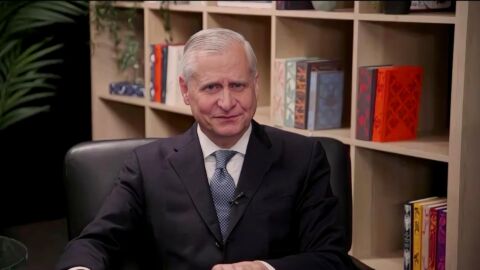
A federal judge ruled an exhibit featuring people enslaved by Washington must be restored to its original place after the Trump admin had it removed. Renowned historian Jon Meacham argues that the move was part of a campaign to sanitize America’s history. Meacham’s new book, “American Struggle,” looks at critical moments in history in which disagreements over the direction of US were in focus.
WATCH FULL EPISODE