
Read Full Transcript EXPAND
CHRISTIANE AMANPOUR, CHIEF INTERNATIONAL ANCHOR: Hello everyone and welcome to “Amanpour and Company.” Here’s what’s coming up.
(BEGIN VIDEO CLIP)
VOLODYMYR ZELENSKYY, UKRAINIAN PRESIDENT: Leader of Russia, because he really doesn’t want to finish this war.
(END VIDEO CLIP)
AMANPOUR: And the Kremlin accuses Europe of scuttling a pro-Russia peace plan. But as predicted, nothing was achieved between Putin and Trump’s
closest envoys after marathon talks in Moscow. Former U.S. Ambassador to NATO Julianne Smith joins us.
Then —
(BEGIN VIDEO CLIP)
UNIDENTIFIED MALE: My brother is missing. Anyone who saw —
UNIDENTIFIED FEMALE: My cousin went missing yesterday in Zikim.
UNIDENTIFIED MALE: Ehab Adel Mansour, 16 years old, went missing in the Zikim area.
(END VIDEO CLIP)
AMANPOUR: — bulldozed corpses and unmarked graves. The Palestinians who went missing while trying to get aid at the Israel-Gaza border. Jeremy
Diamond investigates.
And —
(BEGIN VIDEO CLIP)
EHUD OLMERT, FORMER ISRAELI PRIME MINISTER: There are atrocities committed every day by Jews, which is shameful and unbearable and, as I said,
unforgivable.
(END VIDEO CLIP)
AMANPOUR: — settler violence on the rise again in the West Bank. Former Israeli Prime Minister Ehud Olmert joins me to share a stark warning.
Plus —
(BEGIN VIDEO CLIP)
SEN. BILL CASSIDY (R-LA): My life has been dedicated to making sure that all Americans have access to adequate health care.
(END VIDEO CLIP)
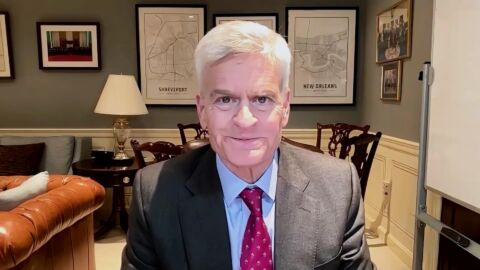
AMANPOUR: — health care under attack in America. Republican senator and qualified doctor Bill Cassidy talks to Walter Isaacson about the threat to
crucial benefits and his proposal to save them.
Welcome to the program, everyone. I’m Christiane Amanpour in London.
High stakes, low results in Moscow, despite at least five hours of talks between the Russian President Vladimir Putin and the United States,
represented by President Trump’s most trusted negotiators, his special envoy Steve Witkoff and his own son-in-law, Jared Kushner. They failed to
reach an agreement for ending the war in Ukraine.
The Kremlin says the work will continue, but key sticking points remain, with Kyiv rejecting Moscow’s maximalist demands to cede territory in
eastern Ukraine that Russia hasn’t even conquered and to severely limit Ukraine’s sovereignty. Both President Zelenskyy and NATO officials say that
Putin shows no sign of making, quote, “meaningful concessions to end the war.”
NATO foreign ministers met today in Brussels, but for the first time since 1999, the United States Secretary of State did not attend, a sign of the
widening gap between America and Europe, perhaps. Julianne Smith was ambassador to NATO under President Biden, including, of course, during
Russia’s full-scale invasion of Ukraine in 2022. And she’s joining me now from Washington, D.C. Ambassador Smith, welcome back to our program.
JULIANNE SMITH, FORMER U.S. AMBASSADOR TO NATO: Thank you.
AMANPOUR: So, can I just start with asking you the today story, and that is that the secretary of state didn’t turn up to this NATO meeting. A, what
do you make of that, and how important was this NATO meeting?
SMITH: Well, look, NATO foreign ministers come together about twice a year for these very high-level and important meetings, and essentially for
almost four years. The chief topic at these meetings when foreign ministers gather has been Ukraine, and no doubt the allies were hoping today that
they would have a chance to sit down with Secretary of State Marco Rubio and get his update on where we are after the meeting in Moscow yesterday.
Rubio opted not to join the foreign ministers’ meeting. Instead, he sent his deputy. This is extraordinarily uncommon for the United States to do
so. And they were peppering him, I suspect, with a lot of questions about where things stand in light of what happened yesterday.
AMANPOUR: So, here’s from the NATO Secretary General Mark Rutte. This is a quote from his press conference after the NATO meeting. He says, “We’re
ready and willing to do what it takes to protect our 1 billion people and secure our territory.” This is after this from Russia, from Putin. Just
take a listen to this.
(BEGIN VIDEO CLIP)
VLADIMIR PUTIN, RUSSIAN PRESIDENT (through translator): We’re not planning to go to war with Europe. I have already spoken about this a hundred times.
But if Europe suddenly wants to go to war with us and starts, we’re ready right now.
(END VIDEO CLIP)
AMANPOUR: So, you know, there are two things going on here. There’s Russia versus Ukraine and then there’s Russia versus Europe. Do you believe Putin
when he says we never want to go to war with Europe, but if it happens, we’ll be ready?
SMITH: Well, I found that statement to be disturbing. It seemed to be a very thinly veiled threat that Russia is at the ready and possibly willing
to try and touch NATO territory. What we do know is that Russia has spent years, decades, trying very hard to erode allies’ commitment and faith in
NATO’s Article 5, an attack on one is an attack on all.
We’ve seen a number of sabotage events in recent years. We’ve seen incidents where drones have flown into Polish airspace. We had the incident
with Russian jets flying over Estonia. These are classic plays on the part of the Russian playbook. They are designed to divide the alliance, to chip
away at the unity that exists inside the NATO alliance, and to create uncertainty and insecurity across the entire European continent.
And so, when I hear the statement that Putin made yesterday, in some ways it’s not altogether surprising, but it should worry Europe quite a bit in
terms of how Russia is positioning itself to possibly touch or invade or intervene in NATO territory, which I hope never happens, but I don’t like
the sound of what we heard yesterday from Putin.
AMANPOUR: And today from Rutte, when he said, we’ll defend our 1 billion people, I mean, you know, it’s something to think that there’s that many
people in NATO. But nonetheless, do you think NATO has the wherewithal, and Europe particularly, to actually confront or stave off any kind of Russian
misadventure inside Europe?
SMITH: I do think the NATO alliance has what it takes to defend NATO territory against a Russian conventional intervention of some kind on NATO
territory. I do believe that cannot be done without the assistance of the United States. Europe is, as you well know, investing eye-watering sums of
resources in their own defense right now. And within the next decade, Europe is going to look entirely different in terms of the capabilities it
has to defend itself.
But right now, here at the end of 2025, the alliance is still very much a transatlantic alliance, a project where America and Europe and Canada can
come together to defend NATO territory.
And I liked what happened in the NATO summit this past summer. President Trump seemed quite confident and upbeat about the NATO alliance. But some
of what we’re seeing and hearing, for example, Marco Rubio skipping the foreign ministers meeting, do make one ask, will this administration
continue to support the alliance through and through and remain an active member of this important alliance?
AMANPOUR: So, obviously critical to that is what the administration does to make Putin understand that this war is unwinnable on the battlefield and
that there needs to be serious negotiations. So, let’s just ask for your analysis on what you saw happen in Russia.
So, sixth time, apparently, that Witkoff has traveled to Moscow to talk to Putin. They didn’t get anywhere. You can tell by the language, none from
them personally, the negotiators. Rubio himself said, you know, kind of productive, but a lot more work to be done. Russia saying similar, but
willing to keep talking.
But also, Moscow and Putin keeping Witkoff and Kushner waiting for many hours, apparently a grueling six-hour trip around the Kremlin they were
subjected to. Then another five hours of talk. What’s in — that’s obfuscation at a very high level, right? That’s playing power games. What
is he trying to get out of this? Putin?
SMITH: Well, Putin is playing for time, and we have seen many instances throughout the past, say, nine, 10 months where Putin makes some very small
gestures towards moving towards peace. But at the end of the day, we don’t see evidence that he’s really ready to make any concessions. So, in my
book, what we saw yesterday in Moscow was just another chapter where Putin smiles for the cameras.
He says a few sentences that one could interpret as encouraging. But then what you hear is the bottom line. And the bottom line is that Russia is
nowhere closer to reaching some sort of agreement. Russia is not prepared to make real concessions. And the middle ground that we really need between
Ukraine and Russia right now seems further away than ever before.
So, I was discouraged by what happened. I would also like to see other members of the Trump administration engage Russia directly. While Jared
Kushner and Steve Witkoff are capable in their own right, I don’t think they have the depth of experience to fully appreciate how President Putin
plans out these meetings, how he executes these meetings and he looks for ways to manipulate his friends across the table. And so, I’d like to see
someone sitting at that table that has years of experience, preferably decades, in dealing with Putin and the folks around him.
This is serious business. And you need people who are familiar with the classic Russian plays, like leaving people to wait for many hours at the
table.
AMANPOUR: Not to mention the Russian plays about what’s happening on the ground or not. While it can — you know, it insists that it’s doing well on
the battlefield and of course, they keep making all these claims, it’s not doing as well as it should, given how much it outnumbers Ukrainians and how
it, you know, outguns them and all the rest of it.
So, do you agree, like most, that a ceasefire is at least the very beginning of any kind of basis for peace negotiations? And Putin doesn’t
even agree to that. What do you think it’ll take to get him at least to commit to the basics, which is a ceasefire?
SMITH: I do think a ceasefire is where we have to start. That has to be central to anything moving forward. But the fact that we continue to hear
from Putin that he doesn’t have any interest in a ceasefire leads me to believe that some sort of negotiated outcome here is months and hopefully
not years away.
But what we need to see on the part of the United States right now is pressure. Pressure on Moscow. I feel that the Ukrainians have come a long
way. We’ve seen movement on their red lines and their willingness to put forward some real concrete concessions. What we haven’t seen is that type
of indication from the other side, from Moscow.
And I liked what I saw the administration do, the Trump administration do, just a couple of weeks ago, and that was to put the sanctions on Rosneft
and Lukeoil. That was an important step of applying pressure on Moscow. But there’s a lot more we could be doing. We could also deliver the Tomahawks
to Ukraine. And I believe that would help Putin focus. I think it would alter his calculus. And I think he would be willing to come to the table
with a different set of demands if he understood that the U.S. was prepared both to pressure Moscow and to continue supporting Ukraine throughout this
series of negotiations.
AMANPOUR: So, that’s a really important point you make. On the one hand, Trump did put those sanctions on, as you said, on the very important oil
organizations. But on the other hand, you know, he was going to do the Tomahawks. Zelenskyy was there. He was told, and we’ve seen that through
these leaked conversations, to talk to Trump before Zelenskyy gets there. I mean, the American negotiators suggested, apparently, according to all
these leaked transcripts with Russian aides, that Putin should talk to the boss first. And boom, no more talk of Tomahawks.
So, again, at what point does one get a sort of a unified American position and a unified American-European position?
SMITH: This has been the challenge since January of this year when the Trump administration came into office. It has been very difficult to
determine what the actual position of the administration is when it comes to Ukraine. There have been times when it appears that the president has
been deeply frustrated with President Putin, and he seemed ready at a number of moments throughout the last 10 months to turn the screws on
Moscow and really push Putin to the negotiating table, pushing him to be more flexible.
Other times, he has called Ukraine not the victim, but the aggressor. And he has taken various positions that has made it appear that he does not, in
fact, support Ukraine in this moment, as it defends its territory against Russian-provoked aggression.
So, navigating this has been not only difficult for our friends in Ukraine and no doubt the Russians have a few questions themselves, but what has
been equally challenging has been our European allies trying to navigate the ups and downs of the U.S. position. They are frustrated.
AMANPOUR: So, you were, as I said, NATO ambassador for the United States during the Biden administration and in 2022 during Russia’s full-scale
invasion. Obviously, Biden rallied NATO, sent weapons and things, but you know that there’s plenty of complaints that it didn’t happen soon enough.
And the big, strong weapons that they needed weren’t, you know, there soon enough. And there were moments when Ukraine was on the front foot and
perhaps could have pushed Russia back or forced them to the negotiating table.
Do you have any reflections on your period there and maybe opportunities missed and lost at that time?
SMITH: I’m very proud of the record that the Biden administration has in supporting Ukraine and grateful to the president and those around him that
were able to rally over 50 countries to come to the support of Ukraine. I think our position was not cloudy throughout those three years. It was
crystal clear and allies knew what to expect of us and Ukraine knew that they could rely on the United States.
Of course, in hindsight, there are moments where we all look back and we question whether or not on a particular month, some capability could have
been delivered faster. I think all of us that served in the Biden administration are willing to sit with some of the choices we made. But
again, at the end of the day, I think we’re very proud of the way in which we were able to support a country in crisis. And we all want to see an end
to this war. We just wish the current administration would apply the necessary pressure on Moscow to get it done.
AMANPOUR: Ambassador Julianne Smith, thank you very much for being with us.
We turn now to Gaza, where a few months into the ceasefire, Palestinians are returning home, trying to restart their lives amid the
rubble and the ruins of war. And families are searching for loved ones who went missing while they were desperately trying to receive food aid at the
height of the war.
Now, a new investigation based on video analysis, satellite imagery and Israeli whistleblower accounts points to the Israeli military bulldozing
some of the bodies of some of the Palestinians near a crossing in northern Gaza. IDF sources also indicate a broader pattern of their soldiers
mishandling bodies in ways that could amount to war crimes. Correspondent Jeremy Diamond has this investigation.
(BEGIN VIDEOTAPE)
UNIDENTIFIED MALE: My brother is missing. Anyone who saw —
UNIDENTIFIED FEMALE: My cousin went missing yesterday in Zikim.
UNIDENTIFIED MALE: Ehab Adel Mansour, 16 years old, went missing in the Zikim area.
UNIDENTIFIED FEMALE: My son went missing while going to the aid area in Zikim on Sunday.
JEREMY DIAMOND, JERUSALEM CORRESPONDENT (voice-over): Messages from desperate families all searching for loved ones who went out to seek aid
and never came back. Twenty-three-year-old Ammar Wadi was one of them last seen in June going to the Zikim Crossing in northern Gaza, where United
Nations food trucks entered. His mother is still desperate for answers.
NAWAL MUSIEH, AMMAR WADI’S MOTHER (through translator): I just want peace of mind, to know what his fate is. Even if he is a martyr, praise be to
God. I just want to know what happened to him.
DIAMOND (voice-over): Wadi’s fate is still unknown, but a CNN investigation based on video, satellite imagery and eyewitness accounts
points to the Israeli military bulldozing the bodies of some of those killed near the Zikim Crossing. IDF whistleblowers who spoke to CNN also
point to a broader pattern of the Israeli military mishandling bodies in ways that could amount to war crimes.
Collecting humanitarian aid became a deadly reality in Gaza over the summer before the ceasefire took effect.
UNIDENTIFIED MALE (through translator): They killed him on the spot.
DIAMOND (voice-over): More than 2,000 Palestinians were killed by Israeli fire while trying to get aid, according to the World Health Organization.
The Israeli military has acknowledged firing toward these crowds, but said it does not intentionally fire at civilians.
Hundreds, some dead, others still clinging on to life, were hauled away amid the mayhem, including here, near the Zikim Crossing. But amid the
clattering of gunfire, others were left behind.
UNIDENTIFIED MALE (through translator): Gunfire, death, killing, martyrs, so many martyrs.
DIAMOND (voice-over): Six aid truck drivers told CNN they saw dozens of bodies near the Zikim Crossing. One shared these photos, showing partially
buried remains, surrounded by aid boxes. Some said they witnessed Israeli military bulldozers burying bodies. They’ve asked us to conceal their
identities, fearing retribution from Israeli authorities.
There are bodies everywhere, decomposed skeletal remains, one truck driver told CNN. Some are covered with dirt because the army cannot tolerate the
smell of decomposing bodies, said another. I watched Israeli bulldozers bury the dead, said a third.
This video appears to show the aftermath of Israel’s bulldozing, alongside a crushed, overturned truck, partially covered bodies of several
Palestinians jut out from the earth. A paramedic at the scene said rescue workers managed to haul away 15 dead Palestinians. With the ambulance full,
some bodies had to be left behind.
CNN geolocated the video to this location near the Zikim Crossing. You can see the overturned truck here, alongside bulldozed roads and track marks
left by heavy machinery or armored vehicles. These are the roads where crowds of starving Palestinians swarmed aid trucks on a near daily basis,
where they were fired upon and at times killed by Israeli gunfire.
We geolocated multiple videos of people being shot and killed to these bulldozed areas. The same areas where Palestinians said some bodies were
left behind in the chaos. On August 9th, 31 hours after crowds are seen here, evidence of fresh bulldozing appears in the exact same location. This
video shows just how close Israeli forces, including this D9 bulldozer, were to those crowds.
The soldiers came in front of us, eyes to eyes, and the quadcopter was 10 meters away from us. They were shot in front of us, and there is a martyr
that stayed over there, and no one could get close to him. We begged the soldiers to carry him back, but they didn’t allow us.
We provided the Israeli military with GPS coordinates for the locations where bodies were likely bulldozed and a detailed list of questions. The
military said bulldozers positioned in the Zikim area are, quote, “used for operational purposes, to deal with IED threats and for routine engineering
needs.” It denied they were used to remove bodies, but did not address questions about burying them.
The military also declined to describe its protocol for dealing with bodies in Gaza. The Israeli military’s apparent improper disposal of bodies of
Palestinians stretched far beyond Zikim.
We spoke with two Israeli soldiers on condition of anonymity due to fears of retribution. Both described bodies of Palestinians being buried in
shallow, unmarked graves in different parts of Gaza.
UNIDENTIFIED MALE: Essentially, the idea was to shove the body with a bunch of dirt, clearing the road, and push it to the sides.
DIAMOND: And that was it?
UNIDENTIFIED MALE: That was it, yes.
DIAMOND: The grave was not marked?
UNIDENTIFIED MALE: No.
DIAMOND: There was no identification process or notification process to any international or Palestinian organization?
UNIDENTIFIED MALE: Not that I was aware of. Not in my unit. So, essentially, we were never given any protocol or any order of how to handle
any bodies. There was never once that anyone told us, if you have a body, this is what should be done.
DIAMOND (voice-over): By allowing the dead to become the missing, international law experts say bulldozing bodies into unmarked graves can
violate international law. If those bodies are mutilated or desecrated, the practice can rise to the level of outrages upon personal dignity, a war
crime under the Geneva Conventions.
As for Ammar Wadi, about a month after he went missing in late June, his phone was returned to his family. A message had been left on the home
screen. Forgive me, mom, if anything happens to me. Whoever finds my phone, please tell my family that I love them so much. A message that reads like a
young man’s final words. Words that are impossible for a mother to accept without a body to bury.
(END VIDEOTAPE)
AMANPOUR: And thanks to Jeremy Diamond for that investigative report. He has also reported gross violations over in the occupied West Bank, where
Israeli settler violence has reached record levels. More than a thousand Palestinians have been killed by them and the security forces in the last
two years. That is according to the U.N.
One of the latest shocking incidents was caught on camera. This footage shows IDF soldiers shooting and killing two people in Jenin who appear to
be surrendering. Now, Palestinian Islamic Jihad say those dead men were fighters who had been engaging fire with Israeli soldiers and called the
IDF action a field execution. Israel’s far-right national security minister, Itamar Ben-Gvir, responded by praising the soldiers and promoting
the unit commander.
Last week, as this video emerged, I spoke with Israel’s former prime minister, Ehud Olmert, who’s sounding the alarm about Israel’s conduct in
the West Bank.
(BEGIN VIDEOTAPE)
EHUD OLMERT, FORMER ISRAELI PRIME MINISTER: I think it has to be checked and I hope it will be checked and examined in a proper manner by the
Israeli army. And that if it will be verified, then I hope that the necessary measures will be taken and those responsible for it will be
court-martialed. And it’s certainly something that needs to be examined carefully.
As for the crackdown, there certainly is some terror coming occasionally in the West Bank. And it has to be taken care of in the most effective manner.
And I hope that the Israeli authorities are doing what needs to be done in order to prevent the terror of Palestinians. I’m not certain they are doing
the same in order to prevent the Jewish terror, which is perpetrated on a daily basis by Israeli settlers in the West Bank. And this is something
which becomes massive and ugly and outrageous and totally unacceptable, intolerable and unforgivable.
On a daily basis, there are settlers that are cracking down on non-involved people, innocent Palestinians. Worst, they are burning their homes and
threatening their lives and burning their olive groves, which in my mind shows that these guys have no really any attitude, any real genuine
attitude towards the land and what grows on the land. Those who can burn the olive groves of Palestinians can burn everything.
And unfortunately, it is done with the tacit cooperation and non- involvement of the Israeli police and a gross indifference by the Israeli military in the area. And this is time to stop it. And I’m afraid that the
day will come that Israel will be brought to the international court — criminal court in The Hague, not because of Gaza, where there is no
genocide and there was no genocide in my judgment, but what is taking place in the West Bank, an area entirely under the control of the State of Israel
and where there are atrocities committed every day by Jews, which is shameful and unbearable and, as I said, unforgivable.
AMANPOUR: You know, Prime Minister, this is incredibly strong stuff to hear from an Israeli, from a Jew, from the former prime minister about the
status of your armed forces, as you say, the tacit approval of the government and the like. You say it has to be stopped immediately. I’m
going to read this to you because the police minister, Itamar Ben-Gvir, who’s known to be very far-right, the national security minister, has
posted in regards to the original video I told you about.
He’s posted on X in Hebrew, quote, “Giving full backing to the border guard fighters and IDF soldiers who fired at wanted terrorists who emerged from a
building in Jenin. The fighters acted exactly as expected of them. Terrorists must die.”
So, just what is your response to that? Because, you know, I mean, the state is backing this and obviously this is still under investigation and
we can’t make a conclusion. But the IDF says that it’s investigating it. And you say these kinds of things must stop.
But when a minister posts this and gives full backing, what does that tell you about the general about the general lay of the land?
OLMERT: This minister, minister of national security, as you know very well, I’m sure, Christine, was convicted in court several times for being
involved in terror, Jewish terror against Palestinians. So, he’s the last person on earth that can testify or can observe the atrocities that are
committed by Jews in the territories.
Now, I’m not — as I said before, I’m not familiar with the specifics of this event and I don’t know what happened. And I hope that the suspicions
are not valid and that there was nothing that is said is actually taking place. But I know of other events which are taking place in other parts of
the West Bank on a daily basis.
And every time the hilltop youth are attacking and burning and penetrating into the private homes of individuals that are not involved in anything and
call for the killing of them. There is not any reaction by the Israeli police, the police of Mr. Ben-Gvir, the national minister of national
security. And he’s not taking the measures are not taken by the army. And it happens and it’s shameful.
And yes, as a Jew, as an Israeli and as a Jew and as a former prime minister. And I know that what I say is something that many Israelis don’t
like to hear and they criticize me and they yell at me sometimes when they see me because they say, why do you say that? And I said, I’d rather speak
up in the most explicit manner in order so that everyone in the world, everyone that watch us now and everyone that will watch you another time,
will know that there are millions of Israelis which are unhappy with this, which are against this, which are against this government, where people
like Ben-Gvir can be ministers of national security perpetrating or supporting the perpetration of things which are totally unacceptable and
unbearable. And we’ll speak up so that it will stop.
AMANPOUR: So, why do you think this is going on? What is the intention, the mission of this Israeli government? Why doesn’t it stop it? And also —
OK, I’ll ask you that question first.
OLMERT: Well, I’m not — you know, I have to say I wouldn’t accuse Prime Minister Netanyahu for wanting that this will happen. I accuse him for not
taking the necessary measures to stop it, knowing that it happens, because those who are responsible for it and those who are acquiescent with it, and
the ministers of Ben-Gvit and Smotrich and their supporters in the messianic groups in the Israeli government, I know what they want. They
hope that we will be able to somehow force out the Palestinians from the West Bank, force the Palestinians out from Gaza and take over these
territories and integrate them into the State of Israel and prepare them for resettlement of Israelis and Jews all over. This is totally
unacceptable.
The majority of the Israeli people are against it. And we are fighting day and night in the streets of Israel, rioting and demonstrating against the
Israeli government for supporting or for ignoring or for overlooking these events, entirely not taking into consideration the massive downfall of the
status of the State of Israel, the perception of the State of Israel as a humanistic country against everything that we were perceived to be in the
past.
AMANPOUR: You know, I obviously hear your anger and I hear you wanting to stand up and be counted and you’re speaking your conscience. And it’s very
interesting to hear from you. You did say that you did not believe Israel would be taken to The Hague, the war crimes tribunal for Gaza, and you
don’t go there on the genocide issue, but you have said that you believe the government has condoned or enabled war crimes in Gaza.
So, I want to ask you about the next phase in Gaza. Do you think there is a good faith effort to actually move on to the second phase of what was, you
know, delineated in the 20-point plan? Because the first phase, the ceasefire and the exchange of hostages and prisoners and bodies is about to
be over. And we hear from Cairo and ongoing talks there about what’s next, that they’ve completely stalled, that Hamas won’t demilitarize because —
and Israel won’t withdraw. According to the plan, it still occupies about half of Gaza. What is the hope for Gaza now?
OLMERT: Israel is not going to pull out from Gaza if Hamas will not be disarmed and Hamas will not be disarmed all entirely if Israel will not
pull out from Gaza. And the truth is that none of these sides, not the Israeli side, not the Palestinian side, in this particular instance and on
this particular issue, are ready to move on forward in the direction of what President Trump has articulated in the 20-point plan. The only
possible solution is the enforcement by President Trump.
And I must tell you something, Christiane, you know, I’m not certain that I know what President Trump has in mind. I don’t know him. I never had a
chance to share with him my thoughts and talk to him. But I take this opportunity because you are watched widely everywhere in the world. There
is an opportunity which may be missed.
At this point in life, Trump is the only person on earth that has the power to make a difference that will change the lives of tens of millions of
people and will do something dramatic that no president before him has been able to do. He has that power now because he can force the Israeli prime
minister to do that which he doesn’t want to do. And he can force him to carry on the full implementation of the 20 points. And he has the power to
use the moderators, the Turks and the Qataris and the Egyptians, to force Hamas to disarm, which is essential. And then he has the power to force the
two sides, the Palestinian side and the Israeli side, to start a dialogue for a two-state solution.
AMANPOUR: Thank you very much, Former Prime Minister. And I just have to say we still hope —
OLMERT: Thank you, Christiane. Thank you.
AMANPOUR: — to get members of the current government on our program to talk about all these issues.
(END VIDEOTAPE)
AMANPOUR: Well, a sign that the current government is not really ready for a proper peace plan, that it’s as far away as ever. Today, the Israeli
prime minister, Benjamin Netanyahu, boycotted a Knesset vote endorsing President Trump’s 20-point plan for Gaza. Netanyahu’s far-right allies
reject any mention of a two-state solution. The opposition leader, Yair Lapid, says he was disappointed about the no-show as it was a chance for,
quote, “uniting around a common goal.”
Coming up, in the United States it’s crunch time for Congress on health care, with insurance costs set to rise for millions of people. Our next
guest believes he has a solution.
Next, to U.S. health care, where Congress will decide on proposed plans next week to save Obamacare tax credits, which are due to
expire in less than 30 days. Without it, tens of millions of Americans could see their premiums increase by an average of 114 percent.
Republican Senator Bill Cassidy was a local doctor who believes he might have a solution, as he explains now to Walter Isaacson. And he also
addresses controversial medical moves by RFK Jr., the health secretary that Cassidy voted to confirm.
(BEGIN VIDEOTAPE)
WALTER ISAACSON, HOST.: Thank you, Christiane. And Senator Bill Cassidy, welcome back to the show.
SEN. BILL CASSIDY (R-LA): Hey, very nice to be with you. Thank you for having me, Walter.
ISAACSON: You know, before you were a senator, before you got into public life, you were a doctor, and one of the things you did as a doctor is you
had a career in public hospitals, where you were serving patients who were uninsured and were poor. Tell me what drew you to that.
CASSIDY: Yes. So, I did my residency and fellowship at Los Angeles County Hospital, I think at the time the largest hospital in the United States,
and I really enjoyed the patient population. I enjoyed teaching, and I also enjoyed being involved with the research thing.
So, I came back to Louisiana with my wife. She was at the time practicing trauma surgery. We both started with LSU, and I worked in the public
hospital in Baton Rouge, again, taking care of the uninsured and poorly insured, teaching medical students, and doing clinical research. Incredibly
rewarding career, which I’m very thankful for the State of Louisiana for giving me the opportunity to do.
ISAACSON: And when you talk about the uninsured, you know, we’re having this big issue now. How does that inform the fact that you want to make
sure that there are extensions of some sort for health care benefits that we’re facing that vote on soon?
CASSIDY: So, my life has been dedicated to making sure that all Americans have access to adequate health care. Now, by the way, that sometimes puts
me at odds with people who think just because you make insurance cheaper, it actually works for the patient. My experience as a physician is that if
somebody has a $6,000 deductible, it can be as if they do not have insurance at all.
The premium may be cheaper. If they get in a car wreck, they’re protected from financial ruin. But they don’t have $5,000 in their account to pay for
health care. So, my whole approach to health care has been very much informed by those patients whom I saw long ago and who would tell me, Doc,
I can’t afford that. I got a deductible. My insurance won’t cover it. How do we make it work for them? That’s a critical question.
ISAACSON: And so, tell me what your plan that you’re trying to get both Democrats and Republicans as a plan, how that would put money to help
people pay their deductibles. And a lot of people, including the Kaiser Family Foundation, say it could actually hurt poor people.
CASSIDY: Yes. So, Kaiser Family Foundation is not familiar with the details of my plan. I just know that from their comments. And let’s put
this in context. We’re speaking about the patients or the people, our fellow Americans who are on the Obamacare exchanges. And it’s about 6
percent of the population. There has been a rapid increase in the cost of health care and of health care premiums, health insurance premiums, rapid
increase.
So, the original Obamacare had an advanced premium tax credit, which helped everybody below 400 percent of federal poverty. Costs were exploding so
much. Under the Biden administration, they added something called the enhanced premium tax credit, benefiting those over 400 percent of federal
poverty. So, that’s the context. And I’m sorry for the technical detail.
By the way, Kaiser Family Foundation thought I was speaking of both the advanced premium, the baseline premium tax credits, and the enhanced. I am
not. I’m only speaking about the enhanced premium tax credits. What if we did this? Instead of giving that money, 100 percent of it to insurance
companies, who take 20 percent of whatever we give them as overhead and profit, 20 percent of the $26 billion we would spend next year given to
insurance companies, 20 percent of that is used for overhead and profit.
What instead, if we said, OK, we’re going to take that same money, we’re going to make sure that no one spends more than pick a number, 8.5, 9.5
percent of their income on health insurance premiums that only affects certain older people, basically, 50s and their 60s, it only affects them,
but we’re going to instead give 100 percent of that money to the patient in the form of a health savings account? The patient would then choose a lower
bronze premium as a cheaper policy. So, they’re spending less on premiums than they would under the typical Obamacare policy.
But they’re also getting money into a health savings account for first dollar coverage of their deductible. Their deductible on net could be lower
than the policy they’re currently getting. And not only that, they have first dollar coverage. What does that mean? Practically, my daughter
sprained her ankle. I bring her to an urgent care center. Instead of a $5,000 deductible, I have to spend $5,000 before my insurance pays. They
have $2,000 in their health savings account, and they pay for the visit out of that $2,000, not out of their pocket. That’s a sweet spot. Cheaper
premiums, lower deductibles, and first dollar coverage. That’s the plan I am proposing, Walter.
ISAACSON: If this doesn’t come to pass, there’s going to be an up or down vote that Senator John Thune said he would have in the Senate on extending
the Obamacare and Biden-enhanced subsidies. If your plan doesn’t go through, would you vote for that?
CASSIDY: No. Why? It still leaves the patient with a $6,000 deductible. It is more about profit for the insurance company than it is about power to
the patient. The ability to give the patient the ability to afford the healthcare that they need, as opposed to if I get in a car wreck, that’s
important, but what about your daughter’s sprained ankle?
And so, I’m working so that we don’t have an up and down vote on a Democratic plan and an up and down vote on a Republican plan and both fail,
rather that we have an American plan that we can all vote for and pass and turn into law.
By the way, you probably won’t. You rarely lose money betting against the ability of Congress to get something done, but this is so important. I’m
hoping that people can put aside their kind of, I’m not going to work with President Trump because it’s President Trump or whatever, and say, wait a
second, this fits the need. It balances lower premiums, first dollar coverage, lower deductibles. This is the way we should go, irrespective of
who actually is proposing the plan.
ISAACSON: What would happen to our state in Louisiana, people there, if none of these passes and the extension doesn’t pass?
CASSIDY: Yes. So, there’s going to be a subset of people in Louisiana, but across the nation, who don’t do as well. And that’s why I’m so committed to
actually making it work. By the way, I’ll point out once more, my experience practicing in Louisiana, but I could say in California because I
did long ago, is that when you give somebody who has a deductible of $6,000, that policy doesn’t really work for them.
Most people don’t have $6,000 in their back pocket to pay for that deductible. So, if we can give them a policy which lowers the premium,
lowers the net deductible, and gives them first dollar coverage to pay for that sprained ankle that their child has, that does work for them. And I
say again, that is an American plan, giving power to the patient, not profit to the insurance company.
ISAACSON: When you were here in Louisiana and practicing, you ended up developing a public-private partnership to vaccinate, I think it was 36,000
Baton Rouge area children against hepatitis B, no cost to the parents and all. I think the CDC Advisory Committee, the Vaccine Advisory Committee is
expected to vote on whether to undo all of that. What would you do if that happens, and how can you make sure that Secretary Robert F. Kennedy Jr.
doesn’t push that through?
CASSIDY: So, the real vote will be not on adolescent immunization, but on whether to recommend a birth dose of hepatitis B. Now, I’m strongly in
favor of that. It’s not a mandate, but it is a recommendation to the mother that the child be vaccinated upon birth.
Now, folks say, why? Because the common criticism is that it’s sexually transmitted. And so, why would you give a vaccine to a child for a sexually
transmitted disease? Why? Because when the child passes through the birth canal, that child is exposed to the same secretions as if it were
intercourse. And if the mother turns out to be hepatitis B positive, that child, if infected through those secretions, has a 95 percent chance of
becoming chronically or permanently infected with hepatitis B. Instead, if you give that child a birth dose of hepatitis B vaccine, not a mandate, a
recommendation, then that child has a 95 percent chance of not becoming chronically hepatitis B infected.
By the way, since this policy has begun, the number of children who’ve acquired hepatitis B at either birth or shortly after birth has decreased
from $20,000 a year to 200 a year. So, how remarkable, all because of a recommendation. And folks say, wait a second, we should know what the
mother’s hepatitis B status is. If you do, that’s fine. But it turns out sometimes it’s just missed.
The regular OB is not there. The mama is out of town and goes to a different hospital who doesn’t have access to the records, or she just
shows up and has not had prenatal care. That happens in a country as big as ours. This is a way to, as much as possible, make sure that when that child
is born, that that child, if exposed to hepatitis B, is not chronically infected.
ISAACSON: When you voted to confirm Robert F. Kennedy Jr., rather reluctantly, I think you were tentative there, you extracted a few
promises, including the fact that they would keep a recommendation on the CDC website saying that vaccines do not cause autism.
(BEGIN VIDEO CLIP)
CASSIDY: It confirmed he will maintain the Centers for Disease Control and Prevention’s Advisory Committee on Immunization Practices recommendations
without changes. CDC will not remove statements on their website pointing out that vaccines do not cause autism.
(END VIDEO CLIP)
ISAACSON: Well, he’s backtracked on that. What do you think of that and how can you hold him accountable?
CASSIDY: As a physician, of course, I know this is wrong, that there has been lots of information out there to show that this is not the case. If
you’re suing drug companies, I can see why you want this out there. But if you’re trying to reassure a mother whose child has autism and now may blame
herself because her child was vaccinated, and you’re blaming yourself, why put that guilt trip on a mom when that has nothing to do with it?
By the way, it also distracts attention from going after real causes, which appears to be a complex mixture of a child’s genetic predisposition, the
age of the parents, environmental stressors, all that as a kind of complex mixture. That’s where we should be focused on.
To distract on the falsity, the falsehood that immunizations have a role or even to imply is a terrible injustice. That said, the only parents I know
who read CDC websites on immunizations are probably pediatricians who happen to also be moms. So, it’s not commonly read.
I strongly encourage mommies and daddies to talk to the child’s pediatrician, to have somebody who’s learned it, who’s gone to medical
school, reviewed the information to actually review it with you so that you can be reassured that the benefits of preventing diseases by having your
child vaccinated are incredible, and the risk of autism is absolutely nothing.
ISAACSON: Well, wait. If it’s on the CDC website, that does have an impact, doesn’t it?
CASSIDY: I’m not denying that. I’m not denying that at all.
ISAACSON: Didn’t you make sure that they weren’t going to do that? Have you talked to Secretary Kennedy about going back on that promise?
CASSIDY: We’ve spoken in a very strenuous conversation. I’ll leave it at that. Now, they’re telling me I have to go to my next function, and I don’t
mean that, but I just have to go. Yes.
ISAACSON: All right. Let me ask you one more general question, which you may want to answer. You’ve been able to reach across the aisle, Senator
Bernie Sanders at one point, Senator Tim Kaine at another, about things, including on vaccines. Do you think it’s possible to restore that ability
to work across aisles, especially on the healthcare coverage issue?
CASSIDY: Yes. I wouldn’t work at this if I didn’t think it was possible, because this will not pass unless it has both Republicans and Democrats
voting for it. And when I ask people, put aside your prejudice, don’t be a Democrat, don’t be a Republican, be first an American. Think about that
couple. Who cares what their political party is who is actually struggling to make their ends meet and they need to have that health insurance. They
need to have that healthcare. They don’t — they can’t handle a $6,000 deductible. If we can do better for that family with the same amount of
money or less, why don’t we do it?
And I say that probably more as a doctor, certainly more as an American than anything else. And that’s, I think, the approach that we should all
take, Americans first.
ISAACSON: Senator Bill Cassidy, thank you so much for joining us.
CASSIDY: Thank you, Walter.
(END VIDEOTAPE)
AMANPOUR: And finally, as efforts to end the Russian war on Ukraine stall, let’s recall the biggest act of peace in 100 years. 36 years ago today, the
presidents of the United States, George H.W. Bush and Mikhail Gorbachev of the Soviet Union declared an end to the Cold War after a two-day summit in
Malta. As the pair announced the pullback of troops and weapons in Europe, it set the stage for a new future, with Bush confidently saying, We can
realize a lasting peace and transform the East-West relationship to one of enduring cooperation. Much later, I spoke to Gorbachev himself about the
critical part he had played.
AMANPOUR: To many people around the world, you are a hero, a once-in-a- generation actor who ended the Cold War. How would you like your people to remember you?
MIKHAIL GORBACHEV, FORMER RUSSIAN PRESIDENT (through translator): History is a fickle lady, and you can expect surprises from history. But I do know
that I did what I did and that I can be proud of what I did.
(END VIDEO CLIP)
AMANPOUR: Gorbachev was right about history, as all that hope of cooperation and enduring peace is obviously under serious threat from a
revanchist Russia today.
That is it for now. If you ever miss our show, you can find the latest episode shortly after it airs on our podcast. And remember, you can always
catch us online, on our website, and all-over social media.
Thank you for watching, and goodbye from London.