
Read Full Transcript EXPAND
BIANNA GOLODRYGA, ANCHOR: Hello, everyone, and welcome to “Amanpour and Company.” Here’s what’s coming up.
Trump’s tariffs face the Supreme Court as the world braces for impact. The director general of the World Trade Organization speaks to Christiane about
navigating these turbulent times.
Then, a record nearly 60,000 runners took part in New York City’s marathon, including elite runner and the Atlantic CEO, Nicholas Thompson. I ask about
his passion and his new book, “The Running Ground.”
Also, ahead —
(BEGIN VIDEO CLIP)
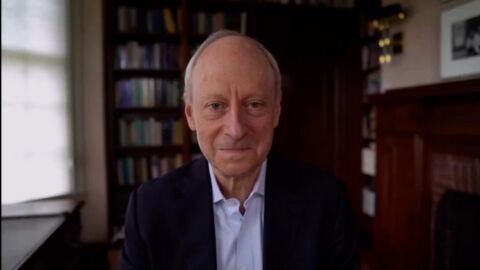
MICHAEL SANDEL, PROFESSOR, HARVARD UNIVERSITY AND WINNER, BERGGRUEN PRIZE FOR PHILOSOPHY AND CULTURE: He’s been able to exploit the grievances of
working people who feel elites look down, and he goes after those elites.
(END VIDEO CLIP)
GOLODRYGA: — how Trump won over the working class. Award-winning Harvard professor Michael Sandel speaks to Michel Martin about the deepening divide
swaying blue-collar support for MAGA.
Welcome to the program, everyone. I’m Bianna Golodryga in New York, sitting in for Christiane Amanpour.
We begin with Donald Trump’s tariff war, which lands in court this week, facing its biggest challenge yet. The Supreme Court will hear arguments
challenging the legality of many of his administration’s tariffs, a move that could upend his entire trade agenda and also decide the limits of a
president’s power.
Relying on a 1970s-era emergency law, Trump has pushed import tax rates as high as 50 percent on key trading partners, including India and Brazil, and
as high as 145 percent on China earlier this year. At stake are almost $90 billion in revenue that the administration has already collected and
potentially trillions more.
Trump has been warning that ruling against him would endanger national security and create what he calls a financial mess.
(BEGIN VIDEO CLIP)
DONALD TRUMP, U.S. PRESIDENT: I will tell you, that’s one of the most important cases in the history of our country, because if we don’t win that
case, we will be a weakened, troubled financial mess for many, many years to come.
(END VIDEO CLIP)
GOLODRYGA: The World Trade Organization is paying very close attention to this legal challenge, and Christiane sat down with its Director General
Ngozi Okonjo-Iweala in London at a summit focusing on Africa.
(BEGIN VIDEOTAPE)
CHRISTIANE AMANPOUR, CHIEF INTERNATIONAL ANCHOR: Thank you, Dr. Ngozi, for being here. I’m delighted to be taking part in this event. The first
thing, as a former Nigerian government official, President Trump this weekend announced that he will intervene militarily in Nigeria if the
government doesn’t stop the anti-Christian attacks. What is your reaction?
NGOZI OKONJO-IWEALA, DIRECTOR-GENERAL, WORLD TRADE ORGANIZATION: Well, you can see that the audience is with me, because this is an incredibly complex
question. Let me say this. Nigeria is a very complex country. 220 million people, 374 different ethnic groups and as many languages, two religions,
and the situation is very difficult and needs careful thought. It has religious issues involved in it, it has resource issues involved in it, it
has different complexities. So, I just think we need careful thinking through.
AMANPOUR: I just wonder, this administration, the Trump administration, has to go to the Supreme Court in the United States this week to defend its
tariff program, because as most people know, tariffs are a prerogative of Congress, instead of just unilateral decisions by the executive. Do you
have an expectation, do you have a desire to see a result from the Supreme Court that will put it back in the hands of Congress?
OKONJO-IWEALA: Well, let me put it this way. At the World Trade Organization, we focus on the multilateral aspects of the trade. And whilst
I always say, and people have heard me say this, that whilst you may not agree with the unilateral actions of the U.S., I agree with a lot of the
criticisms that they’ve made of the organization and the World Trade insist them.
And I actually, you know, want to say that the system has to take this, this crisis, as an opportunity to reform. And that’s the way that I think
we should go. We should not waste time, but look at what works within the system, what doesn’t work, and how do we change that. We should use this as
the chance to reform the organization and the trading system.
AMANPOUR: So, you say you agree with some of the criticisms of the practices of the World Trade Organization and the global trading system.
Can you just tell U.S., I mean, you’re an expert, but for those of us who aren’t, what are the big issues that you think need reform?
OKONJO-IWEALA: First is the way we make decisions. We are a consensus decision-making organization, which is great. True consensus, meaning the
voice of the smallest is as important as the voice of the largest. But we practice this as unanimity, meaning all 166 members have to agree to any
decision. And you can imagine how difficult that is, Christiane. And so, sometimes it does result in paralysis, and you can’t make decisions on some
of the key things. So, I think we need to find a way to make consensus. We should keep it, but make it more efficient in terms of the way we take
decisions.
Another is that many members feel that there’s less transparency in the system now, and they also talk about unfair trading practices. The fact
that barriers to trade are going up more, not down, and level playing field, use of subsidies, industrial policy to try to industrialize and
protect manufacturing. Guess what, Christiane? There are exciting things happening in trade, believe it or not. We’ve got digital trade and
digitally delivered services trade growing at 8 percent per year. We’ve got green trade growing almost $2 trillion worth of green trade.
You know, there’s some services trade is growing twice as fast as goods trade. There’s so many exciting things happening that if we reform
ourselves, we can take opportunity of those new things happening and serve people.
The organization’s purpose, as written in its founding documents, is to help enhance living standards, help create jobs, and support sustainable
development. It’s all about people, and that’s what I want us to focus on.
AMANPOUR: The most recent big group of people who could affect trade just happened last week in South Korea, Busan. President Trump met not just with
his own allies and partners, but also with President Xi Jinping of China.
I spoke to one of President Trump’s previous 1.0 national security officials and expert on China, Matt Pottinger, and he said at best the
agreement that came out was a fragile truce, that at best it was almost like status quo ante. Both of them backed off a little bit of the hardline
tactics that they had employed. How do you see the result of what came of their meeting and their, you know, slightly backing off some of the hardest
line policies that they had?
OKONJO-IWEALA: I see it very positively, and we see it positively at the WTO. If you think back to the beginning of the escalation, when the tariffs
came in in April, I think I was one of the first to say that we would like China and the U.S. to de-escalate, because any escalation and breakup or
decoupling of the two economies, it’s not just China and the U.S., but others. And my members, many of them smaller economies, they are caught
between, and they don’t want to be in a position where they are trying to be made to go on one side or the other.
Secondly, decoupling of this and formation of two trading, separate trading groups, i.e., fragmentation of the trading system, will result in losses to
global GDP in the longer-term. Actually, we’ve modeled it, 7 percent global GDP losses in the longer-term. This is not good, and for developing
countries, it will be double-digit losses.
So, we are very happy about the de-escalation. I think even if people feel it’s fragile and temporary, it gives time for more dialogue and coming to
terms with each other’s difficulties and needs.
AMANPOUR: Trump obviously gets a lot of kudos for calling out the unfair playing field that Chinese trade often plays on. But he also, as we’ve
talked about, has imposed draconian tariffs. We’ve just talked about backing off a little bit with China. But even on allies like India, Brazil,
Europe, just all over the place, South Korea, Japan.
Using trade as a tool, what does it mean if allies, if your allies are being punished in the same way as your adversary is or your competitor is,
if you’re trying to build a fair competitive playing field against the rising superpower?
OKONJO-IWEALA: Well, you know, let me say this. Global trade and the system built over 80 years has largely delivered prosperity to all nations.
It’s lifted more than a billion people out of poverty. It’s made both rich countries and poor countries better. Not everyone benefited the way they
should. We recognize that.
And I think some problems have crept into the global trading system that should have been dealt with. That’s why I say I agree with some of the
criticisms that the Americans make. But by the way, they are not the only ones criticizing the system. Developing countries feel the system has not
worked as well for them, that they haven’t been integrated into the system, they haven’t benefited as much.
I want to use this opportunity to say to the members, to give them credit, because what is happening now, a very interesting thing. Many of them, you
know, it’s like they took the WTO for granted. It’s like your always joke is like the plumbing. And I’ll keep repeating this joke. In your house, you
don’t notice it until a pipe breaks and the water ruins your wonderful Persian carpets. And then you suddenly realize, oh, wow, the plumbing
matters.
So, the WTO has the bedrock of rules that really makes the world’s trading system work in a predictable and stable fashion. And they are coming to
realize that now and saying we really need this system and we have to work at trying to reform those things like you said.
AMANPOUR: So, that’s all great, except that trade growth is declining. Global trade growth is collapsing under this new U.S. tariff regime. WTO
now forecasts your organization that only 2.4 percent this year of growth, but just 0.5 percent next year. You’ve described this as the greatest
disruption in 80 years. But you say the system might be battered, but it’s not broken. But that’s a lot of battering.
OKONJO-IWEALA: Yes, it is a lot of battering.
AMANPOUR: And many nations see — and African nations and other nations, European, South American, wherever you look, Asian, they see their
economies at risk of a serious battering or maybe in some cases collapse. Look at Lesotho because of these just tariffs.
OKONJO-IWEALA: So, Christiane, you’re right. And I’ve said that it’s the greatest disruption in trade in 80 years. But the system, you can see the
battering by the fact that the MFN trade came down from 80 percent to 72 percent. But there’s also one thing that has come up, which I think all
nations are taking account of.
The system was built for interdependence, not over-dependence. And many nations have become too over-dependent on the U.S. for market demand and on
China for critical supplies. So, this is also a wake-up call to try to diversify your sources of demand and supply.
AMANPOUR: We know that China has made huge inroads into the economy and the resources of Africa, outpacing the United States. We know that the UAE
and that region is also doing a lot of that. Give us a health check of the African economy. I know there are many countries, but in general, as a
continent, especially — I mean, Nigeria, South Africa, the big powerhouses.
OKONJO-IWEALA: Well, I would say — I mean, the continent is forecast to grow now by the IMF at about 4 percent for this year and next year, which
is one percentage point almost above global growth. But it should really aim to do, you know, more, given the population size. But still, it’s good
to know that there’s a trend above global growth. That’s one. And the continent has a lot of resources and a lot of things going for it. But
there are also many challenges.
So, let me say one or two of the positive things first. By 2050, there will be 2.5 billion people on — in the continent. It will have 22 percent of
the working age population of the world. If this population is skilled, it could really be a resource for the continent and for the whole world. So,
that’s pretty amazing in a world in which many parts are challenged demographically, whether it’s Europe or the U.S. or China, there’s an aging
population or the U.K., you have a young population, if it is properly skilled
And I want to insist on that. You can’t just say we have people, therefore we are rich. They’ve got to be skilled. We’ve got to be up with the
technology and the A.I. and so on. We have 30 percent of the world’s mineral resources. We have 67 percent of the world’s arable land. And I
could go on and on. So, just to mention a few of the things going for the continent.
But how do we make this work for us? We have to deal with several challenges. Investing in infrastructure is certainly one of them. I think
infrastructure is getting in the way. Lack of infrastructure. Ports. Electricity is the number one.
We need to tackle the challenge of skills and education. Connectivity. We have the African continental free trade area, which is, I think, one of the
best things we have going on trade. But we’ve got to accelerate the workings of the organization because we are trading with ourselves. Only 15
percent to 20 percent of our trade is among ourselves now. Compare that to the E.U., where more than 60 percent of trade. So, we have a long way to
go.
That brings me to the Lesotho comment. I was asking, why don’t we buy this $200 million worth of textiles within the continent? If we spend $7 billion
to import some of the same kinds of textiles, why does Lesotho have to struggle? It costs 20 percent more for us to trade with each other on the
continent than with others externally. Something is wrong with that.
So, we need to bring our average costs down. If we do all of these things, we can take advantage of all these wonderful opportunities that I listed.
But I have to just add, what makes me excited about the continent? What young people are doing. Young people in fintech, they’re inventing new
things. In agri-tech, you know, we have companies that are helping farmers do better. In health tech, and the creative industries also. African music
and creativity.
And I say to myself, if we have young people who are this creative, how do we support them better? Because it shows that we really have what it takes.
And when I say I think this is an exciting continent, and I find my country very exciting in spite of the challenges, I’m not trying to run away from
challenges, Christiane, I’m not. But I’m just excited to be African and to be Nigerian, because of what I see.
AMANPOUR: Well, we went over, but it was worth it.
OKONJO-IWEALA: I’m sorry.
AMANPOUR: No, it was worth it.
OKONJO-IWEALA: I’m an Africa-operator.
AMANPOUR: Dr. Ngozi, thank you so much.
(END VIDEOTAPE)
GOLODRYGA: And now, to the death of former Vice President Dick Cheney, long regarded as one of the most powerful and controversial second-in-
commands in American history. He died at the age of 84 after a career that refined — redefined the vice presidency and shaped America’s response
after 9/11.
Chief architect of the Iraq War and a relentless advocate for expanding presidential power, Cheney’s influence still looms large over Washington.
Wolf Blitzer takes a look back at some of the key moments in his tenure.
(BEGIN VIDEOTAPE)
GEORGE W. BUSH, FORMER U.S. PRESIDENT: Gradually, I realized that the person who was best qualified to be my vice presidential nominee was
working by my side.
WOLF BLITZER, ANCHOR (voice-over): For most of his adult life, Richard Bruce Cheney was the ultimate Washington insider.
DICK CHENEY, FORMER U.S. VICE PRESIDENT: That I will well and faithfully discharge the duties of the office on which I am about to enter, the duties
of the office on which I am about to enter.
BLITZER (voice-over): Named as George Bush’s running mate in 2000, Dick Cheney quickly forged a public identity as a no-nonsense, disciplined
gatekeeper, a powerful politician to whom and through whom access and influence flowed. But his appearance at the very highest levels of
government was by no means his first time in the national spotlight.
He began his public service career in the Nixon administration, working in several White House jobs dealing with the economy. After President Nixon
resigned because of Watergate, Cheney worked for the new president, Gerald Ford, eventually becoming his chief of staff. When that 29-month presidency
ended, Cheney returned to the land he loved, to his home in Wyoming.
But it was a very short stay. Elected as the state’s only member of the House of Representatives, Cheney returned to the Capitol and served for a
decade in Congress. He was in the Republican leadership hierarchy when the first President Bush chose him to be his secretary of defense.
D. CHENEY: Faithfully discharge the duties of the office.
BLITZER (voice-over): In charge of the Pentagon, Cheney was almost instantly engaged in two of the American military’s largest and most
complicated operations since the end of the Vietnam War. First, he led the removal of Panama’s Manuel Noriega from power. And then, Operation Desert
Storm, the American and Allied response after the invasion of Kuwait by Saddam Hussein.
D. CHENEY: We have, in effect, destroyed most of the Iraqi army. We have taken out most of the infrastructure. The lights are out in Baghdad.
BLITZER (voice-over): His experience and steadfastness were of critical importance. And those traits were not unnoticed. Out of government for the
first time in years during the Clinton administration, Cheney became head of the giant oil services company Halliburton. It was a job that kept him
steeped in defense and foreign policy and a role that later became a lightning rod for his critics.
By the time his old boss’ son secured the Republican presidential nomination, Cheney’s health was a major concern. Three mild heart attacks
and a quadruple bypass before he was 50. Doctors gave him a green light, but shortly after the 2000 election, he suffered another mild heart attack.
D. CHENEY: I’ve got a doctor that follows me around 24 hours a day that comes with a job as vice president.
BLITZER (voice-over): Cheney quickly became a target for Bush administration critics, especially for convening oil and energy industry
representatives to a White House meeting and then declining to make public any contents of the sessions. And later, after the terrorist attacks on
9/11, he became at times invisible to the public. Only a few people knew where he was for much of the time.
But behind the scenes, Cheney was a driving force behind some of the biggest controversies of the Bush administration, including the second war
against Saddam Hussein’s Iraq. In 2007, I asked him about mistakes made and concerns among some Republicans that the war had damaged the Bush
administration’s credibility.
D. CHENEY: Wolf, I simply don’t accept the premise of your question. I just think it’s hogwash.
BLITZER (voice-over): Cheney’s health problems returned after he left office for a time drastically altering his appearance. Another heart attack
in 2010 prompted doctors to implant a battery-operated device to help his heart pump blood. His health seemed to stabilize after a 2012 heart
transplant at the age of 71. Cheney largely disappeared from public life until emerging at the site of the January 6th insurrection one year after
it happened.
During a moment of silence on the House floor, Cheney accompanied his daughter, Wyoming Congresswoman Liz Cheney, also a member of the select
committee that investigated the attack. He was warmly greeted by the House Speaker, Democrat Nancy Pelosi.
D. CHENEY: In our nation’s 246-year history, there has never been an individual who is a greater threat to our republic than Donald Trump.
BLITZER (voice-over): Later that year, Cheney tried to help his daughter’s struggling primary campaign after she came under fire from former President
Trump and his devoted supporters over her work on the January 6th committee.
D. CHENEY: He’s a coward. A real man wouldn’t lie to his supporters.
BLITZER (voice-over): When Trump ran for president again in 2024 against Vice President Kamala Harris, Cheney joined his daughter in endorsing the
Democratic nominee.
FMR. REP. LIZ CHENEY (R-WY): Dick Cheney will be voting for Kamala Harris.
BLITZER (voice-over): American politicians have no shortage of critics, and Dick Cheney was no exception. But there were just as many, perhaps
more, who saw him as a resolute, disciplined loyalist who wound up becoming one of the most influential and powerful vice presidents in American
history.
D. CHENEY: The most important thing that any vice president needs to know is to understand what it is the president he works for wants him to do.
(END VIDEOTAPE)
GOLODRYGA: And now, to the spirit of running. On full display this weekend as nearly 60,000 runners took to the streets of New York City for the
city’s legendary marathon.
In a heart-stopping finish, Benson Kipruto from Kenya won by just three hundredths of a second, the closest in the race’s history, crossing at 2
hours, 8 minutes, and 9 seconds. And Hellen Obiri set a women’s course record, finishing in 2’19.51. Well, finishing last to a wave of cheers and
tears. The crowd was Venezuelan Juan Pablo dos Santos, an amputee who ran for over 15 hours.
And somewhere in between, closer to the first finishers, was our next guest, Nicholas Thompson, CEO of the Atlantic and a serious elite runner in
his own right, a record holder in the 50K Ultra Marathon. In his new book, “The Running Ground: A Father, A Son, and the Simplest of Sports,” he
explores what fuels that passion. And he joins me now from New York.
Nick, my good friend, it is good to see you. Congratulations on this book. I read it in one day, in one sitting, almost. It’s a wonderful read. And
I’ve learned so much about you. And as a fellow runner, there’s so much that I identified with as well, even though I’m much slower than you.
So, let’s start off with the marathon on Sunday. I know you were disappointed with your time. Just to give our viewers a sense of what your
time was, you finished in 3 hours, 6 minutes, and 41 seconds. I looked this up on ChatGPT. That’s in the 85th to 90th percentile of all finishers. And
yet you were disappointed. You posted on Instagram that your 15-year-old son said, do not post that race on Strava, which is a fitness app. Do not
tell anyone you ran. Enter another one immediately and bury that garbage. Why were you disappointed in that time, Nick? It’s incredible.
NICHOLAS THOMPSON, AUTHOR “THE RUNNING GROUND” AND CEO, THE ATLANTIC: You know, Bianna, every finish is beautiful. Every finish is wonderful. But as
you know, if you go out and you’re trying to run, like I wanted to run a lot faster, it wasn’t my day, so I ran a lot slower. You know, sometimes
you’re happy, sometimes you’re sad.
I mean, the serious point is, like, it is wonderful. Every finish is a gift. It was beautiful. But, like, in marathoning, you set very specific
goals, and most people don’t understand them. And most people think you did great no matter what you finished. But sometimes, as you know, you’re
psyched, and sometimes you’re not.
GOLODRYGA: And most people don’t know that you have to wake up at ungodly hours for a race. I’m not talking about even the training for the race. But
let’s just talk about race day, especially here in New York. You have to wake up, some people, about seven hours before they even start the race and
then trek on a ferry and on buses all the way to Staten Island in the shivering cold sometimes or the rain and eat at 2:00 or 3:00 in the morning
while your family is nice and cozy in bed. I believe this is your 12th New York City Marathon. I’m not sure.
THOMPSON: Yes.
GOLODRYGA: But you start the book out by detailing that trek to the start line. Why do you do it? Explain why this is such a special event. You do it
much better than I do.
THOMPSON: Well, the New York City Marathon is a particularly special event, right? I live in New York, and it crosses through all five boroughs.
You see everybody. Like, the inconvenience is a feature and a bug, right? It makes it very hard to get to the start, but it also means that you’re
passing through the entire city in a magical way.
And for me, the race has really caught up with, you know, deep emotional things. It was the first marathon I ran really fast. So, when I was 30
years old, I had struggled for a decade to break three hours in the marathon. And then I did, and then I ran two hours and 43 minutes in New
York. So, I felt on top of the world. Like, that’s a great time.
And then right after, I was diagnosed with thyroid cancer. And there was this two-year journey to get back. Surgeries, radiation, it was very hard.
And then I came back in 2007, and I ran the exact same race in the exact same time, two hours and 43 minutes. And so, this race in particular has
emotional resonance to me because it’s a reminder that I’m alive. And then I got through this very hard thing that happened now 20 years ago.
GOLODRYGA: And as a cancer thriver now, you talk about in your book just the fact that you appreciate life more. It’s made you happier as a husband,
as a father, as an entrepreneur, and as a runner. And that’s not unique to your case.
You lay out that most people who survive a disease like cancer and come out thriving appreciate life a lot more, and that is understandable. Nick, if
you could just read for U.S., if you don’t mind, a passage from your book, just to give us sort of a day in the life of what training to be an elite
runner feels like and how grueling it is.
THOMPSON: Yes. Well, I don’t know if this is training to be an elite runner. I mean, this is training to, you know, if you’re going to be a
serious marathoner, this passage applies to you. To get faster, particularly in a long race like a marathon, you have to get out every day
and run, even when you’re sore, tired, cold, grumpy, busy, or all of the above. You have to run when you have problems with aches, blisters, cramps,
diarrhea, exhaustion, fasciitis, grogginess, headaches, ingrown toenails, jock itch, knee pain, lightheadedness, menstruation, numbness, overheating,
queasiness, rashes, swelling, toothaches, unhappiness, vomit, wounds, and xanthomas.
You have to run through swarms of yellow jackets, and you definitely have to run when you’re zonked. But the deeper truth about training for a
marathon is you have to learn to run when you hurt, and you have to learn to hurt when you run. You have to learn to enjoy the pain.
That was a hard passage to write. I had to — like coming up with an X for the alphabetical list was tough, but I got xanthomas, and I was very happy
with it.
GOLODRYGA: Well, you described it perfectly. I mean, that sounds to me like my cycle as a runner and how I got to be able to complete the
marathons that I have, not nearly as many as you have. But talk to us about why, ultimately, you can’t imagine life without going through that now.
THOMPSON: You know, I feel like, you know, A, it’s a reminder about what I got through. B, it’s a way to kind of set a stoic goal and to set an
objective, and you kind of repeat and relearn that lesson of what it means to set a goal, how to pace yourself, how to get out every day. And then
what I say about you have to learn to enjoy the pain, it isn’t just the pain while you run, it’s the kind of the ache that you have.
And you’ve had this, Bianna, a lot. You ran two marathons in the last month where, you know, you’re training so hard, and you’re pushing yourself to
the very limits of what you can do physically, but you’re not across the red line. You’re not at the point where you’re breaking yourself down, but
you are at the point where when you stand up from your chair, you feel it, right, and you feel that ache in your quads, and you feel a little bit in
your calves. And that’s a really beautiful thing because it’s a reminder of what’s happening in your body, right?
And as we get older, right, and as we get past our physical peak, the fact that we can continue to push ourselves and continue to get stronger is a
really beautiful feeling about being alive. And so, that’s why I keep doing it. At some point, I’ll stop. I’m 50 years old. Like, you can’t run
forever. At some point, I’ll stop racing. At some point, I’ll stop running. But I’m going to keep doing both as long as I can.
GOLODRYGA: Well, you know there are runners. I think the oldest runner in the New York Marathon on Sunday was well into his 90s. So, I think you have
many, many more years ahead of you. And every single runner has a story as to what got them into running in the first place, an inspiration, most
people at least. And for you, that was your father who was also a distance runner, quite good at it.
You ran your first mile. There’s a picture of you with long hair. I really dig this look. I never expected it on you, Nick, but it works. You ran your
first mile as a very young child running alongside your dad as he trained. And you write, running connects me to my father. It reminds me of my
father, and it gives me a way to avoid becoming my father.
In those last few words, you had a very complicated relationship with your father who was a very complicated man. He passed away recently. There was a
great deal of love between the two of you. There was also a lot of torment, your father’s own personal demons, his struggle with alcoholism, his
struggle with his own sexuality. Just talk about the role he played in your life as not only a son but a runner like him.
THOMPSON: Yes. So, my father’s an amazing person. He, you know, grows up in a kind of tough situation in Oklahoma. He busts out, gets scholarships,
Andover, Stanford, Rhodes Scholarship. John F. Kennedy says this kid’s going to be president, comes back, marries my mother, who at that point is
a prominent Washington family. My grandfather was undersecretary of defense at the point. My father is marrying into this world and moving into this
world that he could only have imagined behind his Oklahoma curtains. And everybody thinks it’s just going to be, you know, a rocket ship upwards.
And then he starts to struggle. It starts to get hard. He doesn’t fulfill his professional ambitions. He drinks too much. It’s a little chaotic. And
then a few years after I’m born, he realizes that he’s gay. And he comes out of the closet. He leaves my mother, moves to Washington. In some ways,
he becomes a gay civil rights pioneer. He’s the first openly gay Republican presidential appointee.
But he also has this, you know, really rough sex addiction. And his life becomes incredibly chaotic. And, you know, it ends with him bankrupt,
running something kind of like a brothel in Bali.
In the process, like in that period where he’s coming out and his life is changing dramatically, everything is chaos, he starts to run. It’s the end
of the ’70s, late ’70s, running boom. His father just passed away, which kind of frees him up to do things. And I’m five or six years old. And so,
he starts to take me running. And I’ll go run a mile or run two miles with him. And that’s how I learned the sport.
And then when I was seven years old, I go to the Queensborough Bridge, Mile 16, right? You come down. It’s one of the best parts of the race, right?
It’s been loud. You go on the bridge. It’s kind of shady. It’s quiet. It’s strange. It’s a steep uphill. And you go down, and you’re feeling really
good. And then you just sort of hear the loudness, climbing, climbing, climbing. And I was one of those fans at the bottom of the bridge when my
dad runs his fastest marathon, right? And I give him a new pair of shoes. I give him a glass of orange juice. He hurries on.
And so, those memories of him running, of him strong, of him running with me, implanted themselves in me. And I also got this belief that, and it’s
something that his friends told me when I, you know, was doing research for the book, that running helped him control his demons at this hard part of
his life. And running helped him stay disciplined and stay strong and stay connected.
And so, I’ve always felt that running for me is a way to connect me to him, this thing we did together and we did in our adulthood. But it’s also a way
to kind of be different from him, right, to keep my discipline, to kind of keep that stoicism, to keep the sense that every day you’re going to kind
of keep things in control.
And it isn’t a coincidence, I don’t think, that after he died, that’s when I got much faster, right? That’s when I moved from running 243s to running
a 229 to setting records. And I think it was partly, you know, running more intensely was a way to mourn him and also to not be him.
GOLODRYGA: Yes, you took the best of your dad from everything I read in this book. And I have to say, you yourself are an incredible father. I
don’t know how you juggle everything from managing a company to managing your running schedule and, obviously, most importantly, your family.
Quickly, for those at home that say, this is so intimidating. There’s no way I can pick up a pair of sneakers and start running myself. Your few
words of advice in that everyone can really go out and jog.
THOMPSON: Everyone can go out and jog. No matter your body type, look at the people who ran the New York City Marathon. Look at the person who
finished last in the New York City Marathon, who finished the whole thing. This is what I recommend. Get a pair of running shoes. Go out the door.
Maybe you’ll run to one streetlight. Maybe you’ll run to the next block. But as you do it, close every sense but one. Just think about what you
hear, right? And focus on that for a second. Or just think about what you see or think about what you smell or just think about your body. Think
about your forefoot, your heel, your Achilles, your knee, your hip. Think about balance. Think about where your head sits on your neck. Just be fully
present and aware of where you are, and it’s a beautiful experience.
GOLODRYGA: And it helps you make better choices throughout your day and life, I have to say. Nicholas Thompson, it’s a great book. I highly
recommend it. Congratulations, my friend. There’s nothing you can’t do.
THOMPSON: Thank you so much. And congratulations to you on your killer marathons recently, Bianna.
GOLODRYGA: Thank you. Thank you. Nowhere near your time, but thank you. Nick Thompson, really appreciate it.
Now, huge numbers of working-class Americans voted for President Trump in the last election, even as he promised to extend tax
breaks to the richest in the country. And our next guest claims Trump was about to exploit working-class anger towards educated elites to win the
presidency, despite some of his signature policies having the potential to make their lives measurably worse. Harvard philosophy professor Michael
Sandel joins Michelle Martin to discuss what he says is the widening income and education gap in the U.S. that’s helped fuel Trump’s populist rise to
power.
(BEGIN VIDEOTAPE)
MICHEL MARTIN, CONTRIBUTOR: Thanks, Bianna. Professor Michael Sandel, thank you so much for joining us.
MICHAEL SANDEL, PROFESSOR, HARVARD UNIVERSITY AND WINNER, BERGGRUEN PRIZE FOR PHILOSOPHY AND CULTURE: Great to be with you.
MARTIN: And congratulations, because one of the reasons we are speaking with you today is that you have just been awarded what’s considered a very
prestigious prize for philosophy. The Berggruen Prize is an acknowledgement of a body of work and not just a body of work, but a body of work that has
global impact.
One of the reasons it’s really — it’s sort of timely to speak with you is we are in a moment in this country where it just seems like the worst
impulses of human beings are not just brought to the fore, but amplified. You know, we talk a lot about political polarization, but what we seem to
be seeing is like political hatred. I mean, it isn’t just that people disagree with people about tax policy. Like what should the corporate tax
rate be? No, if we disagree with you, you are evil. You are stupid. You are wrong. And I just wonder how does a political philosopher like you think of
a moment like this?
SANDEL: Well, you’re right, Michel. Our civic life isn’t going very well. What passes for political discourse consists of shouting matches of
ideological food fights where people argue past one another without really listening.
And so, part of what I try to do as a teacher of political philosophy, but also when I have the opportunity to travel around the world and to speak to
public audiences, especially to younger people, is to really invite them to engage in a discussion, not only with me, but with one another on some of
the most ethically fraught questions, the moral and civic dilemmas of our time.
And what I find is that given the opportunity, given the occasion to step back, there is a hunger among people generally, Democratic citizens, but
especially young people, to reason together, to argue together, to debate together in public about big questions that matter. The problem is that our
political parties aren’t really attending to this. The mainstream media, for the most part, does not provide these kinds of forums for serious
public debate, and social media only makes things worse.
So, we need to lean against these tendencies, the hollowing out of our public discourse, if we’re to address the questions that really matter for
self-government.
MARTIN: Why do you think it is that somebody like Donald Trump, born to wealth, accumulated much more over his time in public life, has been able
to claim so much loyalty from people whose lives are so different from his?
SANDEL: I am critical of well-educated, well-credentialed elites who were completely blindsided by the election of Donald Trump in 2016, and we see
this around the world. Increasingly, the divide — and this really goes back four or five decades, Michel, the divide between winners and losers
has been deepening, poisoning our politics, setting us apart.
This has partly to do with the widening inequalities of income and wealth brought about by the age of globalization, but it’s not only that. It has
also to do with the attitudes towards success that have accompanied the widening inequalities. Those who’ve landed on top have come to believe that
their success is their own doing, the measure of their merit, and that they therefore deserve the full bounty that the market bestows upon them.
And this has led to a set of anger. It’s led to anger, resentments, and a set of grievances, especially among working people without college degrees.
The diploma divide is one of the deepest divides now in electoral politics, and a great many working people feel that credentialed elites look down on
them.
And here’s where Donald Trump comes in. He’s been able to exploit the grievances of working people who feel elites look down, and he goes after
those elites. It’s no accident that in one of his — after one of his primary victories back in 2016, he proclaimed, I love the poorly educated.
(BEGIN VIDEO CLIP)
DONALD TRUMP, U.S. PRESIDENT: We won with poorly educated. I love the poorly educated.
(END VIDEO CLIP)
SANDEL: It was a crude, perhaps, way of addressing what he sensed was this wellspring of anger that he’s managed to tap into. And so, I think that to
respond effectively to Donald Trump, it’s not enough simply to say he threatens democracy and constitutional norms, it’s also necessary for
progressives, for Democrats, for liberals to reconsider their own political project and to ask, if Donald Trump represents a threat, and if he’s as
disagreeable as we say he is, how come people went for him instead of what we have to offer? I think that the progressives need to offer a reimagined
political project.
MARTIN: What would that look like? I tell you, because this is the kind of thing that I would say the continuum of reaction among progressives is
unease to rage, because on the one hand, they look at their policy accomplishments. They look at something like the Affordable Care Act, and
they say, you know what, 40 million people were uninsured before the Affordable Care Act. The percentage of uninsured is down to single digits,
not because of Donald Trump and his policies, but because of Democrats pushing for this law, pushing for subsidies to help people afford the law.
And yet, people don’t seem — I’m not going to say grateful, but they don’t seem — it’s not sort of as persuasive. On the other hand — and then —
and yet, Democrats are sort of puzzled by their idea of, you know, student loan forgiveness evoke this kind of rage. And then they look at that, and
they think, well, why? What’s so terrible about that? And I’m just sort of curious, how do you understand that?
SANDEL: Right. And you’re certainly right, Michel. Not only is it Democrats who produced the Affordable Care Act, but Donald Trump is trying
to get rid of those subsidies. He’s been trying to get rid of —
MARTIN: And has been for years. And has been for years, since his first term.
SANDEL: On which his voters, his supporters depend, many of them, for their health care. And what that suggests is that there is something else
going on here. And it goes back to this idea of elites looking down. Democrats, along with Republicans, since the 1980s, affirmed and promoted a
version of market-driven globalization that did produce substantial economic growth over the past five decades. But most of that, most of the
gains went to the top 20 percent, and almost none went to the bottom half.
The median — the wage in real terms for the median worker in the United States was nearly flat, nearly stagnant for five decades. And this was
during a period when Democrats, as well as Republicans, promoted free trade agreements, the deregulation of the financial industry, when the financial
crash came, the Wall Street bailout, and valorized getting a college degree.
The response to inequality was, if you want to compete and win in the global economy, go to college. What you earn will depend on what you learn.
You can make it if you try. But it turned out that individual upward mobility through higher education is not an adequate response to
inequality. In fact, it adds that mantra. I call it the rhetoric of rising. It adds insult to the injury of economic inequality, because it says to
people, if you’re struggling in the new economy, and if you didn’t get a degree, your failure must be your fault.
Those of us who spend our days in the company of the credential can easily forget that most of our fellow citizens do not have a four-year college
degree. About 60 percent do not. So, it was folly for Democrats and mainstream Republicans to create an economy that sets as a necessary
condition on dignified work and a decent life, a four-year degree that most people don’t have.
So, what that suggests is we need to focus on the dignity of work, asking how to make life better for everyone who contributes to the common good,
whether or not they have a college degree.
MARTIN: Why do you think it is that, in your view, the center-left or progressives are, as you put it earlier, I don’t know that I would say
this, but allergic to infusing this sort of political discussions with a moral sensibility? Why do you think that is?
SANDEL: It’s not just politesse, it’s the principled conviction that we should try to respect disagreement, moral disagreement, by avoiding it for
political purposes, to avoid coercing people, to avoid imposing values on those who may disagree. But value-neutral politics is not inspiring to
anyone. People want public life to address larger questions of values and meaning.
And so, I think that progressives should overcome their hesitancy, even their allergy, sometimes — and this is not true of all progressives, but
it’s a strain within liberalism, and embrace rather than avoid moral argument in politics.
MARTIN: Is there anybody on the left who you think is doing this, or the center-left, who’s doing this well?
SANDEL: Well, if we can look back to recent history, I think we can find examples. Martin Luther King drew explicitly on moral and sometimes
religious arguments in his politics, in making the case against segregation, Jim Crow. He drew on a morally resonant, spiritually rich,
political vocabulary, and that was an important part of his power and appeal. Robert F. Kennedy in 1968, I don’t mean the junior, I mean, the
senior RFK, he was on to this when he was speaking about the war in Vietnam and poverty in America. He was drawing on a morally and spiritually
grounded political rhetoric, political discourse, and it was very compelling. And so, these are two examples.
MARTIN: Well, that’s kind of depressing, though. These are both — I mean, those are both gentlemen who lived some decades ago, and those are both
gentlemen who met an untimely end by being assassinated, in part because of their — I mean, in part because efforts to advance these beliefs.
SANDEL: Well, we had — we did have another glimpse, and I should mention this, another glimpse of possibility for a morally and spiritually infused
progressive politics, and that was Barack Obama during the 2008 campaign, when he stirred a civic idealism that inspired not only Americans, but
people around the world.
And he promised — I mean, his — by his example and his rhetoric and his eloquence during the campaign, he gestured toward a morally more engaged
kind of public discourse than the technocratic kind of market-driven discourse that Democrats especially had embraced from the ’80s up until
that point. That was part of his promise as a candidate.
But unfortunately, he took office right in the midst of the financial crisis and appointed economists who had been part of the neoliberal
orthodoxy that had shared in the deregulation, and then came the Wall Street bailout. And I think this dampened and diverted him from the civic
idealism that his campaign, that amazing campaign, seemed to gesture toward. And Democrats slid back into more technocratic habits and modes of
political argument, but there was a glimmer there.
And perhaps, who knows, perhaps, in — as people struggle with the question of how to confront Donald Trump and MAGA, perhaps we will hear and find new
voices among progressives for a politics of the common good that takes community seriously, that offers a version of patriotism that can inspire
those who don’t want to associate patriotism merely with hostility to immigrants, but also a more affirmative project of moral and civic renewal.
MARTIN: Professor Michael Sandel, thank you so much for speaking with us, and congratulations once again.
SANDEL: Thank you, Michel.
(END VIDEOTAPE)
GOLODRYGA: And that is it for now. If you ever miss our show, you can find the latest episode shortly after it airs on our podcast. And you can
remember, you can always catch us online, on our website, and all-over social media. Thanks so much for watching, and goodbye from New York.