
Read Full Transcript EXPAND
BIANNA GOLODRYGA, ANCHOR: Hello, everyone, and welcome to “Amanpour and Company.” Here’s what’s coming up.
Republicans point fingers after a dismal election day, while Donald Trump makes new baseless claims of rigging. The Atlantic’s David Graham sounds
the alarm on voting security in America.
And a harrowing report from Libya about the gangs who exploit desperate migrants looking for a better life.
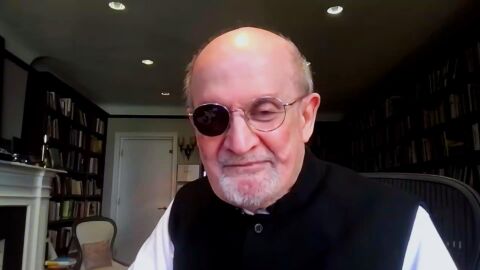
Then, “The Eleventh Hour.” Salman Rushdie speaks with Walter Isaacson about his latest work, an exploration of life and death.
Plus, underwater journalism. Climate reporter Raymond Zhong tells me how he chased a story all the way to the depths of the ocean.
Welcome to the program, everyone. I’m Bianna Golodryga in New York, sitting in for Christiane Amanpour.
It’s a tense time in Washington, as Republicans are still grappling with Tuesday’s election losses, while the government enters the 37th day of the
now record-breaking shutdown. President Trump is throwing out all kinds of reasons to try to explain some of Tuesday’s results, including his go-to
false claims of election rigging. These attempts to sow distrust about the security of American elections would be destructive enough on their own.
But as a new cover story in The Atlantic examines, this administration is also taking concrete actions that undermine that very security. The
Cybersecurity and Infrastructure Security Agency has seen its staffing cut around by a third, while millions of dollars have been cut from assistance
to local officials. As one expert told The Atlantic’s David A. Graham, if you are not frightened, you are not paying attention.
And Graham joins the show now to discuss his reporting. David, it is good to see you. So, as noted, we’re on day 37, record-breaking day now for the
government shutdown, the first record set by President Trump during his first term. You’ve written a book on Project 2025 called “The Project” and
how it seeks to reshape American government. Given all of the research that you put into both that book and now this piece for The Atlantic, how are
you viewing this shutdown through what lens?
DAVID GRAHAM, STAFF WRITER, THE ATLANTIC: Well, I think what’s interesting is seeing how the executive branch is using this opportunity to really make
decisions about funding and what programs get funded and what don’t, whether that’s SNAP or military salaries or air traffic control, for
example, without Congress to say so. And that is very much the animating concept behind Project 2025, this idea that we should empower the
president, that he should not be encumbered by Congress, that he should be able to spend money as he wants, and that other branches of government
shouldn’t really be an impediment.
With Congress out and with no budget, it seems like people in the administration, and especially Budget Chief Russell Vought, are using
opportunity to do that as far as they can.
GOLODRYGA: Are you surprised that Speaker Johnson is sort of allowing the president to do just that and weaken not only his role as speaker, but any
power that Republicans may have? That, yes, for the most part, they have always voted with the administration and supported the president. But is
this not weakening his own leadership?
GRAHAM: I think it is. And the way Congress has interacted with Trump is a little bit surprising. You know, in his first term, we saw Congress
repeatedly standing up to Trump. This time around, we haven’t seen any of that. And so, even as the White House kind of tramples on congressional
prerogatives, Johnson has remained very closely aligned with the White House. And I do think that that weakens him in the immediate term and it
also weakens Congress’s ability to check the executive in the long run, whether that’s under Trump or under a Democratic president.
GOLODRYGA: So, that’s the House. Let’s talk about the Senate, because we are at least getting some pushback from Senate Majority Leader John Thune
on the issue that President Trump has now been pushing for several days, and that is to do away with the filibuster, the Senate majority leader
thinking longer-term and saying, you know, there’s going to be a time when we’re going to be in the minority and we’re going to want that filibuster.
So, we don’t want to get away with it or do away with it right now.
Nonetheless, the president remains defiant and pushing for just that and even suggesting that that is the remedy for the outcome of the elections
two days ago. Here’s what he said.
DONALD TRUMP, U.S. PRESIDENT: It’s time for Republicans to do what they have to do, and that’s terminate the filibuster. It’s the only way you can
do it. And if you don’t terminate the filibuster, you’ll be in bad shape. We won’t pass any legislation. There’ll be no legislation passed for three
and a quarter — we have three and a quarter years. So, it’s a long time.
(END VIDEO CLIP)
GOLODRYGA: What would eliminating the filibuster, in your view, mean in terms of balance of power in this country and maintaining Democratic
guardrails?
GRAHAM: I think he’s certainly right that we’re unlikely to see a lot of legislation passed as long as the filibuster is in place and as long as
there’s a Republican majority. But really, if there’s a Democratic majority as well.
You know, the filibuster has gone from being a rarely used tool to something that is deployed all the time. You know, it’s effectively just a
way from the minority party to block almost anything except for budget resolution. So, I think there’s a case to be made. This is actually a good
governance reform. And it’s interesting, there are liberal wonks who would make that case as well. But it’s also a way for Trump to try to force
through his agenda and to try to make sure that Congress is acquiescent and is on board with the things he wants to do.
GOLODRYGA: How worried, in your view, is the president that he, if not already, is on his way to be a lame duck? Obviously, he can’t run for a
third term. We’ll talk about some of the concerns about that later on in this conversation. But given that, does that alarm you, coinciding with
your reporting and what you’re hearing from others about the lengths that he may go to to maintain his power and not become a traditional lame duck?
GRAHAM: Yes, very much so. And I think we see a lot of signs of sort of lame duck behavior. The focus on foreign affairs is a typical second-term
president move. Talking about a third term, which, you know, he’s ruled out for now, I think is another way to kind of stave off being a lame duck.
We’ve also seen that even when there is high public disapproval for things, he isn’t swayed by that. And in the first term, that seemed to be one check
on him.
This time around, he seems to be sort of indifferent to bad polling. And I think that does make it harder for him to be checked. If Congress won’t
act, if the Supreme Court and other courts are often ruling for him, and if public opinion doesn’t do much, there’s not really many things to stop him
from doing what he wants to do.
GOLODRYGA: So, let’s talk now to this issue of voter rigging and election rigging, because that has been a big concern. You go to great lengths about
it in this piece. And I’d like to first begin by what we saw Tuesday, because we already heard from not only Republicans, but even the White
House press secretary, Karoline Leavitt, responding to allegations from President Trump that there was some election rigging and voter rigging in
California over Proposition 50 involving redistricting. Here’s what she said.
(BEGIN VIDEO CLIP)
KAROLINE LEAVITT, WHITE HOUSE PRESS SECRETARY: The White House is working on an executive order to strengthen our elections in this country and to
ensure that there cannot be blatant fraud, as we’ve seen in California with their universal mail-in voting system. It’s absolutely true that there’s
fraud in California’s elections. It’s just a fact.
(END VIDEO CLIP)
GOLODRYGA: Is that just a fact? I mean, is there any evidence to back up what she just said?
GRAHAM: There is not evidence to back that up. The White House has not provided it. And I mean, it’s remarkable. At this point, they had been
claiming fraud in so many elections that we almost don’t even blink when they do that. What we’ve seen of these mail-in systems is they are safe and
secure. There is very occasionally voter fraud in vote mail-in systems, as there are in other systems. It’s not on the scale to shift an election.
And in this case, the Justice Department had election monitors in California keeping an eye on things and has not produced any evidence from
those people of any fraud either.
GOLODRYGA: More broadly, what’s the impact of hearing those words, not from fringe voices, but from the White House press podium?
GRAHAM: You know, I think it just makes these things seem more real. It gives them the impression of seriousness to have the press secretary saying
these things. And that, in turn, undermines faith in the voting system consistently. And I think that’s a problem because people need to be able
to trust that the results of the elections are real.
You know, elections require the consent of the winners and the losers. And if people don’t believe that they’ve actually lost, it’s hard for them to
bow to the majority will. So, I think it undermines the ability to function in a democratic system.
GOLODRYGA: So, this is just a microcosm from the elections on Tuesday that you’re warning about that we could see next year during the midterms. And
let’s move to your cover article for The Atlantic for more on this because you lay out a chilling premise, and that is Donald Trump’s plan to subvert
the midterms is already underway. One headline reads, Donald Trump’s plans to throw the 2026 midterms into chaos are already underway. What concrete
tactics are underway that you talk about?
GRAHAM: So, we see several things. One is this attempt to suggest fraud. Another thing is we have the Justice Department asking for voter rolls,
sometimes in violation of state laws from places. We see attempts to sort of bully election officials. You know, we heard in that clip, Karoline
Leavitt, talking about an executive order on elections. The president has, in several cases, attempted to assert authority over elections he doesn’t
have. The president simply doesn’t have much say-so on elections. Congress has some, and most of this is run at the local level.
But we’ve seen Trump trying to, for example, mandate what votes states can and can’t count or to decertify the voting machines they use to tell them
how to count ballots. So, you know, these all look like interference, and it’s in the context of a general, you know, bullying the media, attempting
to intimidate political foes by investigating or charging them with crimes. So, all of these together create a sort of broad atmosphere of voter
suppression and of tilting the playing field.
GOLODRYGA: You open the piece with a fictional but plausible scenario, and that is Marines seizing voting ballots in Arizona. Just walk us through
some other possible scenarios that you envision. And I guess what keeps you up at night is what you haven’t thought of yet.
GRAHAM: That’s right. I think it’s — you know, it’s hard to imagine the possibilities. You know, nobody, I think, really anticipated something like
January 6, 2021, before it happened. And I’m not sure many people anticipated the kind of broad legal effort that Trump mounted after the
2020 election also to change those results.
One of the things that I worry about and that voting experts worry about a lot is the presence of potentially the military or other armed law
enforcement on the streets around the election. Obviously, we’ve seen the National Guard and, in some cases, Marines on the streets, ICE and other
federal law enforcement. And that’s a way that can interfere with elections as well. It may drive turnout down. It can create inconveniences. It can
intimidate people. So, you know, that’s something that election officials are very concerned about and something we haven’t seen before.
In addition to threats like seizing voting machines, which is something that the White House considered in 2020 after the election but ultimately
didn’t go forward with.
GOLODRYGA: OK. So, we talk about the concerns of a weakening Congress in terms of the checks and balances in place. But what about the judiciary?
And you have evidence now from Trump’s first term of lower courts tossing out cases that it found didn’t merit some of the appeals the Trump
administration was making there. You have the Supreme Court. A majority of these justices, as we have seen as of late, have been siding more with this
administration and executive power.
But even, for example, on the tariffs case, they haven’t ruled yet, but from what we heard from oral arguments yesterday, they were quite skeptical
about the arguments that the administration was making in support of these tariffs. Is there any solace to take in the power of the judiciary in
intervening if they find that the administration is overstepping here?
GRAHAM: I do think that the courts are a really important check. And they’re one that I think has been fairly strong on a lot of election
issues. We saw a really unusual case in North Carolina in 2024, basically of trying to change an election result after the fact, and that was stopped
by a federal court. Federal courts have consistently ruled against attempts to shift elections.
And I even talked to some Democratic lawyers who said, look, you know, I’m no fan of a lot of the Supreme Court justices, but I have faith that in
election cases, they generally do make the right call, and they’re not going to countenance sort of throwing out the whole system or subverting it
in a major way.
GOLODRYGA: You also write off the bat that Trump will not cancel elections, but we shouldn’t be resting assured that all will go well, and
without sort of the administration stepping in and overreaching here, because you note that other countries around the world where you have
authoritarians in place, if you’re looking at Russia, Turkey, and Hungary, for example, these are countries run by leaders who like to have and host
elections, but obviously they’re not free and fair. So, talk about some of the concerns and parallels you may see or you worry about here with Donald
Trump.
GRAHAM: Yes. You know, I’ve had people ask me if we’ll have elections in 2026, and I think the answer is yes. You know, Trump would not be, for
example, pushing Republican states to redistrict if he didn’t expect to have elections.
What we see in countries like those is a kind of modern variety of authoritarianism where you don’t ban the opposition party, you don’t cancel
elections, you don’t ban an opposition media entirely. You just make it much harder for the opposition to compete. So, there’s an election, but
they can’t fundraise as effectively, or they don’t have the media to get to it, or the votes are suppressed in some way.
That way, from the outside, it looks like a democracy. Voters have the sense that they have a say, but in practice, you don’t have to wield up a
lot of power. And we see, you know, in intimidation of the media, in arrests and investigations of adversaries, for example, a lot of the steps
that have happened in other countries, like Turkey or Hungary, now taking place here.
GOLODRYGA: I mentioned this earlier, concerns about Trump not leaving office, though constitutionally, it’s very clear that he can only serve two
terms. Judge — Conservative Judge J. Michael Luttig warns that Trump is positioning himself for a third term. You know, there’s this debate going
on that the president is just trying to egg on Democrats by constantly wearing 2028 hats and suggesting perhaps, you know, there could be a way
for him to run again for a third term. Here’s how Trump addressed this issue.
(BEGIN VIDEO CLIP)
TRUMP: It’s a very interesting thing. I have the best numbers for any president in many years, any president. And I would say that if you read
it, it’s pretty clear I’m not allowed to run. It’s too bad. I mean, it’s too bad. But we have a lot of great people.
(END VIDEO CLIP)
GOLODRYGA: OK. So, should we be reassured by that response? I mean, is Trump and other — are Republicans trolling Democrats when they constantly
throw out this idea, or is there reason for concern, like Justice — or Judge Luttig is suggesting?
GRAHAM: You know, I think it is good that he’s saying that. That is good, although, you know, Trump may change his mind, so we can’t take that as the
final word. I think there is an element of trolling to it, but I also think we shouldn’t feel totally safe about it. You know, I think back often to a
quote that a senior administration official gave to the Washington Post in the aftermath of the 2020 election, where he said, you know, what’s the
harm in humoring Trump’s claims the election was stolen? It’s not like he’s going to try and stay in office. And in fact, that’s what we saw.
So, I think these things are important, and I think we need to keep an eye on it. We need to stand up for the Constitution and make sure that the
rules do hold.
GOLODRYGA: David A. Graham, thanks so much for taking the time. Really appreciate it. It’s a very thoughtful piece. I encourage everyone to read
it.
GRAHAM: Thank you.
GOLODRYGA: And now, to a deeply troubling look at the exploitation of migrants in search of a better life. Global immigration has hit record
levels this year, fleeing war and prosecution, many Africans desperate to reach the West end up passing through Libya, where some are captures by
criminal gangs.
A warning, what you’re about to see if disturbing. CNN has identified videos of these migrants being brutally tortured. Those videos are then
sent to family members around the world along with the demand for thousands of dollars in ransom. Isobel Yeung travelled to the heart of the story in
Libya where this horrific abuse is taking place.
(BEGIN VIDEOTAPE)
ISOBEL YEUNG, CORRESPONDENT: All across the world, every single day family members are receiving the most horrific videos of their loved ones.
They’re being beaten, tied up, humiliated. These are men and women tortured on camera as they beg for their lives. And the captors are demanding money.
YEUNG (voice-over): Over the last few months, I’ve seen many of these torture videos, each one more harrowing than the one before.
We’re in Libya, where this abuse is rampant. To find out how such depravity is taking place on such a huge scale, and who is responsible.
YEUNG: How much does it cost for one person’s freedom?
YEUNG (voice-over): As global immigration reaches record levels, this is a story of what happens when a desperate search for freedom collides with a
human trafficking network that preys on the world’s most vulnerable. Those fleeing war and persecution in countries like Sudan, Ethiopia, Eritrea and
Somalia come to Libya in the hopes of reaching Europe, the U.K., America.
We spoke to dozens of families abroad who are receiving videos of their loved ones being tortured daily. Their captors demand money.
YEUNG: How does it feel as his sister watching this?
UNIDENTIFIED FEMALE (through translator): I’ve been overwhelmed with sadness and a deep sense of helplessness. I beg you to tell the world of
our story.
YEUNG (voice-over): We uncovered payslips showing families pay ransoms in small amounts through international banks. Even more money is believed to
go through informal networks called the Hawala system. The going rate for freedom is $6,000 to $10,000. Officials say that every month, hundreds of
thousands of dollars are sent from families in Europe and North America to those inflicting pain on their loved ones in Libya.
We’ve come to the southern Libyan border, where migrants are kidnapped by armed gangs as soon as they enter. Authorities say they’re overwhelmed with
the influx of recent arrivals. Several hundred migrants are being held in this detention center after illegally crossing into the country.
YEUNG: You have not left this room for three months?
UNIDENTIFIED MALE: Yes. We stay in here, no one cares. Nobody cares for us.
UNIDENTIFIED MALE: There are some sick here. Yes, sick.
YEUNG: I mean, I’m not surprised people are getting sick. It’s crowded. Pretty shocking conditions.
YEUNG (voice-over): Crammed in among them is a man who has just been arrested on suspicion of collecting money for ransoms. The police
interrogate him over his involvement.
UNIDENTIFIED MALE (through translator): OK. But what’s your role?
UNIDENTIFIED MALE (through translator): My role is transfers.
UNIDENTIFIED MALE (through translator): So, therefore, you are a partner. You know that he’s doing trafficking and torture. You are complicit in the
crime. You only receive money transfers?
UNIDENTIFIED MALE (through translator): Yes, I receive them, then I deduct my commission.
UNIDENTIFIED MALE (through translator): Regarding those people, are they kept in the same farm or in other warehouse?
UNIDENTIFIED MALE (through translator): On the farm.
UNIDENTIFIED MALE (through translator): Does he torture them?
UNIDENTIFIED MALE (through translator): God only knows.
YEUNG: It seems like this guy is admitting to his involvement, saying that he’s involved in the hawala system, which is taking money from these
migrants and paying his boss, who is the big trafficker.
YEUNG (voice-over): The suspect hands over crucial details about a farm where he says the migrants who paid him are held for ransom. The police
gear up and plan to raid the premises.
YEUNG: So, these guys are heading towards a location that they believe a trafficker is operating, where he’s holding migrants that they believe have
been tortured and held for ransom.
UNIDENTIFIED MALE (through translator): This room is a secret prison.
YEUNG: So, they are searching through this room that they believe is where migrants were being held. It doesn’t look like anyone’s here anymore. It
looks like they’ve fled or been taken to the next spot. There’s a lot of clothes hanging up here.
UNIDENTIFIED MALE (through translator): The traffickers keep the migrants’ passports in this room, and when the ransom is paid, they return the
passports.
YEUNG (voice-over): The alleged perpetrators are no longer here, and the authorities don’t seem to have a plan for catching them, leaving unknown
numbers of migrants still under the control of their captors.
Women and children are often the most vulnerable. In this detention center, almost everyone tells us they’ve been trafficked and tortured. Mostly
Eritreans and Ethiopians, they’ve paid their ransoms and are now waiting for help from the U.N. Because of the harrowing details of what they’ve
been through, we’re keeping some people anonymous.
UNIDENTIFIED FEMALE: These guys, they touched me and they did something every day. Like, four boys, they do like that.
YEUNG: Four men came to abuse you at the same time?
UNIDENTIFIED FEMALE: Yes. One first. They touch you on your hands, your leg. I cannot explain it.
YEUNG: I’m so sorry. It sounds like you’ve been sexually abused. Have you had any medical treatment for it? None?
UNIDENTIFIED FEMALE: She checked me, like, for pregnant.
YEUNG: You’re not pregnant?
UNIDENTIFIED FEMALE: I’m not pregnant.
YEUNG: OK.
UNIDENTIFIED FEMALE: But it hurts too much. Even I want to die, but I cannot do it.
YEUNG: You’ve been hurting yourself?
UNIDENTIFIED FEMALE: Yes.
YEUNG: On this hand?
UNIDENTIFIED FEMALE: Yes.
YEUNG: On this arm?
UNIDENTIFIED FEMALE: Yes.
YEUNG: It’s so awful to hear someone who’s so young, you’re just 16 years old, talk about not wanting to live anymore.
UNIDENTIFIED FEMALE: Every girl, they do this. Every girl.
YEUNG: Every girl is the same.
UNIDENTIFIED FEMALE: Yes.
YEUNG (voice-over): Suddenly, everyone in the room breaks down.
UNIDENTIFIED FEMALE: Everyone having pain. Everyone.
YEUNG: Everyone.
UNIDENTIFIED FEMALE: Yes.
YEUNG: I mean, it’s actually unbearable amounts of pain in this one room. Just every single woman, child in here, just seems like they’ve suffered
the most horrific experience imaginable.
YEUNG (voice-over): Girls as young as 14. Children. Pregnant women. These are just a small sample of people trafficked through a living hell. Some
don’t make it. Earlier this year, two mass graves were discovered in this area, containing 74 migrants. Their autopsy reports show signs of torture.
Some had been shot.
It’s rare that authorities get to the torture sites in time. Back in 2022, acting on a tip-off from migrants who’d escaped, they were able to free
over 150 people. They were held inside these rooms for months and said they’d been brutally abused.
Standing outside, guarding the rooms, was an Eritrean man called Tsinat Tesfay. He was arrested by the police and weaponry was seized. In this
footage, you can see the newly released migrants pointing and screaming at Tesfay.
We received special permission to meet with Tesfaye in a high-security prison. He’s been convicted of kidnapping and is serving a life sentence.
He says he’s innocent and that he was one of the migrants being trafficked, rather than someone responsible.
YEUNG: There was evidence, phone evidence, there was ammunitions, there was weapons. It seems like a wild coincidence that you had absolutely no
involvement in this.
TSINAT TESFAY, PRISONER FROM ERITREA (through translator): There was nothing. You just pay the money. There is no harm. You pay your money and
leave.
YEUNG: How do you explain the fact that so many of the migrants that you were with that day say that they were tortured and abused and treated
horrifically, and you’re saying that you saw nothing?
TESFAY (through translator): No, no. I didn’t see torture.
YEUNG: Why is it, do you think, that Eritreans end up working with these Libyans in these human trafficking networks?
TESFAY (through translator): It’s all about money. They want to change their lives.
YEUNG: Do you have any regrets or any remorse over anything you’ve done?
TESFAY (through translator): I didn’t do anything. For sure, I didn’t do anything. All I did was come to Libya. Just that.
YEUNG (voice-over): This business is bigger than one man. The network Tesfay was accused of operating in stretches across this vast desert and
has links to traffickers in Uganda, Ethiopia, and the Emirates. The man in charge of preventing trafficking in this region is Colonel Mohammed Ali Al-
Fadhil.
YEUNG: There are reports, including a U.N. experts panel from last year, which found evidence of collaboration between the Libyan authorities in
this region and the traffickers themselves, essentially turning a blind eye in exchange for a share in the profits. Is that corruption happening under
your watch?
COL. MOHAMMED ALI AL-FADHIL, LIBYAN DEPARTMENT FOR COMBATING ILLEGAL MIGRATION (through translator): There are always similar accusations in
every country. Some accusations are true and others are not. We didn’t get any orders to look the other way, whether or not in exchange for money.
This is not true.
YEUNG: Do you think that the people doing this, the people carrying out the trafficking and torturing are just five steps ahead of you guys?
Because, I mean, we spent several days with your men. They were not looking for people. They didn’t have the technology to do so.
AL-FADHIL (through translator): Look, this matter requires participation by countries. All countries should share it. The whole European Union, all
the countries impacted by illegal migration.
YEUNG (voice-over): He’s right, Libya can’t tackle this alone. But while a rise in anti-immigration politics is failing to translate into
international cooperation, many thousands of people making this treacherous journey will continue to live through this never-ending nightmare.
(END VIDEOTAPE)
GOLODRYGA: Our thanks to Isobel Yeung for that very powerful and disturbing report. All right. Coming up for us after the break, his new
book, “The Eleventh Hour.” Salman Rushdie makes a return to fiction with a collection of short stories and novellas three years after a near-fatal
attack on his life.
GOLODRYGA: And now, Salman Rushdie lived for decades under the threat of a death sentence. And then in 2022, he survived a knife attack which left him
blind in one eye. The award-winning author is no stranger to his own mortality. Three years after that brutal attack, he’s channeling his
experiences in a new work of fiction.
“The Eleventh Hour” is a quintet of short stories exploring life, death, and what becomes clear in life’s proverbial eleventh hour. Rushdie joins
Walter Isaacson to discuss the project and what a close encounter with death has taught him.
(BEGIN VIDEOTAPE)
WALTER ISAACSON, CO-HOST, AMANPOUR AND CO.: Thank you, Bianna. And, Salman Rushdie, welcome back to the show.
SALMAN RUSHDIE, AUTHOR, “THE ELEVENTH HOUR”: Thank you. Good to be with you.
ISAACSON: You were last on with Christiane Amanpour talking about your book “Knife,” which is about the — you can see your eye right now still
from that near fatal knife attack. Now, you’ve got a new book out of short stories called “Eleventh Hour.” But before we get into that, just how are
you?
RUSHDIE: I’m not so bad. Thank you. I mean, I think I’m better than I was when we spoke about “Knife.” I think I’ve made — I mean, I’ve made a
pretty good recovery, thank you.
ISAACSON: And by writing “Knife,” did that help open the way for you to get back to fiction?
RUSHDIE: It really did, you know, because I felt that until I dealt with the attack, it was impossible to think about fiction. And what happened is
almost immediately after finishing the memoir, it’s like that door in my head opened again, you know, and I was able to go into the world of the
imagination once again. And it was actually kind of joyful, you know.
ISAACSON: Wait, wait. That’s a wonderful line, the door in my head opened to the imagination. Describe that a little bit more to me. I’d love to have
that door open in my head.
RUSHDIE: Well, it’s just that, you know, for a couple of years after the attack, I had no stories in my head. You know, the only thing I could think
about and think through was the attack and its nature and its consequences and so on.
But the moment I’d finished writing about it, somehow, I told myself, OK, that’s done, dealt with, finished. And when I could draw a line under it in
that way, suddenly the story started to come back. And it was just as if by magic.
ISAACSON: You know, you’ve had the fatwa that was, you know, the sort of sentence on your life that they tried to do. And then you had the knife
attack. Do each of these things keep reinforcing each other? I mean, how do you break your head out of that?
RUSHDIE: No, I think, you know, I’ve spent a lot of my life having to deal with the consequences of this kind of attack. And I’m quite — I don’t
know, I guess I’m a little bit hardened to it, you know. I know how to deal with it. And what I’ve managed to do all these years, I mean, that — the
first attack was way back in 1989, is I’ve managed to continue with my work, you know, and I’m proud of that.
I mean, “The Satanic Verses,” you know, was my fifth published book, my fourth published novel. This, “The Eleventh Hour,” is my 23rd published
book. So, actually, most of my life as a writer has been since that hostility began, and I’ve managed to overcome it to my satisfaction, I
think.
ISAACSON: And you’ve overcome it, but in some ways, has it informed you, has it sort of pushed more?
RUSHDIE: No, no. I don’t know is the answer. You know, I think it’s hard to know what my writing would have been like if nothing ever happened to
me. But at least I managed to go on doing the work. And these stories really kind of came out very fluently. I mean, it’s as if the imagination
had been waiting to be released, and the stories came out like in a flood.
ISAACSON: You call it “The Eleventh Hour,” and the phrase eleventh hour kind of evokes, it’s a last possible chance you have to do something. Is
that what you’re thinking too?
RUSHDIE: Well, that’s what I was thinking that — you know, that time is short. And I think one of the things that I learned from the attack against
me was, if you’ve been given a second chance, you know, because actually I’m quite lucky to have survived it. And if you have the good fortune to be
given a second act of life, don’t waste it. You know, use the time. Do as much as you can. And so, that’s what I’m trying to do. I’m trying to fill
up the days with work.
ISAACSON: So, you have this wonderful story, “The Musician of Kahani.” And it brings you back, I think, to your childhood in India, where you’ve been
before in your fiction. Tell me about circling back to places that are almost autobiographical.
RUSHDIE: Yes. Well, no, not almost. I mean, definitely autobiographical, because, you know, in my hometown, which was Bombay when I was living
there, Mumbai now, there’s this tiny little neighborhood where I grew up, you know, in this gigantic city. There’s this little lane going up a hill,
and that’s where my childhood home was.
And every time I’ve been back to India, all my life, I’ve been — it’s been necessary for me to go back and stand there again and be drawn back into,
you know, my childhood and my teenage years and so on. It’s a kind of magic space for me. And, you know, the hero of “Midnight’s Children” grows up in
that neighborhood, too. And I’m — actually one of the characters in Kishat (ph), which you mentioned, her backstory is in that neighborhood.
And so, I thought, one more — maybe there’s one more story to tell up that hill. You know, take one last walk up there.
ISAACSON: And the musician we’ve been talking about is a prodigy, sort of a child prodigy. And her mother kind of struggles over whence cometh this
talent? How does this come out? Tell me about that and how you think about yourself as to how did this talent come out?
RUSHDIE: Well, you know, in my family, we do have such a prodigy. I mean, I have a niece who is a brilliant concert pianist. And she started out as –
– you know, when she was like four or five years old, becoming — revealing herself to be very gifted. And to say the least, my family is not a musical
family. I mean, you don’t want to hear me sing.
And so, in a kind of non-musical family, for this great gift to suddenly arrive felt like a miracle. And so, I wanted to explore that idea, that how
does it happen when — and it makes you understand when people say that something is a gift, that’s actually literally what it is. It’s like
something you’re just given. You know, you didn’t earn it. It just shows up. And so, I wanted to write about a character like that who is simply
given a miraculous gift. And how does she use it?
ISAACSON: Chang Ni, who is, that’s how you pronounce it, right? The musical prodigy. It was interesting to me because her father, in your
story, becomes a spiritual follower of a particular guru. And I want to read a sentence you wrote, which struck us, which is, what he failed to
understand was that Mit Mu (ph) was a real man, this guru was a real man who had turned himself into an imaginary one, so that he was a fiction too.
That seems to connect to a lot of what you do in your writing. Expand on that for me.
RUSHDIE: Well, you know that India is full of gurus. Some of them are kind of super gurus who have enormous followings, and who actually sometimes
amass great wealth. And I’ve always been very suspicious of, you know, professional holy men. And so, I have a sort of satirical urge towards
them. And they do, they make themselves up, you know, they announce that they are in some way touched by the gods, and have miraculous qualities and
can heal you and can do all sorts of things. And that’s a fiction that they create that they then live in. And they persuade other people to believe it
too.
And I think the phenomenon of the cult is very much alive in our time, you know, and it’s — and there have been examples in the United States as
well, of very strange cult leaders. You know, you think about Waco, you think about, you know, all these — you think about Jim Jones, et cetera.
So, I wanted to explore that mentality, you know, the mentality of not just of the cult follower, but of the cult leader. You know, how do you become
that person? Because none of us is born as a guru. You have to invent yourself.
ISAACSON: Yes. The musician, the prodigy, this wonderful — you said that turned out to be one of the rare artists whose work directly impacted and
shaped the world in which she lived. That kind of reminds me of you. Your art has helped shape the world. Do you think about that type of impact?
RUSHDIE: No, I mean, I think it’s when it happens, it’s usually an accident. I mean, I think probably the one book that I think that maybe had
a really direct impact on history is “Uncle Tom’s Cabin,” you know, because that was a book which so energized the discussion about the question of
enslavement that it had a real political impact. There’s a story of President Lincoln meeting Harriet Beecher Stowe and saying to her, you’re
the little woman who started this big war. And there’s a sense in which you can understand how that’s true. Also, an exaggeration, of course.
ISAACSON: You have a story in the book called “Late,” in which you’re hanging around your old stomping grounds, you know, Cambridge University in
England. And you say in this that it documents events that cannot easily be accommodated within a rigorously rational description of the world. All of
your fiction, to me, seems to be a blend of rational realism, along with magical fantasy. And it’s woven together. Describe how you consciously are
doing things like that.
RUSHDIE: Well, I just — the way I think about it for myself is that, you know, of course, in our waking lives, we try to be rational people, and we
try to understand the world through reason and so on, and knowledge. But we also are dreaming creatures, you know. And when we dream, we’re completely
irrational. And our minds work in a different way.
And I think there’s something to do — something I’ve tried to do, which is to blend those things, to use the irrationality and fantasy of the dreaming
mind with the rationality and everydayness of the waking mind, you know. So, to mix the imagination with observation, to mix, if you like, reportage
with fiction.
ISAACSON: I was reading something that Demis Hassabis, the, you know, great A.I. pioneer of deep mindset, and he said that one of his discoveries
when he studied neuroscience is that memory is very much linked to imagination. And that seems to be a theme of your work as well. Whence
cometh imagination? How do we have that trait?
RUSHDIE: Well, it’s –well, thank goodness we do, because how dull life would be without it, you know. And as far as I know, we are the only
creature on the earth that has that capacity, the capacity to imagine yourself, you know, the capacity to imagine the world being different,
which, of course, out of which comes the possibility of change.
Because before you can change the world, you have to imagine a different world. You know, and we all do that to a greater or lesser degree. The
interesting thing about, that you mentioned about memory and imagination is that memory is a very tricksy thing, you know.
Many of us remembering the past remember it inaccurately. But the inaccurate memory becomes in a way more powerful than the facts, because we
cling to our memories as the truth, even if we can be shown to us that we’re misremembering. So, memory is a kind of fiction as well.
ISAACSON: You’re a historian by training. You have many specialties within history and India being one of them during the 1900s. But you’re also an
American historian. We’re about to hit our 250th birthday as a country. Tell me about how American history has informed your work and how you think
maybe it can help us bring us back together a little bit for our 250th.
RUSHDIE: Well, you know, one of the reasons why people like me came to live in America was because of our admiration of the system, you know. And
I think something like the First Amendment was not — was an important factor in my deciding that this is a place I want to live in, you know. And
I think there’s no other country in the world which says that its people have the right to the pursuit of happiness. I mean, happiness doesn’t crop
up in a lot of political documents. But if Americans are given the right to pursue happiness, that’s a beautiful thing.
So, there’s many things about the origin story, if you like, of the United States that I admire very much. And, you know, all countries are many
countries. You know, all countries are pluralistic and argumentative and full of differences. So, you choose the country that you choose the America
you want to belong to, you know. And that’s the America that I chose.
ISAACSON: Salman Rushdie, thank you so much for joining us.
RUSHDIE: Thank you.
(END VIDEOTAPE)
GOLODRYGA: Well, as Brazil prepares to host the U.N. Climate Summit and a landmark report warns of the widespread deaths of coral reefs, one reporter
has gone above and beyond in his attempts to understand what’s happening to our natural world.
Raymond Zhong is a climate and environment reporter for The New York Times, but a recent story challenged him more than he had expected. He sought to
cover researchers who were hunting for invisible creatures, eating invisible food on the ocean floor and realized that in order to do the
story justice, he had to learn how to scuba dive.
To explain what he found and what it’s like to report underwater, Raymond joins me now from London. Raymond, it’s good to see you on solid ground.
First of all, you’ve been covering climate from the surface for many, many years as a climate reporter. What finally led you and inspired you to not
only study it beneath the ocean, but also to scuba dive to do some of your own research and reporting?
RAYMOND ZHONG, CLIMATE REPORTER, THE NEW YORK TIMES: Yes, it’s a funny thing. We — so many of us live near the ocean. So, many of us live near
coasts, lots of cities on coasts, and yet it’s a really easy thing to never think about. Despite being so huge, you know, it’s almost huge beyond human
comprehension. And so, we can sort of look out on it and think it’s just sort of there eternally, unending.
And of course, that’s not true. You know, if we talk about what humans are doing to the planet, the oceans cover so much of the surface that it’s a
huge part of — it’s feeling the effects. You know, 90 percent of the extra heat that humans are trapping near earth surface ends up in the ocean. The
ocean is storing up so much of the heat that we’re keeping near the planet. So — and that’s obviously having huge changes down below that we just
don’t see.
And I think part of what I felt like I just have to do in this job is to make people see the natural world, see what’s under their nose, see what’s
all around them. And I think I’d had a couple of opportunities to write about scientists working underwater, scientists who can dive. And I kept
thinking, wow, that’d be really cool to go with them. And I think it finally just came to a head with this story. And I said I should do it. I
went and got certified.
GOLODRYGA: And you say you’re not a thrill seeker. So, was it hard to learn how to scuba dive? What was some of the most challenging aspects of
it?
ZHONG: I had gone snorkeling. I think I’m a pretty good swimmer. And I sort of walked in on my first day of lessons feeling full of confidence.
And basically, at one inch below the surface, when you sort of are in a pool learning to breathe, I had a little freak out. I think there’s a
psychological barrier that you have to overcome if you’re a human being used to breathing air to suddenly have to do it into a machine that’s sort
of — you know, it’s a well-designed machine. The technology is great. But you really have to face a sort of little voice in your brain telling you
this is not normal. This is not natural.
And I think that’s a big part of what scuba teaches you. You know, we are land creatures and we are not meant to live in the ocean. So, you have to
have a certain humility toward the power of the water.
GOLODRYGA: And you have to allow the machines ultimately to do what they’re designed to do. What surprised you the most when you dropped 40 to
50 feet about the ocean or about how you viewed the ocean in your reporting?
ZHONG: I think it’s just really — you know, it’s a different planet almost. You just come to appreciate — you know, you think you understand
what it means for creatures to live on the ocean floor. But until you’re there, until you’re seeing it up close, I mean, I think even frankly
pictures don’t do it justice. It’s just its own world down there. And it really feels like if more people could see it up close, if more people
could sort of appreciate — and you know, it’s not even just things you can see, it’s ocean currents, which we can’t see. It’s the sort of changes in
temperature that are happening invisibly. Even when you’re down there, you just sort of do appreciate the scale and the immensity of the activity
that’s happening there.
GOLODRYGA: Yes. And off the coast of Tuscany, you followed scientists who were hunting microbes that eat methane at mud volcanoes. What did you see
down there, and what does that tell you about the health of our planet and specifically our oceans?
ZHONG: Well, I came to this story thinking, well, how do you even collect a microbe underwater? And I think part of it was just to understand what
science under the ocean, how it works. You know — the answer to that question is you have a plastic bag that you sort of twirl around in the
water, and you imagine that’s where microbes are, and then you have to go back in the lab. But you have this plastic bag full of water. You have
tubes full of water.
You know, to a large degree, I see my job as just helping people understand how we know anything about the ocean. It is so vast. It is sort of we are
so small. We can only do things, you know, really in front of our eyes for the most part. You know, we can put instruments down there, but even that
requires us to be there.
So, I think it’s just an appreciation for, you know, this vast thing that, you know, even with satellites, even with robots, we can see more than we
used to, but a lot of it is still just about human beings putting themselves at risk, diving, you know, getting this training, having the
skills to go there.
GOLODRYGA: You think it’s crucial in covering the industry that you do?
ZHONG: I hope so. And I think — you know, I think I have colleagues who cover so many other things in the world, and I think the principle of being
there and getting there is so important. I think we take for granted how connected and how readily information is available to us, and to a large
degree in science journalism too, I think being there sort of next to scientists as they work is part of understanding what they do and how we
know what we know.
GOLODRYGA: As noted in the introduction, the Earth has reached what has been described as its first catastrophic tipping point according to a
report by 160 scientists from 23 countries around the world, and that is unless the global heating is reduced by 1.2 degrees Celsius as fast as
possible, warm water coral reefs will not remain at any meaningful scale anymore. What is the significance of that, and for those who are watching,
is there any reason for hope or optimism that that can still be reversed?
ZHONG: I think this is something scientists have been warning about for a few years already. We’ve already seen several really extreme marine heat
waves where you have temperatures in the ocean, you know, in the Caribbean and the Gulf of Mexico, recently they were as hot as a hot tub, almost 100
degrees Fahrenheit.
So, you have — you know, you can imagine what creatures like corals who have adapted to very specific conditions in the oceans, they just can’t
keep up. And these are ecosystems that play a huge role not only for marine life, but for human life too. The coral reefs provide protection against
storms, they buttress, you know, they keep land from eroding in lots of smaller island nations. They’re as much a part of our world as they are the
underwater world.
And unfortunately, I think people are trying different ways to save corals, people are trying to plant corals, people are trying to move corals, trying
to understand which species might survive in warmer waters. But it’s a global problem.
GOLODRYGA: Well, we’re talking about it — you’re reporting on it, and the fact that you’ve taken to going underwater, learning how to scuba dive to
bring up these stories just is a reminder of what an impeccable reporter you are. We appreciate you doing that. Raymond Zhong, thank you for joining
the show. We really appreciate it.
ZHONG: Thank you.
GOLODRYGA: And finally, out of devastation emerges hope for a small community in Syria, in the ruined town of Daraya. On the outskirts of the
capital, a group of young Syrian artists imbued bombed out houses with color, painting a mural of remembrance. The collaborative piece honors
families lost during the years of conflict.
All right. Well, that is it for us for now. Thank you so much for watching, and goodbye from New York.