

Read Transcript EXPAND
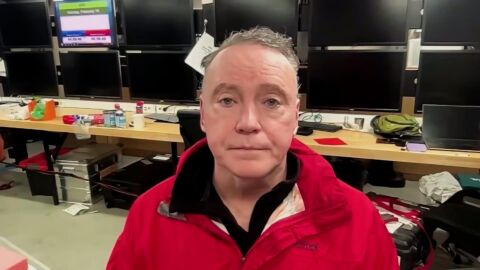
BIANNA GOLODRYGA: Next, another climate rollback in America. The 2009 endangerment finding, which determined that greenhouse gases threatened public health and welfare, was revoked on Thursday. Trump calls it the largest irregulatory action in American history. The U.S. is the second largest carbon emitter in the world. And climate scientist David Holland warns that the consequences are being felt in Antarctica. He speaks to Hari Sreenivasan as he returns from a recent expedition there.
HARI SREENIVASAN: Bianna, thanks. David Holland, thanks so much for joining us. You have just spent almost two months on an expedition to go and study and learn from Thwaites Glacier down in Antarctica. What was the point of this expedition?
DAVID HOLLAND: The point, ultimately, is to provide society with a forecast of the future of the global sea level. So, if you think about it, the world’s coastline is enormous, and Antarctica poses a threat to that of rising sea levels. Of course, through time, sea levels have gone up and down by hundreds of feet naturally. And so right now humanity seems to be tweaking the Antarctic ice sheet.
SREENIVASAN: So what were the kinds of instruments? What was the sort of scientific test that you wanted to do so that we would get a better handle on this?
HOLLAND: If I could kind of make a visual for you. So Antarctica is a big ice sheet about the size of the United States, and it’s sitting on land, but a part of it, if you could picture, is like the Gulf of Mexico. The ice sheet is actually in the ocean, and that’s the part we are really interested. It’s called West Antarctica. And more specifically, we were at a glacier about the size of Florida called Thwaites, and it’s in the ocean, so you can picture it’s on the sea floor, but grounded. And the ocean has easy access to it. So that’s the focus of our study, and we brought instruments to figure out how the ocean is affecting it. And I’ll add one more piece to that – just to make it the quickest analogy, that glacier, that particular one, is unstable. Just like a ball on a hill, if you touch it, it will roll away. A ball in a valley is stable. So for mathematical and physical reasons that glacier is unstable and once pushed, it might retreat from where it is all the way back to the South Pole.
SREENIVASAN: Put that in perspective for us, because I think it’s a hard thing for people to understand just the size and scale. What is the real risk here? Why is this kind of the “Doomsday Glacier” that – you know, I, I’ve seen lots of different titles ascribed to it.
HOLLAND: Right. So it is a special glacier in that it’s the one that’s already grounded in the ocean. It’s sitting on the sea floor. But more particularly, a subtle fact is that it’s in a basin that is like a bowl, like a cereal bowl. So it gets deeper as you go inland. Glaciers flow according to their height. So once you start unraveling it at the coast, as you go inland, it gets deeper and higher, deeper and higher, going faster and faster. That’s a runaway. And so right now, that glacier is on the lip of the bowl and is stabilized on this lip exactly where we positioned our ship by good fortune this year. And so once it comes off that lip, which it’s currently doing in computer models, it just unravels itself.
So there’s two ingredients here. One is you have the most unstable pre-configured glacier in the world called Thwaites, nicknamed “doomsday.” But the second thing is you need a trigger. And the trigger showed up around 1940 or 1950 when warm ocean water appeared on the doorstep of the glacier where it meets the ocean. So previously that was not there, otherwise the glacier would be long gone. So it’s a two punch effect. One is you have an unstable glacier. And the second thing is, of all the places around Antarctica, warm water showed up exactly there; a little bit precarious in its nature, and now we have this two punch.
SREENIVASAN: I guess what you’re saying is that there’s actually a whole different type of melting that’s happening because warm water is going underneath the glacier and just taking – you know, the heat is absorbing and melting the ice down there?
HOLLAND: Yeah. And so that’s the first reaction people have, which in the super big picture is perhaps correct. Warming our planet, which is now happening for the last century, does in fact affect the surface melt. But that’s a slow process that takes thousand or thousands of years. In the past, if we look back through the records, sea level has risen by up to 25 feet in one century, globally. 25 feet. And that can only come through a very rapid process. We’ve identified that process in the north, Greenland, and here south in Antarctica. As you said, warm water slipping under the ice sheets. Of course, ice is lighter than liquid water. One of the few substances in the universe that are like that so ice floats. And so warm salty water from the tropics makes its way here. And because of changing – this is something I found hard to believe, this little story – which is by changing the atmospheric composition of greenhouse gas, you change the winds over the equatorial part of the ocean, which sets off an effect that changes the winds here, brings the warm water and upsets the glacier. A very convoluted, complex path. But one that happened.
SREENIVASAN: So if this glacier kind of accelerated in its melting, what does that mean for someone living in coastal areas like New York or Florida or California?
HOLLAND: It turns out that what happens in our part of the world in the US, affects Antarctica, and Antarctica affects us. In particular, Thwaites represents a couple of feet of sea level rise globally. And now, Hari, if you think about that, that’s a lot of water. Two feet or more all over the globe. And its neighbors left and right, east and west most likely would go unstable. Once the keystone of Thwaites is plucked out of Antarctica. And so then you’re up to 10 feet. And then East Antarctica has more story. So it’s, it’s the changing of our global coastline. Florida, parts of it would disappear, and Louisiana, North Carolina, et cetera. So a lot of people would find that the beach has moved.
SREENIVASAN: So you know, you took different types of instruments there to Antarctica to try to study this. You were trying to drill holes, you were sending robots. Tell me a little bit about the science that you were performing to try to get better data.
HOLLAND: I’d like to paint a visual picture. So think of Antarctica again as a bowl of ice, size of the US, and the continental shelf is what’s between the Pacific Ocean, the Southern Ocean, and Antarctica. The continental shelf here is quite deep, 602,000 feet, because Antarctica has been pushing it down. The place where the warm water – as it goes around Antarctica, in the Antarctic circumpolar current – the curious place that it crashes into Antarctica is right there in front of Thwaites. But moreover, another thing, factor to take in, is there’s the equivalent of the Grand Canyon between the continental shelf break and the face of Thwaites. And that seems a bit unusual, but if you think about it as Thwaites waxed and waned through ice ages, it carved out in the sea floor a riverbed, a channel.
And in that channel, that’s where the warm water is. Why is it at the bottom? Because it’s really salty. It started its life basically in South Beach, Miami. It’s part of the global ocean conveyor belt, made its way around the world, and part of that belt is there in this canyon.
So, so in the channel, there is a sill, which is, as the glacier moved back and forth over time, it left what I would call a moraine, just a large pile of debris rock. And the warm water just gets over that sill and then goes downhill to Antarctica. So we put some robots, two robots, which are ocean temperature and water, current speed sensors up and down on a wire. They’re busy now going up and down every hour. We’ll get back in two years, hopefully, and get the data from that. So then that creates a visual of where is the warm water? How much of it is coming?
The second part was when we got to the glacier, a part of the glacier where it comes out into the ocean, begins to float and form a feature known as an ice shelf. The float floating extension. And through that ice shelf, the ocean is beneath, we drilled about a half a mile through it, and the plan was to put sensors down through the ice shelf down into the cavity of the ocean that’s below the ice shelf. That’s a special point. That’s where the continental ice begins to unground and float, and the ocean’s coming the other way. And the sea floor is below it. That juncture is the beach of Antarctica. It’s down a half mile, but that’s the beach. And that’s where the action is happening. Unfortunately, as we drilled a hole, time is running out and it begins to freeze. Our sensors went in and they froze three quarters of the way down the hole. So that failed. And so that mission did not succeed.
SREENIVASAN: You know, I think about that and look, science is a series of steps, and it’s not in a perfect line. You, I wonder what did this particular type of failure in this experiment teach you to do better the next time?
HOLLAND: Right. It teaches you – and it’s, I’m glad you asked that, because only by being here and not succeeding only – it doesn’t have to be that way – but failure teaches you a lot. And it’s taught me that we need to do this in a completely different way. It has to be redesigned, re-engineered. If we’re going to get the data that’s gonna build a forecast, that’s gonna help people answer the question, when will the global coastline flood, or if it will at all? It’s only coming to math and physics to an equation that can make a forecast on your iPhone. That’s only coming from data. The way we’ve been going about it is not working. And so I think we have to lean on world expertise from other industries. I can think of one – oil and gas industry – which could really go at this problem and solve it far better than we can.
SREENIVASAN: I don’t know if that’s ironic or fitting that the experts in the industry that is contributing to climate change would be some of the people who might actually help you drill the hole the best way to get the best data to predict, you know?
HOLLAND: Yeah, and it might be whole drilling, or it might be more of observatories on the sea floor. You might be aware that some places on earth have the sea floor now cabled and robots and explored. And so I think that’s the technology to bring to Antarctica, or something like that.
SREENIVASAN: I mean, look, we have famously withdrawn from the Paris Climate Agreement as of January of 2026, that is sort of official, right? And that’s something where 174 countries came together and we try to agree on at least a shared reality. And now we seem to be in a position where that’s not the case. At least the United States does not want to participate in that, considering how big we are, how much pollutants that we emit into the air, how responsible we are for the rest of the planet. Are you hopeful that conferences like this can work?
HOLLAND: Very much so – right now, the US is going through some dramatic changes in its whole approach to climate. I think part of it lies on the shoulder of scientists for inability to explain the nature of the problem. We make things too distant from people. We use words that disconnect people from what we’re trying to express. As shocking as it may seem, I personally am not a big fan of the word climate. I don’t know if people know what it means. It’s weather, long-term weather. It’s the thing that affects you every day of your life. A climate model – I remember a while ago, a congress person in Antarctica was asking me, why do we fund climate models? And I said, you don’t. You fund weather models. The one you use in Arkansas in order to plan how does the army work, the Air Force, civil navigation, agriculture, that’s the result of our research that you’ve supported that produces weather models. And the climate model, the glacier I’m talking about is just an extension of that.
So we have to be clear to people what we’re trying to do and the benefit to society and to them in their daily lives.
So getting back to your question, yes, a setback, but that’s only gonna make the advances of the future when we, the USA, pick ourselves up and go forward, and we will go forward in blazing colors.
SREENIVASAN: I wonder, you know, look, some of these shifts could be abrupt, as you’re saying if this glacier did fall in. When you think about the longer time horizon of how we perceive danger and threat, and whether, and how we respond to that, is it too late?
HOLLAND: Not, not at all. Recent times, yes, we have performed a geoengineering experiment, which we are kicking it up another ratchet, next ratchet level next year in increasing greenhouse gases. So it’s going to get warmer and warmer, and the planet is getting warmer and warmer. So there is one thought, which is, could you remove the carbon from the atmosphere, called mitigation? Turns out that’s really difficult to do. As I breathe here, I’m breathing air that has 50% more carbon than it did a century ago. That’s a lot. And you can’t see it with your eyes because we’re visible. But in the infrared, this is increased and put a blanket over the earth. So option A is, remove the carbon, and we don’t seem to be making progress there.
Option B is what is called adaptation. And that is you adapt to the problem. And so one thing is, are we gonna live with the problem? We might recognize that part of the issue is that the carbon is increasing and should we have other approaches? Now, some people are vehemently opposed to this, and I get it. That brings me to my point, which is in the case of this glacier, Thwaites, the Grand Canyon that I spoke of, and the sill that I spoke of, and the warm water creeping over it, we, humanity could build a barrier above that, a curtain, and that would stop it. And the glacier does not have a mind of its own. It’s not going to dissipate and fall apart if it’s not triggered. So there’s a potential solution, and there are a handful of these around the world. So that’s something part of this crew is we’ve focused on is, is there a solution to this problem? And I think there just might be. So that also gives me some hope. Will this work? Because we cannot afford to build barriers around the entire coastline of the planet, can’t be done. Few rich places, New York City might be able to do something, et cetera. Florida cannot. But here’s a little place that you could block, and for all intents and purposes, it might stop and or halt the problem to give us time.
SREENIVASAN: You know, I, I wonder if you could just give our audience a little bit of what it’s like to be there. I know you’ve been there many, many times before, but put in perspective, what people see on tv, so to speak, versus what’s happening, what you don’t see, how significant this kind of movement of ice is.
HOLLAND: Okay, well two things. First of all, I was shocked when I woke up and looked out my port window, and there was a huge cruise ship nearby to us. So that was quite a shock to see that. So people are gaining access to this place, albeit not so often. But the difference here is, for me personally, to get my head around the visuals of this as you look at the scenery and you, the sun is a growing around the sky 24/7 some days, a beautiful blue sky, the ocean, the sea ice, the wildlife and the glacier, and realizing that this glacier does come and go over time. And the fact that right now it’s on edge and it may quickly retreat and change this part of landscape in the world. For me, it was this idea of change that most struck me how beautiful it is, and inevitably that it will change and it will be different.
SREENIVASAN: Climate scientist from NYU, David Holland. Thanks so much for your time.
HOLLAND: Thank you, Hari.
About This Episode EXPAND
In yet another climate crisis rollback in America, the 2009 endangerment finding — which determined that greenhouse gases are a threat to public health and welfare — was revoked on Thursday. Climate scientist David Holland warns about the consequences of climate change being detected in Antarctica. He speaks to Hari Sreenivasan as he returns from a recent expedition there.
WATCH FULL EPISODE