
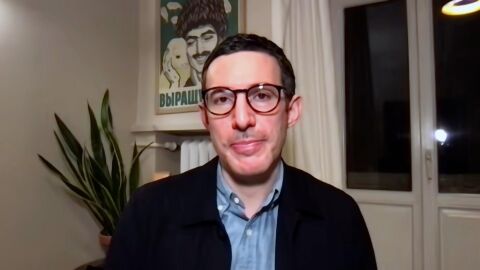
Read Full Transcript EXPAND
CHRISTIANE AMANPOUR, CHIEF INTERNATIONAL ANCHOR: Hello, everyone, and welcome to “Amanpour and Company.” Here’s what’s coming up.
(BEGIN VIDEO CLIP)
DONALD TRUMP, U.S. PRESIDENT: Venezuela sends us drugs, but Venezuela sends us people (INAUDIBLE).
(END VIDEO CLIP)
AMANPOUR: Trump ramps up threats against Venezuela. The administration faces serious questions from Congress. But do the president’s actions have
support in the region? I’ll ask Colombia’s former president, Ivan Duque.
Then —
(BEGIN VIDEO CLIP)
(MUSIC PLAYING)
(END VIDEO CLIP)
AMANPOUR: — defiance in Iran. Journalist Farnaz Fassihi tells me about the younger generation breaking taboos.
Plus, as Putin threatens Europe, is peace in Ukraine really possible and what will it take? Journalist Joshua Yaffa, chronicler of Putin’s Russia,
Russia joins Michel Martin.
Welcome to the program, everyone. I’m Christiane Amanpour in London.
The Trump administration has some serious questions to answer as Congress probes the so-called double tap strike that killed survivors during an
attack on an alleged drug boat in the Caribbean. A potential war crime. The administration insists that what it did was legal. They’ve hit 21 boats in
recent months as part of their self-declared war on narco-terrorism. Of course, it’s all part of a wider campaign, though, that seems aimed at
Venezuela and its despot leader, Nicolas Maduro.
The U.S. has now deployed more military resources and forces in the region than at any time since the Cuban Missile Crisis. So, are the alarm bells
ringing in Latin America? Well, not really. The president’s actions have plenty of supporters there, like my first guest tonight, Ivan Duque, who
was president of Colombia from 2018 through 2022.
Millions of Venezuelans fled to his country at that time. So, there’s no love lost there for Maduro. Welcome to the program.
IVAN DUQUE, FORMER COLOMBIAN PRESIDENT: Thank you so much, Christiane. It’s always a pleasure to be with you.
AMANPOUR: So, you’re joining me from Yale University where you’re teaching. So, you’re seeing the American reaction and you know what’s
happening, obviously, in your own country and on your own continent. But how do you explain, I’ve said that you’re a supporter of Trump’s actions,
that 53 percent — according to a poll, 53 percent of people across Latin America support U.S. military intervention in Venezuela. That’s according
to Bloomberg Atlas poll.
DUQUE: Well, the first thing to say, Christiane, is that this is not the first time that we have a campaign of this nature in the Caribbean. As you
know, in 2018, we started a plan that was called the Orion complaint, where Colombia participated actively with the U.S. and 18 more countries in order
to do effective interdiction against narco-trafficking. And I think that operation had a very important success at the time.
Now, the United States is deploying more military resources, and I think this is an effective deterrent. And I have to also mention that this is
also a message to Maduro, because as you know, Maduro has provided safe haven to narco-terrorist organizations inside Venezuela, and they have used
Venezuela as a route to deploy cocaine throughout the whole Caribbean.
So, I think this is a very important and decisive operation that needs to be seen as something that is comprehensive, as an interdiction campaign
that we must believe will have a potential benefit for the region.
AMANPOUR: Yes. So, look, I know that that’s your position. It’s much more than an interdiction campaign, because President Trump is actually sitting
in the White House saying that he’s going to bomb the mainland of Venezuela soon. And by the way, maybe even your country, Colombia, because he said
you make cocaine. So, are you not a little bit worried?
DUQUE: Well, Christiane, as you know, we had, during my administration, a very close relationship with the United States, which was bipartisan, and
it was also bicameral. We worked with President Trump, we worked with President Biden, and the previous administrations also worked with
President Obama, with President Bush and President Clinton.
It was very successful, that work that we had between Colombia and the U.S. And we destroyed labs. We faced many of the campaigns of the cartels. In
fact, I, for example, extradited Otoniel to the United States, which was the most dangerous campaign after Pablo Escobar. So, we had that kind of a
relationship.
Today, sadly to say, because Petro has aligned with Maduro, we don’t have that level of support. And you have seen how, for example, the interdiction
numbers have dropped, how, for example, there has been more permissive behavior with the campaigns of narco-trafficking organizations. So, I think
this has created a lot of tension.
I hope that President Petro can give it a second thought and not to keep on supporting Maduro, and instead allow the U.S. and our Colombian forces to
keep on doing strategic strikes against the cartels. If not, I think it will only make Colombia an accomplice of the Maduro structure, which I
think is a reckless behavior from President Petro.
AMANPOUR: OK. So, you’re talking about your successor, who’s from a very different party than you are, and you’ve just described his differences and
your differences with his strategy. But can I just get to the heart of it? Can we just please discuss honestly what this is really about? Because most
of the people who are commenting on it point out correctly that actually Venezuela is not classically — well, you can describe it what you want,
whether it’s narco-terrorist or not, for facilitating the routing of it, but you’re the country, Colombia, that sent 3,000 tons of cocaine to the
U.S. in 2023, accounts for about 70 percent of the world’s overall cocaine production.
As you said, Venezuela is a transit route. Only about 5 percent of your cocaine passes through there. 96 percent of fentanyl seized by the United
States is intercepted on the Mexico border. So, there’s literally no Venezuela connection to the fentanyl trade and production or, indeed, the
cocaine production. So, I’m trying to figure out, is this really about narco-terrorism, or, in the case of Venezuela, is it about a continent
that’s had enough with Maduro and wants to get rid of him?
DUQUE: Well, I think we have to see it in a holistic way, Christiane. As you know, many times that I’ve been sharing this situation with you, you
know that I denounced Nicolas Maduro before the International Criminal Court in 2019 when I was president of Colombia. And you know that for
various years I denounced that he was the head of a cartel called the Soles cartel, that him and his structure of cronies, they have been participating
in narco-trafficking operations. I denounced that for many, many years.
And I think there has been an advance in the way the United States has dealt with this because they have declared Cartel de los Soles a foreign
terrorist organization, which I think was something that was spending. And that particular cartel has allowed many of the Colombian narco-terrorist
organizations to have a safe haven in Venezuela. It has happened with the FARC dissidencies. It has happened with ELN. And they have used the
Colombian bordering line as a safe haven for them to do cross-border operations.
And, yes, also Maduro has another criminal structure linked to the Cartel de los Soles, that is Tren de Aragua, and they have been doing cross-border
narco-trafficking and micro-trafficking operations. So, is Venezuela the whole problem? No, but it’s a substantial part of the problem. And,
obviously, if you keep having a cartel running that country, it would only become a threat to regional security, hemisphere security, and also a
threat to the United States national security.
AMANPOUR: OK. So, I just want to say that, as you know, critics and analysts dispute even whether Soles, as you call it, is even a cartel. But
I get your point and what you’re saying. There are different views around Latin America. Argentina, Ecuador, Panama, like you say, they support U.S.
military intervention to depose President Maduro. Several others, like the Mexican president, the Brazilian president, they’re quieter, avoiding big
statements or being public because it seems that they’re more worried about what might happen, you know, if they antagonize the United States.
So, again, I guess one question is, if you guys are all so committed to removing Maduro for whatever reasons that you cite, why don’t you do it
yourselves? Why does the United States have to do it?
DUQUE: Well, I think that’s a great question, Christiane. As you know, there’s something very important in this region, and it’s that we are one
of maybe — or exclusively the region in the world that has an Inter- American Democratic Charter.
And that charter invites us all to work jointly in the defense of the rule of law and the defense of democracy. Maduro is a dictator, yes, but he’s
also a narco-dictator, head of a criminal organization. And I think we all have to use our diplomatic power, our diplomatic coordination, and also our
security coordination to fight the threat.
And the fact that the United States has seen this as a threat for the whole hemisphere, I think it just points out that Maduro is not only supporting
terrorists in his territory, but he has also allowed the presence of Hezbollah effectives in that territory. And he has also, from Venezuela,
used its territory to allow enemies of the United States to plot against U.S. assets in the region. So, that’s why the U.S. has also been very much
involved.
But I have to say something else, Christiane, and you’ve heard this from me many times. Nicolas Maduro is also an equivalent of Slobodan and Milosevic
in Latin America. Brutal violations of human rights, systematic annihilation of opposers, and also a promoter of crimes against humanity on
a permanent basis, but he has also stolen elections in that country for a permanent base in order to keep his illegal structure.
So, I think the fight against Maduro in the United States, because you have mentioned that many times, it is, one, important to say bipartisan. Second,
it’s bicameral. And I think most of the countries that respect the rule of law, that defend democracy, we’re united that it is a good aim to oust
Maduro out of power and facilitate a democratic transition in Venezuela.
AMANPOUR: OK. As you know, there’s quite a lot of criticism in the United States. There’s no stated legal basis for this. President Trump also says
that he doesn’t even have to get Congress’s position. They can keep — I’m going to paraphrase, you’re killing the bad guys, basically.
And you see what — but let me just take your other point. In terms of stealing the elections, I spoke with Maria Carino Machado, as you know very
well, the key opposition person, the Nobel Peace Laureate. Not only does she support this intervention, but she dedicated her Nobel to President
Trump because of what he’s doing. And this is what she told me about that.
(BEGIN VIDEO CLIP)
MARIA CARINO MACHADO, VENEZUELAN OPPOSITION LEADER AND 2025 NOBEL PEACE PRIZE WINNER: Oh, because it’s absolutely fair. And that’s what the
Venezuelan people feel. We’re getting finally a leadership that is addressing this tragic situation in Venezuela that has been evolving for 26
years, as it should. We have been asked that this criminal structure be addressed using law enforcement. And that’s finally what’s happening.
(END VIDEO CLIP)
AMANPOUR: She also said to me that if the election had been respected, regime change would anyway have happened because her party would have been
in office. So, question, though, is she speaking for all the Venezuelan people?
And I want you to explain this to me, because it’s interesting. Within Venezuela, support for a U.S. intervention is about 34 percent, according
again to the same Bloomberg Atlas poll. Amongst Venezuelan diaspora outside, support is 64 percent. So, there’s clearly a lot of agitator
outside and less than — you know, less than half the people support it from the inside. Just tell me how you analyze that.
DUQUE: Well, Christiane, we have seen in Latin America, but also in the world, more than 7 million Venezuelans that have left the country in
seeking opportunities because of all the destruction that Maduro has triggered. So, is it good for the Venezuelan people to oust Maduro? Their
response is yes. Is it good for the region? Obviously yes. And I think that triggering a construction of a democratic system that is credible and based
on the rule of law is something that is not only beneficial to Venezuela, but beneficial to the whole region.
But I also have to say something that is essential. We have to understand that the situation in Venezuela is the most dangerous migration crisis ever
generated in this region, and the human rights violation situation that is taking place in Venezuela, it’s insane. The United States historically
played a very important role to depose Milosevic and take him to the international court systems, which has worked in that specific case.
But the United States has also undertaken operations against terrorist organizations. As you know, we saw the operation against Osama Bin Laden.
You saw the operation against Soleimani. You’ve seen the operations against ISIS. So, I think there is a legal basis.
And when people ask me, do I believe there’s going to be an invasion, I don’t think this requires an invasion. I think there has to be an operation
that will be supported by some people within the structure of power in Venezuela. But I think there has to be now a plan to construct a unity
government, a transition framework, that would allow the Venezuelans for the first time in 25 years to really enjoy democracy, the economic
freedoms, and a credible rule of law system. This is a must for the hemisphere. And in order to embrace, protect, and defend the democratic
charter that we have in the Inter-American system.
AMANPOUR: Look, there’s no doubt that he’s a very unpopular man. I’ve interviewed him myself. I know that his commitment to democracy, if I can
put it that way, is seriously lacking from what he told me. But what I want to ask you also is you mentioned a whole bunch of instances and examples.
You didn’t mention Iraq, which was a case of intervention to depose under the cover of, you know, WMD, which proved not to be the case. And as you
know, it turned into a huge, huge issue, a debacle, some people say, with decades of backlash. Are you not slightly afraid? What makes Venezuela
different?
DUQUE: Well, I think also, historically speaking, Christiane, I think the United States has learned lessons from occupation operations. And I don’t
think they’re planning to do an occupation operation in the case of Venezuela. I think there will be some kind of an operation that would allow
a transition to take place, which I think is pretty much needed. But I also have to say, and I know what I’m going to say is controversial, but I think
when you look at Iraq today, definitely it’s in a much better place than it was during Saddam Hussein’s government.
Now, was a success the operation in Iraq? Well, I think there are a lot of criticisms to be made, but there are also things to be applauded. But in
this particular case, I don’t think the U.S. is thinking in Venezuela as an occupation operation as it did in the case of Iraq. I think there is a
great room to create a unity government that would allow a transition for democracy and also for the implementation of a credible rule of lawless
system.
And if Maduro keeps staying in power, what we’re going to see is more migration, more narco-trafficking, and more protection of terrorists in his
soil. So, it’s not good for the hemisphere to allow Maduro to remain in office, specifically when he is an equivalent of Slobodan Milosevic in this
region based on his human rights violation record.
AMANPOUR: Yes. I mean, as you know, Milosevic was tried for genocide and so were his hench people, which is slightly different. But I understand
what you’re saying to an extent. But I also want to ask you about double standards and how we’re meant to make sense of what the U.S. policy
actually is.
Because as you know, just this week, the former Honduran president, Juan Orlando Hernandez, received a pardon from President Trump. Now, he had been
sentenced to 45 years in prison in New York for taking bribes from what? Drug traffickers who moved some 400 tons of cocaine through Honduras to the
United States. I mean, can you make head or tails of that?
On the one hand, he frees an actual person who’s been convicted in the U.S. for doing this stuff. And on the other hand, he’s pursuing this anti-drug
trafficking thing against Maduro.
DUQUE: Christiane, I don’t know what were the arguments —
AMANPOUR: I know, but the facts are that you know what he was convicted of and he’s now being pardoned.
DUQUE: Yes. Well, I mean, I can tell you by my own experience, Christiane, because I think it’s the best judgment that I have available. When I was in
office, and as I said, I served during President Trump’s first administration, but also during President Biden’s administration. And we
had a very strong support to fight narco-trafficking in all its forms, including also the extradition of members of the drug cartels that were
trialed in the United States of America.
So, far, I think the strategy that the United States has against all these cartels has been bipartisan and bicameral. And I think that should remain
like that because that is what the region requires. And in this particular case, I just hope that there can be a farther explanation from the legal
advisor in the White House on why that pardon was justified. Because as you know, those are not just decisions that come out of the president’s mind,
they have to be based on a study and rigorous study of the circumstances. So, I just hope those things can be explained.
AMANPOUR: Me too.
DUQUE: But in concrete, I just believe that it is a duty at this moment to keep on fighting the cartels, fight the Soles cartel, and now it’s Maduro,
because I think that’s the most important objective, thinking on the whole security in the region.
And let me just also say this, I think the best legacy that President Trump can contribute in defense of the democratic charter of the Americas is that
working with all these administrations that defend democracy is that by the end of this term, we don’t have more dictators in Latin America.
AMANPOUR: OK.
DUQUE: I think this should be the end of all the governments that want to have a region governed by democracy as their cornerstone.
AMANPOUR: OK. So, just very finally, and as tightly as you can, you know, the politics are slightly changing in a wave across Latin America. They’re
becoming much more conservative than perhaps they were a few years ago. Do you think that’s part of it? And by the way, when you say you hope the U.S.
can remove dictators, as you know, the U.S. historical experience with intervention in Latin America has been to introduce and to prop up military
dictatorships.
DUQUE: Well, you know, Christiane, I think we’ve all learned from the historical lessons. I just have to say that one of the big conquests that
we had in institutional terms in this region is the Inter-American Democratic Charter. That is something that has to unite us.
What we’re seeing in Cuba, what we have seen in Nicaragua, and what we see in Venezuela is just insane, our constant violation of human rights. And as
you say, it’s not just the United States, I think regionally, we all have to work towards that purpose.
And I think when you mentioned about these ideological changes in governments, I think more than ideological, I think people have realized
that populism, demagoguery, and also polarization just for the stake of winning elections is not working. And that’s why people now prefer no more
demagogues, but more pedagogues that will tell the people that in order to accomplish results, we all have to contribute and we’ll have to contribute
with sound policies, with sound government and technocratic administrations.
I hope this will be a lesson that we have learned out of the last decade, where so many populists and demagogues have created so much damage in terms
of economic values and dividing our society.
AMANPOUR: OK.
DUQUE: So, I really cheer for more pedagogues winning elections in Latin America in order to defeat the demagogues.
AMANPOUR: Former President Ivan Duque of Columbia, thank you very much for being with us.
And now, take a look at this video.
(BEGIN VIDEO CLIP)
(MUSIC PLAYING)
(END VIDEO CLIP) Music blaring, people dancing freely, women dress casually, nothing unusual except this is Iran. And while the country is
still a theocratic police state, increasingly women are going hijab free, three years since Mahsa Amini died in the custody of the so-called Morality
Police arrested for allegedly failing to wear her headscarf properly. Protests over her death were met with a brutal crackdown and yet, a growing
youth movement is now bravely insisting on social freedoms.
Joining me with more on this is the New York Times’ Iran chronicler, Farnaz Fassihi. Welcome back to our program.
FARNAZ FASSIHI, JOURNALIST, THE NEW YORK TIMES: Hi, Christiane, thank you for having me.
AMANPOUR: So, there you are in New York, you know, reporting all these interesting developments. OK. So, what is it? Do you think it’s just a
bunch of young people letting off steam and the authorities thinking, well, let’s let them for a little bit, let’s not crack down and create another
political earthquake, or is it more real than that?
FASSIHI: I think that this is far too widespread and nationwide and a sort of a collective movement of really the youth reclaiming public space in
Iran. We saw this start with, as you pointed out, post-Mahsa Amini protests, with the women sort of collectively deciding that they were going
to be done with the mandatory hijab rule and making that effect on the ground, because when the numbers are too much, when this is happening, not
in small pockets, but all over the place, the government has a challenge, although it wants to and it says it wants to counter it, but it’s really
challenging for them to do that.
So, you know, I’ve sort of been watching these videos, including the concert one that you just showed pouring in from, you know, parks that have
morning yoga to a marathon in the conservative city of Yazd where men and women are running together, a rave party in Isfahan, impromptu dance
parties at cafes and malls all over the country, street musicians and women singing solo have become sort of a staple of cities, hip-hop dancers are
popping up with young women dancing to crowd — cheering crowds.
So, really — you know, it really points out, Christiane, to a really courageous Gen Z that wants to sort of say that we are not going to allow
the Islamic government to tell us how to behave, how to dress, how, you know, what to do when we’re going to kind of remove this barrier that has
existed where you lived one way privately and you lived one way publicly. The youth just want to live the way they want to live everywhere and I
think that this is sort of the long game.
AMANPOUR: So, as you say, you quote in your article, young Iranians saying to you, we have a fearless generation that is breaking taboos. So, do you
think — before I get to the reaction from the government, which is also really interesting, do you think there are underlying social, economic,
even military intervention, you know, those kinds of pressures that lead to that?
We know that the economy is so awful, especially young people can barely, you know, keep their head above water. We know there are actual water
shortages because of mismanagement, you know, the environment threats that the capital city might have to be evacuated. And then there’s the whole
public demand for unity after the war that Israel and the United States launched. Are those contributing to this or not?
FASSIHI: I think that the government has its handful of lots of crises, as you pointed out, water pollution, energy crisis, you know, a tanking
economy, dealing with sort of another war with Israel and a potential other round of, you know, strikes that everybody’s worried about. And of course,
the youth are not immune to this. You know, a lot of people we interviewed in Iran said, look, just because we’re out dancing at concerts or like, you
know, going to this event and that event doesn’t mean that we are not, we’re indifferent, that we don’t care.
But the government seems to want to give a little bit of open space, perhaps to sort of not create another social crisis for itself. And people
are running with that little openness that has happened. So, I think that, you know, to the extent that the government’s concerned, it seems like the
government of President Pezeshkian doesn’t want to now create another front where it’s cracking down on the youth or cracking down on the women and
risk having another social uprising added to all the problems it’s having.
AMANPOUR: OK. So —
FASSIHI: So, I think they are underpinning it. Yes. But they’re not just the only reason. You know, Gen Z is very connected to the outside world.
And it just — you know, it’s a movement.
AMANPOUR: Yes. You know, it’s really interesting. Obviously, you mentioned the new president, well, the president, Pezeshkian, his spokesman for the
government said in September that concerts will, quote, “increase collective happiness, and that holding concerts with millions of people
participating strengthens our unity.” I mean, I don’t know what kind of time warp, you know, I’m reading here because just a year or more ago, they
would have said exactly the opposite.
But Pezeshkian have said they don’t want to use, quote, “the failed methods of the past.” I assume the crackdowns on certainly women and outside music
and stuff like that, hijab, social freedoms, et cetera. And he has really campaigned on that, didn’t he? He campaigned on that. So, what is he saying
to the supreme leader that so far has avoided a crackdown on this?
FASSIHI: Well, I think we today, you know, the judiciary chief said that we’re going to try to find ways to make women observe the hijab law or
we’re going to try to find ways to bring, you know, bring people back in. But there’s been pushback by the president because he campaigned on more
social freedoms.
And I think because, again, they recognize that this is too many people, it’s not limited to a pocket in northern Tehran or here and there, it
really is a nationwide phenomenon. And they can’t arrest everybody. They can’t crack down and fine everybody. And, you know, he has said that, look,
my policies are not to create — I quote, “he said, I don’t want to create a conflict that I can’t really then contain in society.”
So, there’s been hesitation by the government to unleash sort of the Morality Police or crack down and arrest. And it’s sort of to the extent
that they have fined a business that is holding sort of a DJ or a dance party or canceled an event here and there at the design show. It’s like
playing a game of whack-a-mole. They crack down, they arrest somebody, they fine somebody, but it’s too widespread. It pops up at another place.
AMANPOUR: Whack-a-mole.
FASSIHI: So, I think this is really — it’s totally a game of whack-a- mole. And it’s really like, you know, I — it’s interesting because, you know, conservative politicians are acknowledging this. They’re saying that,
look, we are facing a generation that is not, is indifferent to power, that is not allowing us to tell it what to do.
And this is where Iran is going to change. And this is where Iran is changing. The things that we’re saying are not happening with, you know,
with bombs. They’re not happening with military intervention. They’re not happening with opposition figures telling people in Iran what to do. This
is a grassroots movement from within. And I think this is why people that we spoke to in Iran, sociologists, young people, political analysts, said
this is so grassroots that we think that this is the youth and the women are going to win the long game.
AMANPOUR: So, I just want to pick up on what you just said, because there are obviously some fissures amongst the conservatives. So, The Atlantic
magazine quotes a conservative politician last month telling a news outlet that he didn’t believe in the hijab mandate, that its enforcement was no
longer feasible. And he said the majority of people, quote, “want to simply live their lives. Well, that’s all true, obviously. But he was — there was
pushback from a Friday prayer leader who said, who do you think you are to say such things? Who gave you such permission?
So, you and I know that there’s always a battle between the public and the people, and sometimes within the leadership. Who’s going to win this war
inside the conservative side, the religious conservative side?
FASSIHI: Well, I — you know, it’s — Iran is fluid, right? There’s definitely tension within the conservatives as well, conservatives who say
we need to be a little bit more pragmatic and the hardliners, including the Supreme Leader, who says, no, we’re an Islamic country. And the optics have
to look like an Islamic country. They have lost the optics. And that’s what’s very concerning for them, right?
Because, you know, to the extent that the revolution was going to deliver Islamic justice, economic justice, supporting the poor, getting rid of
corruption, it has failed on all those fronts, right? And it hasn’t even been able to deliver any sort of, you know, democratic change or any of the
really foundations that they claimed that they were bringing. So, the only thing that it has to cling on is the optics of an Islamic revolution. And
now, they’ve lost the optics too. So, it’s really kind of like they view this as an existential crisis.
Now, I think that ultimately, the pragmatics are going to win because they have tried, as many point out, all the other ways, and it has only
backfired. It has only led to, you know, the youth being more sort of emboldening them.
It was interesting. I read somewhere that one of the conservatives said, you know, we’ve gotten to a point where, you know, Mahsa Amini’s hijab and
what was happening when we were cracking down has become our dream. We dream of, you know, women coming out with just, you know, a loose scarf,
but they can’t get back to that point. It’s —
AMANPOUR: Yes.
FASSIHI: You know, it moved far too —
AMANPOUR: Yes. Loose scarf to no scarf. But here’s the thing, of course, there is no — you know, there’s no political space that’s still very
repressed. Dissidents are still or any ordinary people are still filling the jails.
And according to Amnesty International in September, they said over 1,100 people were executed in 2025. So, that’s first three quarters of 2025,
highest in 15 years.
So, we can, you know, enjoy what’s going on in terms of social movement, but the actual so-called Islamic justice is being meted out fiercely.
What’s — I mean, how do you reconcile all that?
FASSIHI: Look, political repression is still a cornerstone of the Islamic government in Iran. They’re still cracking down on dissidents. They just
recently arrested economists and journalists and dissidents. And that’s going on, as you pointed out, death sentences are being handed out,
executions are happening. We’re not really seeing any sort of opening on the political front, but socially it is.
So, you know, I think that people in Iran say, look, it’s not like the government has decided to allow us to, you know, not wear the hijab, it’s
not like the government’s decided that we’re suddenly going to allow, you know, yogas and marathons, it’s the people, the young, brave people and
youth and women who, you know, through their sheer perseverance and, you know, civil disobedience are reclaiming that right, right? So, it is a
tension between the government and the people.
Socially, we’re seeing these freedoms, politically we’re not. So, really where to watch is whether this is the social freedoms, if they last, are
going to have any influence on politics or not.
AMANPOUR: OK.
FASSIHI: Or like, you know, places like Saudi Arabia, maybe there’s — you know, we’re seeing social freedoms, but not political freedom. So, you
know, I think Iran is sort of a little bit like that right now.
AMANPOUR: And Pezeshkian has admitted that there’s literally almost no support for the government. He says, when we visit provinces, we see in
surveys that people are discontent about the administration. We’re answerable since we cannot provide services to people.
So, very, very quickly, what does answerable mean? Do you think there will be what everybody outside wants to see anyway, which is a toppling of the
autocracy, the theocracy? 10 seconds.
FASSIHI: I don’t think there’s any real signs of the government toppling from within. And I don’t think we have any, you know, a military invasion
to topple the regime right now from the outside.
AMANPOUR: OK.
FASSIHI: So, toppling of the government does not seem like it’s in the immediate future, even if, you know, many people desire it.
AMANPOUR: Farnaz Fassihi, thank you. Always fascinating.
Now, despite lengthy negotiations, it appears the war Russia launched against Ukraine is no closer to ending. Russian and American aides
reported that five hours of conversations in Moscow earlier this week produced progress. But during a visit to India, President Putin threatened
to liberate the Donbas by military or other means. That is Eastern Ukraine.
A Ukrainian delegation heads to Florida to meet with U.S. officials in a bid for a ceasefire and a fair deal. Joshua Yaffa, a contributing writer
for The New Yorker, has reported on the war since 2022, and he joins Michel Martin to discuss what it would take to stop it.
(BEGIN VIDEOTAPE)
MICHEL MARTIN, CONTRIBUTOR: Thanks, Christiane. Joshua Yaffa, thank you so much for talking with us once again.
JOSHUA YAFFA, CONTRIBUTING WRITER, THE NEW YORKER: Thanks for having me.
MARTIN: You know, we talked at the beginning of this conflict, the beginning of this kind of all-out, Russia’s all-out invasion of Ukraine.
Are you surprised we’re having the same conversation four years later?
YAFFA: Hard to think back to those early days of the war when I was in Kyiv and we spoke, I think I was actually in a subway station, where,
overnight —
MARTIN: Yes, you were.
YAFFA: — sheltering with other residents of the city, where actually many residents of Kyiv still go these nights to shelter from Russian air
attacks. So, there is a kind of sad, tragic, Groundhog Day nature to the conflict and how it feels, certainly for the people in Ukraine.
Really, the dynamics of the war, why the war started and how the war might end have stayed remarkably constant, which essentially is Russia, Vladimir
Putin, seek to severely limit, if not negate Ukrainian sovereignty, to limit both politically, certainly militarily, the kind of potential Ukraine
has to chart its own course, especially if that means growing closer with the West, either politically, above all, militarily through NATO. So,
that’s something that Putin seeks to not just limit, but essentially take off the table for generations to come. It’s a kind of historical project
for him.
And Ukraine looks to preserve that sovereignty, right? Looks to preserve its sovereign right to chart its own historical path, culturally,
politically, militarily, right? The military aspect actually is seen as a way of protecting those other realms. And so, what Putin seeks to achieve,
his kind of ultimate strategic war aims, are exactly what Ukraine considers anathema and sort of non-starters, something it can’t agree to, as it
understands, for the kind of survival of the nation.
And so, we’re at loggerheads, right? We’re in a war that grinds on each side, thinking that a bit more time can improve its position, mainly
because it will exhaust its opponent. And that’s really the kind of the grinding logic of the war of attrition we’re still stuck in four years
later.
MARTIN: So, one of the reasons we’re speaking now is that we’re in the midst of kind of a flurry of diplomatic moves. President Trump’s envoy,
Steve Witkoff, a former golf buddy of his, a fellow real estate developer, and his son-in-law, Jared Kushner, they just concluded this, you know, sort
of hours-long session. NATO is meeting without the United States, interestingly enough. And the Ukrainian president has been kind of back and
forth to Europe, trying to shore up support there. This comes after this lengthy sort of peace proposal was put on the table, ostensibly crafted by
the United States. But it’s emerged that it’s very much — it was very much initially based on Russia’s sort of talking points.
So, the first thing I wanted to ask you is, does this flurry of diplomacy mean anything, to your knowledge, in the context of what we’ve seen so far?
Does it seem like it is any kind of an inflection point, or is it just another day?
YAFFA: There are some new dynamics, right, despite what we talked about a minute ago, and that the kind of overall — the kind of the logic of the
war has remained constant. Of course, there are dynamics that come up. The most important one is Donald Trump, as president of the United States, who
has a dramatically different position regarding Russia. I don’t think we need to sort of go over, right, his history of conciliatory statements
toward Putin. But I think ultimately what’s most important is Trump’s desire to end the war.
If President Biden had a desire to end the war in a way that, as he and European partners understood it, would deliver some kind of kind of both
durable and just peace for Ukraine, Trump is interested in ending the war, getting a victory, a diplomatic victory, his Nobel Peace Prize, like, for
example, was the case with the Gaza deal from last fall, where how the war ended was less important than the fact that it did end.
And so, then it flows from that that it’s only natural, if you’re interested in speed, that you effectively put pressure on the weaker party,
and that is Ukraine, right? And Ukraine is the weaker party for a number of reasons. Certainly, just by looking at the battlefield dynamics, Russian
army, just objectively, quantitatively much larger, it’s moving forward. And Ukraine is losing territory. At the same time, Ukraine is under
increasing financial pressure. The Ukraine budget could really be running out of cash effectively.
And the third point is a political crisis coming — stemming from a corruption scandal in Ukraine that hits really close to Volodymyr
Zelenskyy, Ukraine’s president. People around him, his longtime chief of staff, right-hand man, Andriy Yermak, was forced to resign this week under
the specter of a corruption allegation. So, all of that comes together to put Ukraine in a much more difficult and vulnerable position. And it’s that
position that Russia hopes the Trump administration will effectively exploit, right? That the Trump administration will be so interested in a
peace deal fast and kind of really twist Ukraine’s arm. Putin thinks that time will bring him closer to victory.
So, as far as Putin sees it, either he gets the deal he wants, or he does it and keeps fighting, and that will still get him closer to the deal he
wants eventually.
MARTIN: So, what does Putin want? This is one of the things that was interesting about this 28-point peace plan that was evidently, at least
based on a kind of a transcript of the leaked phone call that was reported by Bloomberg, where the president’s envoy, Steve Witkoff, was overheard
speaking to his Russian counterpart and coaching him on how to win over President Trump.
But one of the things that was interesting about this document is it really kind of laid out Russian objectives in black and white. What are they?
YAFFA: First, I would caution a little bit of seeing the 28-point Witkoff plan as a kind of pure expression of Russian or Putin priorities.
Certainly, there was Russian input. We know now about the genesis of that document. But my sources in Moscow, foreign policy circles, I wrote about
this in The New Yorker last week, were actually cautious about that Witkoff document. These are kind of potentially some kind of attractive for Russia-
sounding proposals, but how are they implemented? How can Russia count on them?
Politicians come and go. Even Trump, as one Moscow source told me, is a temporary political phenomenon, right? He could be out of office in three
years, and just like U.S. policy shifted so dramatically from Biden to Trump, it could shift again.
Now, to the core question, right? What Putin wants, and he’s actually spoken about this quite openly, right, and what he thinks is that Ukraine
has essentially become, he calls it, a, quote, “anti-Russian project,” right? It’s been led astray by the West, that its integration with Western
political, and certainly military structures like NATO, is a kind of ahistorical aberration.
That’s not Ukraine’s place, and it’s being kind of led out of Russia’s rightful sphere of influence, and Russia simply cannot tolerate this,
quote, “anti-Russian project” on Russian borders, that the idea that there would be foreign military bases, foreign troops stationed in Ukraine, with
a Ukraine that is culturally and historically rejecting Russia, all of that feels like a kind of security threat, as Putin sees it, that is simply a
kind of non-starter. A non-starter for Russia, a non-starter for his own political legacy that he’s trying to ensure this is right. We’re also
dealing with an autocrat who’s been in power for 26 years and counting, and I think that also kind of affects how he sees the world at his own place in
Russian history.
What this is not about is territory. It’s not about lines on a map. It’s not about, you know, where are the borders drawn? Who controls what city?
All of those issues are proxies for Putin’s real issue, which is that Ukraine simply cannot be allowed to be a threat as he defines it.
MARTIN: And why is the cost worth it to him? I mean, we’ve been reporting, at NPR we’ve reported that he’s losing as many as 25,000 soldiers a month.
What makes it worth that cost in lives?
YAFFA: What’s important to remember is that Putin’s initial calculation in launching this invasion was that the war would be quick. The Ukrainian army
would crumble. He’d be in Kyiv in three days, right? So, we have to understand that Putin has ended up in a protracted war that he never
counted on and either would have made different calculations or not launched the invasion if he knew. You know, who knows? Those are all in the
realm of kind of hypotheticals, but he counted on something very different.
What he’s ended up in is a war of attrition. And the kind of grim, dark logic of a war of attrition is you win by having your opponent lose more.
So, everything you just said about loss of troops, cost of the economy, it’s relative to how those factors are weighing on Ukraine, right?
And Ukraine is a smaller country economically, population. And there are large questions about Ukraine’s ability to continue to field trained,
equipped infantry, right? There’s a huge problem with troops going AWOL or deserting in Ukraine, right? So, the kind of the manpower question is very
real in the Ukrainian army and the financial question, you know, according to some prognoses, Ukraine could be in serious financial deficit, really
running out of cash to run the country by the first quarter of next year. Europe, as Ukraine’s chief financial backer, they can’t seem to get a plan
together. They can’t seem to get this money to Ukraine.
So, getting back to your question, this war is incredibly, incredibly costly for Putin. He would like for it to end, but his calculation is that
he can achieve his strategic objectives with time because things are actually worse for Ukraine. And as Ukraine who will be forced to
effectively bend the knee faster than Russia will run out of, whether it’s, you know, troops to fuel the war, money to fuel the war and so on.
MARTIN: Let’s talk about the European position. I mean, one of the arguments from the European side is that if Russia is rewarded or is
successful in invading Ukraine, you know, who’s next? You know, could it be Poland? Could it be, you know, Moldova? Who’s next? And so, the question
is, you know, why isn’t there more urgency in Europe around supporting Ukraine, at least giving them the resources to resist?
YAFFA: That’s a great question. One I ask often as a reporter myself who lives in Europe, I’m based in Berlin. I’m talking to you tonight from
Warsaw. And of course, the view in Warsaw is very different than the view, let’s say in Budapest, Hungary, right, where Viktor Orban just recently
went to Moscow to meet with Putin or in a place like Portugal, Greece, right? Frontline states as they’re called, like Poland have of course
different view of this than states elsewhere in Europe.
And that’s part of the problem, right? Is kind of how do you triangulate positions among these states that have different sense of urgency,
different sense of priority. Some are trying to deal with their own domestic situations. There’s little appetite in European populations for
taking out, for going further into deficit, right? For providing — for taking out new loans to essentially having new European taxpayers foot the
bill for increased aid to Ukraine.
But your point — or your question really is absolutely the correct one. And I don’t have an answer to it, right? The Europeans were so upset about
the emergence of these 28 points and how it was done by kind of end run around European states, European diplomats, didn’t take into account
European interests. Well, where is the European peace plan, right?
I mean, a vacuum will be filled perhaps in ways that you don’t like, right? But I didn’t see European diplomats out in front of a E.U.-led peace plan.
There was an attempt to create one after Witkoff and the 28 points emerged, but that plan was quickly discarded effectively both by Russia and Trump.
And it seems like Europe hasn’t attempted since.
And the point about the money, I think, gets to the real crux of the matter, which is European politicians say all the right things about the
importance of supporting Ukraine, the strategic interest of making sure Ukraine doesn’t lose this war, that Russian aggression cannot be rewarded.
But where — you know, where kind of does the rubber hit the road?
MARTIN: You’ve been in and out of Ukraine over the course of these years, and you’ve talked to people there all the time. Clearly, they’re war weary.
But do you have a sense of how they view the current situation? You just pointed out that there’s just been body blow after body blow, some of them
sort of self-inflicted, like this corruption scandal that you just mentioned. What is your sense of morale in Ukraine right now?
YAFFA: Right, war weary, I think, is exactly the right way to put it. I mean, Kyiv right now, which at various points in the war had been more or
less relatively spared, at least the kind of semblance of normal life continued and still does continue actually during the day. But, you know,
regular drone attacks at night, but more importantly for daily life, long stretches of blackout, hours at a time, 10 hours or so or more of rolling
blackouts across the capital City of Ukraine. So, of course that leads to – – that brings the war home and it leads to a new sense of exhaustion that even in the capital city life is so impacted.
You know, you ask every million — you know, tens of millions of Ukrainians about how the war should end, you’ll get as many millions of responses. But
generally, I think there really is a willingness to end the war, knowing that it’s not going to end with a kind of resounding Russian defeat, that
Ukraine gets all its territory back and joins NATO. Ukrainians understand that there’s going to be an ugly deal to end this war. It’s going to be
ugly and it’s going to be unfair for Ukraine, that the aggressor in some way will be rewarded. I think we’re just objectively on that trajectory.
What Ukrainians want above all is that a sense that for the sacrifices, certainly for the lives lost, both huge losses in the military, incredible
losses that you, myself, other colleagues have documented among civilians, at least Ukraine gains — they’re often talked about as security
guarantees. What it really means is the confident hope that this will not happen again in one year, two year, five years, that there is a durable
peace. And that means a Ukraine that is secure and sovereign over the medium and long term.
MARTIN: Joshua Jaffa, thank you so much for talking with us once again.
YAFFA: Thanks for having me.
(END VIDEOTAPE)
AMANPOUR: Exactly what Ukraine is battling for. And finally, despite a nominal ceasefire in Gaza, Israel has again launched airstrikes, this time
on a makeshift camp in Khan Younis yesterday evening, killing a number of children. But amidst the pain and destruction, people found a rare moment
to rejoice this week as hundreds gathered in the ruins to celebrate the marriage of more than 50 couples. A parade of drummers, dancers and singers
joyfully escorting couples to the wedding venue. In this case, outdoors in the open air amid mountains of rubble. The war made it impossible for
Palestinians to hold these kinds of gatherings. And while children and families are still suffering tremendously, small rays of light and glimmers
of joy shine through.
That’s it for now. If you ever miss our show, you can find the latest episode shortly after it airs on our podcast. And remember, you can always
catch us online, on our website, and all-over social media. Thank you for watching, and goodbye from London.