
Editorial: LGBTQ+ Rights and the Fight for Equality
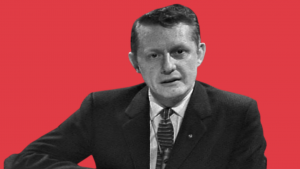
A rare glimpse into some of the debates that centered around homosexuality and equal rights in 1961.

By Nida Khan

This content contains scenes that may be too sensitive for some viewers.

On April 27, 1953, President Dwight Eisenhower signed Executive Order 10450, banning homosexuals from working for the federal government or any of its private contractors. In fact, the order listed them – along with alcoholics and neurotics — as “security risks.” It has been a long and arduous road paved with organizing, demonstrations, public pressure and legal battles to the present, with the current President saying that he wants every member of the LGBTQ+ community to “know that you are loved and accepted just the way you are, regardless of whether or not you’ve come out”. 

How did we get here?   

Aired in 1961, The Rejected was immediately recognized as a groundbreaking film that opened up for discussion some of the issues surrounding LGBTQ+ life and legal rights. Several experts — a psychiatrist, a district attorney, religious leaders — discussed societal norms, LGBTQ+ life in a heterosexual society, and issues of rejection and isolation. Unprecedented for its time, The Rejected was considered both educational and courageous. Now, decades on, viewers can clearly ascertain the remarkable progress achieved by the LGBTQ+ liberation movement.   

James Day, General Manager of TV station KQED in San Francisco, provides important context for the discussion.

Part of the Legacy Archive Project of Exploring Hate: Antisemitism, Racism and Extremism, The Rejected is one of 50 films featured in this new public media content initiative. Providing historical context for the rise of hate in America and elsewhere, the Legacy Archive Project seeks to engage audiences to promote understanding, healing and civility. The films of the Legacy Archive Project touch on everything from antisemitism and the Holocaust to racism, slavery, Jim Crow and other examples of injustice and cruelty. The Rejected was an effort to examine the topic, and to challenge perceptions of LGBTQ+ life in the context of the early 1960s – a time when opening up a dialogue about this subject was itself a revolutionary act. Decades of grassroots activism and determined political pressure have since led to significant gains. 

On his very first day in office, President Joe Biden signed an Executive Order extending federal laws prohibiting sex discrimination to cover sexual orientation and gender identity as well – in employment, education, housing, health care and other fields. President Biden also issued an Executive Order ending the previous administration’s ban on military service by transgender Americans. In March, there was the Executive Order establishing the White House Gender Policy Council, and in February, the President signed an Executive Order expanding U.S. refugee admissions by cancelling a requirement to specify sexual orientation and gender identity. 

While all of these measures should be applauded, the LGBTQ+ community is under significant threat even today. In just the first few months of 2021, more than 100 anti-transgender bills were introduced in 33 states. Anti-equality extremists are still targeting and attacking members of the LGBTQ+ community, with hate crimes at a disturbingly high level. Many of the attacks — including murders — have gone unresolved, especially those committed against transgender people. 

The Equality Act, which would amend the 1964 Civil Rights Act explicitly to prohibit discrimination based on sexual orientation and gender identity, passed the House but failed to win the vote in the Senate. In many parts of the country, discrimination against LGBTQ+ people still is permitted under the law. The Equality Act would expand protections in employment, housing, public accommodations, and other essential areas. 

When the film The Rejected first aired in 1961, an open discussion about LGBTQ+ life and its impact on society was considered revolutionary. The film offers an eye-opening impression of attitudes and beliefs about LGBTQ+ life at the time, a reference point for advances achieved in ensuing decades — and a sense of the importance of continuing the struggle.  

The Legacy Archive Project of Exploring Hate: Antisemitism, Racism and Extremism launches with the hope of increasing our understanding of one another, while advocating for inclusion and tolerance. That is the only way to ever break down barriers, debunk misinformation and achieve equality. Or, in the deathless words of civil rights leader Fannie Lou Hamer: “Nobody’s free until everybody’s free.” 

The views and opinions expressed are those of the author.  

More From Legacy Archive Project

Journalist John A. Williams discusses Black pride and freedom from oppression.

Editorial: Justice Delayed Is Justice Denied

October 12, 2022

In summer 2020, the death of George Floyd at the hands of a police officer awakened in Americans a renewed sense of urgency. Protests broke out across the United States in a demand for justice, police reform and accountability.  

From the Archives

October 12, 2022 | Episode

Famed actor and activist Ossie Davis narrates and acts in this nine-part series from 1965. The first episode focuses on the word “negro” — its origin, its meaning in society and the deep psychological scars left upon people by its…

Full Film: Why in the World: After Auschwitz (1985)

October 12, 2022 | Episode

A weekly public affairs program geared toward teens, led by University of Massachusetts history professor David Wyman with a group of high school students in a roundtable discussion. The focus for this episode was the Holocaust, the lessons of history,…

Full Film & More: Elie Wiesel on The Nature of Human Nature (1985)

July 13, 2022 | Episode

Nobel laureate and Holocaust survivor Elie Wiesel discusses human behavior, the notion of indifference, trauma, faith, the importance of remembrance, and his love for Israel. In this exclusive interview Wiesel explains how a situation of absolute cruelty was allowed to…

Editorial: What History Can Teach Us About Hate Crime

July 13, 2022

With hate crimes and antisemitism on the rise, marginalized groups under attack, draconian laws in place restricting the right to vote, and the rescinding of human rights by the Supreme Court, this moment demands a close examination of how our…

Full Film & More: Nuremberg Trials Part I and II (1971)

July 13, 2022 | Episode

A difficult but important look at the post-WWII Nuremberg trials, held by the Allies to bring to justice prominent Nazis who participated in the Holocaust and other crimes against humanity. The work of filmmaker Pare Lorentz, Part 1 of the…

Editorial: Indigenous Erasure and the Fight for Recognition

April 19, 2022 | Video

"While official recognition of Indigenous Peoples’ Day and a National Day for Truth and Reconciliation are important and necessary symbolic steps, the Indigenous still face a very real threat from forces attempting to rewrite history."

From the Archives: A Conversation with Elie Wiesel

April 18, 2022 | Episode

A group of journalists sit down with Holocaust survivor Elie Wiesel, a renowned author and humanist. The Nobel laureate discusses everything from the rise of antisemitism and the origins of hate to Jewish/Black relations and the importance of preventing future…

Full Film & More: Take This Hammer (1964)

April 18, 2022 | Episode

Author and activist James Baldwin meets with members of San Francisco's African American community in 1963. Escorted by Youth For Service's executive director, Orville Luster, Baldwin is intent on discovering "the real situation of Negroes in the city, as opposed…

Full Film & More: The Long Walk: Tears of the Navajo (2009)

April 18, 2022 | Episode

Learn about the forced relocation of 6,000 Navajo through a 300-mile journey on foot into some of the most barren land in the Southwest. Elders share horrific accounts of hardship, starvation and death as the narrator translates.

Full Film & More: Confronted (1963)

April 5, 2022 | Episode

What happened when white Americans in Northern cities and towns were confronted with integration. The film captures images of the protests, the racist backlash, and the fight for equality.

Full Film & More: The Negro and the American Promise (1963)

April 5, 2022 | Episode

Dr. Martin Luther King, Malcolm X, and James Baldwin -- three of the most highly regarded civil rights leaders of the 1960s -- were united in their quest for Black empowerment. But their methods of approach were polarizing.

Full Film & More: From Protest to Resistance (1968)

April 5, 2022 | Episode

The antiwar, Black power and free speech movements came together in a broader effort of resistance against oppression. Focusing on three pivotal figures of the era – Stokely Carmichael, David Harris and Mario Savio – the film provides insight into…

About The Legacy Archive Project

February 7, 2022

A treasure trove of 50 archival documentary films, series, and rare interviews. Focused on the Black experience, indigenous rights, and antisemitism, the Legacy Archive Project includes conversations with civil rights leaders Dr. Martin Luther King, Jr., James Baldwin, Muhammad Ali,…

Full Film & More: Some of Our Best Friends – Part 1 & 2 (1969)

February 7, 2022 | Episode

Broadcast in 1969, 11 men and women from Black and Jewish communities gathered for a rare and candid conversation about racism, antisemitism and how they see one another. Passionate and at times combative, their frank discussion ranges from education to…

Full Film & More: Where is Prejudice? (1967)

February 7, 2022 | Episode

A group of 12 college students from various ethnic backgrounds, religions, and geographic locations live together for six days and six nights to determine where prejudice is within America. The Director of the Boston University Human Relations Laboratory worked and…