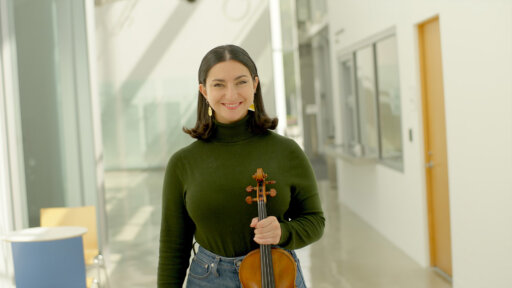
Do you get nervous to perform? Here, Allison Taylor, featured performer from Chasing Crescendos, shares her advice on how to beat the nerves and set you up for success.
Performance and practice are inseparable. The most important and effective performance habits are rooted in how we practice, and how we practice performing. These habits include physical aspects, including muscle memory and stress management (i.e. recognizing how stress manifests in our bodies and how to overcome it), as well as mental aspects, such as how we frame our approach to performing, how we talk to ourselves while we’re playing, and staying hyper-present and in control of our minds throughout our performance. This takes as much practice and as much patience—and is just as important to the foundation of a successful performance—as our scales and etudes. If you’re reading this in hopes of discovering a few magical, cure-all, fool-proof tips that crack the code to giving consistently perfect performances, you’ve come to… the wrong place. There’s no one-size-fits-all advice to having a successful performance; however, here are some tips that might help with approach to performance practice.
1. Visualize everything
We’ve all heard of the power of manifestation. Manifestation as a tool, in the form of visualization, can be immensely helpful when preparing for a performance. For me, the more detailed the visualization, the more effective and worthwhile this tool becomes. Here’s how I do it: I start by visualizing exactly how I want my performance to go, starting with what I will be wearing, how I will feel when I am backstage warming up, what it will feel like to walk on stage, the sound I aim to produce as I play, the way performing will feel in my hands, and every musical choice I plan to make until the very last note before I take my bows. You know what, while we’re at it, I’ll go ahead and visualize taking my bows and accepting my flowers. I’ve earned it.
Another way in which visualizing can aid in successful performance is by using it as a kind of play-through or warm up performance before you actually get on stage. How often does it feel better the second time we play something through? Using visualization techniques, we can convince ourselves we’ve already played it once, and feel as though the actual performance is the second time.
I usually take the time to run through these scenarios before I fall asleep, when I am on a plane or a train, or when I find myself needing to retreat into my own mind. If people question why you’re distracted or ask you what you’re thinking about, just tell them you’re practicing in your head for a performance you have coming up. They will either think you are bonkers, or they will understand. Either way, they leave you alone.
From start to finish, these visualizations usually take about as long as the performance itself. It may seem tedious at first, but oftentimes can be just as effective for me as actually playing things through on my instrument.
2. Practice performing
The benefit of putting yourself in front of an audience, regardless of stakes, cannot be overstated, as nothing can simulate the physiological effects of performing other than actually being in front of listeners and under pressure. Performing well is a skill in and of itself; it is the fraternal twin of practicing well. The practice room is the incubator and chopping block, and how we practice is imperative for building the trust within ourselves that is required for a successful performance. However, playing for yourself, in the comfort of your practice space, can only take you so far when it comes to physiological preparation. The more comfortable we become with actually performing what we’ve practiced, the easier it is to recognize how it feels to be ready. Trust, even when it comes to our own body and mind, is earned. When we practice something at home, and nail it 35 times in a row, why should we have any doubt, statistically, that we won’t nail it the next time we play it, even if that circumstance is on stage? We must create opportunities to prove that to ourselves.
Perform for anyone and everyone who will listen. The more performance opportunities you create for yourself, the more opportunities you have to try different exercises. For me, I know a performance has been successful when I am able to enter a meditative flow state, and achieve a truly present state of mind while I am playing. This can only be achieved when I can completely let go and trust my muscle memory, which comes from smart practice and visualization. Here are a couple of exercises I’ve used to help train my mind:
- Repeatedly thinking of one word throughout the performance—similar to a meditation; “om”.” Words that have worked for me include “calm”,” “chill”,” and “breathe.””. This keeps me grounded and keeps my thoughts in control, which in turn keeps my body in control.
- Tell yourself a story about the music you’re playing. What comes to mind when you play? What do you imagine the main character is feeling or doing when there’s a key change or dynamic change? How do the colors of the music feel in your body, and how do you hope to evoke that feeling through your playing?
3) Performing isn’t about not making mistakes—it’s about managing mistakes
Expecting a perfect performance is a recipe for disaster. A mistake-free performance is an impossible standard to hold yourself to, and will always lead to upset. Instead, accept that things won’t always go exactly as planned, and learn how to make split second decisions to recover immediately and move on, so that the rest of your performance is not affected. Use each performance as an opportunity to learn how you can best manage and recuperate—physically and mentally—from unexpected bumps in the road.

4) Be an actor
Here’s the first rule of acting: you cannot “act like” the character you are trying to portray, you must be the character. It is a great exercise to apply this to your performance practice. Practice being your favorite soloist or performer; someone you’ve seen perform and thought to yourself: “Wow, their confidence and accuracy is amazing. They literally never mess up”.” For a minute or two of your performance, convince yourself you are that person, with that level of confidence, and that level of consistency.
It is easy to let doubt creep in and shake our confidence during high pressure moments, but our minds are powerful tools: we can convince ourselves of almost anything. Even if you don’t feel so confident, channel your inner Denzel Washington or Meryl Streep and play the part—become, as an actor, a performer who has ridiculous confidence and impenetrable accuracy. In other words, fake it ‘til you make it.
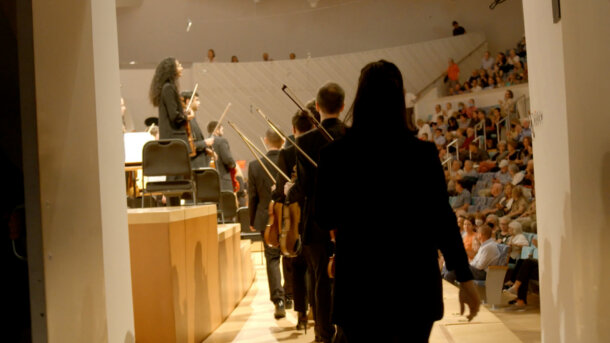
5) Perform as though someone who cannot hear or see and can only read your mind is in the audience
During a performance, how we talk to ourselves in real time can greatly impact the trajectory and outcome of how we play. It is easy to be self-critical (we spend much of our time in the practice room through this lens and so it becomes a force of habit), but getting caught up in imperfections can cause a performance to completely derail. We must accept that perfection is unobtainable, and focus instead on staying completely present—if anything, focus on what’s coming ahead in our performance—as opposed to focusing on what has already happened and what we cannot change.
An exercise that has helped me practice this mindset is to imagine that the only information my audience has about my performance is what is going through my mind. They cannot hear me, they cannot see me, but they are telepathic. If I am focusing on all the things I’m doing wrong, or what I’m unhappy with, or the note I played out of tune seven measures ago or the shift I missed at the beginning of the piece, my audience will know about every mistake I made and will probably think my performance didn’t go very well. However, if I only think about the music I’m producing in the moment, visualize my ideal sound as I am producing it, focus on the story I want to tell and the emotion I hope to exude, my audience will be very impressed. If I internally react kindly to my playing, and have positive self-talk as I perform, my audience will be none the wiser. For all they know, my performance was perfect! And isn’t audience perception of a performance just as (if not more) important as self-perception?