
Mason Bates, composer of “The Amazing Adventures of Kavalier & Clay” discusses how he uses a mix of hip-hop beats and a live orchestra to create the world of “The Escapist.”
Features
TRANSCRIPT
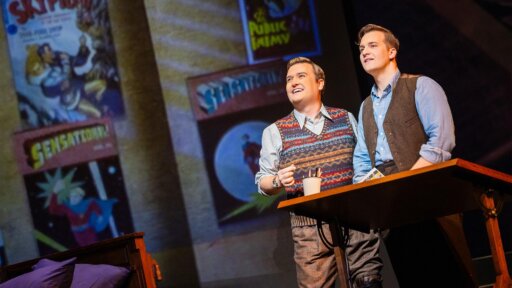
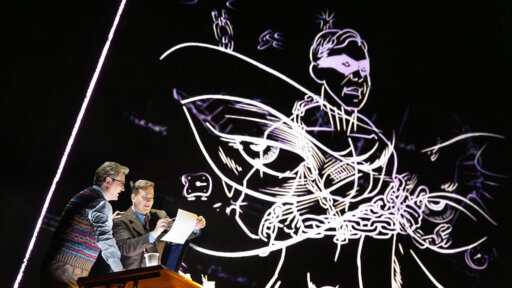
A place where a lot of things come together in the opera is this Escapist interlude where we see Joe and Sam, Kavalier and Clay building “The Escapist.” ♪♪ “The Escapist” is the superhero of the night who kind of comes out of nowhere and frees people from the bounds of fascism.
So he's not exactly like a Superman.
He's got a little more edge.
He's sort of like The Shadow.
And so I wanted to make sure his music had that edge of darkness too.
♪The Escapist ♪ So the world of superheroes is kind of electroacoustic.
I call it symphonic electronica.
We're going to build this beat by beat.
Here's just a beat behind him.
♪♪ So we add a layer of synthesizer.
♪♪ So here's what the orchestra is doing, if you kind of take away the electronica.
♪♪ So if we if we add all that together, sounds sort of like this.
♪♪ So that beat is kind of a hip hop beat.
You know, it's got that big backbeat element to it, and in a big space like this, those really big beats have a cool sound.
♪♪ Always when you're having electronica with an orchestra, you got to remember it's about the orchestra.
The electronica is coming out of the orchestra like a giant supernatural percussion instrument, but the orchestra itself has a world of sound.
And so we have a kind of heroic brass playing.
Weve got these huge percussion, percussion hits, also the strings are, you know, in this kind of quicksilver world, conjouring almost kind of flight and movement.
And of course, the woodwinds usually are getting the sparkle on top it.
♪♪ So all the orchestration then integrates with the electronica.
So we have that kind of symphonic electronica that I've been using in my non operatic works.
I've been integrating electronica into my symphonic works for like 20 years, and I really see it as an expansion of the percussion section, a kind of natural development.
If you look at like the history of the orchestra, really, it came from the opera, you know, adding things like a thunder sheet or a wind machine.
These are theatrical sounds that help with storytelling in addition to the rhythmic elements.
These are rhythms that can really kind of add a lot of visceral elements to a piece of music.
Beuase theyre very carefully orchestrated.
You can really take the storytelling to a different level.
♪♪ And it's such a dream come true for me to bring this piece to life here at the Metropolitan Opera.
♪♪
You May Also Like

GP at the Met: Akhnaten
Philip Glass’ masterpiece portrays the Egyptian Pharaoh as he rises to the throne.
Pavarotti: A Voice for the Ages - Preview
Some of Pavarotti's finest performances and in duet with pop stars and The Three Tenors.

GP at the Met: Otello (2016) - Preview
Aleksandrs Antonenko in his first Met performance as Otello, the tormented Moor of Venice.

GP at the Met: Lucia di Lammermoor
See the most recent production with French soprano Natalie Dessay

Capriccio
Renee Fleming sings her first full Met performance of Richard Strauss's final opera

GP at the Met: Don Carlo
Love, politics, and religion intertwine against the backdrop of the Spanish Inquisition