
Cordella, in church, in a long romantic soliloquy, praises her God for her good fortune, but wishes for the thing she cannot have, her father’s love. But she then blames her sisters, not him, but reverses course, and forgives all, as she is forgiven by her savior.
Scene 12 . . . Directory . . . Scene 14
Scene 13
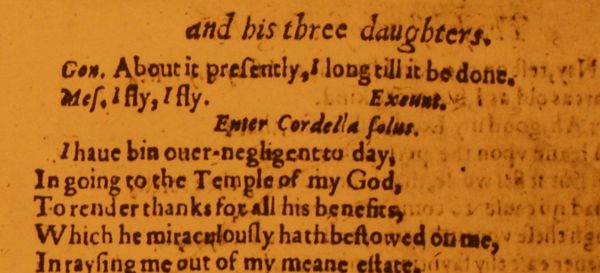
Enter Cordella solus.
CORDELLA: I have been over-negligent today,
In going to the Temple of my God,
To render thanks for all his benefits,
Which he miraculously hath bestowed on me,
In raising me out of my mean estate,
When as I was devoid of worldly friends,
And placing me in such a sweet content,
As far exceeds the reach of my deserts,
My kingly husband, mirror of his time,
For zeal, for justice, kindness, and for care … [13.10]
To God, his subjects, me, and Common weal,
By his appointment was ordained for me.
I cannot wish the thing that I do want;
I cannot want the thing but I may have,
Save only this which I shall ne’re obtain,
My father’s love, oh this I ne’re shall gain.
I would abstain from any nutriment,
And pine my body to the very bones:
Barefoot I would on pilgrimage set forth
Unto the furthest quarters of the earth, … [13.20]
And all my lifetime would I sackcloth wear,
And mourning-wise pour dust upon my head:
So he but to forgive me once would please,
That his gray hairs might go to heaven in peace.
And yet I know not how I him offended,
Or wherein justly I have deserved blame.
Oh sisters! you are much to blame in this,
It was not he, but you that did me wrong.
Yet God forgive both him, and you and me,
Even as I do in perfect charity. … [13.30]
I will to Church, and pray unto my Savior,
That ere I die, I may obtain his favor.
[exit.]