
Leir meditates alone on his plan to marry off his daughters, unaware that they know his plans. He admits some indefinite apprehension, but his daughters arrive “to rid me of this doubt.” Alluding to the near prospects of his death, he asks which daughter loves him best, put in terms of yielding to his wishes. Gonorill first suggests that she would kill herself or marry the worst of men if Leir so ordered. Leir beams, but Cordella (in an aside) says she abhors such flattery. Ragan then offers after more slavish flattery to marry whomever Leir commanded as well. Leir and Cordella react the same way. As it is her turn, Cordella says she owes no more than any child owes any father. The two daughters respond first, aghast at her impudence. Lier first wonders at her pride, but with encouragement from his two older daughters he soon works himself into disowning her and dividing the kingdom into two rather than three. She protests her sincerity and her sister’s false flattery in vain. Alone with Perillus, Cordella laments her now exiled fate, and Perillus grieves as well for Leir’s foolishness.
Scene 2 . . . Directory . . . Scene 4
Scene 3
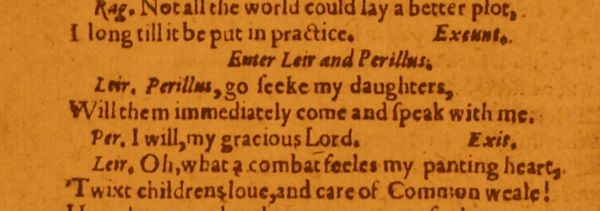
Enter Leir and Perillus.
LEIR: Perillus, go seek my daughters,
Will them immediately come and speak with me.
PERILLUS: I will, my gracious Lord. Exit.
LEIR: Oh, what a combat feels my panting heart,
‘Twixt children’s love, and care of Common weal!
How dear my daughters are unto my soul,
None knows, but he, that knows my thoughts & secret deeds.
Ah, little do they know the dear regard,
Wherein I hold their future state to come:
When they securely sleep on beds of down, … [3.10]
These aged eyes do watch for their behalf:
While they like wantons sport in youthful toys,
This throbbing heart is pierced with dire annoys.
As doth the Sun exceed the smallest Star,
So much the father’s love exceeds the child’s.
Yet my complaints are causeless: for the world
Affords not children more conformable:
And yet, me thinks, my mind presageth still
I know not what: and yet I fear some ill.
Enter Perillus, with the three daughters.
Well, here my daughters come: I have found out … [3.20]
A present means to rid me of this doubt.
GONORILL: Our royal Lord and father, in all duty,
We come to know the tenor of your will,
Why you so hastily have sent for us?
LEIR: Dear Gonorill, kind Ragan, sweet Cordella,
Ye flourishing branches of a Kingly stock,
Sprung from a tree that once did flourish green,
Whose blossoms now are nipped with Winters frost,
And pale grim death doth wait upon my steps,
And summons me unto his next Assizes. … [3.30]
Therefore, dear daughters, as ye tender the safety
Of him that was the cause of your first being,
Resolve a doubt which much molests my mind,
Which of you three to me would prove most kind,
Which loves me most, and which at my request
Will soonest yield unto their father’s hest.
GONORILL: I hope, my gracious father makes no doubt
Of any of his daughters’ love to him:
Yet for my part, to show my zeal to you,
Which cannot be in windy words rehearsed, … [3.40]
I prize my love to you at such a rate,
I think my life inferior to my love.
Should you enjoin me for to tie a millstone
About my neck, and leap into the Sea,
At your command I willingly would do it:
Yea, for to do you good, I would ascend
The highest Turret in all Brittany,
And from the top leap headlong to the ground:
Nay, more, should you appoint me for to marry
The meanest vassal in the spacious world, … [3.50]
Without reply I would accomplish it:
In brief, command what ever you desire,
And if I fail, no favor I require.
LEIR: O, how thy words revive my dying soul!
CORDELLA: O, how I do abhor this flattery!
LEIR: But what saith Ragan to her father’s will?
RAGAN: O, that my simple utterance could suffice,
To tell the true intention of my heart,
Which burns in zeal of duty to your grace,
And never can be quenched but by desire … [3.60]
To show the same in outward forwardness.
Oh, that there were some other maid that durst
But make a challenge of her love with me;
I’d make her soon confess she never loved
Her father half so well as I do you.
Aye then, my deeds should prove in plainer case,
How much my zeal aboundeth to your grace:
But for them all, let this one mean suffice,
To ratify my love before your eyes:
I have right noble Suitors to my love, … [3.70]
No worse than Kings, and happily I love one:
Yet, would you have me make my choice anew,
I’d bridle fancy, and be ruled by you.
LEIR: Did never Philomel sing so sweet a note.
CORDELLA: Did never flatterer tell so false a tale.
LEIR: Speak now, Cordella, make my joys at full,
And drop down Nectar from thy honey lips.
CORDELLA: I cannot paint my duty forth in words,
I hope my deeds shall make report for me:
But look what love the child doth owe the father, … [3.80]
The same to you I bear, my gracious Lord.
GONORILL: Here is an answer answerless indeed:
Were you my daughter, I should scarcely brook it.
RAGAN: Dost thou not blush, proud Peacock as thou art,
To make our father such a slight reply?
LEIR: Why how now, Minion, are you grown so proud?
Doth our dear love make you thus peremptory?
What, is your love become so small to us,
As that you scorn to tell us what it is?
Do you love us, as every child doth love … [3.90]
Their father? True indeed, as some
Who by disobedience short their fathers’ days,
And so would you; some are so father-sick,
That they make means to rid them from the world;
And so would you: some are indifferent,
Whether their aged parents live or die;
And so are you. But, didst thou know, proud girl,
What care I had to foster thee to this,
Ah, then thou wouldst say as thy sisters do:
Our life is less, than love we owe to you. … [3.100]
CORDELLA: Dear father, do not so mistake my words,
Nor my plain meaning be misconstrued;
My tongue was never used to flattery.
GONORILL: You were not best say I flatter: if you do,
My deeds shall show, I flatter not with you.
I love my father better than thou canst.
CORDELLA: The praise were great, spoke from another’s mouth:
But it should seem your neighbors dwell far off.
RAGAN: Nay, here is one, that will confirm as much
As she hath said, both for myself and her. … [3.110]
I say, thou dost not wish my father’s good.
CORDELLA: Dear father —
LEIR: Peace, bastard Imp, no issue of King Leir,
I will not hear thee speak one tittle more.
Call not me father, if thou love thy life,
Nor these thy sisters once presume to name:
Look for no help henceforth from me nor mine;
Shift as thou wilt, and trust unto thyself:
My Kingdom will I equally divide
‘Twixt thy two sisters to their royal dower, … [3.120]
And will bestow them worthy their deserts:
This done, because thou shalt not have the hope,
To have a child’s part in the time to come,
I presently will dispossesse myself,
And set up these upon my princely throne.
GONORILL: I ever thought that pride would have a fall.
RAGAN: Plain dealing, sister: your beauty is so sheen,
You need no dowry, to make you be a Queen.
Exeunt Leir, Gonorill, Ragan.
CORDELLA: Now whither, poor forsaken, shall I go,
When mine own sisters triumph in my woe? … [3.130]
But unto him which doth protect the just,
In him will poor Cordella put her trust.
These hands shall labor, for to get my spending;
And so I’ll live until my days have ending.
PERILLUS: Oh, how I grieve, to see my Lord thus fond,
To dote so much upon vain flattering words.
Ah, if he but with good advice had weighed,
The hidden tenure of her humble speech,
Reason to rage should not have given place,
Nor poor Cordella suffer such disgrace. Exit. … [3.140]