Grade Level 7-12
Subjects History and Geography
Estimated Time Required minimum 2 (50-60
minute) class periods
Introduction
In the bloodiest war in American history, the battle
of Antietam stands out as the bloodiest single day.
At the end of the battle, 2,108 Union soldiers were
confirmed dead, and another 10,293 were missing. By
comparison, on the bloodiest single day of World War
II, D-Day, the US forces lost only half as many men.
(In total, Union and Confederate losses were over nine
times the number lost on June 6, 1944.)
Though Confederate losses were slightly less; only 10,318
men, Commanding General Robert E. Lee lost a quarter
of his army. More importantly, Lee was repelled in an
attempt to invade the North, and hopefully gain recognition
of the Confederate government by European powers.
When the battle was finished, nearly twice as many men
had died in one single day at Sharpsburg as had fallen
in the War of 1812, the Mexican War, and the Spanish-American
War combined.
In this activity, students will analyze primary historic
sources relating to the battle as well as maps of the
battle. They will make conclusions about the impact
of the battle on the North and South, as well as investigate
why the battle allowed President Lincoln to announce
and sign the Emancipation Proclamation.
Relevant Standards
This lesson addresses national content standards established
by the Mid-Continent Research for Education and Learning
(McREL)
(http://www.mcrel.org/standards-benchmarks/).
History
• Understands the technological, social, and strategic
aspects of the Civil War (e.g., the impact of innovations
in military technology; turning points of the war; leaders
of the Confederacy and Union; conditions, characteristics,
and armies of the Confederacy and Union; major areas
of Civil War combat)
• Understands the provisions and significance
of the Emancipation Proclamation (e.g., reasons Abraham
Lincoln issued it, public reactions to it in the North
and the South)
• Understands the impact of the Civil War on social
and gender issues (e.g., the roles of women on the home
front and on the battlefield; the human and material
costs of the war; the degree to which the war united
the nation; how it changed the lives of women, men,
and children)
• Understands the influence of Abraham Lincoln's
ideas on the Civil War (e.g., the Gettysburg Address,
how the Emancipation Proclamation transformed the goals
of the Civil War)
Geography
• Knows major physical and human features of places
as they are represented on maps and globes (e.g., shopping
areas, fast food restaurants, fire stations, largest
cities, rivers, lakes, wetlands, recreation areas, historic
sites, land forms, locations of places discussed in
history, language arts, science, and other school subjects)
• Knows the geographic factors that have influenced
people and events in the past (e.g., the effects of
the site of a Civil War battle on the course of the
conflict.)
Resources used in the lesson
Episode 3 (chapter 8/ 44:04-1:02:10) of The
Civil War series, highly recommended but not required.
National Park Service Antietam National Battlefield
web page
(http://www.nps.gov/anti/).
specific links for the lesson
National Park Service (NPS) Antietam Battlefield Historic
site page (http://www.nps.gov/anti/)
(This is the home page for the NPS resources)
NPS Battle of Antietam (http://www.nps.gov/anti/battle.htm)
(This page highlights the battle, as well as provides
links for many resources relating to the battle, including
those listed below.)
Morning Phase Map (http://www.nps.gov/anti/map_top.htm)
(This map highlights the battle as it raged across the
Miller Cornfield.
Confederate Battle Eyewitness (Morning: Miller Cornfield)
(Private Isaac G. Bradwell, 31st Georgia Infantry) (http://www.nps.gov/anti/eyewit-1.htm)
Union Battle Eyewitness (Morning: Miller Cornfield)
(Major Rufus R. Dawes, 6th Wisconsin Volunteers) (http://www.nps.gov/anti/eyewit-2.htm)
Mid-Day Phase Map (http://www.nps.gov/anti/map_mid.htm)
(This map highlights the battle as it occurred along
what became known as "Bloody Lane".)
Confederate (Mid-Day: Bloody Lane) Eyewitness (Colonel
John B. Gordon, 6th Alabama Infantry) (http://www.nps.gov/anti/eyewit-3.htm)
Union (Mid-Day: Bloody Lane) Eyewitness (Sergeant Thomas
F. Galwey, 8th Ohio Infantry) (http://www.nps.gov/anti/eyewit-4.htm)
Afternoon Phase Map (http://www.nps.gov/anti/map_bot.htm),
which highlights the battle as it raged at the Burnside
Bridge
Confederate (Afternoon: Burnside Bridge) Eyewitness
(Lieutenant Theodore T. Fogle, 2nd Georgia Infantry)
(http://www.nps.gov/anti/eyewit-5.htm)
Union (Afternoon: Burnside Bridge) Eyewitness (Lieutenant
John W. Hudson, 35th Massachusetts Infantry) (http://www.nps.gov/anti/eyewit-6.htm)
NPS Emancipation Proclamation Page: (http://www.nps.gov/anti/emancip.htm)
supplementary links that may be used
NPS "Why Lee Invaded Maryland" Page: (http://www.nps.gov/anti/why_inv.htm)
NPS Antietam Time Line (http://www.nps.gov/anti/time_line.htm)
NPS "Eyewitness to Battle" pages (http://www.nps.gov/anti/eyewitness.htm,
http://www.nps.gov/anti/eyewitness2.htm)
NPS "Generals Who Died" (at Antietam) page
(http://www.nps.gov/anti/6_gener.htm)
"Official Records & Battle Description"
(Shotgun’s Home of the American Civil War page)
(http://www.civilwarhome.com/antietam.htm)
Various "Antietam Archives" information (http://www.antietam.com/antietam/)
The Battle of Antietam on the Web (http://www2.ari.net/brdowney/)
"Eyewitness History Page" (http://www.ibiscom.com/antiet.htm)
Reproduction of The New York Times coverage of the battle
(http://www.stcloudstate.edu/~brixr01/NYTSept181862.html)
American Memory photographs of Antietam
(http://memory.loc.gov/cgi-bin/query/v?ammem/cwar:0126-0156:T8)
National Archives and Record Administration (NARA) page
on the Emancipation Proclamation, including an essay
on the signing by noted historian John Hope Franklin
(www.archives.gov/publications/prologue/
summer_1993_emancipation_proclamation.html)
New York State Library "Virtual Visit" page
on the Emancipation Proclamation (http://www.nysl.nysed.gov/library/features/ep/index.html)
Lesson Strategy
Before beginning the lesson, the teacher may wish to
introduce it by having students view the battle segments
in The Civil War series (Episode 3, Chapter
8). This may also be supplemented with excerpts from
the accompanying book to the series. In addition, other
books regarding the battle or the war might be incorporated,
such as "Battle Cry of Freedom", by James
McPherson.
After the teacher has reviewed basic point regarding
strategy of the Union and Confederacy, as well as a
basic overview of the battle, the assignment is introduced.
The teacher should explain to the students that battlefield
correspondents were important to this war as they were
to any other war in which the American public had a
desire (and a right) to know what the army was doing.
Explain to the students that there were several correspondents
working for newspapers on both sides, reporting information
and making editorial judgments about each battle and
troop movement.
In this lesson, students will role play battle correspondents,
and will work in groups to develop newspaper "front
pages" which highlight the battle, as well as including
pictures of the battle scene, maps, and other pertinent
information. In addition, students will highlight an
editorial viewpoint on a major issue that was debated
in September 1862, that is, whether President Lincoln
should issue the Emancipation Proclamation.
Depending on the amount of technology available in the
school, the teacher may elect
to do the following:
• Have students develop "poster presentations"
using poster board to simply paste stories on it.
• If the teacher has access to software such as
Microsoft Publisher, they may elect to actually have
the students create pages using Publisher that can be
printed.
• If the teacher desires, using Publisher or similar
software, they may wish to publish the front pages as
web pages, and have them available online.
In planning the lesson, the teacher might also consider
dividing the class into groups, some representing "Northern
newspapers", and some representing the Southern
point of view. In addition, the teacher may note that
newspapers not only would want to present the news accurately,
but they would probably be mindful of the feelings of
their readership in regard to battles won or lost, soldiers
injured or killed, etc.
(Note: One good resource for news stories about the
war comes from the University of
Virginia’s "Valley of the Shadows" web
site. The newspaper archives can be found at http://www.iath.virginia.edu/vshadow2/newspapers.html,
while the entire "Valley" site is located
at
http://www.iath.virginia.edu/vshadow2/. In addition,
archival stories from the New York Times are available
at http://www.nyt.ulib.org/.)
Lesson Methodology
The teacher divides the class up into groups according
to whatever conditions desired (class size, grade level,
etc.) The teacher may also wish at this point to assign
roles (which groups will be Northern or Southern), or
allow the class to select this on their own.
The teacher may either elect to read the following,
or photocopy and distribute the following statement
to the students:
You, and the students in your group,
are a newspaper staff working in September 1862. Your
job is to report the Battle of Antietam as completely
as possible. Field reports (using online resources)
are available, as are photographs of the battle scene.
It’s your job to determine how to best cover the
story, write it, and then to create a front page for
your "newspaper", highlighting the following:
• An account of the battle, along with battle
statistics (number dead, areas captured by which side,
and other information).
• Eyewitness statements (quotes) of those directly
involved in the battle.
• Maps of the various phases of the battle.
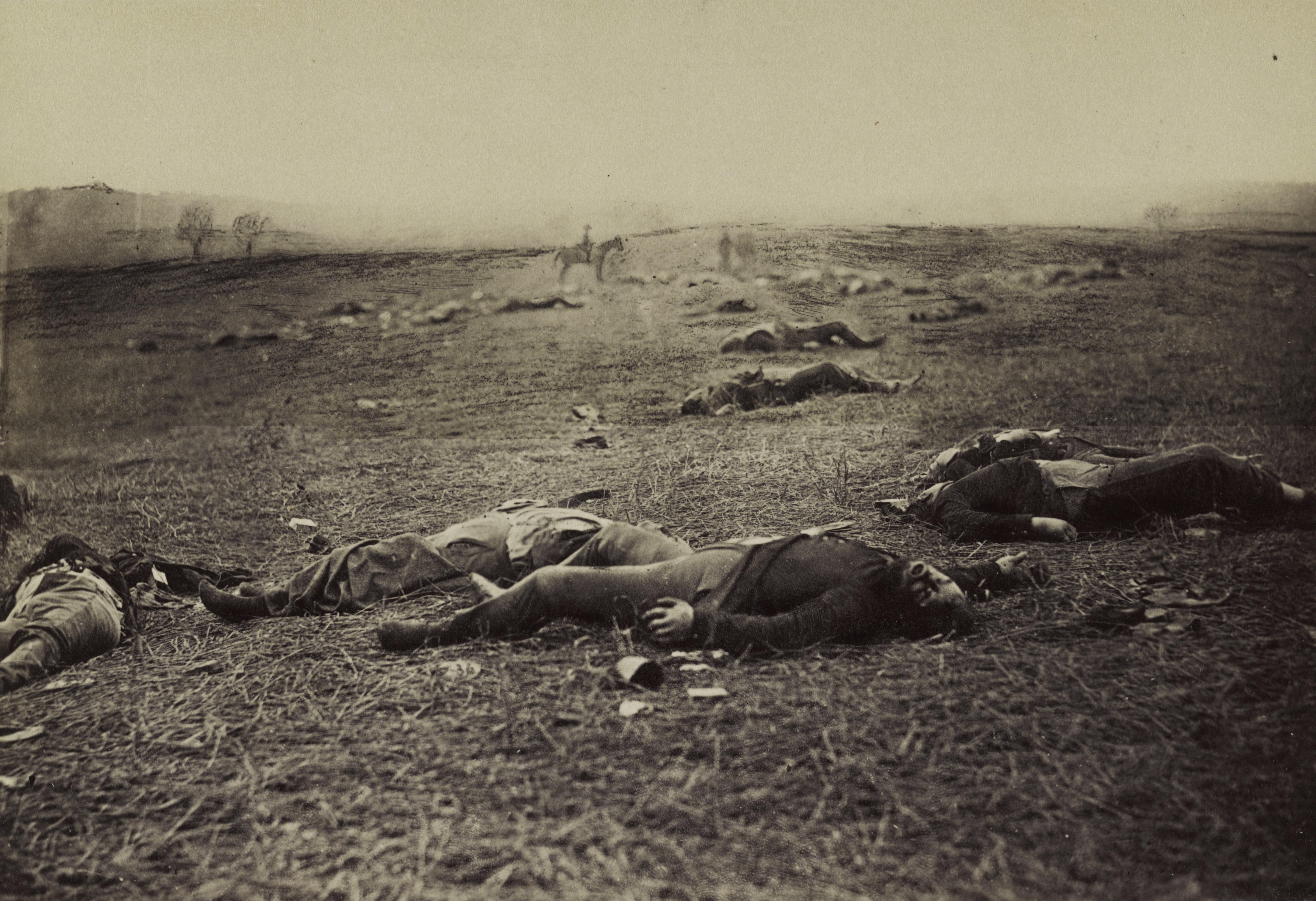
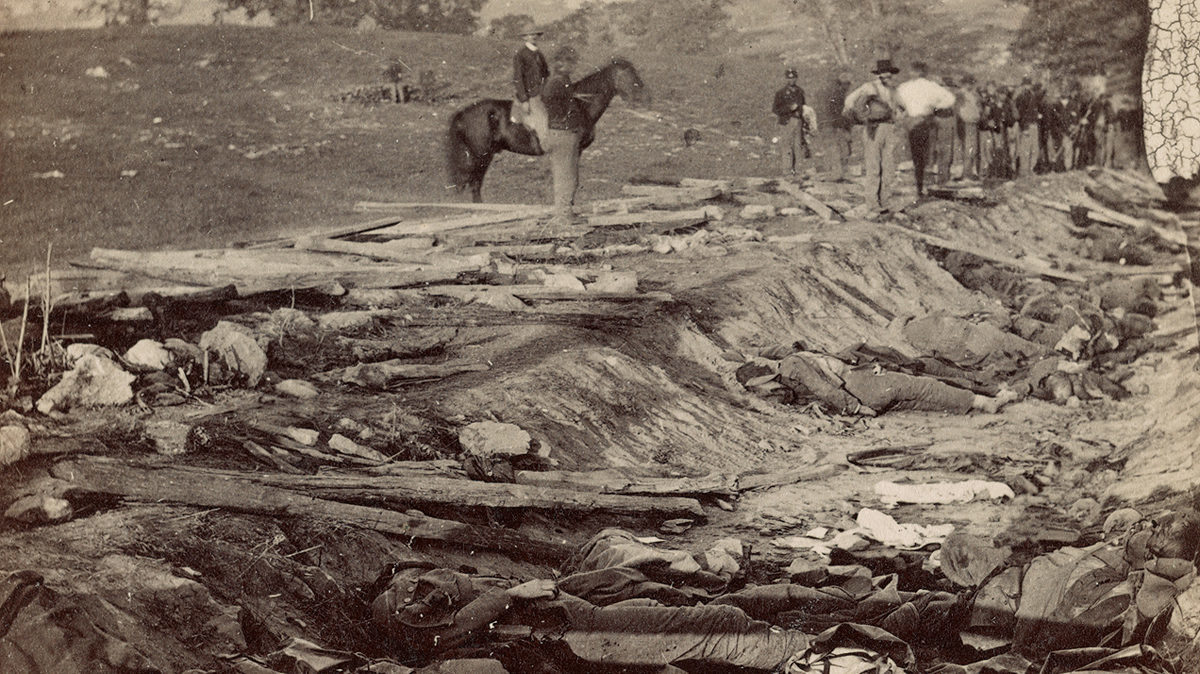
• Photographs of the battle scene or of the aftermath
of the battle.
• An editorial position regarding one of the major
issues of the period, that is, whether President Lincoln
should (or should not) emancipate the slaves. (Recall
that this obviously would not be popular in the South,
but was also opposed in the North by many.)
As a group, you should go about this
task in the following manner:
• Assign members of your group to do the appropriate
"reporting" (research on the web), and write
the stories.
• Assign members to investigate and write an editorial
(stating what you believe the opinion of your newspaper
and area of the country would be) regarding the emancipation
issue. Remember, you are trying to convince others that
your view is right.
• Assign members of your group to find pictures
that effectively highlight the story as well as maps
that will let your readers know what happened in this
battle.
• Assign members (or the whole group) to edit
copy (the stories your reporters do), write headlines,
and "layout" the information into an "as
easy to read" format as possible. Your teacher
will explain more about how that will be done.
• Remember, all work your group does should be
readable, but it should also be in your own words. If
you use a source, be sure to "quote" that
source when you write the story.
Finally, some simple journalism rules:
Remember good newspaper stories contain a strong lead,
that is a opening sentence which contains enough information
and is interesting enough to "hook" the reader
into reading the rest of the story.
Also, good newspaper stories answer the following questions:
Who (the people or groups involved in the incident)
What (what happened)
When (at what time/date did the event occur?)
Where (geographically, what is the location
of this event?)
Why (for what reasons did the event occur?)
How (in this instance, how did this incident
occur… how was the battle fought, what types of
strategies were used, etc.)
Finally, an editorial is an opinion story. The writer
is trying to persuade his audience. A news story is
factual, although during wartime, stories may be altered
because of censorship, or because the news source wants
to save the feelings of civilians at home. Editorials
are usually not the opinion of one individual, but the
stand of the publication on a particular issue.
From that point, allow the students to research the
information, pictures, and maps to do the layout. While
there is substantial information available on the Internet
about this event, remind the students that they are
the reporters, photographers, and editors, and the stories
are to be written in their own words and they should
remember to check their sources.
The teacher should determine how best to allow time
for research for the activity, based on the availability
of online resources, and the amount of time desired
for the lesson.
This lesson was written by Michael
Hutchison.
|