Grade Level 7-12
Subjects History and American Studies
Estimate Time Required 2 (50-60 minute)
class periods
Overview
"… then there is nothing left me but
to go and see General Grant, and I would rather die
a thousand deaths…"
--Robert E. Lee, April 9, 1865
The Civil War still holds the distinction of being the
bloodiest in American History. It all came to an end,
however, in the parlor of Wilmer McLean’s home
at Appomattox Court House, Virginia, in April, 1865.
While the war may have been bloody, the terms given
by General Ulysses S. Grant to Robert E. Lee for the
surrender of the Army of Northern Virginia were extremely
generous. In this activity, students will analyze these
terms, as well as the events leading to Lee’s
surrender, by investigating Grant’s own memoirs
of this time.
Related Resources for this Lesson
Chapter
LXVII of Ulysses S. Grant’s memoirs (http://www.pbs.org/wgbh/amex/grant/broadband/memoirs.pdf)
Episode 8 (chapter 6/ from 34:15-34:45; chapter 7/ 34:46-49:11; and chapter 8/ 49:12-1:04:00) of The
Civil War Series, highly recommended but not required.
Relevant Standards
This lesson addresses national content standards established
by the Mid-Continent Research for Education and Learning
(McREL) (http://www.mcrel.org/standards-benchmarks).
History
• Understands issues other than slavery that led
to the Civil War (e.g., the appeal of the Northern "free
labor" ideology in preventing the further extension
of slavery in the new territories; cultural differences,
conflicting economic issues, opposing constitutional
perspectives)
• Understands the technological, social, and strategic
aspects of the Civil War (e.g., the impact of innovations
in military technology; turning points of the war; leaders
of the Confederacy and Union; conditions, characteristics,
and armies of the Confederacy and Union; major areas
of Civil War combat)
• Understands the circumstances that shaped the
Civil War and its outcome (e.g., differences between
the economic, technological, and human resources of
both sides; the impact of the Emancipation Proclamation
on the outcome of the war)
Strategy for the Lesson
The teacher may wish to open with a discussion of the
last days of the Civil War as well as Grant’s
strategy to defeat Lee. In order to enhance this, the
teacher may wish to either show related scenes from
the series, or utilize the companion book. (In the book,
the end of the war and Lee’s surrender to grant
are chronicled from pages 365 to 381.)
The teacher may also wish to discuss battle strategy
with the students, and can utilize the maps
on this site to do so. If the teacher has not noted
to this point Grant’s strategy of forcing the
Confederates to lose men and material that they could
not replace, that issue might be used to help explain
why Lee decided to surrender.
(Note: as a historic side note, the teacher may wish
to discuss the role of Wilmer McLean in the surrender,
as well as in the Battle of Bull Run, which was the
first major battle of the war. McLean’s house
was used as a headquarters during the Battle of Bull
Run, and was damaged in the battle. McLean then decided
to move, and his second home was used as the site of
Lee’s surrender to Grant.)
Next, the teacher might briefly discuss the surrender
and its terms, noting the leniency Grant gave to Lee’s
army. Distribute copies of the pages of Grant’s
memoirs to the students.
Before distributing the question sheets, the teacher
may wish to discuss the importance of primary historic
sources with the students, and may also wish to discuss
the idea of subjectivity of that source. The teacher
might note that primary sources are especially important
because they are from an eyewitness, someone who was
actually present at the event. However, students and
historians must also look at the source’s bias…
that is, whether their own personal views and opinions
unduly flavor their account. The teacher may wish to
have students specifically look for instances of Grant’s
bias, if any.
The teacher can then distribute the question sheets,
directing the students to read through the chapter of
Grant’s memoirs and answering the questions. (Please
note: two versions of the question sheet are posted.
One with possible answers and one for student distribution.)
Extension Activities
• Have the students discuss in class discussion
the merits of "unconditional surrender". (The
teacher may also wish to note that the Allies demanded
unconditional surrender of the Axis Powers in World
War II.) Did Grant follow through with this idea with
his treatment of Lee, or did he abandon this idea? Have
students take different sides on the issue and try to
"win" the argument.
• Based on the memoirs, class discussions, and
viewing the series, have students compare Grant to Lee
in regard to the way they conducted themselves during
the surrender. (For example, students might want to
consider Grant’s dress versus Lee’s attire.)
Question Sheet for Lee and Grant at Appomattox
Court House
(with possible answers)
1. The selection you are reading is from US Grant’s
personal memoirs of the Civil War. What kind of perspective
would you expect Grant to have regarding these events?
(Answers vary. Many might say Grant would have the perspective
of the victor, and would explain what happened in terms
of a victorious general. Others might look at Grant’s
gestures toward Lee as being compassionate, and might
be likely to say he was relatively objective in his
account.)
2. Grant describes the events of the day before he and
Lee meet. What illness or ailment did Grant have at
this point? How did he try to cure it? How was it finally
cured?
(Grant noted at several points in his memoirs that he
was suffering "very severely" with a "sick
headache". He used what was probably the traditional
remedy for that in the mid 19th Century, which included
bathing his feet in hot water and mustard as well as
putting mustard plasters on his wrists and back part
of his neck.
Grant noted that as soon as he read Lee’s note
suggesting they meet to formalize the surrender of the
Confederate army, his headache disappeared.)
3. Grant also includes several excerpts of correspondence
between he and General Lee. How would you describe the
correspondence between the two?
(Because salutations and letter writing in the 19th
Century differed from that of the 21st, it might be
difficult for students to specifically note instances
where Grant was cordial to Lee, forceful, etc. However,
some might look at Grant’s note of April 9 where
he states that by the South laying down their arms,
they will hasten "that most desirable event, save
thousands of human lives, and hundreds of millions of
property not yet destroyed." He then closes the
letter with "Sincerely hoping that all our difficulties
may be settled without the loss of another life…"
Other students may look at Grant’s mention in
this note that the "meeting proposed for ten A.M.
to-day could lead to no good" as being proof that
Grant was unwilling to negotiate with Lee unless Lee
surrendered his army.)
4. Some of Grant’s commanding officers believed
that Lee did not intend to surrender at all, but had
an alternative purpose. What did they believe Lee planned
to do?
(They believed Lee had planned the meeting to stall
Grant while Lee’s army escaped, hooked up with
General Johnston, and then fight a guerilla war. Grant’s
men wanted to launch an attack to defeat Lee’s
army.)
5. Finally, Lee and Grant met in the McLean home. Had
they met each other before? What did Grant recollect
about this? According to Grant, how were he and Lee
dressed?
[Grant wrote that he had known General Lee in the "old
army", and had served with him in the Mexican War.
He added that because of the difference in age and rank,
he didn’t think Lee would remember him. (Lee mentioned
he did, but Grant suspected that he mentioned that as
a courtesy.)
Grant noted that he did not expect the meeting to take
place so soon, so he was dressed in "rough garb",
without a sword, and he wore a ‘soldier’s
blouse’ for a coat, with shoulder straps of his
rank to indicate to the army who he was.
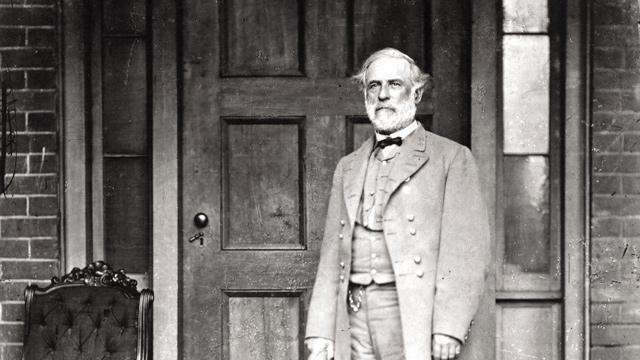
Grant noted that General Lee was dressed in a full uniform
that was entirely new, and was wearing a sword of "considerable
value, very likely the sword which had been presented
by the state of Virginia".
Grant also noted "in my rough traveling suit, the
uniform of a private with the straps of a lieutenant
general, I must have contrasted very strangely with
a man so handsomely dressed, six feet high and of faultless
form. But that was not a matter that I thought of until
afterwards."]
6. At a couple of points during the meeting between
the two men, Grant notes that at different points in
their conversation, they entered into "small talk",
and it was Lee who had to remind Grant why they were
meeting. What conclusions can you make regarding this?
(Answers vary. Some might note that Grant did not want
to make the situation difficult for Lee, and it was
hard for him to bring up the subject of surrender, so
Lee had to do it.)
7. Describe the surrender terms to which Lee and Grant
agreed.
• Rolls of the all the officers and men were made
in duplicate. One list was given to an officer designated
by Grant, the other list to an officer designated by
Lee.
• The officers were given individual paroles not
to take up arms against the Government of the United
States until "properly exchanged."
• Each company or regimental commander would sign
a like parole for the men of their commands.
• The arms, artillery, and public property to
be parked and stacked, and turned over to the officer
appointed by me (Grant) to receive them.
• Officers were allowed to keep their side arms,
personal horses, and baggage
• Each man was allowed to return to his home,
not to be disturbed by US authorities so long as they
observed their paroles and the laws "in force where
they may reside".)
8. In your view, were these terms harsh or lenient on
the South? Explain your answer.
(Answers vary. Most may state that they believe Grant
was easy on Lee. No one was arrested, nor was there
any attempt by the North to seize arms owned by the
Confederates. Grant mentions in the memoir that a rumor
had spread that Lee offered Grant his sword as a formal
surrender. Grant discounts this, but notes that if Lee
had offered the sword, Grant would not have accepted
it because of how the terms of the surrender had been
written. Students may also note that Lee mentioned to
Grant that his men were in need of provisions, and Grant
made arrangements to take care of Lee’s estimated
25,000 men.)
9. After the surrender was concluded, Union soldiers
began to celebrate Lee’s surrender. How did they
celebrate? What did Grant do regarding this celebration?
(The Union men commenced in firing a salute of a hundred
guns in honor of the victory. Grant immediately ordered
it stopped, noting "the Confederates were now our
prisoners, and we did not want to exult over their downfall.")
10. Grant notes at several points after the surrender,
his officers and Lee’s met together. How does
Grant describe these meetings? In your view, what message
does this send regarding the men who fought each other
during the war?
(Grant notes that some of his officers "seemed
to have a great desire to go inside the Confederate
lines", and adds that they finally asked Lee’s
permission to do so, to see some of their old army friends.
Grant writes that they had a "very pleasant time
with their old friends", and brought some of them
back when they returned. Grant also writes of his own
pleasurable conversations with Lee after the surrender.
Regarding the message send, answers vary. However, many
students might note, as is highlighted frequently in
the series and the book, that both Union and Confederate
soldiers saw themselves as friends although they’d
fought a war against one another.)
Question Sheet for Lee and Grant at Appomattox Court
House
(for student distribution)
1. The selection you are reading is from US Grant’s
personal memoirs of the Civil War. What kind of perspective
would you expect Grant to have regarding these events?
2. Grant describes the events of the day before he and
Lee meet. What illness or ailment did Grant have at
this point? How did he try to cure it? How was it finally
cured?
3. Grant also includes several excerpts of correspondence
between he and General Lee. How would you describe the
correspondence between the two?
4. Some of Grant’s commanding officers believed
that Lee did not intend to surrender at all, but had
an alternative purpose. What did they believe Lee planned
to do?
5. Finally, Lee and Grant met in the McLean home. Had
they met each other before? What did Grant recollect
about this? According to Grant, how were he and Lee
dressed?
6. At a couple of points during the meeting between
the two men, Grant notes that at different points in
their conversation, they entered into "small talk",
and it was Lee who had to remind Grant why they were
meeting. What conclusions can you make regarding this?
7. Describe the surrender terms to which Lee and Grant
agreed.
8. In your view, were these terms harsh or lenient on
the South? Explain your answer.
9. After the surrender was concluded, Union soldiers
began to celebrate Lee’s surrender. How did they
celebrate? What did Grant do regarding this celebration?
10. Grant notes at several points after the surrender,
his officers and Lee’s met together. How does
Grant describe these meetings? In your view, what message
does this send regarding the men who fought each other
during the war?
This lesson was written by
Michael Hutchison.
|