Grade Level 6-12
Subjects History and English
Estimated Time Required To complete
all activities would take 8 class periods, but teachers
can choose to implement some but not all activities
in the lesson.
Overview
The lesson begins with an analysis of what historians
can learn from ordinary Americans whose Civil War letters
were preserved. It begins with the moving and memorable
"Sullivan Ballou" letter (since made famous
by The Civil War series), and then asks students to
analyze a variety of primary source letters online.
Next, students are put into pairs of letter-writing
correspondents living in 1863. Partners represent a
variety of American voices, North and South, and the
lesson emphasizes the important roles women played during
the war. As the memorable events of 1863 unfold
-- the Emancipation Proclamation, Gettysburg, Vicksburg,
Chattanooga, the New York City draft riots -- students
respond to events and recount how their lives were affected.
Suggestions are made at the end of the lesson for implementing
the letter writing paradigm using a different sequence
of Civil War events.
Objectives
• To learn about events that were critical to
the outcome of the Civil War and its meaning in American
history.
• To learn about the roles ordinary citizens played
in making history, both men and women.
• To learn to analyze what historians can learn
from primary source material generated by average citizens.
• To learn as writers how to incorporate factual
material into fictional accounts.
Materials
• The web addresses listed within the body of
the lesson.
• Materials for writing old-fashioned letters
(paper, ink pens, etc).
• Episodes 1
and 5 of The
Civil War, highly recommended but not required.
Relevant Standards
This lesson correlates to the standards of the National
Center for History in the Schools (http://www.sscnet.ucla.edu/nchs/standards/).
Era 5, Standard 2
• Identify the turning points of the war.
• Evaluate provisions of the Emancipation Proclamation.
• Analyze the purpose, meaning, and significance
of the Gettysburg Address.
• Compare the motives for fighting and the daily
life experiences of Confederate with those of white
and African American Union soldiers.
• Analyze the reason for the northern draft riots.
This lesson correlates to standards for the Language
Arts of the Mid-Continent Research for Education and
Learning (http://www.mcrel.org/).
• Writes fictional and observational narrative…
Provides a specific setting for scenes and incidents;
provides supporting descriptive detail; uses literary
devices to enhance style and tone.
• Uses a variety of print and electronic sources
to gather information, including primary source material.
Procedure
Activity 1: Off to War
Ask students when they last wrote a hand written letter.
What prompted them to write their letters? Now ask them
when they last sent an email, and what occasioned their
writing it. Did any of these communications contain
important news? If students had something highly important
to convey, what means of communication would they use?
Why?
Now ask students how important they think letter writing
may have been in 19th century America. With telegraphs,
but no telephones, and relatively slow means of transportation,
people were often separated from one another without
any other way to communicate except
by letter.
Ask students to imagine they are living during the Civil
War. They themselves, or one of their family members,
has just enlisted and gone off to fight. How important
would it be to receive a letter in this situation? What
would those left at home hope to hear about? What would
those gone off to fight yearn to know?
Now show a segment from the first video of the PBS series
The Civil War. Begin with "Traitors and
Patriots" at 53:18 and stop at the end of "Gun
Men" at 113:05. This portion of the video describes
the signing on of volunteers for the Union and Confederate
armies during the opening months of the war. Ask students
as they watch it to pay special attention to any quotations
from letter (or diary) writers.
After viewing the segment hold a discussion of the following:
• Did the men who signed on envision a long or
short war?
• What important choices did men have to make
in these early days of the war? Why do you think men
from each side enlisted? (If you have not covered events
leading up to the Civil War, you can show the first
50 minutes of the video.) For example why might Sam
Watkins from Tennessee (who owned no slaves) have enlisted
to fight for the Confederacy?
• Why did Lee reject the offer to be general of
the Union forces, and instead choose the Confederacy?
What did this decision portend for the future of the
Civil War?
• Were African Americans at first allowed to fight?
What happened to fugitive slaves who fled to the North?
• The program describes what Grant, Lee, Sherman
(and other soon-to-be important players in the Civil
War) did in these early days. But the program also quotes
men like Elisha Hunt Rhodes from Rhode Island, and Sam
Watkins from Tennessee, men whose names were never destined
to be remembered in textbooks. What of importance can
we learn about the war based on what these men may have
written?
• If you were a man living during 1861, would
you have enlisted? If you were a woman, would you have
wanted your brothers, husbands and fathers to sign up?
Activity 2: Reading Letters from the Civil War
Now show the very last segment of the video, "Honorable
Manhood" from 132:05 to 132:23. This is a beautiful
reading of the "Sullivan Ballou" letter, since
made famous by the program itself. The letter is also
worth downloading and distributing to students for discussion.
*Sullivan
Ballou Letter
(http://usinfo.state.gov/usa/infousa/facts/democrac/23.htm)
At first just ask students how this letter made them
feel. Then proceed with the following questions:
• Why do you think Sullivan Ballou wrote this
letter?
• If you were Sullivan’s wife or children,
would you plead with him not to enlist in the Union
army? Why or why not?
• In how many ways does Sullivan comfort his wife
by what he writes to her?
• Does he have regrets for himself, or only for
his wife and children?
• Sullivan writes that he is "communing with
God, my country, and thee." What is his relationship
to the claims that each of these make upon his life?
• Images of "wind" and "breath"
appear and reappear in the letter. How are these images
related at different times to "God, my country,
and thee"?
• Sullivan says that he is perfectly willing to
die to pay the debt owed to those who fell in the American
Revolution. What debt, if any, do students feel we owe
to Sullivan Ballou and other men like him?
*Further information about the Sullivan Ballou letter:
Sullivan Ballou grew up in Rhode Island. His own father
died when Sullivan was 14; thus he understood in a most
poignant way what it would mean for his own sons to
lose their father. While growing up Sullivan had to
work at various times to support his family, but he
fought hard to acquire an education. After attending
public schools, he went to Phillips Academy in Andover,
Massachusetts and attended Brown University for two
years. He was admitted to the Rhode Island Bar in 1853.
A passionate Republican, and ardent supporter of Lincoln,
Sullivan naturally gravitated to politics. (The second
paragraph of the letter in many ways foreshadows the
Gettysburg Address.) He was elected as clerk of the
Rhode Island House of Representatives. By 1857 he was
so well respected that he was chosen Speaker of the
House. While his further forays into politics were for
the moment stymied, his law practice flourished. He
married Sarah Hart Shumway in 1855. He died after his
leg was amputated following the battle of Bull Run.
His wife never remarried. As Sullivan predicted, Sarah
was able to successfully raise their two sons; one graduated
from Brown University and became a lawyer like his father.
While Sullivan mailed other letters to his wife, this
one was found in his trunk. It was probably intended
for her eyes only upon his death, and may explain why
he allowed himself to give into his forebodings. Another
interesting fact about the letter is that it has never
been found in Sullivan’s own handwriting. Perhaps
he dictated it in the hospital, or perhaps his wife
would never part with the original copy. Sullivan Ballou
has no surviving heirs.
(*This information
is based on an article that appeared in the Brown Alumni
Monthly, November 1990, written by Charlotte Bruce Harvey.)
Now divide the class into small groups such that each
group is given one of the pairs of letters listed below.
There are letters written by southerners and
northerners, including letters from a free African American
family(the Demus letters). While most of the authors
are men, there is a letter by Mary Jane Demus, two letters
by E. and Fannie Hunt, and another set by Mary Lincoln.
(You may wish to ask students if it is likely that more
men’s letters than women’s have been preserved
from the Civil War period; if so why and to what effect.)
Materials at the Websites give a varying amount of information
about the letters and/or letter writers.
You can print out the letters or have students work
directly on them from computers. First have each group
fill out a Written
Document Analysis Worksheet from the National Archives.
(http://www.archives.gov/digital_classroom/lessons/analysis_worksheets/
document.html)
In addition give them the Civil War Letter Analysis
Worksheet below. As they fill it in remind
students that from one person’s letter they may
be able to make inferences about the recipient of the
letter as well as its author.
Civil War Letters Analysis Worksheet
• What can we infer about the letter writer at
the time the Civil War started, his or her home, family
members, work, level of education? How do you know?
• Can we tell which side the author of this letter
supported, the Union or Confederacy? If so, how do we
know? Give specifics.
• What is happening during the Civil War at the
time the letters were written? (Students can check their
texts and/or internet sources)
• If the author is a man, why do you think he
has enlisted? Does he say anything about the views or
attitudes he holds that have led him to make the commitment
to fight, or can we infer them in any way?
• If the author is a woman, does she say anything
that enables us to know which side of the conflict she
supports and why?
• If either the author or recipient is a woman,
what can we learn about the lives of women during the
Civil War from the letters? How did women make sacrifices
for or contributions to the war effort, even though
they themselves could not fight or hold political power?
• What personal concerns does the author express?
Is the Civil War the only threat to his or her well
being and happiness?
• How important does it appear to be for the author
to receive letters and/or to write letters at this time?
Why?
• By searching the Internet site where the letters
appear, or any other sources, what can you discover
about the letter writer?
When teams have finished analyzing their letters, ask
one member from each team to come before the class as
the letter writer. (Draw on students with some
dramatic flair to volunteer for this.) Each "author"
should then describe him or herself, thereby sharing
the contents of the letter(s).
As another activity you can ask students to compose
a letter in answer to the last one in the set they read,
responding as the addressee might have.
The following letters are from the Valley of the Shadow
Web site: (http://www.iath.virginia.edu/vshadow2/).
• Franklin County, Pennsylvania: David Demus to
Mary Jane Demus, November 8, 1863 and February 23, 1864.
http://etext.lib.virginia.edu/etcbin/civwarlett-browsemod?id=F3060
http://etext.lib.virginia.edu/etcbin/civwarlett-browse?id=F3009
• Franklin County, Pennsylvania: Letters of E.
and Fannie Hunt, December 1, 1861
http://etext.lib.virginia.edu/etcbin/civwarlett-browse?id=F0647
http://etext.lib.virginia.edu/etcbin/civwarlett-browse?id=F0648
• Franklin County, Pennsylvania Samuel M. Potter
to Cynthia Potter, December 10, 1862 and July 20, 1863.
http://etext.lib.virginia.edu/etcbin/civwarlett-browse?id=F0013
http://etext.lib.virginia.edu/etcbin/civwarlett-browse?id=F0020
• Augusta County, Virginia: Brooks Family Letters,
Andrew Brooks to Mary Susan Brooks, January 23, 1861
and May 28, 1861
(http://jefferson.village.virginia.edu/vshadow2/cwbrookslist.html).
http://etext.lib.virginia.edu/etcbin/toccer-new2?id=
Bro1e28.sgm&images=images/modeng&data=
/texts/english/modeng/parsed&tag=public&part=1&division=div1)
• Augusta County, Virginia: Letters of the Cochran
Family
John H. Cochran to his mother, December 11, and December
21,1860
http://etext.lib.virginia.edu/etcbin/civwarlett-browse?id=A0572
http://etext.lib.virginia.edu/etcbin/civwarlett-browse?id=A0573
• The following letters written by Mary Todd Lincoln
are in the
Abraham Lincoln manuscript collection of American Memory
(http://memory.loc.gov/ammem/alhtml/malhome.html
). Do a keyword search.
Letter, Mary Todd Lincoln to Abraham Lincoln November,
1862
(This letter also appears in "Words and Deeds"
in the Manuscript Division where it is exhibited with
background information)
Mary Todd Lincoln to Abraham Lincoln, November 3. ("Contraband"
refers to fugitive slaves. Congress had just forbidden
their return to their masters.)
Activity 3: Becoming Civil War Letter Writing
Correspondents
Next, tell students that you are going to put them into
pairs. Each pair will choose imaginary identities for
themselves such that one writer is or pretends to be
a girl, and the other writer is or pretends to be a
boy. Assign each pair to write as either supporters
of the Confederacy or the Union such that the class
is about evenly divided. (During the Civil War no mail
was sent across Confederate lines into Union states.)
If your class has an odd number of students ask two
to write as "twins" to a third student, or
become a letter writer yourself.
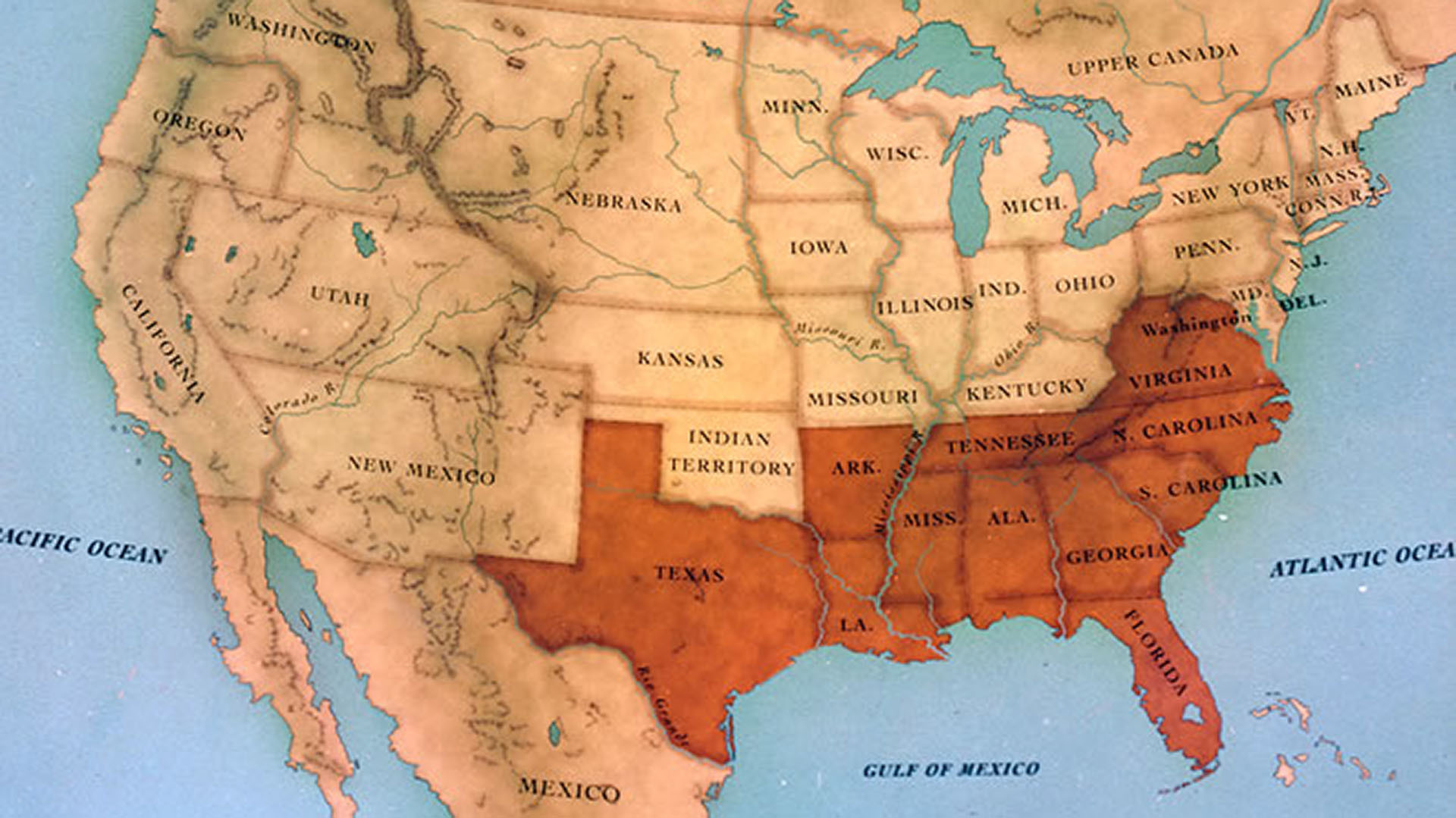
After you have partnered students, tell them to look
at the map of the U.S. in 1861, and then to decide the
following about themselves:
• What are your imaginary names?
• How do you know one another, or how are you
related? (e.g. mother/son, father/daughter, sister/brother,
husband/wife, engaged couple, etc.)
• How old is each of you?
• Where does each of you live? What are your addresses
(no zip codes needed back then!)
(Note: Students should consider the various kinds of
Americans living in the 1860’s – they might
be an immigrant, a freeborn African American, a slave,
a Mexican American, an American whose ancestor fought
in the American Revolution, and so forth.)
Pass out index cards and ask each pair to write on the
top their real names and below to write down the answers
to the above questions.
Once their identities have been approved by you, assign
each student (in consultation with their partner) to
write a biographical description of themselves, based
on the following list:
• Describe your home.
• Describe the most important members of your
family in some detail.
• Describe your upbringing and the extent of your
education.
• Describe your livelihood or how you were financially
supported before the Civil War began.
• Describe your reasons for supporting the position
of either the Union or the Confederacy.
• If you are a man, explain what compelled you
to enlist to fight. If you are a woman, explain how
you feel about your writing partner joining up to fight.
• Describe the most pressing concern in your life,
your hopes and dreams, before the war broke out.
• Describe the ways in which you fear the war
will change your life.
Next, ask each student to get a photograph of their
character. They can use a downloaded image from the
web, or take a photo of themselves dressed in costume.
You can post their biographical descriptions and photographs
under the index cards for all class members to read
and see. They will generate great interest and excitement
as the lesson proceeds!
Activity 4: Women and the Civil War
All the men in the primary source documents students
read enlisted to fight in the Civil War, as do the men
that students are role-playing. What were the choices
open to women who wanted to contribute to the war effort,
and therefore, how might the letter-writing roles play
out for women? Ask students to brainstorm a potential
list and write their ideas on the blackboard.
In order to understand gender roles in the 19th century,
ask students to read the following essay about "The
Cult of Domesticity and True Womanhood"
(http://www.library.csi.cuny.edu/dept/history/lavender/386/truewoman.html).
It describes the 19th century ideal of white middle
and upper class womanhood as having four characteristics:
piety, purity, submissiveness and domesticity.
Now ask the following questions:
• How were women expected to behave at this time
in history?
• What can you infer about the way men were expected
to treat women?
• What were women not expected to do, and what
were some of the negative consequences they faced if
they broke with convention?
• To help in the war effort, what activities could
be done in the home?
• What difficulties did women face if they ventured
from their homes in order to work?
Show the video segment "She Ranks Me" from
Episode V of The Civil War, beginning at 53:31-56:34.
Now introduce the following list of women who actually
did contribute to the war effort in some unusual ways:
Louis May Alcott – author and army nurse
Clara Barton – founder of the American Red Cross
Mary Ann Bickerdyke – hospital administrator
Belle Boyd – spy
Kady Brownell – "daughter" of a regiment
Lydia Maria Child – abolitionist and author
Dorothea Dix –Union superintendent of nurses
Rose O’Neal Greenhow - spy
Sarah Edmonds – fought disguised as a man
Charlotte Forten – taught in the Freedman’s
schools
Angelina Grimke – antislavery activist
Susie Taylor King – escaped slave, teacher and
nurse
Mary Livermore – hospital administrator
Harriet Beecher Stowe – author and anti-slavery
activist
Sojourner Truth – abolitionist
Harriet Tubman – abolitionist
Loreta Velazquez – recruited her own battalion
as a man
After students have done some preliminary research about
these women, ask students in what ways these women had
to break gender stereotypes in order to perform the
roles they did in the Civil War.
Useful Websites about women in the Civil War:
Women’s
Activities During the Civil War: A Select List of Photographs,
Library of Congress (http://www.loc.gov/rr/print/107_civw.html)
Biography of Charlotte
Forten (http://www.pbs.org/onlyateacher/charlotte.html),
a free-born African American who went South during the
war to educated freed slaves.
Rose
O’Neal Greenhow Papers, Duke University (http://scriptorium.lib.duke.edu/greenhow/).
Born in Maryland, O’Neal became a most effective
spy for the Confederacy.
Biographies
of Harriet Beecher Stowe and Lydia Maria Child (http://www.pbs.org/wgbh/amex/lincolns/wworld/index.html)
(author and anti-slavery activist), and an essay about
medical care during the Civil War.
Lydia
Maria Child’s letters to the Governor of Virginia,
1860 in American Memory.
(http://memory.loc.gov/cgi-bin/query/r?ammem/murray:
@field(FLD001+07016677+):@@@$REF$)
Hearts
at Home: Southern Women in the Civil War Era, University
of Virginia. (http://www.lib.virginia.edu/speccol/exhibits/hearts/)
Women
Soldiers of the Civil War, National Archives
(www.archives.gov/publications/prologue/
spring_1993_women_in_the_civil_war_1.html)
Activity 5: Letters Round 1
Now that students can envision the roles both women
and men played in the war years, they are ready to write
their letters. Letters will look authentic if they are
hand written on white stationery. Each should be headed
with a date and the place from which the letter is being
written. They should be "mailed" in envelopes
with the name and address of the fictitious person being
written to. For samples of Civil War envelopes go to
the collection of the New
York Historical-Society (http://memory.loc.gov/ammem/ndlpcoop/nhihtml/cwnyhsarcpp.html#env).
Letters can be tea-stained to make them look old.
Below are three rounds of letter writing topics and
activities. It speeds the process up if each partner
writes their Round 1 letters simultaneously. The postman
is the teacher who then distributes all letters at once.
Next, both partners respond simultaneously in Round
2 to the letters received in Round 1 and so forth. Between
rounds call up pairs to read aloud their letters, or
put students in groups of four (a northern pair and
a southern pair) to read each other’s ongoing
correspondence.)
Remind students to write about the events below in character
(and not in essay style). For example, in reacting to
the Emancipation Proclamation, how would the following
have been affected differently: a slaveowner, a slave,
a northern immigrant, a northern abolitionist. Also
remind students to write about their ongoing personal
lives – romances, finances, family stories and
so forth.
In between some rounds suggestions are made for watching
corresponding sections of The Civil War Part
5. (Alternatively students can follow events in their
texts.)
Round 1 Topics: January 1, 1863.
• Your wishes for the coming New Year.
• Your predictions about the prospects for ending
the war.
• Your response to the Emancipation
Proclamation (http://www.nara.gov:80/cgi-bin/starfinder/7594/images.txt)
and the enlistment of freed slaves and free Negroes
in the northern army.
• The Confederate army commandeers male slaves
as laborers and factory workers; your reaction.
• Confederate economic woes: prices rise 10% in
a month.
• Northern factories boom, but discontent with
slow progress of the war rises.
• Your efforts in the war; battlefront or homefront.
• Personal news, news from relatives and friends.
Enclosure: Send a political cartoon, a clipping from
a Civil War newspaper, and/or a casualty list from a
recent battle.
(For ideas go to http://xroads.virginia.edu/~CAP/SCARTOONS/cartoons.html
or http://etext.lib.virginia.edu/civilwar.html)
Video Interlude: The Battle of Gettysburg, "The
Universe of Battle" from 7:36 through "Gettysburg
the Third Day" to 32:15.
Questions to ask after viewing the segments:
• If you had been a foot soldier in one of the
battles, would you have understood the grand scheme
of the battle?
• If you had been a civilian in the surrounding
area, how would your life have been affected?
• If you had lived far away from Gettysburg how
would you have learned of the battle? Would you have
understood its full significance immediately?
Round 2 Topics: July 4, 1863.
• July 4th; it’s meaning to the cause you
support.
• Military progress this spring; revised predictions.
• Death of Stonewall Jackson on May 10; your feelings
about it and what it bodes for the future.
• The Battle of Gettysburg. Describe what you
experienced in some detail if you either fought in the
battle or served the army in some other function (e.g.
nurse). Write what you have heard about it in newspapers
or word of mouth if you were not there.
• Somewhere you have seen first hand an important
military or political leader. Describe the situation
and experience.
• The Union begins a military draft. Your reaction,
the reaction
of others (Note: NYC Draft Riots will erupt July 11.)
• The effort of women you know to support the
cause.
• A terrible personal loss (a child, a soldier,
aging parent, etc. related or not related to the Civil
War.)
• Your wishes for the person to whom you are writing.
Enclosure: Send a sketch of a battlefront or homefront
scene, something that helps your correspondent "see"
with your eyes a scene you have experienced. For Civil
War sketches go to the New
York Historical-Society collection at American Memory
(http://memory.loc.gov/ammem/ndlpcoop/nhihtml/cwnyhsarcd.html).
Video Interlude: Show "A New Birth of Freedom"
from The Civil War Part 5, 126:06 to 129:14.
This segment is about the Gettysburg Address. Ask students
to compare Lincoln’s words to those of Sullivan
Ballou with which this lesson began.
Round 3 Topics: Thanksgiving, 1863
• President Lincoln initiates a national day of
Thanksgiving the last Thursday of November. Experience
of this day in the North; reaction in the South.
• Gettysburg
Address (http://jefferson.village.virginia.edu/readings/gettysburg.txt)delivered
on November 19th. Whom did you know who fell at Gettysburg?
What do Lincoln’s words mean to you?
• The Battle of Chattanooga (fought October-November)
as you experienced or learned about it; what it portends.
• Blockade running in the South, stories and rumors.
• Enlistment of African American soldiers; work
of African American women.
• Experience of a hospital either as patient or
nurse(if you have not written about one yet).
• Ongoing personal news about family and friends
you know, health and finances, hopes, dreams and fears
for the future.
• Your revised predictions for the future of the
war.
Enclosure: A keepsake to be remembered by your correspondent
(e.g. lock of hair, photograph, tear-stained poem).
Activity 6: Debriefing
Hold a discussion posing the following questions:
• In how many ways was 1863 a turning point of
the Civil War?
• Why then did it take two more years for the
North to win the war?
• How did Northerners and Southerners experience
the war in different ways?
Assessment
Students can be assessed (either by the teacher or fellow
students) on the letters they wrote, according to the
following rubric:
• Did the student create a believable character
and consistently write and respond to events as that
character?
• Did the student cover the topics in all three
rounds in depth, thereby reflecting a solid understanding
of Civil War events?
• Were the letters well written, detailed, and
carefully proofread?
• Did the student include the enclosures with
each letter, and was care taken to make them seem authentic?
• Were envelopes labeled properly? Was an effort
made to make the letters appear authentically old?
• Did the student respond effectively to the letters
he or she was sent?
Extensions
• As a concluding activity you can hold a letter-reading
event. Ask students to dress in costume and to practice
reading aloud their letters with dramatic flair. Then
invite parents, or another class studying the Civil
War, to your reading.
• Ask students to continue to keep a diary as
their character through the end of the Civil War or
even through Reconstruction.
• Use the paradigm of the letter writing activity
and restructure it to cover a different set of events.
The activity works well with events leading up to the
Civil war, with a letter assigned for each of the following
years: 1856 Bleeding Kansas, 1857 Dred Scott Decision,
1858 Lincoln-Douglas Debates, 1859 John Brown’s
raid, 1860 Lincoln elected. In this paradigm assign
students to pairs with one Southerner and one Northerner
per pair. As events unfold partners should grow more
angry at one another as Civil war impends.
This lesson was written by Joan
Brodsky Schur.
|