|
|
 |
 |
|
|
 |
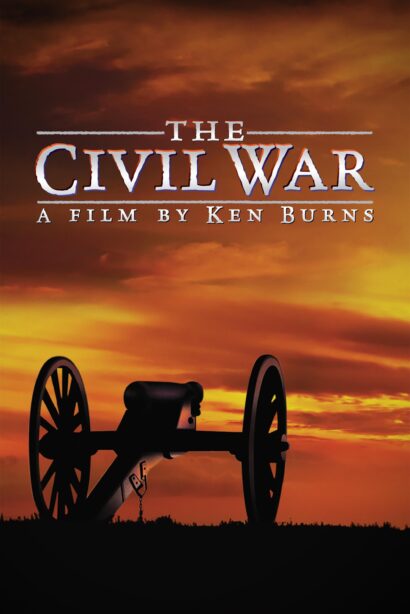
In a recent interview Ken Burns reflected on the film
and on the War and its role in America's history. Below is an
excerpt from that discussion.
QUESTION: When you undertook The Civil War,
your first long-form documentary series, you were tackling the
pivotal event in American history. Were you ever daunted at
all in the enormity of the task?
KEN BURNS: You know, when I look back at The Civil War experience, I can’t believe that I wasn’t
daunted every single day by the task. And the only excuse or
explanation I have is that I must have been incredibly naïve
and optimistic.
And maybe that’s what the whole story of it is about,
that I bit off more than I could chew, and then sort of slowly
and tenaciously learned how to chew it, with the help of extraordinary
people. You know, my brother was eventually the co producer;
and with Geoff Ward as the principal writer, David McCollough
as the senior creative consultant, Paul Barnes as the editor
and the help of assistants and cameramen, together, we were
able to figure out a way to wrestle this monster of an idea
to the ground.
I remember once talking to Shelby Foote about U.S. Grant, and
he said Grant had what they called "four o’clock
in the morning" courage, which meant you could wake him
up at four in the morning and tell him that the enemy had turned
his right flank, and he’d be as cool as a cucumber. I
think we all, as filmmakers — but I know, especially myself
— developed a kind of "four o’clock in the
morning" courage as each day you woke up with a gasp and
a gulp. "What have we taken on? How can we possibly understand
and represent this most defining event to the country?"
QUESTION: I’ve heard you say many times
when someone has pressed you about the impact of The Civil War,
you have defined it in the differences between two verbs, "are"
and "is." Can you explain?
BURNS: Well, this is something that we began
to see creeping into the language of Americans during the course
of the war, and it was reinforced by historians like Shelby
Foote, who reminded us that if all the complicated causes and
all the complex effects of the war are too difficult to ultimately
comprehend, we can see The Civil War in very simple terms.
Before the war, in speaking about our country, we said, "The
United States are" — plural. We saw ourselves as
a union, a stitched-together collection of states, a "many"
thing. After the war — though we ended slavery, we didn’t
really end the question of race that has bedeviled and ennobled
our struggle — we then began to talk about America as
a "one" thing, as a nation. And we began to say something
that is still to this day ungrammatical; we say, "The United
States is." And that is ungrammatical. It would be like
saying, "These shoes is."
And we say it without thinking about it because something happened
in those four years between 1861 and 1865 that, for whatever
reasons and for whatever consequences issued from it, formed
this country in a way that not even the Declaration of Independence
and the Constitution did. And so, in the end, the story of The Civil War is the story of the change of a simple verb from a
plural to a singular.
QUESTION: The film brings us so close to the
key figures in this drama. In all your years of research and
work on this project, was there one figure from The Civil War
period who struck you the most?
BURNS: I think if I look back at the series,
the strength of The Civil War series, as a film, as a documentary,
is the fact that we focused on telling a story, not just history
from the top down, but from the bottom up. So it was as important
for us to have our audience get to know the Northern grunt Elishah
Hunt Rhodes or the Southern soldier Sam Watkins, as well as
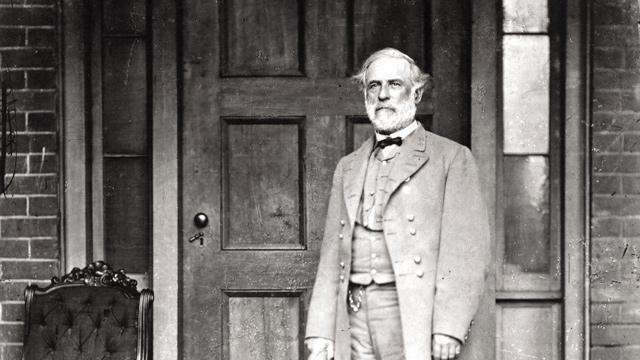
it was critical to know what was going on in the mind of Jefferson
Davis or Abraham Lincoln and the myriad generals, North and
South, that made the war go and happen and turn out the way
it did.
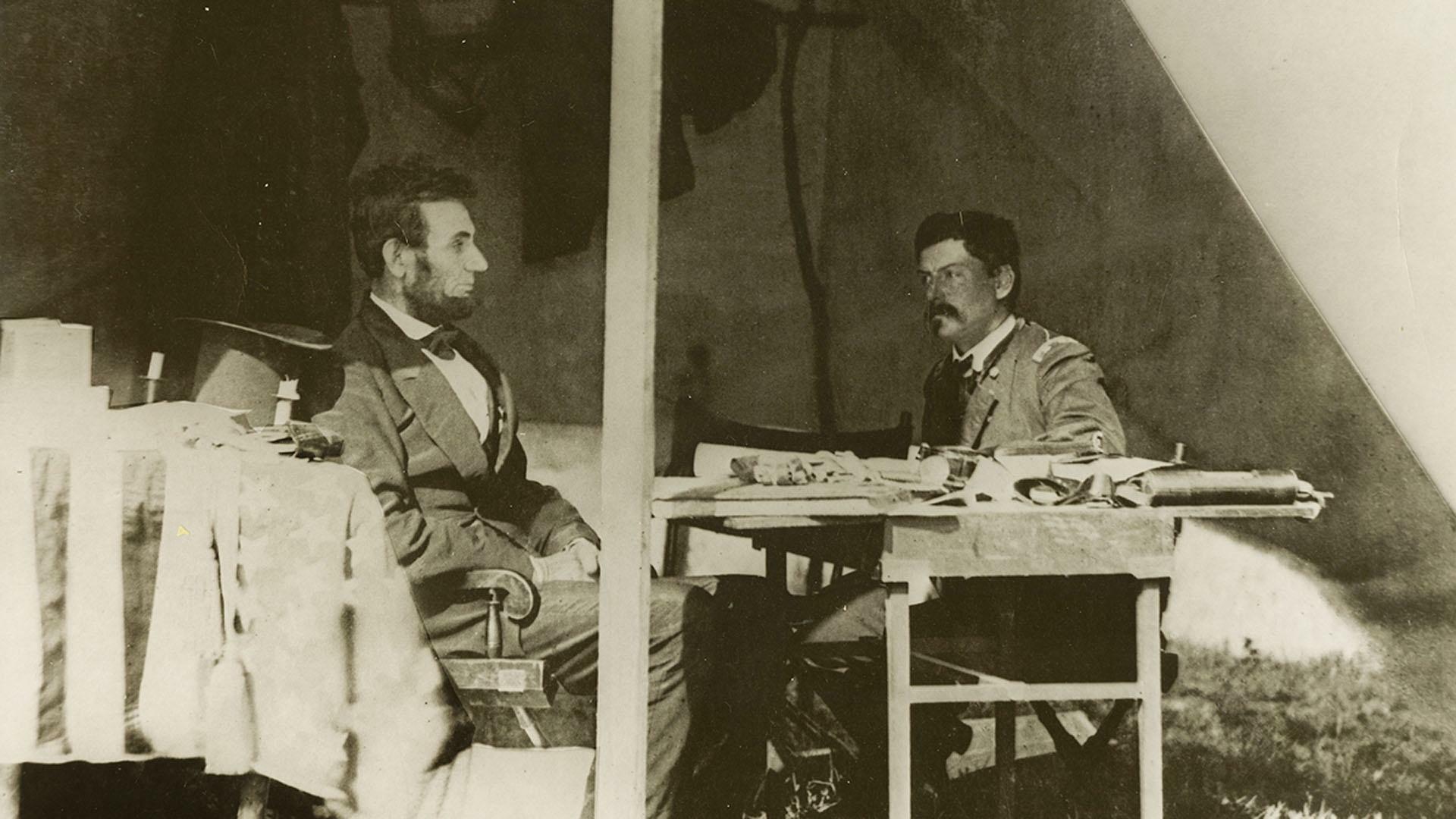
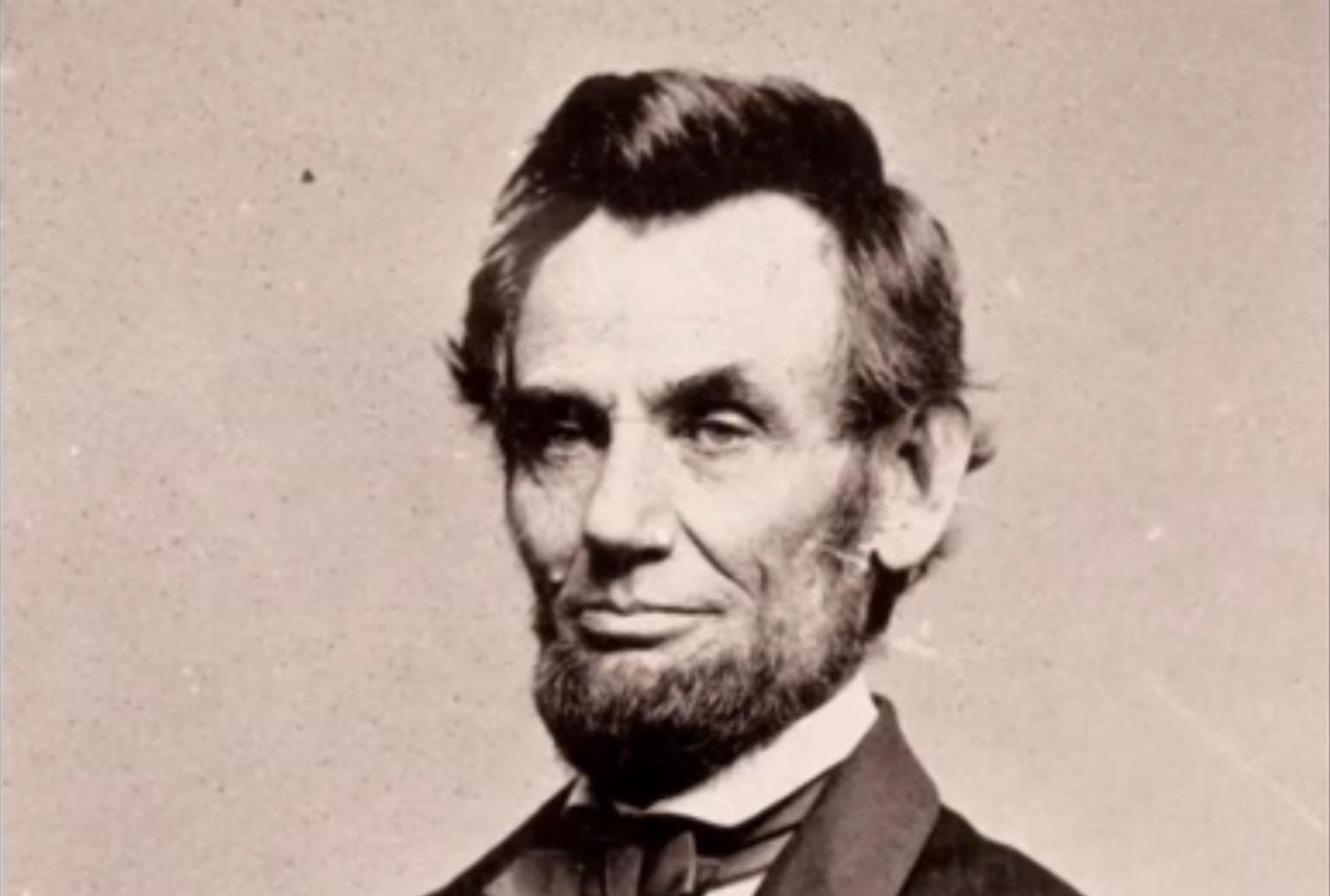
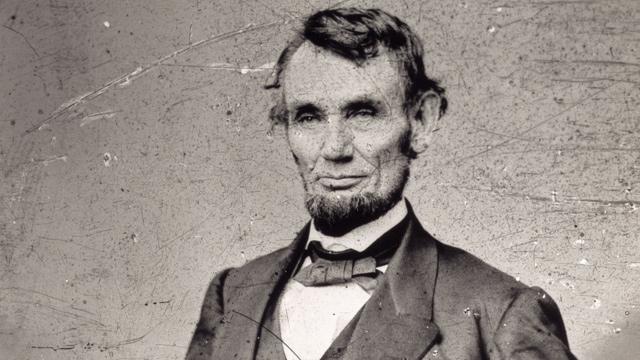
But at the end of the day, when you consider the important figures,
one cannot help but be inexorably drawn to that extraordinary
poet-president who saved the union, Abraham Lincoln: this unlikely,
essentially lower-middle-class guy from the frontier, from Kentucky
and Illinois, who had raised himself up and was able to not
just articulate what was going on in the moment, but to gather
together all the impulses of the past and to see into the possibilities
of our future, and to do so without a lot of fuss. And to do
so with a great deal of poetry, in the way he spoke about the
war and about the struggle. And helped to, I think, remake our
country, helped to reshape and give new purpose to ideas that
had perhaps become corrupted since the founding of the nation.
And he gave us this impulse, this new start.
He called it, in the Gettysburg Address, a "new birth of
freedom," and I think we still are the beneficiaries of
it today. You know, the Age of Enlightenment, of which the United
States is the prime, tangible example, still goes on today in
large measure because Abraham Lincoln was able to articulate
and help put into practice the manifestations of democracy and
freedom in a society for all people.
QUESTION: You also, in The Civil War, introduced
us to the actual ground on which these epic struggles were fought.
Was there any one of the many sites you visited and filmed at
that, to you, captured the essence of the conflict?
BURNS: We knew, as documentary filmmakers,
that one of the most dangerous things is to rely too heavily
on re-enactments and recreations. And so The Civil War has almost
none. I think there are a few instances where a horse runs through
a puddle and all you see is the hoof splashing the puddle and
erasing the beautiful blue sky in a muddy, dirt track. And that’s
all you see.
We rely instead on a kind of atmospheric, evocative, live, modern
cinematography that took in the two villages that we followed,
North and South, that took in sites like the Capitol dome or
the Smithsonian in Washington, or various other scenes. But
also, our cameras went to the battlefield, and we tried as much
as possible to go at the same time of day and year that the
battles took place, so that we would be in Gettysburg on
July 1st, 2nd and 3rd, hoping, straining, listening, trying
to catch the ghosts and echoes of this almost inexpressibly
wide path that we hoped to bring back for ourselves and for
our audience.
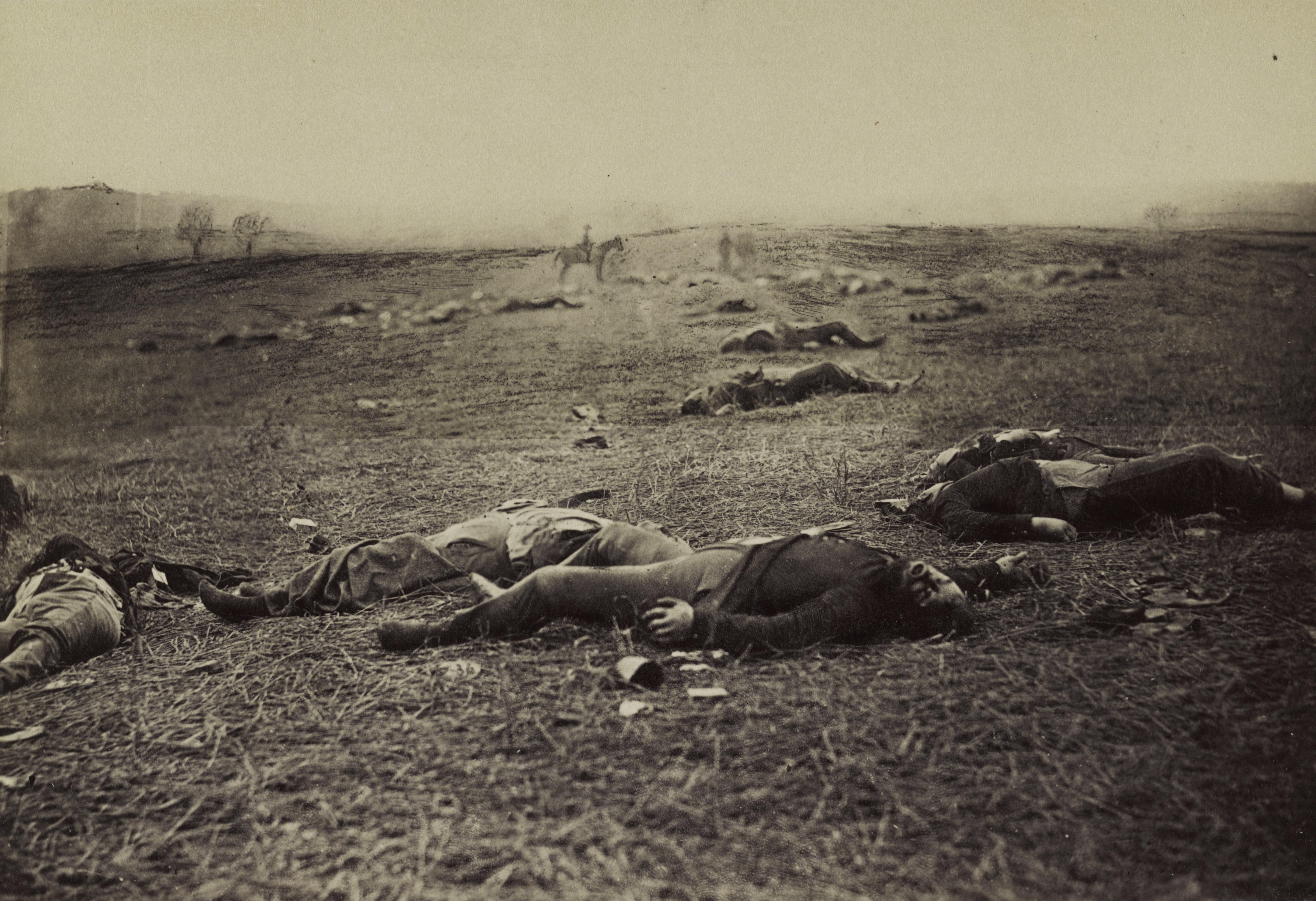
And we really endeavored to do this. And so, quite often, you’ll
see a peach tree in blossom at Shiloh, raining down on, now,
the quiet grass, as it did back in 1862, in a battle the size
of Waterloo, on the dead and the dying of that horrendous struggle.
But I think of all the places we’ve been — and it’s
really been from Deer Isle, Maine, down into Florida, and as
far west as Kansas and Missouri — it was the experience
in Gettysburg that sort of — you felt the ghosts. We chose
to focus a good deal of our attention on the life of Joshua
Lawrence Chamberlain. He had been a rhetoric professor at Bowdoin
College in Brunswick, Maine, and had been denied permission
to take a leave to go into the army. Instead, he took a leave,
supposedly, to study someplace, but actually became a colonel
commanding the 20th of Maine, a volunteer regiment. The regiment
saw horrendous action at Fredericksburg, which was a huge Union
defeat, and ended up on the extreme left of the Union line on
the second day of the Battle of Gettysburg, on this little hill
called Little Round Top. The times that we spent filming on
Little Round Top, you could almost swear you could hear the
bugle call or the musket fire or the moans and shouts of men.
And those experiences, I think, helped to cement Gettysburg
as the place, the defining experience of the war for us in terms
of place.
QUESTION: Prior to The Civil War, you had done
many successful films and a lot of acclaimed work, but the distinctive
style that you have, of great writing and music and compelling
commentary from experts, all seemed to coalesce with The Civil War. Can you talk about that process a little bit and how that
came to you?
BURNS: Well, there was some frustration after
The Civil War came out, that I wanted to yell that I wasn’t
born yesterday, that I had been struggling for well over ten
years with some of the styles and techniques that we used, in
a film first about the Brooklyn Bridge, in which we went in
and microscopically examined old photographs, used first-person
voices, complicated sound effects, evocative music, the telling
commentary of experts and what we hoped was a poetically written
and driven narrative.
And each subsequent film – on the Shakers, on the turbulent
Southern demagogue Huey Long, on the Statue of Liberty, on the
history of the Congress, on the painter Thomas
Hart Benton – all kind of refined
and expanded on things we were learning from that very first
film.
Somehow, it all coalesced in The Civil War. I think it’s
less that it was something new that we were doing — and
people having a chance to go back and look at BROOKLYN BRIDGE
will see lots of similarities to The Civil War — is that
the event itself, The Civil War, is so central to American consciousness,
whether you washed up in a boat from Haiti three weeks ago or
your ancestors came over on the Mayflower: that somehow in our
bloodstream, the second you sort of set foot on this soil with
intentions of becoming a citizen, The Civil War takes its place
as the defining moment.
Because we were working with, arguably, the greatest story in
American history, we were ourselves as filmmakers called to
a much higher purpose. And I think that the film does reflect
our attempts at least to meet the high standards of the subject.
QUESTION: Twelve years after it first aired,
The Civil War remains the highest-rated limited series in the
history of PBS, and seemingly every month, there’s a new
volume that comes out on some aspect of The Civil War. Do you
have a theory as to why this epic event resonates so much with
Americans?
BURNS: Shelby Foote said it best. The war defined
us. It made us who we are, for good and for ill. Everything
that came before it led up to it, and in many ways, everything
since has been in some ways, however faintly, a consequence
of it. We’re constantly struggling as a nation, particularly
in these challenging times, for a sense of national self-definition.
And paradoxically, it’s the moment where we try to rip
ourselves in two that we come to terms with the greatest sense
of unity that we’ve ever had. And that, in the end, is
why The Civil War has always been and will always be the central
subject in American history. It goes down to that simple, paradoxical
idea.
We tried to contain it in one sentence in the introduction of
The Civil War, in episode one. We said, "Between 1861 and
1865, Americans made war on each other and killed each other
in order to become the kind of country that could no longer
conceive how that was possible."
And I think, in the end, it’s that duality, that paradox,
and whatever spirit of reconciliation issues from those opposing
and contrasting ideas that sustain The Civil War as a subject
for so long.
|
|
|