
Title: Environmental Harmony
Grade: 9-12
Subject: Language Arts
Estimated Time of Completion: The time required for completion of this lesson is dependent upon students backgrounds in essay writing and workshop procedures as well as their prior knowledge of Internet protocols.
Students should be taught to credit their work and their sources of intellectual and aesthetic references. However, dependent upon the age and skill levels of the student, lesson adaptation can be adapted in depth of focus upon research protocols.
NOTE: see Teaching Strategies for suggestions to support the utilization of the standard, MLA citation methodology.
I. Summary
II. Objectives, Standards, Prerequisites
III. Procedures
IV. Classroom Assessment
V. Extensions and Adaptations
VI. About the Author
I. Summary
Students will use information from a variety of media to evaluate different artists' views on the human relationship to nature. From these sources, class discussion, and personal experience, students will synthesize a thoughtful, well-supported essay that addresses the subject.
II. Objectives, Standards, and Prerequisites
Objectives:
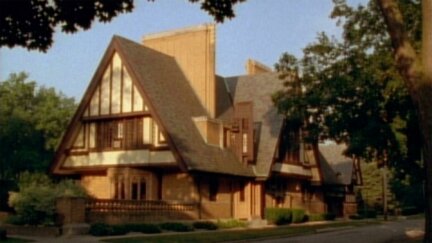
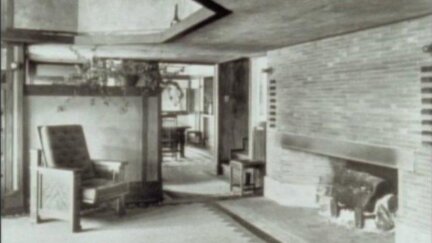
- Synthesizing a personal environmental view through reflection upon a view of Frank Lloyd Wrights architectural expressions of harmony with nature, Emersons views as expressed in Nature, and reference to a third, individually selected professional writer.
- Utilization of resources from a variety of different mediums.
- Application of materials from different genres to the analytical thought process.
- Collaborative expression and discussion of professional expressions of points of view as well as personal points of view.
- Writing a personal essay with analytical support and references to relevant sources.
- Utilization of standard MLA research paper conventions.
- Preparation of word processed, revised and polished, final manuscript.
LANGUAGE ARTS STANDARDS from McREL standards at
http://www.mcrel.org/standards-benchmarks/docs/toc.html
- Demonstrates competence in the general skills and strategies of the writing process
- Demonstrates competence in the stylistic and rhetorical aspects of writing
- Uses grammatical and mechanical conventions in written compositions
- Gathers and uses information for research purposes
- Demonstrates competence in speaking and listening as tools for learning
- Utilizes Internet Connections Resources in the Language Arts Standards
TECHNOLOGY STANDARDS from McREL standards at
http://www.mcrel.org/standards-benchmarks/docs/toc.html
- Knows the characteristics and uses of computer software programs
LIFE SKILLS STANDARDS from McREL standards at
http://www.mcrel.org/standards-benchmarks/docs/toc.html
- Sets and manages goals
- Performs self-appraisal
- Considers risks
- Understands and applies the basic principles of presenting an argument
- Understands and applies basic principles of logic and reasoning
- Effectively uses mental processes that are based on identifying similarities and difference
- Applies decision making techniques
- Contributes to the overall effort of a group
Prerequisites:
- A copy of the Ken Burns PBS documentary, Frank Lloyd Wright, a television, and a VCR
- Computers with Internet access
- Computers with word processing program
- Pencil and paper
III. Procedures
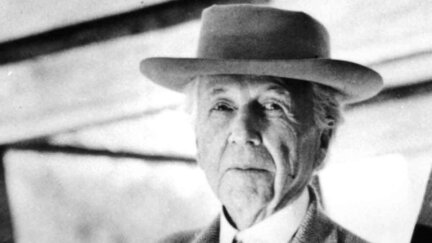
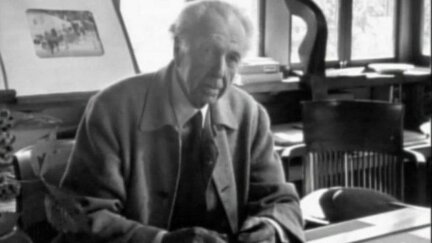
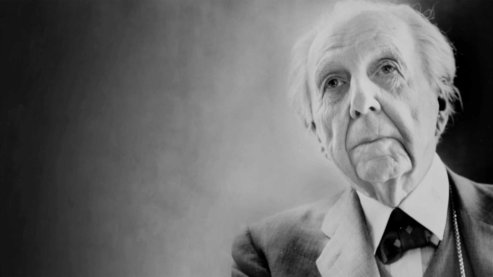
- 1. Frank Lloyd Wright Wright once asserted that he attended the greatest of churches and that he placed a capital N on Nature. Reverence for nature can be difficult to express, but it is a reflection of spirit that contains evocative power.
Consider the work of two, Pulitzer Prize-winning poets: W.S. Merwin and Mary Oliver. Have students read and reflect upon the human relationship with nature in W.S. Merwins poem, Gift and/or Mary Olivers poem, Five A.M in the Pinewoods.
Merwin, W.S. Selected Poems. New York: Atheneum Press, 1988.
Oliver, Mary. House of Light. Boston: Beacon Press, 1990. Oliver's poem is reproduced here by permission of Beacon Press, Boston.
FIVE A.M. IN THE PINEWOODS
by Mary Oliver
Id seen
their hoofprints in the deep
needles and knew
they ended the long night
under the pines, walking
like two mute
and beautiful women toward
the deeper woods, so I
got up in the dark and
went there. They came
slowly down the hill
and looked at me sitting under
the blue trees, shyly
they stepped
closer and stared
from under their thick lashes and even
nibbled some damp
tassels of weeds. This
is not a poem about a dream,
though it could be.
This is a poem about the world
that is ours, or could be.
Finally
one of themI swear it!
would have come to my arms .
But the other
stamped sharp hoof in the
pine needles like
the tap of sanity,
and they went off together through
the trees. When I woke
I was alone,
I was thinking:
so this is how you swim inward,
so this is how you flow outward,
so this is how you pray.
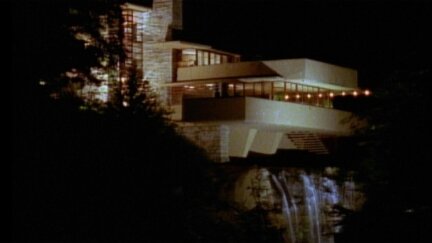
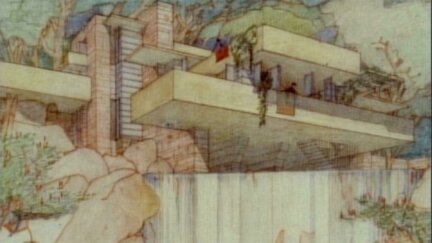
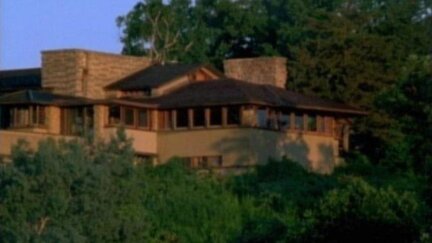
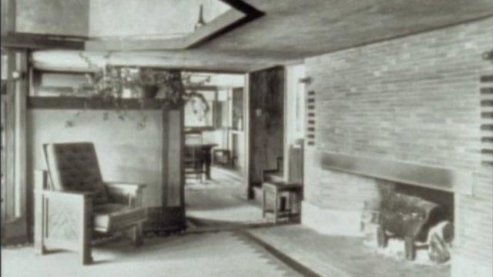
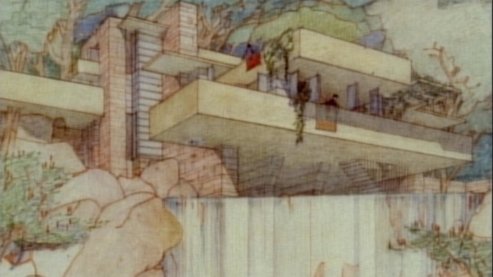
- View in class with your students the PBS documentary, Frank Lloyd Wright. Allow time for discussion and reflection upon specific, key parts such as the segments on Fallingwater, Taliesin East, and Taliesin West.
- Accompany a viewing of the PBS documentary, Frank Lloyd Wright, with exploration of its PBS Web sites resources. Reference students specifically to the Legacy section of the PBS web site where they can find insightful commentary reflective of mans relationship to nature made by documentary participants.
- Accompany the viewing of the PBS documentary, Frank Lloyd Wright, with
the reading of Emersons Nature.
The text of Emersons Nature can be found at:
http://www.emersoncentral.com/nature.htm
or
http://www.vcu.edu/engweb/transcendentalism/authors/emerson/essays/naturetext.html
(Note: These links will take you away from PBS Online.)
While students can be instructed to read the 1836 manuscript in its entirety,
assignment of its individual chapters to different students with oral summaries can serve to highlight its reflections and direct student researchers
to the segments which will best serve a synthesis of personal views.
Division of Emersons nature can be made on this basis:
Introduction: read by all with oral summary by teacher
Specific student groups read and summarize an assignment chapter:
Chapter 1: Nature
Chapter 2: Commodity
Chapter 3: Beauty
Chapter 4: Language
Chapter 5: Discipline
Chapter 6: Idealism
Chapter 7: Spirit
Chapter 8: Prospectus
To further synthesize the ability to draw analogies as well as to develop individual views, after classwide summaries, combine student groups for
small group discussion of Emersons concepts on nature and the architectural reflection of Frank Lloyd Wrights concepts on harmony with the environment.
Group Focus Questions could include the following:
- What is your reaction to the views of Fallingwater, both interior and exterior?
- What common ideas can you see reflected in the three constructions:
Fallingwater, Taliesin East, and Taliesin West?
- Wright indicated that his Johnson Wax Building was to be . . . like working in a glade . . . an open forest. Would Emerson have understood what Wright was trying to create? Why or why not?
- Instruct students to find another professional writer, whose work holds some reflection of Frank Lloyd Wrights reverence for nature.
Students could be directed to explore some of the following resource possibilities: (Note: these links will take you away from PBS Online.)
The text of Henry David Thoreaus Walden: or Life in the Woods accessible electronically from the Princeton text archive site:
http://eserver.org/thoreau/walden00.html
The text of Walt Whitmans Leaves of Grass accessible from the Columbia University site:
http://www.cc.columbia.edu/acis/bartleby/whitman
The poetic works of Robert Frost through Project Bartlebys Electronic Archive:
http://www.columbia.edu/acis/bartleby/
Particular recommendation might be made of Road Not Taken, Birches, A Prayer in Spring, and Mending Wall.
The poetic works of Carl Sandburg through Project Bartlebys Electronic Archive:
http://www.columbia.edu/acis/bartleby/
Particular recommendation might be made of Haze and For You.
For students interested in exploring with a focus on Modern Women Writers, they could be directed to access the Virtual Library of Virginias Electronic Text Center at:
http://etext.lib.virginia.edu/eng-on.html
The prose work of Annie Dillard with particular recommendation of Chapter 1, Heaven and Earth in Jest, from Pilgrim at Tinker Creek.
Dillard, Annie. Three by Annie Dillard. New York: Harper Perennial, 1990.
- Have the students consider their own ideas about nature and mans role in the environment. Ask them to examine their feelings and their ideas. Ask them to brainstorm their ideas, images, and feelings in phrases, words, or sketches as they listen to a CD based upon sounds from nature. A possible CD for use would be Sanctuary: A Day Remembered, a digital recording by Samuel Reid produced by Ashmore-Willow Productions.
- Have students prepare a rough draft of a personal essay of their individual, environmental view. Instruct them to refer to concepts from the Frank Lloyd Wright video recording, from Emersons Nature, and from a professional piece of their own choice.
- As students prepare essay, they should follow standard MLA citation methods. To assist them in this, they can consult the following Internet resources (Note: these links will take you away from PBS Online):
- As student revise and move toward final manuscript, allow them time to workshop their papers with a writing partner. Their peers in these cooperative working groups or partnerships should proof and provide feedback. Direct the focus of the student writers toward the clarity, depth, and presentation of their individual ideas.
- A final, polished manuscript of an essay offering a personal environmental viewpoint should be handed in.
V. Classroom Assessment
Student evaluation should be based upon the process of this essays production. Areas of consideration should include the following:
- Quality of student involvement in discussion of film, readings, and
intellectual concepts
- Quality of involvement in group collaborations including assessments of leadership, cooperation, and contributions
- Quality of involvement in the writing process including focus and depth in freewriting, revision, and final manuscript production
- Assessment of final manuscript for correct use of conventions in grammar, mechanics, and citations
- Assessment of critical and analytical thinking in the final manuscripts synthesis of an individual environmental viewpoint with reference to the ideas of Wright, Emerson, and a third, professional writer
- Assessment of final manuscript for style, structure, and organization
V. Extensions and Adaptations
- Students might wish to create an Environmental Web Site and post their manuscripts.
- If your school has an Environmental Club, students might wish to select their best essays for presentation at an event sponsored by the Environmental Club.
- Students might contact a birding, hiking, historical preservation organization in the community and publish their best essays as a booklet for the consideration of that community organization.
- A class, grade level, or school chatroom on the Internet might be opened up. Several essays could be posted weekly for live, electronic discussion or posted for e-mail responses.
- Students interested in electronic publication could research on-line literary magazines and submit their essays to an e-zine interested in that genre or the essays topic focus.
Interested students of all ages may submit essay work to Electric Soup, the award-winning, on-line literary magazine of Hunterdon Central Regional High School. Submission guidelines are on-line, and the electronic magazine may be accessed at: http://www.hcrhs.hunterdon.k12.nj.us/esoup/welcome.html
OR manuscripts with name, grade, and school as well as contact address or e-mail address may be sent attached to e-mail sent to
fmcginn@star.hcrhs.hunterdon.k12.nj.us
VI. About the Author
Florence McGinn teaches English and Writing at Hunterdon Central Regional High School in Flemington, New Jersey, where she sponsos the award-winning electronic literary magazine Electric Soup. Florence is also a published poet (including many haiku), conference presenter, software reviewer, and grant program developer. She was recently named the 1998 Technology and Learning National Teacher of the Year. Florence enjoys cooking, birding, reading, and traveling. She hopes to find a publisher for her fiction manuscript in the fall of 1999.
|