
Title: ZEN AND THE WORK OF FRANK LLOYD WRIGHT
Grade: 9-12
Subject: English, Art, Humanities, Writing, Technology
Estimated Time of Completion: The time required for completion of this lesson is dependent upon the teacher and students backgrounds in presentation software, art software, and Internet protocols.
I. Summary
II. Objectives, Standards, Prerequisites
III. Procedures
IV. Classroom Assessment
V. Extensions and Adaptations
VI. About the Author
I. Summary
In this lesson students will see Zen philosophies reflected in artwork, poetry, and architecture. Students will explore these connections and expand the discussion to include a professional author of their choice. The end product will be a multimedia presentation showcasing these materials and displaying the students knowledge of Zen principles.
II. Objectives, Standards, and Prerequisites
Objectives:
- Students will develop an interpretative, multimedia presentation reflective of Zen concepts in the work of Frank Lloyd Wright.
- Synthesizing critical thinking through analogies perceived between Zen art and an architectural work of Frank Lloyd Wright.
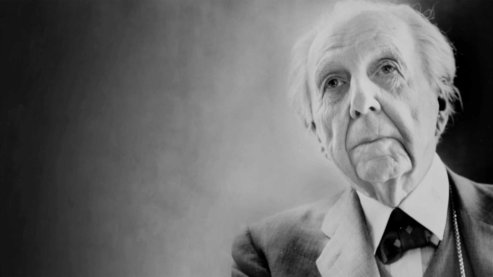
- Creating digital metaphors interpreting a professional work linked to an image of Frank Lloyd Wright. .
- Utilization of resources from a variety of different mediums.
- Application of technology as an interpretative tool of creative expression
- Application of materials from different genres to the analytical and creative thought processes.
- Students will give a presentation of their multimedia presentation.
Standards:
LANGUAGE ARTS/TECHNOLOGY STANDARDS from McREL standards at
http://www.mcrel.org/standards-benchmarks/docs/toc.html
- Demonstrates competence in the general skills and strategies of the reading process
- Demonstrates competence in the general skills and strategies for reading a variety of literary texts
- Demonstrates competence in speaking and listening as tools for learning.
- Utilizes Internet Connection Resources in the Language Arts Standards
TECHNOLOGY STANDARDS from McREL standards at
http://www.mcrel.org/standards-benchmarks/docs/toc.html
- Knows the characteristics and uses of computer software programs
- Understands the relationships among science, technology, society, and the individual.
- Understands the nature of technological design.
LIFE SKILLS STANDARDS from McREL standards at
http://www.mcrel.org/standards-benchmarks/docs/toc.html
- Uses various information sources, including those of a technical nature, to accomplish specific task.
- Sets and manages goals.
- Considers risks.
- Effectively uses mental processes that are based on identifying similarities and differences.
- Applies decision-making techniques
ART STANDARDS from McREL standards at
http://www.mcrel.org/standards-benchmarks/docs/toc.html
- Understands connections among the various art forms and other disciplines.
- Understands and applies media, techniques, and processes related to the visual arts.
- Knows how to use structures and functions of art.
Prerequisites:
- A copy of the Ken Burns PBS documentary, Frank Lloyd Wright, a television, and a VCR
- Computers with Internet access
- Computers with word processing program
- Computers with art/image manipulation software such as Adobe PhotoShop 5 or PaintShop Pro 5.
- Computers with presentation software such as Microsoft PowerPoint 97
- Pencil and paper
III. Procedures
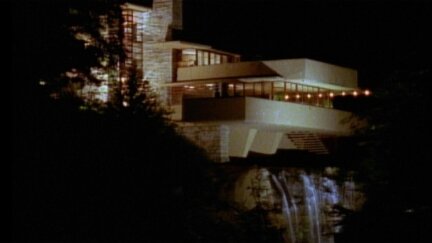
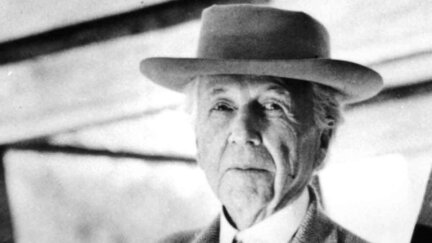
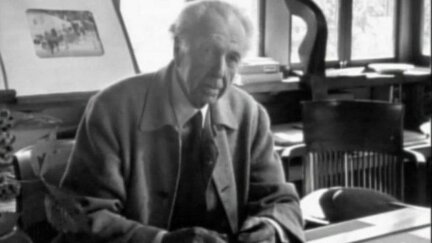
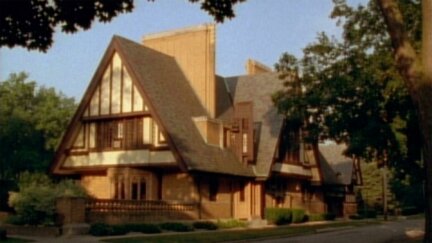
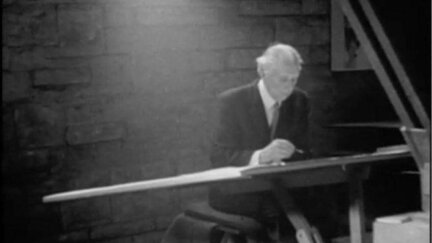
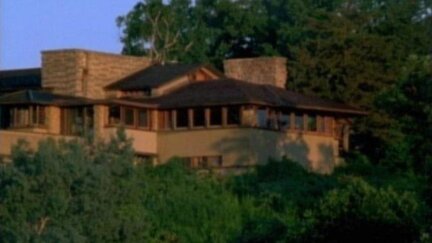
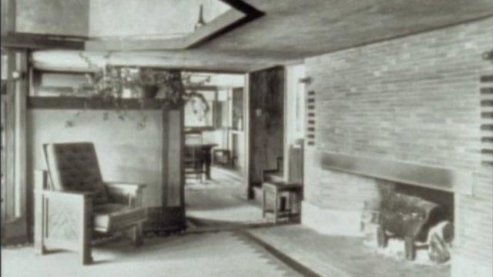
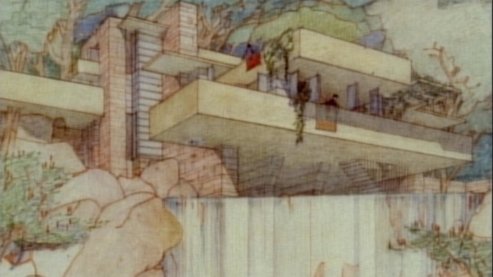
- View in class with your students the PBS documentary, Frank Lloyd Wright. Allow time for discussion and reflection upon specific, key parts such as the segments on Fallingwater, Johnson Wax building, Guggenheim building, Taliesin East, and Taliesin West.
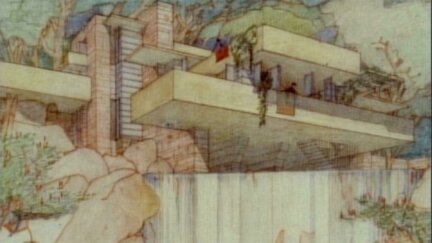
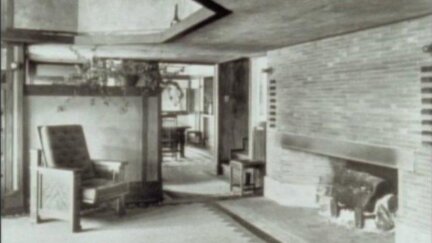
- Accompany a viewing of the PBS documentary, Frank Lloyd Wright, with exploration of the PBS Frank Lloyd Wright Web site resources. Direct students to the Web sites essay on organic architecture as an intellectual focus for reflection. Specifically, recommend to students that they employ the images of Frank Lloyd Wrights buildings as PBS internet resources as they reflect upon emotional and intellectual responses to each pieces of architectures expressiveness and its relationships to its site.
- The text of Emersons Nature can be found at:
http://www.emersoncentral.com/nature.htm
or
http://www.vcu.edu/engweb/transcendentalism/authors/emerson/essays/naturetext.html
(Note: these links will take you away from PBS Online.)
Instruct students to read two segments: the segment, Nature, and the segment, Beauty.
To further synthesize the ability to draw analogies as well as to develop individual views, have each student zero in one of Frank Lloyd Wrights buildings for reflection upon its relationship to nature. Have each student select one of the buildings of Wright for which they feel an affinity. If that building image is on the PBS site, the student should bookmark its location.
The PBS Frank Lloyd Wright site provides convenient digital access to images for students. However, if Internet access is limited, photographic images can found in Frank Lloyd Wright by Bruce Brooks Pfeiffer.
Questions for individual reflection could include the following:
- What struck me as beautiful or expressive about this building?
- How did the building or image make me feel?
- When, if ever, have I had those feelings before?
Then, create small groups of students as discussion groups. Ask
each discussion group to explore Emersons concepts on nature to the Wright building individuals selected earlier. Have each student bring up the previously selected Frank Lloyd Wright image for their group and present personal reflections, comparing and contrasting in discussion with the reactions of the group.
Group Focus Questions could include the following:
a. Do Wrights buildings reflect Emersons idea that all natural objects make a kindred impression, when the mind is open to their influence? How?
b. Can a building be a work of art? Emerson refers to a work of art as an expression of nature.
c. Do you feel the Wright building you selected is a work of art? Why or why not?
- Classroom discussion should be held focusing on Wrights reverence for nature and his harmonious recognition of mans place within the fabric of nature.
Professor Helmut Brinker in his book, Zen in the Art of Painting, indicates that Characteristic of Zen . . . is the attempt to understand and experience . . . from within . . . to let oneself be seized and taken by . . . the work of art.
Brinker, Helmut. Zen in the Art of Painting. New York: Penguin, 1987. Write that quote on the board for student reflection and class discussion.
- Indicate to your students the universality of the archetype of nature. Zen Art explores the aesthetic of man and nature. Invite your students to experience this in Zen art and short poetry.
Students should go to the site listed below where they can view a series of ten, famous pictures from 1689. The collection is entitled Ten Oxherding Pictures. (Note: these links will take you away from PBS Online.)
Pictures and introduction begin at this URL:
http://www.shantimayi.com/ox_story/10ox.htm
Students should read the Introduction to the Ten Oxherding Pictures by Urs App before proceeding into the digital gallery.
Ask students to examine the sequence of 10 pictures. Then, as a class, discuss the expression of metaphor they see in the pictures and poems, making reference to specific pictures and poetic lines.
For further background as a general resource on Zen, go to the short What is Zen essay written by Eido Tai Shimano Roshi Abbot of The Zen Studies Society. The essay is at this URL:
http://www.zenstudies.org/
For more in-depth research on Zen, go to The Electronic Bodhidharma, for the largest collection of Buddhist primary text materials on the Internet. The site of the International Research Institute for Zen Buddhism in Kyoto, Japan is located at this URL:
http://iriz.hanazono.ac.jp/index.en.html
- Discuss the concept of metaphor with your students. Can a metaphor in poetry express a philosophical idea? express an artistic concept or feelings such as perceived in one of Wrights buildings?
As students discuss and explore the concept of metaphoric representation, ask them to consider the following quotation from Frank Lloyd Wright documentary participant Neil Levine:
I think that the relationship between Wrights words and Wrights architecture is intimate; its a very tight bond, and I think there is no reason to try to separate them. I have a feeling that he was one of the most articulate architects who ever lived, and he was able to describe his buildings in words that to us sometimes sound metaphoric . . . For instance, he designed this small camp called Ocatillo in Arizona in 1928. And he talked about the camp as something that would live for a few days and then die . . . And then he said, You are ephemera.
And I began to think, ephemera, yeah, that means something that is not going to last. But then I realized that ephemera are little mayflies . . . that rise out of a pond from the larva state and rise into the air and then fall and die after about a day. And it was quite clear that he was thinking not just of the kind of abstract concept of ephemerality, but that these would be like flies with wings and the canvas of the tents were like the wings of the flies.
Alan Cooper is a Canadian poet from near the Bay of Fundy. His work holds a reverence for nature. Reflect upon the linkage between Frank Lloyd Wrights architectural metaphor, Neil Levines reflections upon the intimacy of building, words, and nature, then upon the metaphoric beauty and understanding of relationships in Alan Coopers poem, The Moth.
Read to your students Alan Coopers poem, The Moth, from his collection, The Pearl Inside the Body: Poems Selected and New.
Cooper, Alan. The Pearl Inside the Body: Poems Selected and New. New Brunswick, Canada: Percheron Press, 1991.
Reprinted with permission.
THE MOTH
By Alan Cooper
a man is lying on his bed;
the quiet of the room
broken only
by a moth tapping a bare lightbulb.
he rises,
and in one slow sweep
catches the moth in his hand.
wings beat soft as
silk against his palm.
he carries it to the window;
the night goes still
the dust from its wings
will mark him forever.
- Instruct students to each find a poem that they feel holds some reflection of Frank Lloyd Wrights reverence for nature and/or sense of harmony with nature.
Students could be directed to explore some of the following resource possibilities (Note: these links will take you away from PBS Online):
The poetic works of William Wordsworth through Project Bartlebys Electronic Archive:
http://www.bartleby.com/people/WordswthW.html
Particular recommendation might be made of To A Skylark, Lines Written in Early Spring and Influence of Natural Objects.
The text of Walt Whitmans Leaves of Grass accessible from Project Bartlebys Electronic Archive:
http://www.bartleby.com/people/WhitmnW.html
The poetic works of Robert Frost through Project Bartlebys Electronic Archive:
http://www.bartleby.com/people/Frost-Ro.html
Particular recommendation might be made of Birches and A Prayer in Spring.
For students interested in exploring with a focus on Modern Women Writers, they could be directed to access the Virtual Library of Virginias Electronic Text Center at:
http://etext.lib.virginia.edu/eng-on.html
The poetic work of William Stafford, who in his long career has won the National Book Award, the Shelley Memorial Award, and served as Consultant for Poetry for the Library of Congress, with particular recommendation of
Mornings in Allegiances: New Poems
Stafford, William. Allegiances: New Poems. New York: Harper & Row, 1970.
The poetic work of Navajo Indian poet, Elizabeth Woody, with particular recommendation of Unity, Shells on Stone, and Longhouse I from her collection, Seven Hands, Seven Hearts.
Woody, Elizabeth. Seven Hands, Seven Hearts. Portland, Oregon: Eighth Mountain Press, 1994.
The poetic work of Jane Hirshfield, who translated the love poems of Izumi Shikibu and Ono no Komachi in The Ink Dark Moon, with particular recommendation of The Illuminist, Lake and Maple, and Three Foxes by the Edge of the Field at Twilight from her collection, The Lives of the Heart.
Hirshfield, Jane. The Lives of the Heart. New York: Harper Perennial, 1997.
The poetic work of Mary Oliver with particular recommendation of In Blackwater Woods from American Primitive as well as Mockingbirds and At the Lake from White Pine.
Oliver, Mary. American Primitive. Boston: Little, Brown, and Company, 1983.
Oliver, Mary. White Pine. New York: Harcourt, Brace, and Company, 1991.
- Have the students consider what images could reflect the metaphorical meaning within their selected poem. Instruct each student to create an interpretative, multimedia presentation of an individually selected professional poem reflective of the Zen concept of harmony with nature inherent in the work of Frank Lloyd Wright.
- Have students give a presentation of their multimedia interpretation. Student presenter should access the PBS site and present the stimulus, Wright image, describing how it evoked the student. From the Wright image, the student should present the multimedia interpretation of the professional poem followed up by a brief analysis of the analogies perceived between philosophy, architectural image, and poetic metaphor.
TECHNICAL NOTES: The student should bookmark the Wright image in anticipation of the presentation. Prior to the presentation, the student presenter should bring up both the web site and the PowerPoint presentation, keeping them minimized on the desktop. An alt/tab key stroke or appropriate click on the bottom of the screen bar will allow the student to shift back and forth between them as needed during discussion.
TECHNICAL RESOURCES:
- MODELS: Two, student-created multimedia programs are included. The programs are created with the use of Microsoft PowerPoint 97. Extensive use is made of PowerPoint 97s custom animation features. Graphics are manipulated interpretatively with the use of Adobe PhotoShop 5. A digital camera is used to obtain some images; other images and/or sounds are obtained from educational use, copyright free, CD-ROM galleries. Sounds are manipulated with the use of the software, Finale.
Multimedia Model #1: Student Douglas Gorton interprets Alan Coopers poem, The Moth, published in The Pearl Inside the Body by Percheron Press.
Multimedia Model #2: Student Richard Morrison interprets Florence McGinns poem, Modern Day Coming, reprinted from Poetry Motel magazine.
- TUTORIAL: Microsoft maintains a Microsoft in K-12 Education site with Training and Classroom Resources. If a teacher is unfamiliar with PowerPoint 97 and how to use that software, an educator could learn on-line by going to the electronic tutorial: In and Out of the Classroom with PowerPoint 97.
http://www.microsoft.com/education/?ID=IOCTutorials
(Note: these links will take you away from PBS Online.)
IV. Classroom Assessment
Student evaluation should be based upon both process and product. Evaluation should take into account the process of the multimedia presentations development, its production involvements, the finished multimedia interpretation, and its class presentation. Areas of consideration should include the following:
- Quality of student involvement in discussion of film, readings, and
intellectual concepts
- Quality of involvement in group collaborations including assessments of leadership, cooperation, and contributions
- Quality of involvement in the exploration process including examination of the PBS images and selection of one, personal focus image, the exploration of the Hanazono University, Kyoto, Japan, site and discussion of Zen concepts, as well as the connection of image and text in relation to Ten Oxherding Pictures accompanied by the very short poems Kuoan, translated by Urs App, and finally the search for and selection of a professional poetic manuscript for multimedia interpretation.
- Assessment of student involvement in learning and utilizing software and technical resources
- Assessment of critical and analytical thinking as reflected in interpretative multimedia
- Assessment of aesthetic quality and technical quality of the multimedia interpretation
- Assessment of final class presentation for insight into linkages of metaphor and intellectual concept
IV. Extensions and Adaptations
- Students might wish to present their multimedia interpretations of professional poetry to a poetry or literature class in school
- If your school has a Writing Club, students might wish to select their best multimedia interpretations for electronic presentation at one of the clubs meetings.
- If students enjoyed the creation of multimedia interpretations, they could create multimedia interpretations of their own, creative manuscripts.
- If students create multimedia interpretations of their own manuscripts, they might enjoy collecting those together for electronic publication on CD-ROM.
- If students create multimedia interpretations of their own manuscripts, they could print them out and collect the printed PowerPoint slides in a class notebook.
IMPORTANT POINT TO NOTE: In order to avoid copyright infringement, students must be made aware that their multimedia presentations of the published work of professional writers cannot be made publicly without obtaining permission from the professional writers and/or publishers.
VI. About the Author
Florence McGinn teaches English and Writing at Hunterdon Central Regional High School in Flemington, New Jersey, where she sponsos the award-winning electronic literary magazine Electric Soup. Florence is also a published poet (including many haiku), conference presenter, software reviewer, and grant program developer. She was recently named the 1998 Technology and Learning National Teacher of the Year. Florence enjoys cooking, birding, reading, and traveling. She hopes to find a publisher for her fiction manuscript in the fall of 1999.
|