
|
Art Blakey
Powered by Oxford University Press.
Buhaina, Abdullah ibn (1919 -1990) Drummer and bandleader
Art Blakey received
some piano lessons at school and by seventh grade was playing music
full-time, leading a commercial band. Shortly afterwards, he changed to
drums, on which he taught himself to play in the aggressive swing style of
Chick Webb, Sid Catlett, and Ray Bauduc. In autumn 1942, he joined Mary Lou
Williams
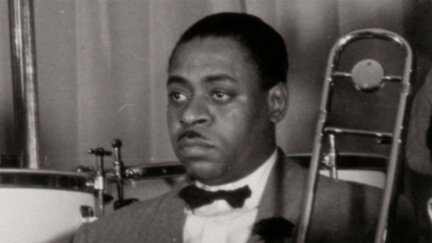
for an engagement at Kelly's Stable in New York. He then played
with the Fletcher Henderson Orchestra from 1943-4, with whom he made a long
tour of the South. After leaving Henderson, Blakey briefly led a big band in
Boston before joining Billy Eckstine's new band in St. Louis. During his
years with Eckstine from 1944-7, Blakey became associated with the modern-jazz
movement along with his fellow band members Miles Davis, Dexter Gordon,
Fats Navarro, and others.
 |
NPR's Basic Jazz Record Library: Art Blakey
NPR's Murray Horwitz and jazz critic and poet AB Spellman recommend The Best of Art Blakey (Blue Note).
(Courtesy NPRJazz.org) |
When Eckstine disbanded his group in 1947, Blakey organized the Seventeen
Messengers, a rehearsal band, and recorded with an octet called the Jazz
Messengers, the first of his many groups bearing this name. He then
traveled in Africa for more than a year to learn about Islamic
culture. In the early 1950s, he performed and broadcast with such musicians
as Charlie Parker, Davis, Clifford Brown, and particularly with Horace
Silver, his kindred musical spirit at this time. After recording together
several times, in 1955 Blakey and Silver formed a cooperative group with
Hank Mobley and Kenny Dorham, retaining the name Jazz Messengers. Silver left the following year taking leadership of this important band, and he has been associated with it from then on.
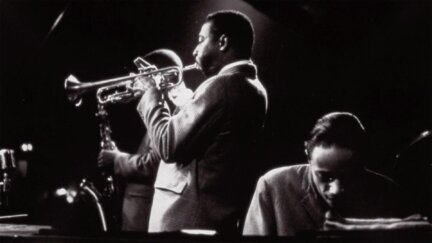
 Photograph by Lee Tanner
| The Jazz Messengers were
the archetypal hard-bop group of the late 1950s, playing a driving,
aggressive extension of bop with pronounced blues roots. Over the years the
Jazz Messengers have served as a springboard for young jazz musicians such
as Donald Byrd, Johnny Griffin, Lee Morgan, Wayne Shorter, Freddie Hubbard,
Keith Jarrett, Chuck Mangione, Woody Shaw, JoAnne Brackcen, and Wynton
Marsalis
. In addition to his numerous tours and recordings with the
Messengers, Blakey also made a world tour in 1971-2 with the Giants of Jazz
(with Dizzy Gillespie, Kai Winding, Sonny Stitt, Thelonious Monk, and Al
McKibbon) and frequently appeared as a soloist at the Newport Jazz Festival, most memorably in a drum battle with Max Roach, Buddy Rich,
and Elvin Jones in 1974. He continued to maintain a busy performing schedule
into the 1980s. Among his sidemen from 1982 were Terence Blanchard and
Donald Harrison, and in 1987 he was leading a septet of young musicians including the trombonist Delfayo Marsalis and the pianist Benny Green.
 Image courtesy of Chuck Stewart
|
Although Blakey
discourages comparison of his own music with African drumming, he adopted
several African devices after his visit in 1948-9, including rapping on
the side of the drum and using his elbow on the tom-tom to alter the pitch.
Later he organized recording sessions with multiple drummers, including
some African musicians and pieces. His much-imitated trademark, the
forceful closing of the hi-hat on every second and fourth beat, has been
part of his style since 1950-51.
Blakey is a major figure in modern jazz and an important stylist in drums. From his earliest recording sessions with Eckstine, and
particularly in his historic sessions with Monk in 1947, he exudes power
and originality, creating a dark cymbal sound punctuated by frequent loud
snare and bass drum accents in triplets or cross-rhythms. A loud and domineering drummer, Blakey
also listens and responds to his soloists. His contribution to jazz as a
discoverer and molder of young talent over three decades is no less
significant than his very considerable innovations on his instrument.
The New Grove Dictionary of Jazz, Oxford University Press. All rights reserved. For personal, non-commercial use only. Copying or other reproduction is prohibited.
|