
|
Clifford Brown
Powered by Oxford University Press.
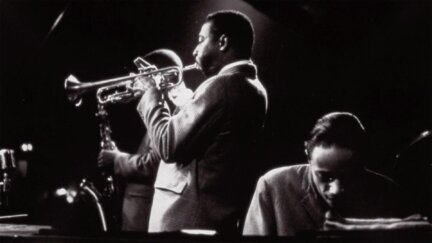
Brownie (1930-1956) Trumpeter
 |
NPR's Basic Jazz Record Library: Clifford Brown
NPR's Murray Horwitz and jazz critic and poet AB Spellman recommend Clifford Brown and Max Roach (Verve).
(Courtesy NPRJazz.org) |
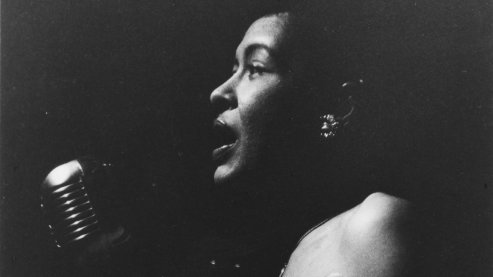
 Image courtesy of Chuck Stewart
|
Clifford Brown took up trumpet at the age of 13 and under the tutelage of his band director at high school, Harry Andrews, developed an
extraordinary technical facility. While studying mathematics at Delaware State College and music at Maryland State College, he attracted attention through his
exceptional performances with the college jazz bands and his brief appearances in Philadelphia with such leading jazz musicians as Fats Navarro, Dizzy Gillespie, and
Charlie Parker, all of whom praised and encouraged him. Navarro's style was particularly important as a model for Brown and the two men formed a close
friendship. Brown spent a year in the hospital after an automobile accident in June 1950, but thereafter resumed his career in Philadelphia, and in March 1952, made
his first recordings with Chris Powell's Blue Flames. He joined Tadd Dameron's band for a recording session (the results of which were later issued as The Clifford
Brown Memorial Album) and for appearances in summer 1953 at Atlantic City, New Jersey. In September of that year, Brown toured Europe with Lionel
Hampton's big band and made a number of recordings with American and European jazz musicians; Hampton's trumpet section at the time consisted of Art Farmer,
Quincy Jones, Walter Williams, and Brown, all of whom were superb players. On his return to the USA, Brown performed with several East Coast groups, including
a newly formed ensemble led by Art Blakey. In 1954, with Max Roach, he formed the Brown-Roach Quintet, with which he was associated until he was killed two
years later in an automobile accident. The quintet, whose other members were Harold Land (replaced in December 1955 by Sonny Rollins), George Morrow, and
Richie Powell, was one of the most significant groups of the 1950s and had a major influence on the establishment of the style later known as hard bop.
The New Grove Dictionary of Jazz, Oxford University Press. All rights reserved. For personal, non-commercial use only. Copying or other reproduction is prohibited.
|